• In Politics, Hate > Love

    Ezra Klein explains the power of the dark side today:

    Abramowitz and Webster test a host of political characteristics to see what best predicts party loyalty. The real key, they found, was fear of the other party: “Regardless of the strength of their attachment to their own party, the more voters dislike the opposing party, the greater the probability that they will vote consistently for their own party’s candidates.”

    It’s worth saying that a bit more clearly: you’re more likely to vote Democratic if you hate Republicans than if you love Democrats, and vice versa. What parties need to do to keep you loyal isn’t make you inspired. Rather, they need to make you scared.

    Or, if Robert Heinlein is more to your taste than George Lucas: “If you are part of a society that votes, then do so. There may be no candidates and no measures you want to vote for, but there are certain to be ones you want to vote against.” That’s certainly true of me. Over my lifetime, the Republican Party has done far more to repulse me than the Democratic Party has done to appeal to me. But the result in the voting booth would be about the same either way.

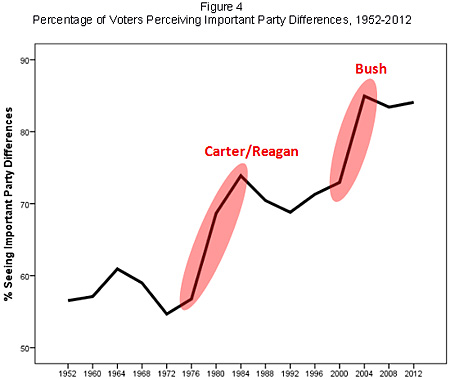
    Anyway, I don’t think this comes as much of a surprise to anyone. However, the chart below is interesting because it shows the proximate cause of all this polarization: Ronald Reagan and George Bush. Other presidents have little effect one way or another. This suggests either (a) Reagan and Bush were far more radical than other presidents, (b) Republican voters already hated Democrats so much that Clinton and Obama didn’t really have much impact, or (c) Democrats are awfully sensitive to losing power for a few years. I report, you decide.

    UPDATE: Hmmm. I guess I should have gotten out a straightedge instead of relying on my tired old eyes. That first spike actually starts during Jimmy Carter’s term. So….apparently the Republican base got radicalized first, and Democrats picked up the ball later. Or something. I’ve corrected the chart.

  • Boehner, Obama Show What a Couple of Lame Ducks Can Accomplish


    Apparently John Boehner has done his bit to clean the ol’ congressional barn before decamping Capitol Hill for West Chester Township and a golf-filled retirement. (Or a condo near K Street. No telling which, really.) He’s reached a budget deal with the president that increases social spending and saves the Social Security disability fund (yay Democrats!), and increases defense spending, tightens penalties for defrauding the disability program, and cuts payments to Medicare providers (yay Republicans!). Everyone gets a break from government shutdowns and debt ceiling threats (yay ordinary citizens!).

    But what about those entitlement cuts? Should liberals be worried? Greg Sargent reports that we shouldn’t be:

    On Medicare and Social Security: Nancy Altman, the president of Social Security Works, a group that strenuously opposes benefits cuts and argues for their expansion, tells me that the deal “doesn’t actually cut benefits or really hurt beneficiaries who aren’t gaming the system.”

    Altman says the Medicare cuts are all on the provider side, which could harm beneficiaries at some point, but it’s not a major concern. “On the Medicare side, they limited their cuts to far in the future, and to providers,” Altman says. “There’s time to correct that.”

    On the change to Social Security, Altman says: “They stiffened the penalties for fraud, they extended nationwide efforts to make sure that payments are accurate and they closed a loophole in which people were gaming the system. They didn’t change eligibility requirements or reduce the level of benefits.”

    So I guess that’s not bad. The defense side of the budget actually ended up getting a bigger increase than the non-defense side, but I suppose we can all live with that. Gotta kill us some Taliban terrorists, after all. And ISIS terrorists. And Assad terrorists.

    So now we can all get back to the business of the day: reporting on whatever loony thing Ben Carson or Donald Trump said. I think they’re arguing right now about whether Ben Carson wants to abolish Medicare and turn old people into soylent green. Or something. I might have that wrong. I’ll check into it later.

  • Media Takes Usual Sober Approach to Latest Cancer Warning


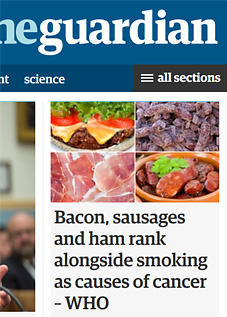
    The Guardian wins today’s award for misleading science reporting. “Bacon, sausages and ham rank alongside smoking as causes of cancer,” their headline thunders, and technically that’s true. About as true as saying that my housecats “rank alongside” elephants as large mammals.

    In other words, size matters, not just taxonomy. So what does the World Health Organization really say? This is from their handy Q&A:

    About 34 000 cancer deaths per year worldwide are attributable to diets high in processed meat….These numbers contrast with about 1 million cancer deaths per year globally due to tobacco smoking, 600 000 per year due to alcohol consumption, and more than 200 000 per year due to air pollution.

    The consumption of processed meat was associated with small increases in the risk of cancer in the studies reviewed….An analysis of data from 10 studies estimated that every 50 gram portion of processed meat eaten daily increases the risk of colorectal cancer by about 18%.

    In other words, the WHO took care to explicitly say that processed meat didn’t rank alongside smoking when it comes to cancer risk.

    Colorectal cancer is fairly common as cancers go, but it still affects only about 4.5 percent of the population. What’s more, an increase of “18 percent” does not mean your cancer risk skyrockets from 4.5 percent to 22.5 percent. It means that if you eat a few ounces of processed meat—bacon, bratwurst, ballpark franks, spam1every day, your lifetime risk of getting colorectal cancer goes up from 4.5 percent to 5.3 percent.

    That’s not nothing. You’re probably better off taking it easy on the spam. Nevertheless, not everything in the category “causes cancer” is created equal. If you’re really worried about cancer, cut out the smoking, the drinking, the overeating, and the city living. Once you’ve done that, then it’s time to decide if you also want to skip the bacon.

    1But not hamburger, despite what the Guardian’s photo editor seems to think.

  • House Hostage Takers Give Up, But Promise Plenty of Hostages in Future


    The good news today is that John Boehner is apparently making good on his promise to “clean the barn” before he leaves by cutting a budget deal with the White House. From the New York Times: “The accord would avert a potentially cataclysmic default on the government’s debt and dispense with perhaps the most divisive issue in Washington just before Speaker John A. Boehner is expected to turn over his gavel to Representative Paul D. Ryan of Wisconsin.”

    Then there’s today’s schadenfreude-ish news: House super-conservatives are sad because they don’t think there’s anything they can do to halt this reckless attempt to keep the government running and pay our legal debts. Reuters: “Representatives Mark Meadows, Jim Jordan and Mick Mulvaney, founders of the hard-right Freedom Caucus, told Reuters in an interview that there was not enough time for House Republicans to rally around a list of demands for raising the $18.1 trillion U.S. borrowing limit.”

    Then there’s today’s bad news:

    Leaders of the U.S. House of Representatives’ most influential conservative group told Reuters on Monday it was too late to stop an extension of the federal debt ceiling this week, but they will not hold it against the expected next House Speaker, Paul Ryan.

    ….The three lawmakers said they wanted to work with Ryan on process reforms that would allow them to get a much earlier start on future fiscal deadlines to demand spending cuts and reforms to federal benefits programs such as Social Security and Medicare. This way, they would not be trying to craft a strategy at the last minute with default or government shutdowns looming in the balance.

    ….[Mulvaney] said Ryan’s first big test would be a spending bill to keep government agencies open past a current shutdown deadline of Dec. 11. This would have to produce “at least something better than we would have gotten under Mr. Boehner.”

    So they’ve given up on provoking a debt limit/government shutdown crisis for now, but by God they expect Ryan to give them enough time to provoke plenty of them in the future. And that starts in six weeks, Mr. Speaker.

  • The Great 1998 Chart Swindle Is Now Officially Over


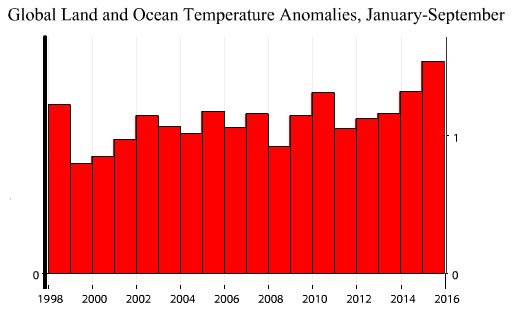
    One of the favorite topics in the climate change denial community is the “global warming pause.” It’s based on the fact that 1998 was an unusually warm year, so if you begin a climate chart in 1998 it will look as if nothing much has happened since. I made fun of this last week, but it occurs to me that we might genuinely have seen the last of that famous chart.

    Why? Because it’s no good anymore. David Roberts tells me today that Republicans are incensed over a recent NOAA paper that suggests the “pause” is due to mismeasurements of ocean temperatures, but who even needs that anymore? Just look at the basic numbers in the chart below. Even if you start in 1998, you can see obvious evidence of warming.

    Bottom line: Even the famously deceptive 1998 chart doesn’t work anymore. I suspect that we’re going to see a sudden lack of interest in 1998 charts from the denialists. They’ll have to move on to swindling the rubes with something else.

    And if you’re curious, here’s an honest, plain-Jane chart of the past 50 years. The 1998 outlier is pretty obvious here, and the evidence of steady warming is pretty obvious too.

  • The Ben Carson Bandwagon Is Killing Trump in Iowa


    Oh FFS:

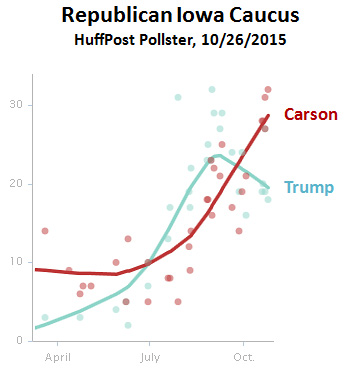
    The Monmouth University Poll of likely Iowa Republican caucusgoers finds Ben Carson has taken a double digit lead over Donald Trump….When Iowa Republicans are asked who they would support in their local caucus, Ben Carson (32%) tops the list, with Donald Trump (18%) holding second.

    What’s left to say? Sure, the Iowa caucuses are still three months away. I suppose Carson will fade. And historically, winning the Iowa caucuses has hardly been a reliable predictor of future success. Still. On the bright side, it gives me an excuse to quote Josh Marshall on Carson:

    I’ve been a little mystified that no one seems to bring this up. But in the debates he frequently strikes me as half-lost or sedated. Gut check me here, am I really the only one who has this impression? Is it just me? Again, like Trump, I think he’s judged by a different standard because people don’t think he’ll ever be the nominee. But he seems like he’s not quite all there or thinking out loud in a way that is vaguely endearing but not at all what people look for in a head of state.

    Actually, Carson’s sleepy-eyed persona has been a pretty common topic of conversation. True, I don’t think anyone has suggested he’s sedated or suffering from early-onset Alzheimer’s or anything. But yeah: he’s a right-wing conspiracy-theory-loving loon and he talks as if someone just woke him up at 3 am. Even for Iowa, he’s a very strange GOP frontrunner.

  • Texas Schools Are Performing Pretty Well. Surprised?


    David Leonhardt:

    When the Education Department releases its biennial scorecard of reading and math scores for all 50 states this week, Florida and Texas are likely to look pretty mediocre. In 2013, the last time that scores were released, Florida ranked 30th on the tests, which are given to fourth and eighth graders, and Texas ranked 32nd.

    But these raw scores, which receive widespread attention, almost certainly present a misleading picture — and one that gives short shrift to both Florida and Texas. In truth, schools in both states appear to be well above average at teaching their students math and reading. Florida and Texas look worse than they deserve to because they’re educating a more disadvantaged group of students than most states are.

    This conclusion is based on a new report by the Urban Institute. That’s fine, but we pretty much knew this already. Texas has large black and Hispanic populations, and they tend to do worse on academic tests than whites—which makes the overall scores for Texas look weak. But if you head over to the NAEP site and look at scores for each state disaggregated by race you can get the real story in about five minutes. The chart below is for 8th grade math, but you can do the same thing for any other test. It’s sorted by black test scores, and as you can see, Texas is 3rd in the nation. (Florida is 15th.) It’s also 3rd in Hispanic scores, and 5th in white scores.

    The Urban Institute controls for other factors besides race (poverty, native language, special ed), and that makes Florida look even better than the disaggregated NAEP scores suggest. But Texas looks good no matter what. If education reporters would pay attention to this stuff, it might not come as such a big surprise. Like it or not, Texas has been scoring pretty well for quite a while.

  • Will America’s True Conservatives Please Stand Up?


    Here is America’s conservative movement in action:

    Things may never be the same for the Freedom Caucus after most of its members moved last week to support Rep. Paul Ryan (R-Wis.) as the next House speaker. Suddenly, they may not be conservative enough for some in the party.

    ….The anger over Ryan’s ascent has been fueled by voices across the conservative media landscape. On the Internet, sites such as Breitbart.com and the Drudge Report have pumped out a steady stream of anti-Ryan stories casting doubt on his record, while such prominent commentators as Erick Erickson, Ann Coulter and Mickey Kaus have sharpened their teeth and urged conservatives to contact lawmakers and tell them to spurn Ryan.

    Particularly brutal have been the syndicated talk-radio hosts who have helped foment the anti-establishment outrage that has kept Donald Trump atop the GOP presidential race and forced Jeb Bush, a well-financed mainstream conservative, to undertake a campaign shake-up.

    First, the Republican conference in the House wasn’t conservative enough, so it moved to the right and put Newt Gingrich in charge. Then that wasn’t conservative enough, so the real conservatives restarted the Republican Study Committee. Then that wasn’t conservative enough, and the Tea Party was born. Then that wasn’t conservative enough, so we got the House Freedom Caucus. Now, even the HFC isn’t conservative enough. Only the small band that voted against Paul Ryan are true conservatives.

    So that’s where we stand. Former conservative darling Paul Ryan is now a crypto-RINO squish, and there are only about a dozen true conservatives left in the House. Maybe they should split off and form the House Super-Duper Freedom Caucus.

  • The Very Best of the Benghazi Hearing


    Congressional hearings are partisan by nature. In the abstract, there’s nothing wrong with that: the strongest oversight is often performed by political opponents who are motivated to find problems.

    So on Thursday, when Republicans on the Benghazi committee peppered Hillary Clinton with questions about why she didn’t respond to requests for more security in the months before the 2012 attacks, that was fair game. We can argue about whether they harped on it too much or spent too much time grandstanding, but basically there’s nothing wrong with it. Like it or not, grandstanding is part of what politicians do.

    But Republicans insist that the committee is solely about Benghazi and a search for the truth, not about attacking Hillary Clinton. So when the questioning and the grandstanding veer off into areas that clearly have no motivation except to smear Clinton, it gives the game away.

    Every single Republican on the committee went there on Thursday. What’s especially remarkable about this is that they had just endured weeks of criticism on exactly this point. They had a strong incentive to stay tightly focused on Benghazi and how to prevent future attacks on diplomatic facilities. But they didn’t. They couldn’t help themselves. And with that, they exposed what they really think this committee is about.

    Here are each Republican member’s greatest hits: the obsessions and lines of questioning that unmask their true purpose. Enjoy.

    CHAIRMAN TREY GOWDY was desperate to tie Clinton to her longtime friend and confidant Sidney Blumenthal. Why? Blumenthal is a Clinton loyalist who was a particular thorn in the GOP’s side during the scandal hunts of the 90s. So tying Hillary to Blumenthal offered obvious political benefits, despite the fact that he plainly had nothing to do with either diplomatic security in Benghazi or the attacks themselves:
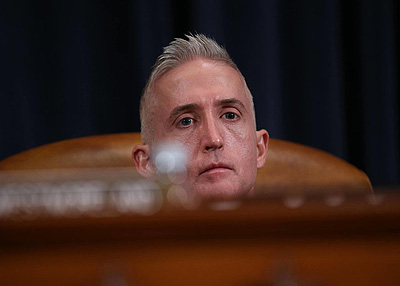
    Madam Secretary, regardless of where he ranked in the order of advisers, it is undisputed that a significant number of your e-mails were to or from a Sidney Blumenthal….He worked for the Clinton Foundation….He worked for Media Matters….He worked for Correct the Record.

    ….And Madam Secretary, he had unfettered access to you….I have this contrast in my mind. A ambassador newly in place. It’s a day after an attack on our facility. Your deputy chief of staff is sending him an e-mail from Sidney Blumenthal, asking him to take time to read and react to it. And then to the best of my recollection, that’s forwarded to you.

    So help us understand how Sidney Blumenthal had that kind of access to you, Madame Secretary, but the ambassador did not.

    MICHAEL POMPEO also jumped on the Sidney Blumenthal bandwagon. For obvious reasons, Blumenthal used Clinton’s personal email address to contact her, while security professionals in the State Department used official channels. Email records simply tell us nothing about who Clinton did and didn’t talk to. But Pompeo was nonetheless determined to accuse Clinton of caring more about her shady friend than she did about security in Benghazi:

    Madam Secretary, Mr. Blumenthal wrote you 150 e-mails. It appears from the materials we’ve read that all of those reached your desk. Can you tell us why security requests from your professionals, the men that you just testified — and which I agree, are incredibly professional, incredibly capable people, trained in the art of keeping us all safe — none of those made it to you.

    But a man who was a friend of yours, who had never been to Libya, didn’t know much about it, at least that was his testimony, didn’t know much about it, every one of those reports that he sent on to you that had to do with situations on the ground in Libya, those made it to your desk. You asked for more of them. You read them. You corresponded with him. And yet the folks that worked for you didn’t have the same courtesy.

    SUSAN BROOKS spent nearly an entire round of questions asking Clinton why there were so few emails about Libya in 2012. Clinton explained over and over that she conducted very little business via email, but Brooks didn’t care. She had spent a lot of time putting together what she thought was a devastating personal attack on Clinton’s priorities and personal character:
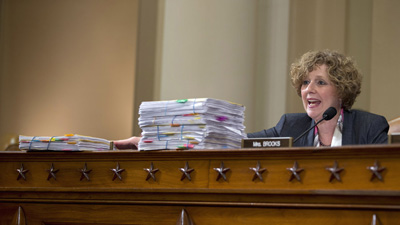
    This pile represents the e-mails that you sent or received about Libya in 2011, from February through December of 2011. [Points to pile of paper.] This pile represents the e-mails you sent or received from early 2012 until the day of the attack. [Points to another pile of paper.] There are 795 e-mails in this pile. We’ve counted them. There’s 67 e-mails in this pile in 2012. And I’m troubled by what I see here.

    ….When I look at this pile in 2012, I only see a handful of e-mails to you from your senior staff about Benghazi….And I can only conclude by your own records that there was a lack of interest in Libya in 2012.

    JIM JORDAN spent an entire round of questioning obsessing about why, in the first few days after the Benghazi attacks, Clinton and others in the Obama administration mentioned a scurrilous anti-Muslim YouTube video as one of the motivations for the attack. The short answer is (a) it was mentioned only briefly during the first week after the attacks, and (b) it really was one of the motivations. But Jordan didn’t care. This was his entree to outline his theory of Hillary Clinton as a serial liar:

    If there’s no evidence for a video-inspired protest, then where did the false narrative start? It started with you, Madam Secretary.

    ….Here’s what I think is going on….A key campaign theme that year was: “GM’s alive, bin Laden’s dead,” Al Qaida’s on the run. And now you have a terrorist attack, and it’s a terrorist attack in Libya, and it’s just 56 days before an election.

    You can live with a protest about a video. That won’t hurt you. But a terrorist attack will. So you can’t be square with the American people. You tell your family it’s a terrorist attack, but not the American people. You can tell the president of Libya it’s a terrorist attack, but not the American people. And you can tell the Egyptian prime minister it’s a terrorist attack, but you can’t tell your own people the truth.

    PETER ROSKAM had prepared a long line of questioning that turned out to be a tortured attempt to somehow get Hillary to concede that there was such as thing as a “Clinton Doctrine.” She never did, but Roskam soldiered on anyway. He’d spent a lot of time on this, and he just had to get it off his chest:
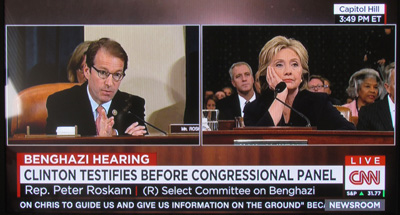
    Two months before the end of the Gadhafi regime and you’re already planning on how to make your statement dramatic to maximize political gains, isn’t that right?….Let me tell you what I think the Clinton doctrine is. I think it’s where an opportunity is seized to turn progress in Libya into a political win for Hillary Rodham Clinton, and at the precise moment when things look good, take a victory lap, like on all the Sunday shows three times that year before Gadhafi was killed. And then turn your attention to other things.

    MARTHA ROBY was bound and determined to string out a long line of obviously immaterial questions designed solely to establish what a calculating, uncaring person Hillary Clinton is. She started by insisting that Clinton help her individually name each and every person who was still at work when Clinton left for home on the evening of 9/11/2012. Then she moved on to whether Clinton had personally spoken to the survivors of the Benghazi attacks:

    ROBY: Your surviving agents were evacuated to Tripoli the morning of the 12th. Did you talk to the survivors either that night or once they arrived in Tripoli?

    CLINTON: We did not speak to them directly. We obviously made arrangements for them to be safely evacuated, and then to be transported to a hospital facility that we thought was safe from any potential attacks.

    ROBY: Did you talk to them the next day?

    CLINTON: No.

    ROBY: Did you talk to them later that week?

    CLINTON: No, I did not.

    ROBY: Did you talk to them when they first got back to the United States?

    CLINTON: I did not talk to them until they had had an opportunity to be debriefed and to provide information that would help us understand what happened; help the intelligence community and help the FBI as they were trying to build their case.

    ROBY: How would it have harmed the case that they were trying to build for you, secretary of state, just to check in on their well being?

    CLINTON: I did check on their well being.

    ROBY: No, personally.

    CLINTON: Well, I did personally talk with the people who were taking care of them, transporting them….

    ROBY: Again, the survivors — when did you talk to the survivors?

    CLINTON: I talked to the survivors when they came back to the United States. And one who was for many months in Walter Reed on the telephone.

    ….ROBY: Your people were on the ground in harm’s way and you never had a conversation with them….I think, Mr. Chairman, there’s two messages here. I think the first message is the message that you sent to your personnel the night of the attack that you went home. They all stayed there and you didn’t go back until the next morning.

    I think the second message that is sent is that you used the FBI’s inquiry as an excuse not to check in with your agents who were on the ground who survived that horrible night just to ask them how they were.

    LYNN WESTMORELAND thought it was damn suspicious that other Secretaries of State had also used private email accounts when they were in office. After all, that conveniently helps Hillary make the case that she wasn’t doing anything very unusual. None of this has anything to do with Benghazi, but Westmoreland really, really wanted to offer up his home-brew theory about how that happened:

    In August, the State Department met with your attorneys to talk about the lack of the e-mails that they had….Let me tell you what I thought. I think that your attorneys sat down with the State Department and they said, we got a problem. And so, we got to come up with something that this is not just the Secretary having these e-mails in a private server.

    So I tell you what let’s do. Let’s go back and ask Madeleine Albright, who was Secretary of State in 1997, that never even had an e-mail account. Or let’s go back and ask, you know, Colin Powell, Condoleezza Rice, and me to find all this information. I’m just telling you, it smells — it doesn’t smell right.