• Yovanovitch Was “Appalled” When She Saw What Trump Thought of Her

    Caroline Brehman/Congressional Quarterly via ZUMA

    Marie Yovanovitch, our former ambassador to Ukraine, describes her reaction when she saw how Donald talked about her in private:

    “It was a terrible moment,” she told the House Intelligence Committee on the second day of public impeachment hearings….In the July 25 phone call, according to a rough transcript released by the White House, Mr. Trump called Ms. Yovanovitch “bad news” and said that “she’s going to go through some things.”

    ….Asked her reaction when she read that, Ms. Yovanovitch said: “Shocked. Appalled. Devastated that the president of the United States would talk about any ambassador like that to a foreign head of state — and it was me. I mean, I couldn’t believe it.” Asked what the words “going to go through” sounded like to her, she said, “It sounded like a threat.”

    Them’s the breaks. When you resist repeated suggestions from Rudy Giuliani to focus on getting the Ukrainians to lie about Joe Biden, you have to figure your time is up. He’s America’s Mayor, after all, working on behalf of what’s good for the country, not just some geriatric mook using government resources to smear Joe Biden. Amirite?

  • Trump Suddenly Decides to Screw Yet Another Ally

    CNN’s Nicole Gaouette reports that President Trump has suddenly decided that South Korea should pay the United States a whole lot more for the troops we station there:

    Trump is demanding that South Korea pay roughly 500% more in 2020 to cover the cost of keeping US troops on the peninsula, a congressional aide and an administration official confirmed to CNN.
    The price hike has frustrated Pentagon officials … deeply concerned Republican and Democratic lawmakers … and unnerved Seoul.

    ….In the US, congressional aides and Korea experts familiar with the talks say the President’s $4.7 billion demand came out of thin air, sending State and Defense Department officials scrambling to justify the number.

    I can’t say that I care a great deal about the terms of our troop presence in South Korea, but I do care about whether our allies feel like they can trust us. Trump has made it abundantly clear that they can’t. From Canada to Europe to Ukraine to the Syrian Kurds and now to South Korea, Trump has repeatedly pulled the carpet out from under alliances both new and old. This is one reason, among many, that eight years of Trump could very well be far more than twice as catastrophic as four years.

    And for the record, $4.7 billion in the South Korean national budget is about the equivalent of $50 billion in the US federal budget. It’s a lot of money he’s asking for.

  • Laura Ingraham Is the New Star of Fox News

    Fox News Channel/YouTube

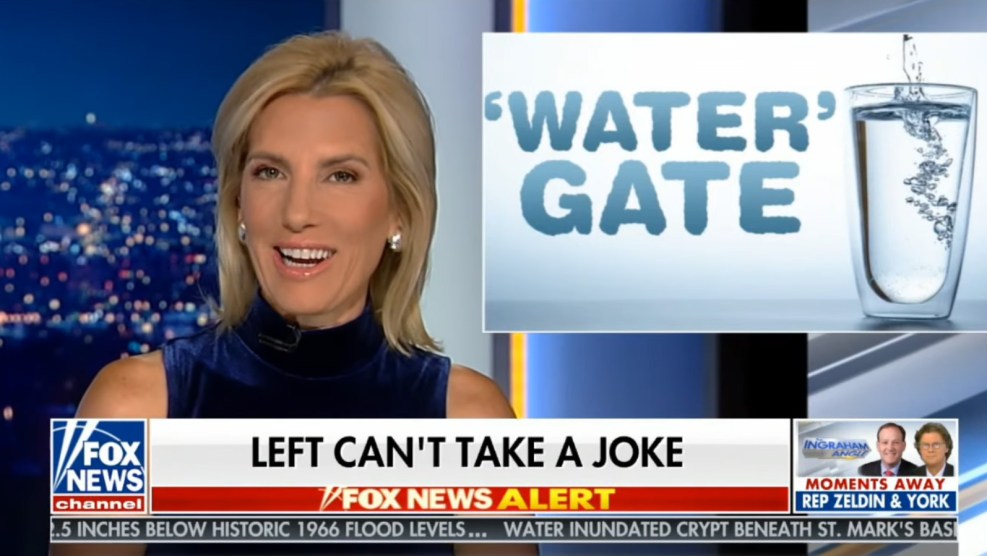
    A little while ago I noticed that Laura Ingraham had somehow seized the zeitgeist from the rest of the Fox News lineup, explicating the conservative view of impeachment and Ukrainegate more thoroughly and more accurately than Tucker and Sean and even the Friends.

    I don’t watch enough Fox News to really know for sure if this is anything new, but apparently Justin Peters does. And he says, yes, it’s something new:

    Impeachment has given The Ingraham Angle a new focus, clarity, and purpose….In Ingraham’s telling, the House impeachment hearings are the liberal elite’s latest attempt to thwart the will of the American people and overturn the results of a democratic election in order to sabotage a transformative president and reconsolidate power within the clutches of the hated deep state.

    ….Fox amplifies these themes by having the same messages come out of three very different mouths. Carlson projects earnestness and appeals to the educated xenophobe. Sean Hannity throws rage tantrums and is the lion of America’s furious YouTube autodidacts. Ingraham’s shtick is snickering contempt. She is the mean one of the trio, forever stifling a laugh at whomever or whatever she is about to mock or marginalize. Her demographic is everyone who finds it hysterical when Trump insults Rosie O’Donnell or mocks a disabled reporter.

    As the geezers used to say, read the whole thing.

  • New Evidence Shows That 2020 Census Citizenship Question Was a Sham All Along

    Do you remember Thomas Hofeller? He’s the Republican redistricting guru who authored a study in 2015 which showed that adding a citizenship question to the census would allow Republican legislatures to draw even more gerrymandered congressional maps than they already did.

    Hofeller died last year, and Republicans have long insisted that his study had nothing to do with their effort to add a citizenship question to the 2020 census. Just a few months ago the Department of Justice said yet again that Hofeller’s study “played no role in the department’s December 2017 request to reinstate a citizenship question to the 2020 decennial census.”

    Ahem. About that:

    Let’s break this down. The official story from the Trump administration has always been simple: DOJ needed the citizenship question to enforce the Voting Rights Act, and that’s that. Wilbur Ross, the Secretary of Commerce, asked them to please put their request in a memo, and John Gore, the Assistant Attorney General for Civil Rights, got the assignment. Ross then complied with the DOJ request and added the citizenship question.

    But now we have documentary evidence from a court deposition that Gore didn’t write the DOJ request at all—or at least not this part of it. Instead, the wording came from Mark Neuman, one of Ross’s advisors, who “incorporated verbatim the VRA enforcement rationale from a 2017 document Hofeller authored.” Neuman asked Hofeller to approve the wording, then sent it off to Gore, who cut-and-pasted it into the DOJ memo. In short:

    • Hofeller wanted the citizenship question added in order to improve Republican gerrymandering efforts.
    • This was no good for public consumption, so Hofeller also dreamed up a different rationale: that the question was necessary for VRA enforcement.
    • Mark Neuman at the Department of Commerce took Hofeller’s language and passed it along to John Gore at the Department of Justice.
    • Gore promptly added Hofeller’s wording to his memo.
    • The memo was sent to the Department of Commerce.
    • The Department of Commerce used the memo as evidence that it was DOJ that wanted the citizenship question from the start, when in fact it originally came from the Department of Commerce, which had copied it from a Hofeller study.

    Rick Hasen reacts:

    Or, as Chief Justice John Roberts said in more measured language when he ruled against Wilbur Ross, “Our review is deferential [to executive power], but we are ‘not required to exhibit a naivete from which ordinary citizens are free.'” That is, don’t peddle a story that we can only believe if we pretend to act like idiots.

    The evidence now, however, suggests that the Trump administration didn’t just treat the justices like idiots. They flatly lied to them. I prefer Hasen’s reaction.

  • We Need to Cut the Crap on Climate Change

    I can’t tell you how much this pisses me off:

    Vermont Sen. Bernie Sanders and New York Rep. Alexandria Ocasio-Cortez have fused two major presidential campaign issues — housing and climate change — in a $172 billion policy proposal released Thursday.

    Dubbed the Green New Deal for Public Housing Act, the proposal aims to transform the entire stock of public housing in the US, 1.2 million units, into energy-efficient homes powered by onsite renewable energy. Authors say the bill would create about 240,000 jobs per year and reduce greenhouse emissions equivalent to taking 1.2 million cars off the road.

    This is the first piece of legislation with official Green New Deal branding….

    Let’s just accept the estimate that this proposal is the equivalent of taking 1.2 million cars off the road. That’s 0.4 percent of all cars in the US. Transport accounts for 30 percent of greenhouse gas emissions, so this represents a total reduction of about 0.12 percent of all greenhouse gas emissions.

    In other words, this housing proposal, the very first GND proposal to hit the public stage, is just noise. If we approved it, we’d be spending $172 billion on something we literally couldn’t even measure.

    This needs to stop. Conservatives are already convinced that progressives don’t really care about climate change. They figure that the GND is little more than a thin excuse to spend lots of money on liberal pieties—and why shouldn’t they believe it if this is the kind of thing we’re peddling? It’s obvious that this is just a mediocre jobs program dressed up in the language of climate change.

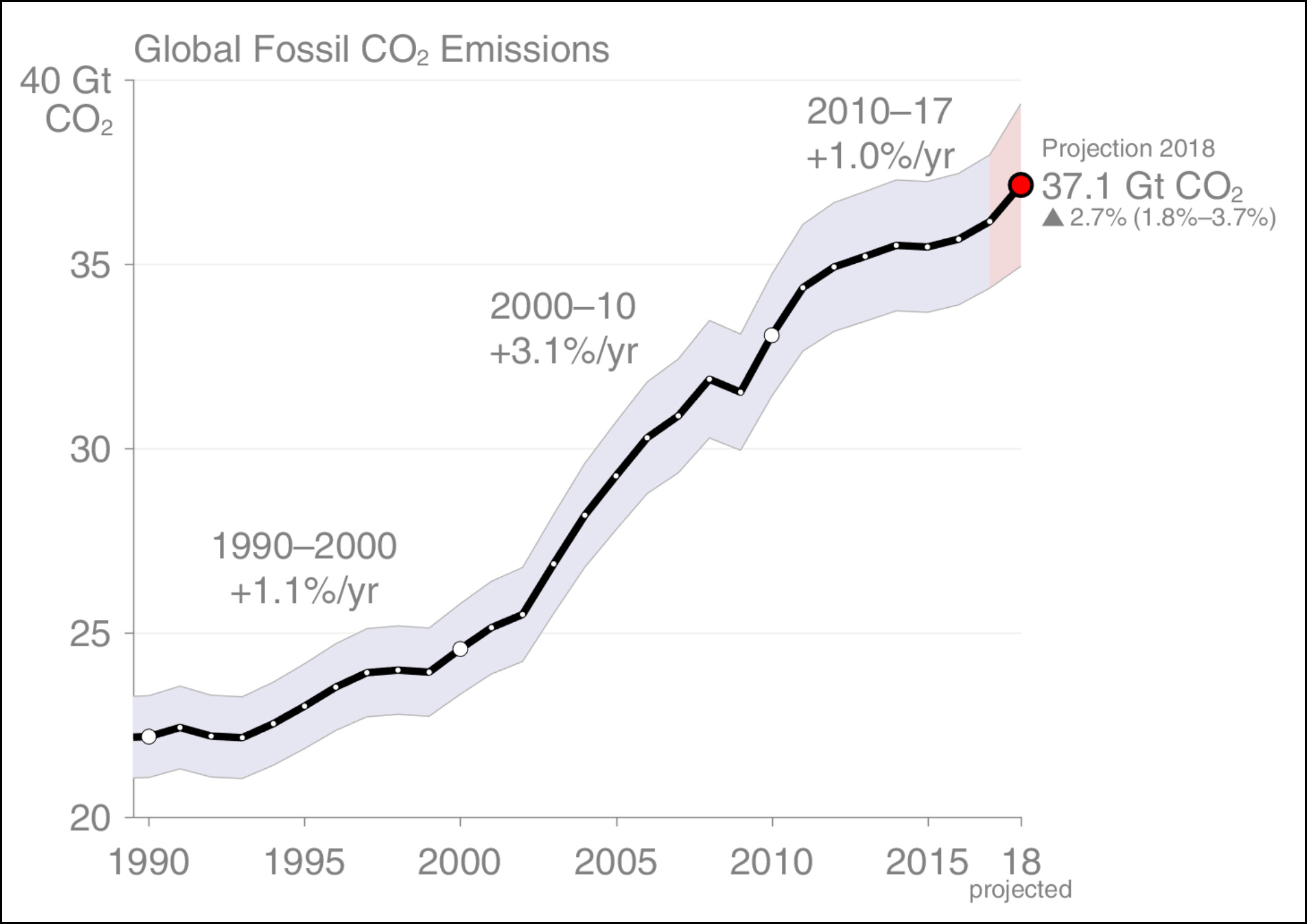
    Does this look like anyone is truly taking climate change seriously?

    Source: Global Carbon Budget

    I understand that climate change seems frustrating right now. There’s obviously no chance of Congress taking any action as long as Republicans remain in charge of things, so it’s natural to look around for things that will at least make them look bad—like forcing them to vote against 240,000 new green jobs. But this proposal might as well be a huge neon sign admitting that the fight against climate change is just a partisan schtick. If we really cared about climate change, what we’d be doing is proposing to spend money on the biggest bang for the buck possible. Then, somewhere far down the road, we might include public housing as part of our final mop up. But it sure wouldn’t come first.

    Since I’ve already admitted that nothing is going to pass in the near future anyway, why am I making such a stink about this? I’m not sure. Part of the reason is that I’ve become more and more obsessed with climate change over the past few years, and I’m desperate for progressives to start taking it truly seriously. No more wishful thinking about what the public will accept. No more “environmental justice” programs dressed up in GND language. No more pretense that Republicans are the only thing standing in our way. Climate change is just too important for all that. If it’s really an existential crisis, then even longstanding liberal priorities are sometimes going to need to be sacrificed in favor of getting something done quickly. We only have a few decades left.

  • Here’s How College Pays Off For You

    Engineering students from the class of 2019 graduate at CSU Long Beach.Brittany Murray/SCNG via ZUMA

    Do you have a college degree? Do you ever wonder about how worthwhile it really is, moneywise? Wonder no more. A team of boffins at Georgetown University has created a database of universities that ranks the average value of graduating as measured by net present value.

    I graduated 38 years ago, so the 40-year NPV is the best measure for me. Here it is:

    Not bad! I’ve earned a million extra bucks thanks to my degree from Cal State Long Beach. This narrowly beats out the local competition at CSU Fullerton but lags the performance of the shiny new CSU Channel Islands campus. Out of a total of 4,529 schools in the database, CSULB ranks 441st. I find this a little surprising, though I can’t say for sure why.

    As it turns out, the highest NPV comes from schools that specialize in pharmacy and maritime degrees. This doesn’t surprise me a lot, since any school that specializes in a particular field is likely to have a higher average than a school that offers degrees in lots of subjects, including those that don’t pay especially well. (Unless the school specializes in a low-paying field, of course, like theology.)

    In any case, it turns out that CSU schools do only slightly worse than UC schools. So if it’s money that interests you, and you live in California, you might want to think about attending your local CSU university and calling it a day. They’re easier to get into, easier to graduate from, and cheaper to attend. What more could you want?

  • Lunchtime Photo

    This is Navy Pier in Chicago, reaching out in delicate repose to the ever-watchful naiads of Lake Michigan. Rosy-fingered dusk is off to the east as fiery Helios sets in the west. Meanwhile, the god of Ferris wheels waits patiently for ebony-shrouded Nyx to wield her inevitable dominion and provide the mortals’ plaything with the wine-dark sky it needs for all its pretty lights.

    October 22, 2019 — Chicago, Illinois
  • Medicare for All Might Be a Political Loser

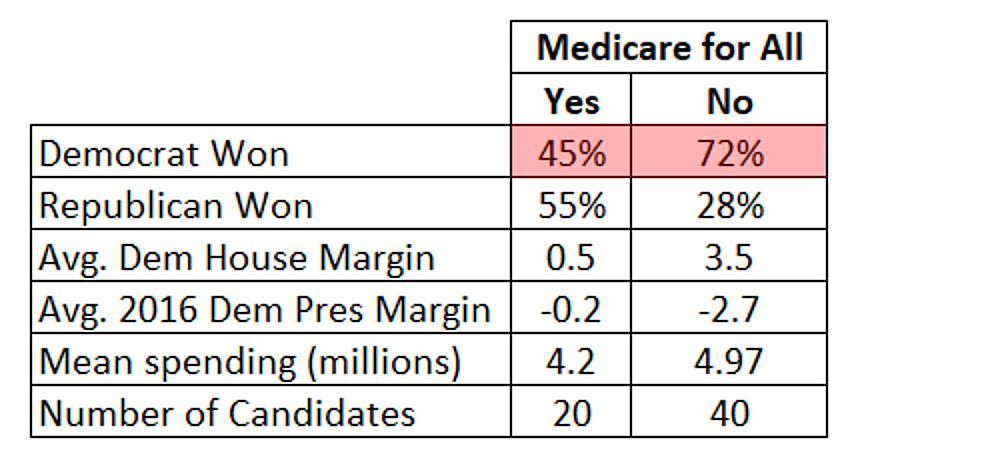
    Is Medicare for All a political winner for Democrats? Alan Abramowitz examines the fate of 2018 Democratic candidates in swing districts and concludes that it’s not:

    Among those who supported Medicare for All, only 45 percent won. Among those who didn’t, 72 percent won.

    This is not conclusive, and in any case it’s possible that support for M4A is just a proxy for how generally progressive a candidate is. Still, it’s worth taking seriously. I’m all in favor of M4A personally, but that doesn’t mean I have to ignore evidence that not everyone else is. There’s still plenty of public persuasion left before a majority of the country is with us on this.

  • How Effective Is Facebook Advertising?

    Jaap Arriens

    Online advertising is famously measurable: run an ad and count the clicks. What could be easier?

    But wait. What if most of those clicks are from people who would have clicked anyway, even without an ad? This is called the “selection effect,” and obviously your ad campaign is just wasted money if the selection effect is large. Jesse Frederik and Maurits Martijn take a look at this over at the Dutch website The Correspondent:

    A large retailer launched a Facebook campaign. Initially it was assumed that the retailer’s ad would only have to be shown 1,490 times before one person actually bought something.

    But the experiment revealed that many of those people would have shopped there anyway; only one in 14,300 found the webshop because of the ad. In other words, the selection effects were almost 10 times stronger than the advertising effect alone!

    And this was no exception. Selection effects substantially outweighed advertising effects in most of these Facebook experiments. At its strongest, the selection bias was even 50 (!) times more influential. In seven of the 15 Facebook experiments, advertising effects without selection effects were so small as to be statistically indistinguishable from zero.

    To some extent this is just the age-old advertising dilemma: it’s really hard to measure how effective any particular ad is. Ironically, though, the very thing that supposedly makes online advertising so good—targeting—also allows us to measure whether it works. You can target different ads at different groups, or even halt advertising entirely, and just look at the results. And it turns out that the results are often pretty weak.

    Why should you care about this? If Toyota and Walmart want to waste their money on Google and Facebook ads, that’s fine. Maybe their shareholders should gripe about it, but that’s all.

    Here’s why:

    Advertising rationally, the way it’s described in economic textbooks, is unattainable. Then how do advertisers know what they ought to pay for ads? “Yeah, basically they don’t know,” Lewis said in one of those throw-away clauses that kept running through my head for days after.

    Keep that in mind the next time you read one of those calamity stories about Google, Facebook or Cambridge Analytica. If people were easier to manipulate with images and videos they don’t really want to see, economists would have a much easier task. Realistically, advertising does something, but only a small something — and at any rate it does far less than most advertisers believe.

    “What frustrates me is there’s a bit of magical thinking here,” Johnson says. “As if Cambridge Analytica has hacked our brains so that we’re going to be like lemmings and jump off cliffs. As if we are powerless.”

    This is why I’m nowhere near as upset about Facebook as a lot of progressives. Facebook has plenty of issues with privacy and hate speech, and those need to be cleaned up. But the notion that political advertising on Facebook represents a massive new threat to democracy is overwrought. Most of it is targeted at people who are true believers already (the selection effect) and the rest probably has only a modest impact. The effect might be larger than zero, but it’s almost certainly fairly small—certainly smaller than the effect of Fox News or Rush Limbaugh or conventional TV ads.

    In other words: to a large extent, the disinformation folks are wasting their money. I’m OK with that.

  • Outrage Culture Has Ruined the Apology

    Ahem:

    In The Apology Impulse, co-author Sean O’Meara, a professional apologizer and public relations professional, argues that the corporate world has ruined the sanctity of the apology by failing to say sorry and over-apologizing. The book, which was published on October 29, examines the most egregious and effective business apologies in recent memory, from United Airlines’ passenger-dragging debacle in 2017 (and its failure to properly apologize) to Johnson & Johnson’s calm handling of a Tylenol recall in 1982.

    Allow me to disagree. But first: a professional apologizer? How does one become a professional apologizer?

    And now for my disagreement. I don’t think it’s corporations that have ruined the apology. It’s the rest of us. There is virtually no apology that is widely accepted anymore. No matter how sincere or real, half of us will call it a non-apology apology; half of us will insist the company still doesn’t get it; half of us will say the apology is useless because that particular bell can’t be unrung; and half of us will be pissed off that an apology was offered in the first place when none was necessary. In many cases, the permanently outraged insist that two or three of these are true at the same time, which is why this adds up to 200 percent.

    I have come to believe that outrage culture makes apologies pointless. The people who claim to be offended will never accept an apology of any kind and the people who aren’t offended don’t care unless you screw up the apology so badly it becomes a story in itself. It’s a no-win situation.

    If you want to publicly apologize because you genuinely think you’ve wronged someone, you should do it. But do it for your own good and that of the person you’re apologizing to. Not only should you not expect any kind of public appreciation, you should expect to be dragged even more for your utter failure as a human being to understand the immense damage you’ve done.

    And one other piece of advice: never, ever apologize on YouTube. Issue a press release and leave it at that.