I’m sure I’ve said this before—maybe on Twitter!—but we should all pay a whole lot less attention to Twitter. A lot less. Stop obsessing about it. Stop arguing endlessly on it. Stop following hundreds of people, many of whom are stone assholes. Stop getting upset because one or two—or a few dozen—people say something nasty about you. Stop thinking you might change minds or win arguments on Twitter.
Just stop. Twitter represents the American id, to a certain extent, and if you voluntarily decide to dive into our national id and swim around in the muck, that’s fine. But know it for what it is, and don’t bother the rest of us with your discoveries. We all know that there are lots of assholes out there.
For the rest of you, follow these rules:
A “meme” doesn’t exists unless at least 10,000 people have repeated it on Twitter. In the Twitterverse, 10,000 is about equal to 100 in the ordinary world.
Follow people you like following. Ditch all the rest.
If you’re a thin-skinned type, block people with abandon. Don’t allow any second chances. If they say something mean, block ’em. You owe them nothing.
Don’t argue with assholes. This is actually just general advice for a healthier life, but it’s super-good advice for Twitter.
I’m not sure why I suddenly felt the need to repeat this. I guess it’s because we’re going through another round of how horrible Twitter is and how horrible @Jack is, but honestly, Twitter is only as horrible as you allow it to be. It can be the worst place in the world or it can be a modest part of your life that’s good for an occasional laugh or some handy information. The folks at Twitter will probably never change, but that doesn’t mean we have to just accept what they give us. With a small amount of effort, it’s not that hard to make Twitter into something that’s personally fun and useful.
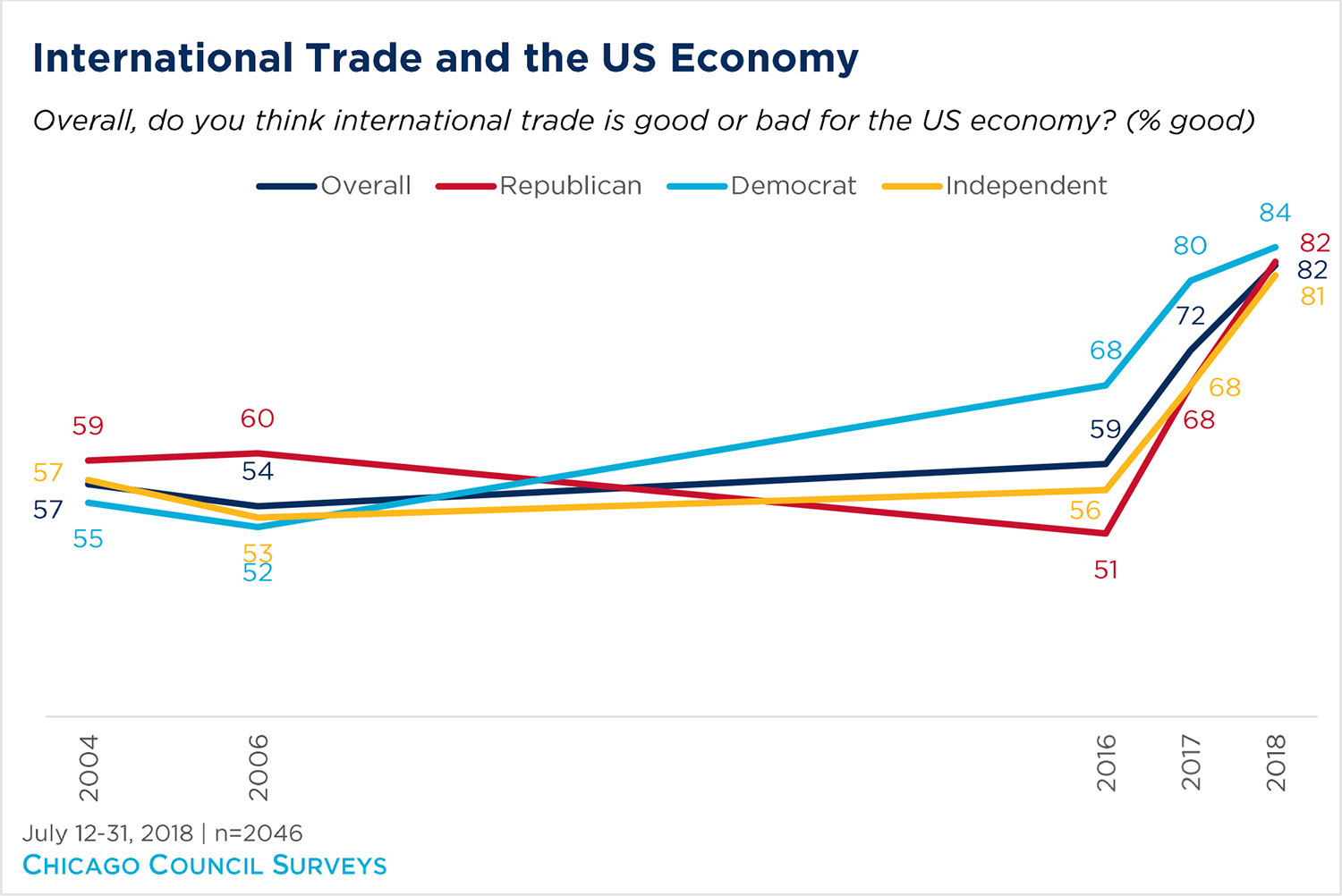
The Chicago Council on Global Affairs has been busily polling the American public, and their latest survey is about international trade. It’s become surprisingly popular ever since the trade-warrior-in-chief started his anti-trade jihad from the White House:
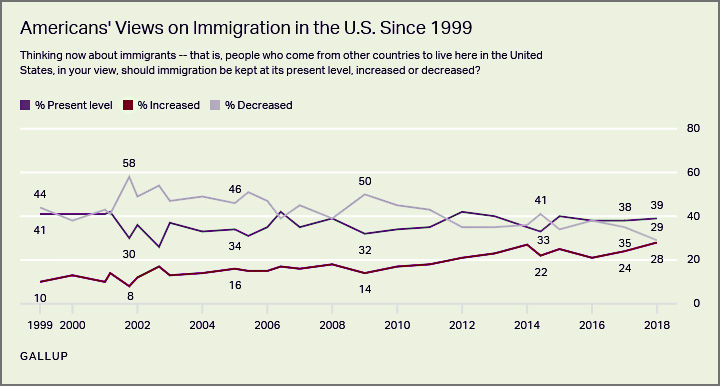
How about that? Trump’s bellowing seems to have had the opposite effect from what he wanted. Suddenly everyone is a fan of trade. Even Republicans. But before we draw any conclusions from this, here’s another chart:
This is not quite so dramatic, but nonetheless it shows that support for higher immigration levels has gone up from 20 percent to 28 percent since 2016. Throughout the entire post-9/11 period, the number of people who want to decrease immigration has plummeted from 58 percent to 29 percent.
So what’s going on? Do things get more popular the more that Trump bashes them? That’s my working hypothesis so far, but more empirical evidence is needed. I’ll get on that later today.
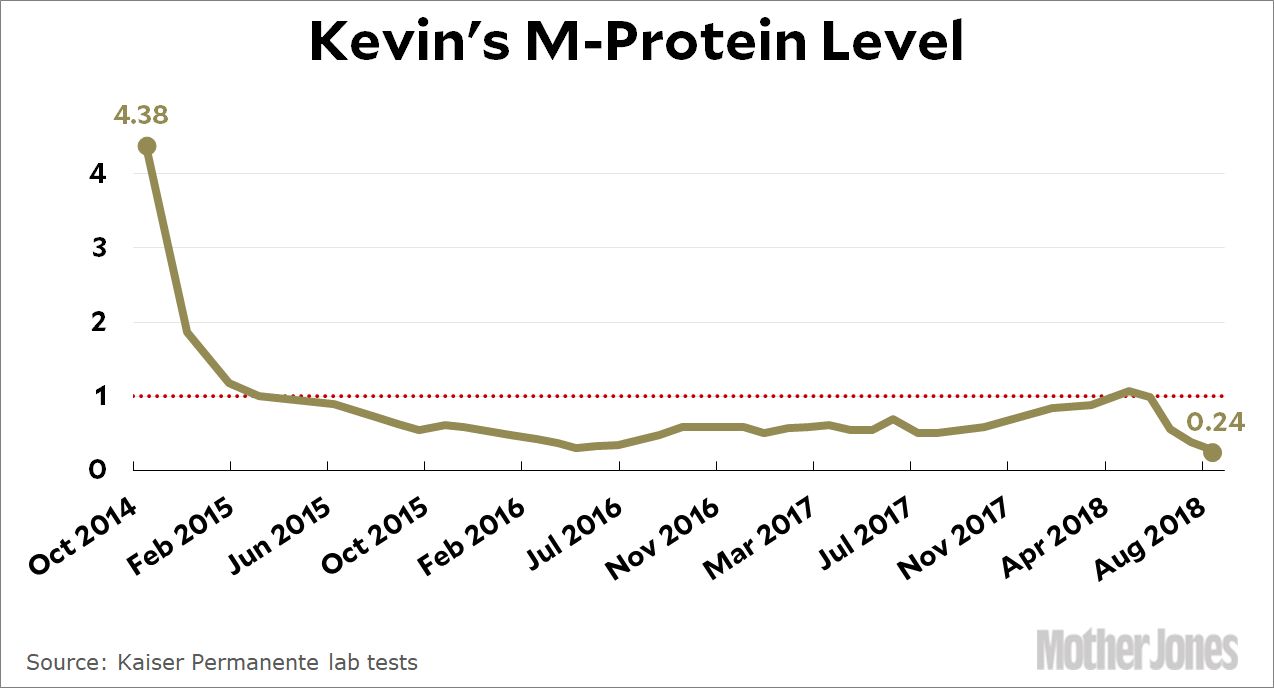
My test results didn’t quite set a new record low last week, so I decided to wait to post them until I got this week’s results. This one comes after a Darzalex infusion, which only happens one out of every four weeks, and my M-protein level is now at 0.24, the lowest it’s been since I was first diagnosed with multiple myeloma in 2014. I don’t know if we’ll get it down to zero by December,¹ but it sure looks like we’re going to get close.
The real question, of course, is how low it stays after the second round treatment is finished. But one thing’s for sure: this is good news, and it’s now almost a certainty that I’ll stay alive long enough to see Donald Trump booted out of the White House. That’s enough to keep me going.
¹This is a special medical use of the word “zero,” which means that it’s below the level that the test can detect. It will never get to a mathematical zero unless and until someone invents an actual cure.
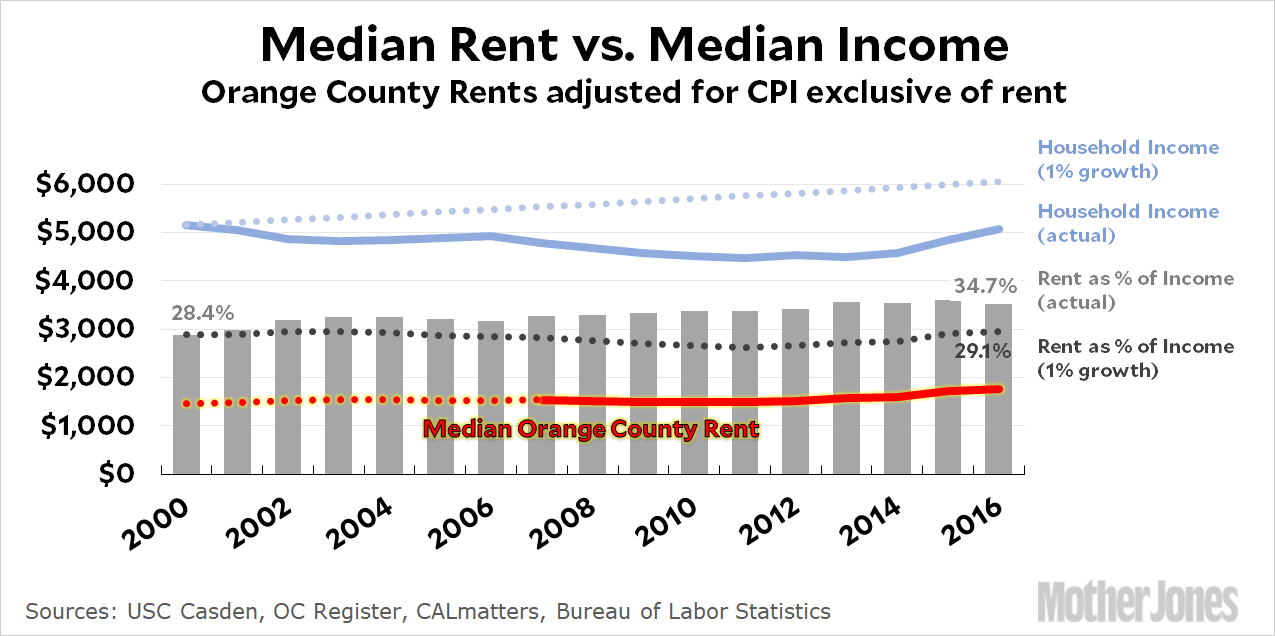
Here’s another chart that makes a point I didn’t have room for in this morning’s post on urbanization. It’s an example of why I consider urbanization per se a modest problem compared to everything else on the progressive agenda. It’s a little busy (sorry) but here it is:
The blue line at the top shows median household nationwide. The dotted line shows what household income would look like if it had grown at a steady, modest annual rate of 1 percent.
The red line at the bottom shows median rents in Orange County. I chose Orange County because it’s not a huge outlier like San Francisco or New York, but it’s still a very expensive place to live. It’s semi-urban, and places like OC house way more of the US population than the two or three big cities that are always the focus of urbanization articles. I did my best to be fair here, combining two different series that showed different rent levels and then deflating by an index that doesn’t itself contain rental inflation. I couldn’t find a single good long-term series, so the dotted part of the line is an assumed rental increase of 20 percent from 2000-2006.
Finally, the gray bars show rent as a percent of income: since 2000 it’s gone up from 28 percent to 34 percent.
That’s not actually outrageous, but it’s still an increase. However, the real reason for the increase isn’t rental inflation, it’s wage stagnation. The dotted black line shows rent as a percent of income based on household income increasing 1 percent per year. In that scenario, rent as a percent of income is flat.
So this is what I’m talking about when I say that I view urbanization through a political lens. As a progressive, what’s my real issue?
Development barriers are raising rents in big cities.
Bad economic policies have caused incomes to stagnate all over the country.
It’s the second one by a mile. Sure, there will still be a few insane places like San Francisco and the Bay Area that would have housing issues anyway. Nothing is perfect and no policy change solves every problem. But in this case, doing something about median wages fixes the rent problem and lots of other other problems besides. If I’m going to put my political energy into something, that’s it.
POSTSCRIPT: This all comes with my usual caveat. As a local issue, urbanization is fine. Fighting zoning and land-use rules that have run amok is a great thing to do. Educating people about transit is God’s work and pressing for more and better transit options is a good idea in practically every city. It’s just not, in my opinion, a major national issue, that’s all.
After my post two days ago about urbanization—i.e., the general desire to make big cities even bigger—I ended up in a Twitter conversation with David Schleicher that started getting into the weeds of land-use rules and the economic benefits of building more housing in large cities. But after a few back-and-forth tweets, I realized that I owed everyone a clear explanation of what my real issue with the urbanists is. It’s something I mentioned on Thursday, but it’s worth pulling it out and spotlighting it on its own.
It’s true that in my previous posts about urbanization I’ve talked about the nuts and bolts of the urbanist arguments and I’ve illustrated many of my points with charts. But all of this stuff is secondary to me. It’s there to explain where my viewpoint comes from and to give readers a fair chance to assess what’s motivating me. None of it is meant to be a precision review of the literature, just a brief layman’s summary of some of the main threads of the urbanist case. I want everything to be in the right ballpark, but that’s all.
My primary lens, though, is a political one. I have no issue with people fighting for more development in the cities they live in, only with the question of whether progressives should make urbanization an issue they’re associated with on a national basis.
Here’s the thing: the main case for urbanization is that it confers various benefits that progressives value. Economic benefits. Environmental benefits. Social justice benefits. But we also know that urbanization provokes intense and relentless opposition. I assume this is uncontroversial. The very fact that new development is so difficult is what spurred the urbanist movement in the first place.
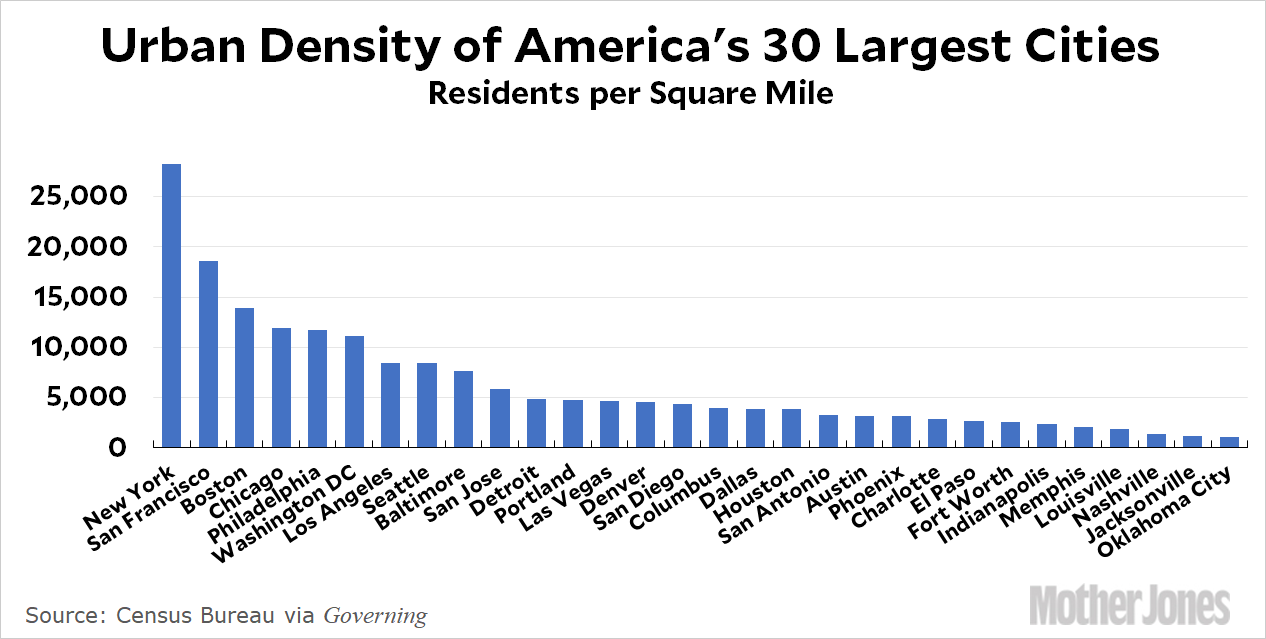
So here’s my question: Is urbanization the most effective way of using our political energy to accomplish urbanism’s goals? Even without perfect evidence at hand, I don’t think it’s even a close call. Take the economic argument: if you double the density of, say, New York City, it turns out that this will raise the productivity of New York’s workers by x percent (x depends on which researcher you listen to). But that’s a pipe dream. If you could increase New York’s density by 10 or 20 percent over a decade, you’d be kicking ass. It would be a huge political win. And yet, that level of extra density would increase productivity by only a small amount—perhaps 2-3 percent if you’re being optimistic.
Ditto for the environmental benefits. There’s no hard-and-fast consensus about how much density reduces per-capita CO2 emissions, but the effect is certainly fairly modest. If that’s really your goal, there are lots of ways to channel your political energies more effectively.
And then there’s the flip side: in addition to modest benefits, urbanization just isn’t very popular. There are a small number of people who support it, a larger number of people who hate it, and an even larger number of people who don’t care. And even that understates the case. In some places there are plenty of people who claim to support higher density in the abstract, but when it comes to specific projects in specific neighborhoods, that support almost always vanishes and all the research in the world won’t sway anyone’s mind. As a political proposition, urbanism is a loser.
So there you have it. My best assessment is that the benefits of urbanization are pretty modest and the political costs are very high. It’s fine as a local issue, but at the national level it just sucks political energy away from things that are far more effective at accomplishing progressive goals. My guess is that even if I’m wrong about the benefits by a factor of two or three, urbanism still wouldn’t come close to being a political winner. And that’s why I don’t support it.
POSTSCRIPT: One more thing that’s worth a quick note. A lot of urbanists seem convinced that opposition to development is a boomer thing. It’s not. My parents grew up in Los Angeles, but after they got married they couldn’t afford a place in LA. So they moved to Orange County and bought a house with a GI loan. This was in 1959.
The problem of expensive cities and opposition to high density isn’t a boomer thing, it’s a population thing and a car thing. Both of those converged in the late 20th century in most big cities, and so the opposition to further density just happened to fall on the generation that was living in big cities at the time. Boomers made up a big part of that population.
The reason this is important is that an awful lot of urbanists have adopted a self-righteous tone about the whole problem being one of selfish boomers who got their piece of the pie and now want to keep anyone else from joining them. This is both unhelpful and mostly wrong. As I alluded to on Thursday—perhaps a little too sharply—it would be about the same as me saying that the whole problem is one of millennials who want to force other people to pay the price of density so they can get cheaper housing for themselves. Then they dress it up with altruistic arguments about the environment and economic growth. Does that sound fair? Probably not. But everyone is selfish—it’s a feature of human nature, not of any particular generation—and probably either both statements are accurate or neither of them is. Take your pick.
Lenders are stepping up offers of consumer loans with few strings attached, often to individuals with poor credit histories they all but ignored in the years after the financial crisis. The offers promise a way to help pay down other debts or fund home renovations or vacations, fueling concerns that customers could overextend themselves. “Take control of your finances,” says one mass mailing. “Your dream can come true,” says another.
FFS. It’s only been ten years since the Great Recession. I guess it’s the perfect time for Republicans to push for repeal of even the modest new regulations that we put in place after Wall Street crashed the global economy.
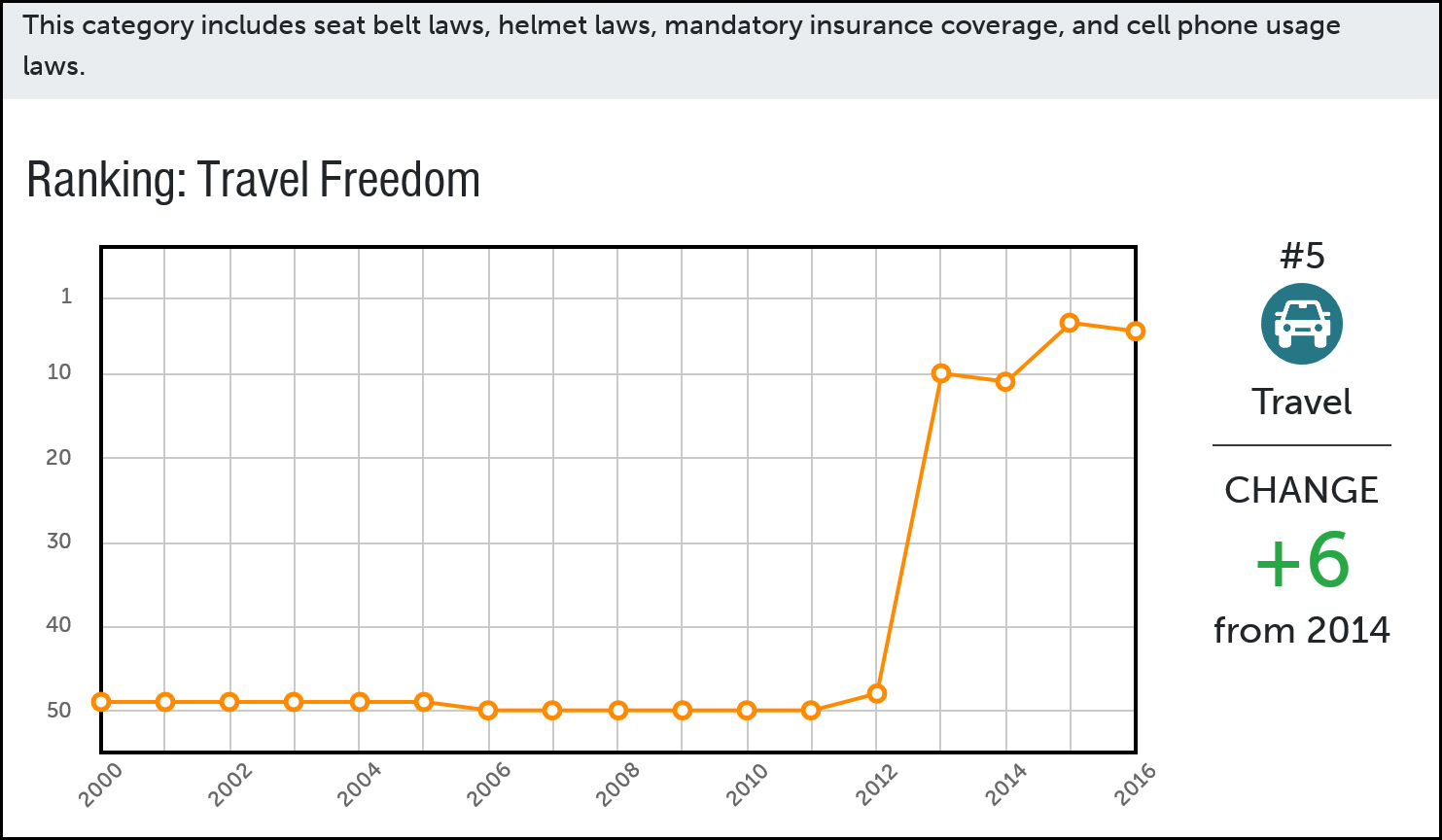
Paul Krugman is blogging about Cato’s latest Freedom Report, so I went over to take a look. California, once again, is ranked a dismal 48th:
Our low ranking, of course, is due to the fact that our taxes are high and we look poorly on businesses polluting our air and water. But as I browsed the various categories, I came across this:
What’s this all about? We were an absolute travel hellhole through 2012 but then suddenly jumped to paradise status in a single year. We currently score 0.007062 on travel freedom, whatever that means, but I guess it must be pretty good since it makes us #5 in the nation.
Drilling down, it turns out that our overall travel score jumped from -0.00707 in 2012 to 0.003676 in 2013. But why? Drilling down even further, their downloadable spreadsheet records only one change: our score on “Finger or thumbprint required for driver’s license”—although I can’t quite tell precisely what caused this since there seem to be two columns with two different numbers and only one of them changed. What’s more, as far as I know we still require a fingerprint to get a driver’s license. Can anyone help me out here?
In any case, what’s really weird about this whole thing is that apparently our travel freedom rank can skyrocket from #49 to #10 due to one change that’s somehow related to fingerprints on driver’s licenses. What the hell kind of travel freedom ranking is this, anyway? Texas is currently #50 and I’m afraid to even look at their raw data. Speed traps? Lots of civil asset forfeiture? Passports required if you enter the state driving a Prius? Lingering memories of Chuck Norris constantly kicking ass on Texas highways? It is a mystery.
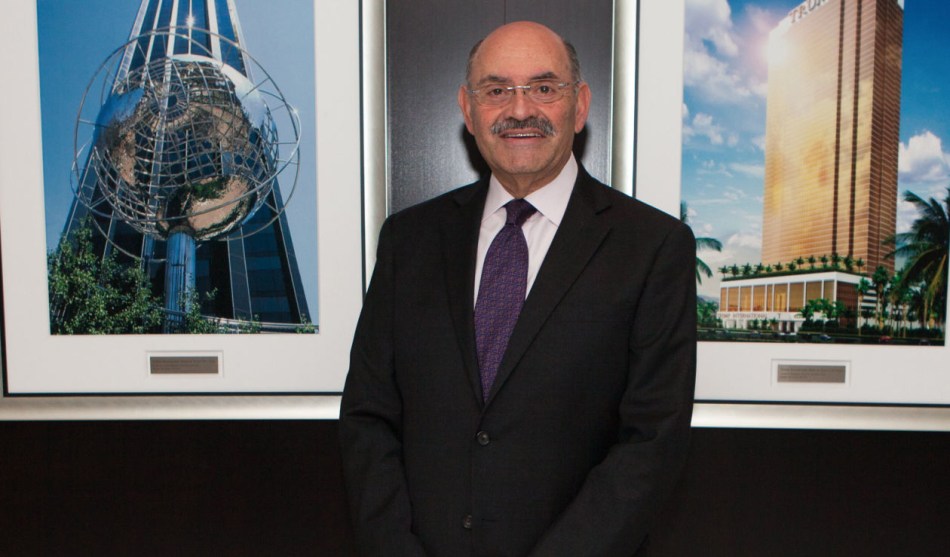
The longtime chief financial officer of the Trump Organization, Allen Weisselberg, was given immunity by federal prosecutors in New York during the course of the Michael Cohen investigation, according to two people with knowledge of the matter. The news was first reported Friday by The Wall Street Journal.
Weisselberg is “Executive 1” on page 17 of the criminal information filed by prosecutors in the Michael Cohen case, a person with knowledge of the matter told NBC News.
This happened earlier in the year, and Trump certainly knew about it when it happened. It was probably responsible for some kind of epic tweetstorm that left us all scratching our heads and wondering what the hell sparked all that? Eventually, I suppose we’ll manage to put dates to all the ins and outs of the Mueller investigation and then line them up with Trump’s Twitter timeline. Finally it will all make sense. But not for a while.
Can you pitch in a few bucks to help fund Mother Jones' investigative journalism? We're a nonprofit (so it's tax-deductible), and reader support makes up about two-thirds of our budget.
We noticed you have an ad blocker on. Can you pitch in a few bucks to help fund Mother Jones' investigative journalism?
We’re halfway there, but time’s running out.
With only days left in 2025, we've made real progress toward our $400,000 goal—the funding we need to keep our nonprofit newsroom running at full
strength. But to close the remaining $200,000 gap before December 31, it will take a huge surge in reader support. Whether you've given before or this is your first time, your contribution right now will matter. Will you help us get there?
We’re halfway there, but time’s running out.
With only days left in 2025, we've made real progress toward our $400,000 goal—the funding we need to keep our nonprofit newsroom running at full
strength. But to close the remaining $200,000 gap before December 31, it will take a huge surge in reader support. Whether you've given before or this is your first time, your contribution right now will matter. Will you help us get there?