• There’s No Point in Pardoning Paul Manafort

    Everyone is talking about whether Donald Trump will pardon Paul Manafort. Today, for example, the New York Times reports that Trump has discussed the idea with his lawyers:

    Mr. Giuliani had said in an interview on Wednesday that he and Mr. Trump had discussed the political fallout should the president grant a pardon to Paul Manafort, his former campaign chairman who was convicted of financial fraud this week, adding that one was not under consideration. Mr. Giuliani told The Washington Post earlier on Thursday that the president had asked his lawyers for their advice on pardoning Mr. Manafort, though Mr. Giuliani characterized the discussions to The New York Times as instigated by the lawyers, not the president.

    I don’t get this.  My understanding is that if Manafort is pardoned, he no longer has a Fifth Amendment right against self-incrimination. After all, he can’t be convicted of anything no matter what he says. This means he can be questioned under oath and he has to answer.

    Isn’t this the worst possible position for Trump to be in? Either Manafort sings like a canary or else he risks lying, in which case he gets a brand new indictment for making false statements—which isn’t covered by the pardon. In one case, Trump is toast, and in the other the pardon did no good.

    What am I getting wrong here?

  • (Almost) Everyone Hates Urbanization

    How about a nice little town with national forests on all sides instead?

    In theory, everyone is in favor of building more housing in big cities. Conservatives are in favor because they oppose regulatory regimes that prevent the free market from building whatever it wants. Liberals are in favor because they believe a bigger supply of housing will bring down prices and help establish more low-income housing.

    So we’re all one big happy family, building new housing as far as the eye can see. Right? Emily Badger brings down the truth hammer:

    It is clear from other research that homeowners’ views on this issue transcend partisan politics. Michael Hankinson, a political scientist at Baruch College, has surveyed Americans about their support for development and found no evidence that conservatives particularly oppose regulation or embrace free markets when it comes to housing. He found them less likely than liberals to support a 10 percent increase in their city’s housing supply, and more likely to support a ban on new development in their neighborhood.

    ….Similarly, in other surveys, Clayton Nall and William Marble at Stanford have found that liberals who say they support redistributive policies also oppose new development around them. Their ideology on national issues clashes with their personal interests as homeowners, and if forced to pick one they tend to choose the latter. Even being shown messages reminding them of the benefits of new housing for low- and middle-income families does little to alter their views.

    In fact, practically no one who lives in a big city wants more housing. They may or may not be willing to admit why, but they don’t. Liberals will accuse conservatives of racism and conservatives will accuse liberals of hypocrisy, but before long they’ll all sing Kumbaya and loudly agree that the problem is too much traffic. Maybe you don’t believe them, but an atomic crowbar will fail to pry the real story out of them.

    You all know how I feel about this: I don’t personally care one way or the other because I don’t live in a big city. At a policy level, though, I don’t care much either. The single biggest attraction of urbanization is supposed to be the economic dynamism of big cities, but as near as I can tell the evidence is pretty equivocal on this score. A big increase in housing in, say, New York City, might have a noticeable effect on economic growth, but any feasible level of growth is likely to produce very little.

    So who is in favor of urbanization? As near as I can tell, the answer is young, college-educated people who would like to live in a big city but can’t afford it. They have reams of white papers about why urbanization is a great thing, but really, they’re motivated by their own selfish desires, just like the folks who already live in the cities.

    This is why I think it would be insane for the Democratic Party to adopt urbanization as any kind of party platform. Centrist conservatives would hate it. Most liberals would hate it. People who live in cities and suburbs would mostly hate it. Rush Limbaugh would say that it proves Democrats are just a bunch of socialists who want to force everyone to live in high-rise beehives. And even with a massive effort, it would never produce enough affordable housing to make New York City 20-somethings just out of college satisfied. It would almost literally be pareto-catastrophic. No one would be happy.


  • Lunchtime Photo

    Here’s a little cluster of asters that I found on the road up to Clear Lake, a few miles outside of Silverton, Colorado. I’m looking west, toward the hazy mountains, and this is one kind of photo where haziness can be a help. By opening the aperture all the way up, the background becomes both blurry and hazy, which allows the flowers to pop. It wouldn’t work as well if the mountains were bright and distinct.

    Too bad the flowers are a day or two past their prime. Luck of the draw.

    August 12, 2018 — Silverton, Colorado
  • Random Knowledge: How Segregated Are Urban American Schools?

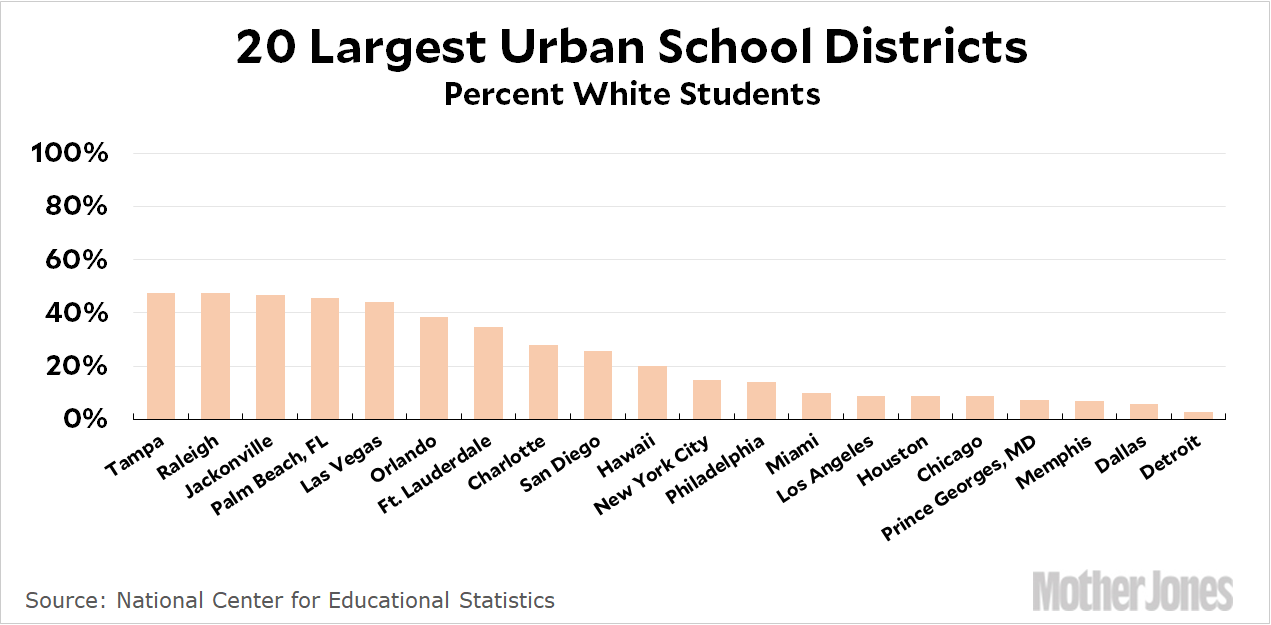
    Bob Somerby is always going on about this, so I thought I’d show it to everyone in simple chart form. Among America’s 20 biggest urban public school districts, here are the percentage of students who are white:

    Outside of Florida and North Carolina, there are virtually no big urban school districts that are more than 20 percent white. This is partly because white families long ago fled to the suburbs or because they send their kids to private schools in the city. Either way, the result is the same: the vast majority of the student body is black and Hispanic.

    Why does this matter? Because it means that desegregation of our cities’ public schools is all but impossible. If you did a perfect job of desegregation in Los Angeles, each school would have 9 percent white kids. In a more likely scenario, a few schools would have a quarter or a third white kids, and the rest would have about 1-2 percent. There’s just no realistic way to make genuine, broad-based desegregation happen.

    This is apropos of nothing in particular. It’s just a reminder that if we want to improve education for children of color, then we have to improve education for children of color. Full stop. As nice as desegregation would be, we have to accept the world the way it is and figure out how to do a good job with classrooms that are all but completely black, Hispanic, and Asian. So what’s the answer?

  • Chart of the Day: It’s a Good Time to Be a Bank

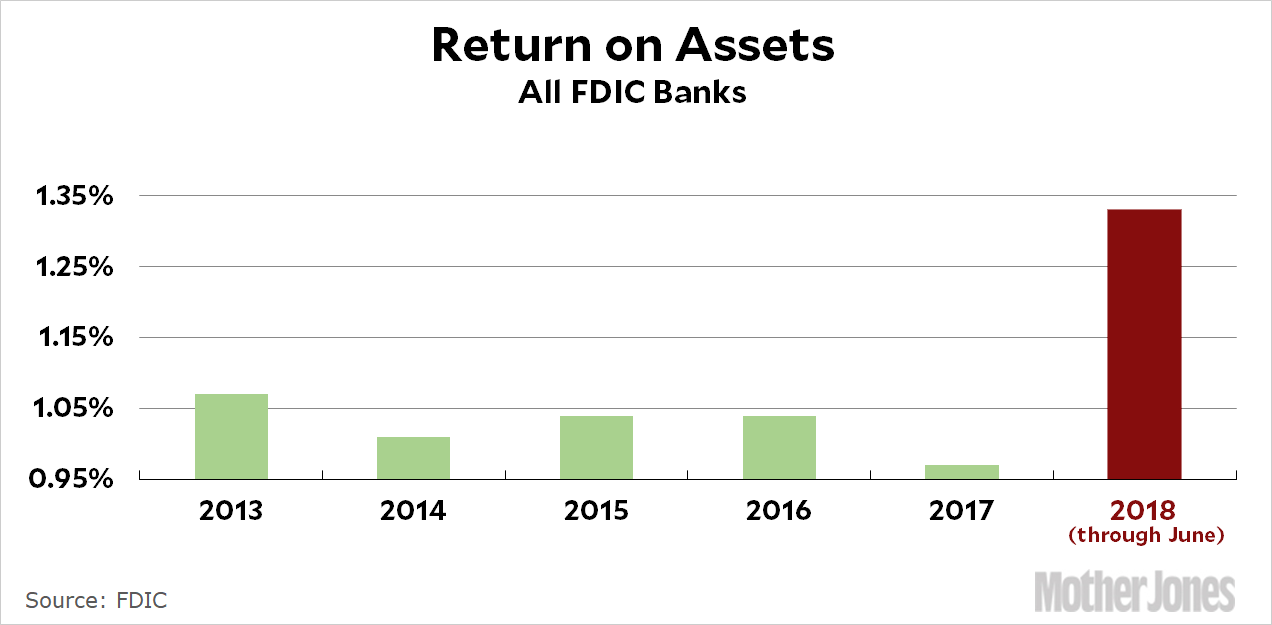
    The latest FDIC report is out, and I know you’ve been waiting for it. Check out how our banks are doing!

    Isn’t that great? And don’t be bitter just because you and I are more likely to be getting 2 percent raises this year. America’s banks made their money the old fashioned way: they lobbied for it. The FDIC explains:

    The 5,542 FDIC-insured commercial banks and savings institutions reported net income of $60.2 billion during the three months ended June 30, an increase of $12.1 billion (25.1 percent) from a year earlier. Higher net operating revenue (the sum of net interest income and noninterest income) and a lower effective tax rate contributed to the increase in industry net income. Assuming the effective tax rate before the new tax law, net income would have totaled an estimated $53.8 billion, an increase of $5.6 billion (11.7 percent) from second quarter 2017.

    Without the Republican tax cut, bank earnings would have increased $5.6 billion last quarter. But with the Republican tax cut, bank earnings increased $12.1 billion. Ka ching! We should be seeing some very nice bonuses on Wall Street this year.

  • Trump: Impeach Me and the Economy Will Go Up in Smoke

    Today’s ramblings from from President Trump:

    • The New York Times cannot write a good story about me. They’re crazed, they’re like lunatics
    • He [Manafort] refused to “break” – make up stories to get a “deal.” Such respect for a brave man!
    • I’ve seen it many times. I’ve had many friends involved in this stuff. It’s called flipping and it almost ought to be illegal.
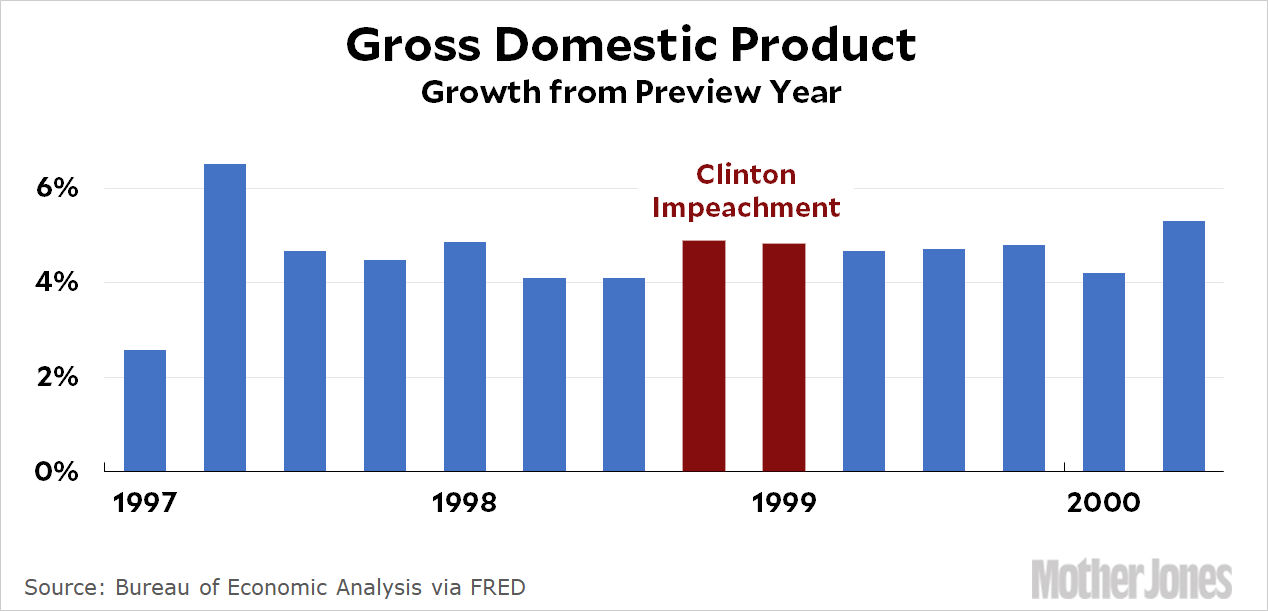
    • “If I ever got impeached, I think the market would crash. I think everybody would be very poor. Because without this thinking you would see” —points to head — “you would see numbers that you wouldn’t believe in reverse.”

    I dunno. The economy seemed to do fine the last time we impeached a president. I think I’m willing to take the chance:

  • Really, the Whole Cohen Thing Is Just a Big Nothingburger

    Remember a few months ago when Rudy Giuliani casually admitted on the Hannity show that Donald Trump had paid hush money to keep Stormy Daniels quiet about their affair? Then the next day he said it was all a big mistake and he hadn’t really meant any of it? Everybody went nuts. It was a bizarre clusterfuck even by Trumpian standards, and no one could figure out how and why it happened.

    I think now we know. Consider this tidbit yesterday from John Hinderaker:

    Today’s legal developments unquestionably represent a step forward for the Democrats….But in principle, there is no reason why they should change the landscape. Manafort’s conviction has nothing to do with Trump. And no matter how Mueller may try to dress it up with talk about campaign finance—which voters don’t care about, anyway—the Cohen plea simply confirms what we already knew–that Trump tried to keep Stephanie Clifford quiet. That may be a big deal to Melania, I can’t speak for her. But I doubt that it is a big deal to a significant number of voters, and I doubt that tomorrow’s headlines will move the needle on the midterm election.

    You see what happened there? There’s nothing new here. We already knew all about Stormy. This just adds some obscure campaign finance stuff that no one cares about except for a few lawyers.

    That’s how it works: you let the news drop early so everyone has time to absorb it and move on. Then, when Cohen officially admits Trump knew all about the payoff, it gets some big headlines but it’s basically old news. All that’s left is to go on TV and muddy the waters about how every campaign has some finance violations because campaign finance law is so complex. It’s really nothing that hasn’t happened before a hundred times. We’ll let the green eyeshade guys work it out.

    Now then: who wants to talk about those WHITE FARMERS whose land is being BRUTALLY EXPROPRIATED by the BLACK government in South Africa? And white farmers have been MURDERED! That’s what we should be outraged about, amirite?

  • Which Country Suffers Most From Senioritis?

    Tyler Cowen points today to a new study that examines the PISA test of problem-solving and cognitive skills. PISA is conducted every three years in 60+ countries around the world, and as near as I can tell, its only real purpose is to provide an excuse for op-ed columnists to wail about how stupid US students are. But not at this blog! No country whose “adults” elect Donald Trump president has any business complaining about its teenagers any longer.

    Anyway, it turns out that this new study tries to assess how seriously students take the test. After all, PISA doesn’t count toward their GPA or toward graduation and it doesn’t help get them into college. Given the vast number of standardized tests high school students take these days, it’s fair to wonder how much energy they put into one that doesn’t matter to them personally.

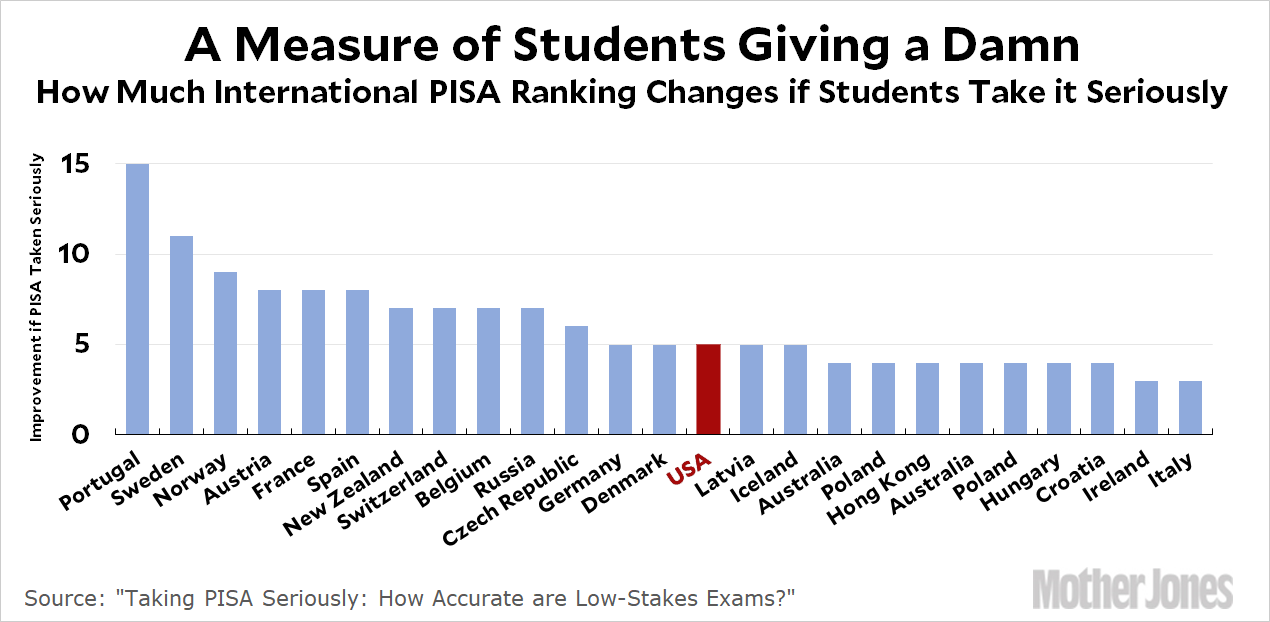
    The authors go through a long explanation of how they judge seriousness, and I suppose it sounds reasonable enough. I don’t really care, though. My goal is to use their data for a completely unauthorized purpose: judging which countries have the largest share of slackers and shirkers. Here’s the chart:

    Check out Portugal! If their students gave a shit, their world ranking would rise from 31 to 16. Either Portuguese kids are really lazy or else their teachers don’t care about the test and tell the kids to just pencil whip it so they can all take a longer lunch break.

    Among the top countries, Dutch kids are apparently the most serious. They rank a very respectable 12th, and that’s as good as it gets. There’s no evidence of non-serious behavior and no evidence that they could move up the rankings. These are the kids you want to control your nuclear power plant or your international court of justice.

    And then there’s the good ol’ USA. As usual, we’re sort of half-ass mediocre even at being half assed. We rank 27th overall, which is mediocre, and we lose 5 ranking levels from laziness, which is a mediocre amount of laziness. We could be a slightly less mediocre 22nd, but why bother? Must be time for a nap.

  • Lunchtime Photo

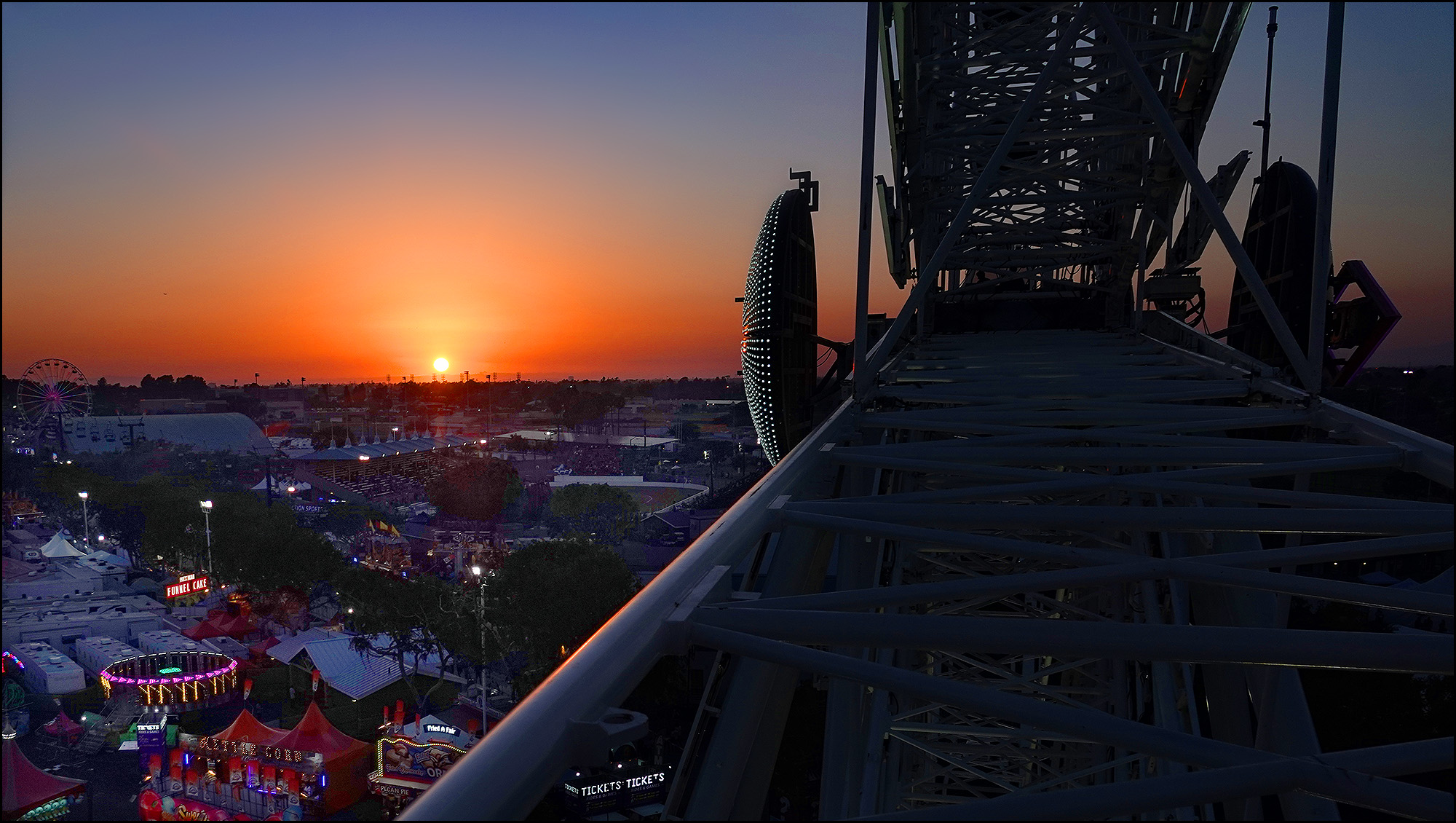
    Here’s a picture of sunset at the Orange County Fair as seen from La Grande XL, “quite possibly the largest traveling observation wheel in the Western Hemisphere.” Hmmm. “Quite possibly”? Sounds like someone better get cracking on La Grande XXL.

    July 13, 2018 — Costa Mesa, California