• A Simple Look at Middle-Class Taxes Under the Trump Plan

    UPDATE: I got this completely wrong in the initial post. Basic taxes are lower for everyone under the Republican “unified framework,” including the working and middle classes. I’ve corrected the charts using the proper tax brackets.


    Here in Cork, it’s raining and the wind is howling. Neither one of us feels like roaming around town in this mess, so we’re staying in.

    So let’s talk taxes. Noah Lanard described the Trump tax plan in this space earlier today, but you know me: I want a chart. First, let’s review what the plan does for low and middle-income folks:

    • Increases the bottom tax rate from 10 percent to 12 percent.
    • Increases the standard deduction from $6,000 to $12,000 (twice that for couples).
    • Eliminates the personal exemption of $4,050 for each person in a household.

    For example, for a single person making $50,000 under the current structure, your taxable income is $50,000 – $6,000 – $4,050 = $39,950. You pay 10 percent of the first $10,000, 15 percent of the next $28,000, etc. It adds up to about $5,500.

    Under the Trump plan, your taxable income is $50,000 – $12,000 = $38,000. You pay 12 percent of that, or $4,560. That’s less than you pay now. Here it is in chart form:
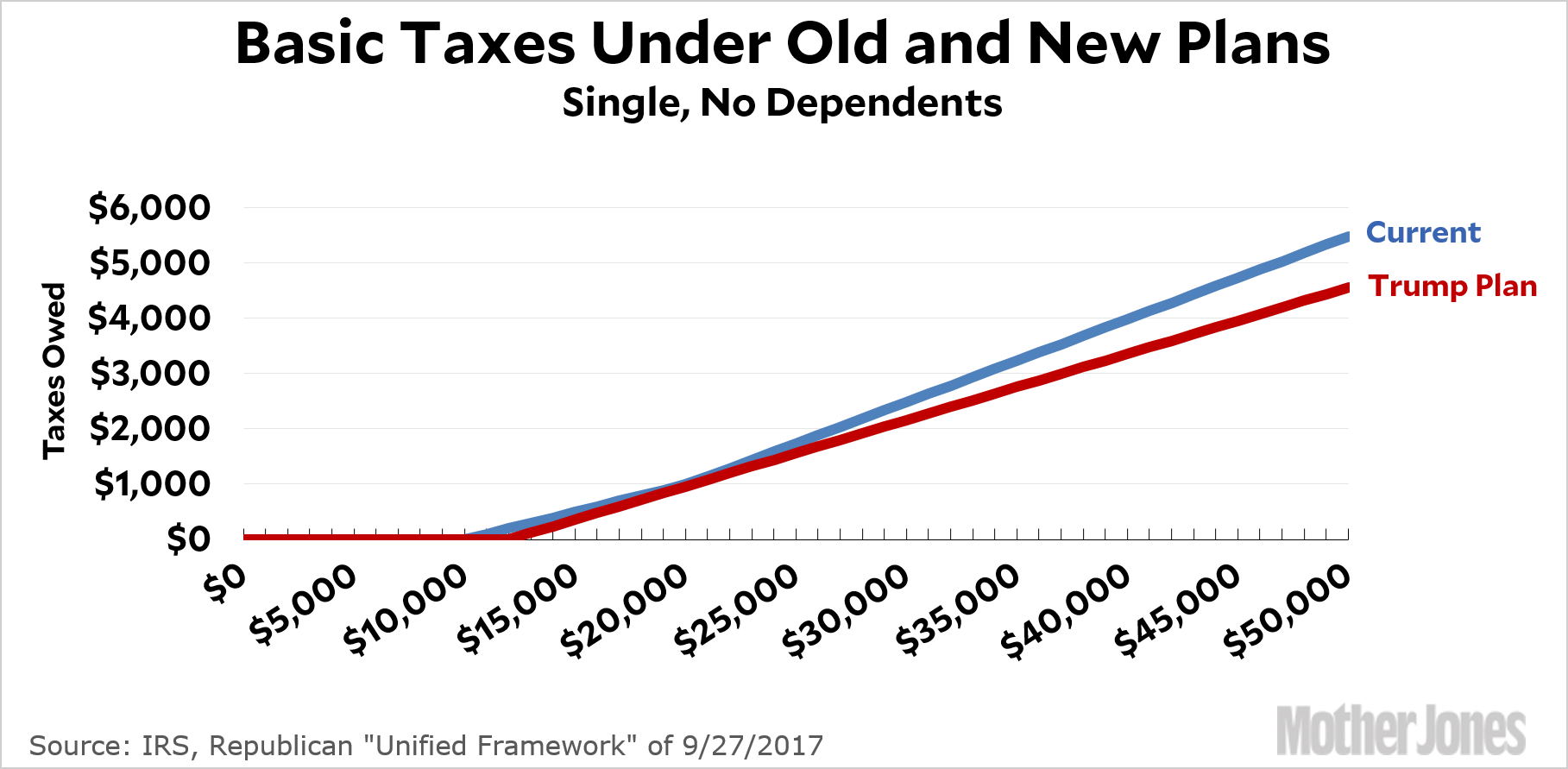
    Things look a little different for a family. The standard deduction is doubled, but you lose more personal exemptions. You also have to account for the child tax credit, which Trump promises to “significantly” increase. He doesn’t provide a number, so I’m assuming an increase from $1,000 per child to $1,500.

    His plan also doesn’t say where his 25 percent tax bracket kicks in, so I’m assuming it starts at the same place as it does under current law, which means it doesn’t come into play under $100,000. Here’s the chart:
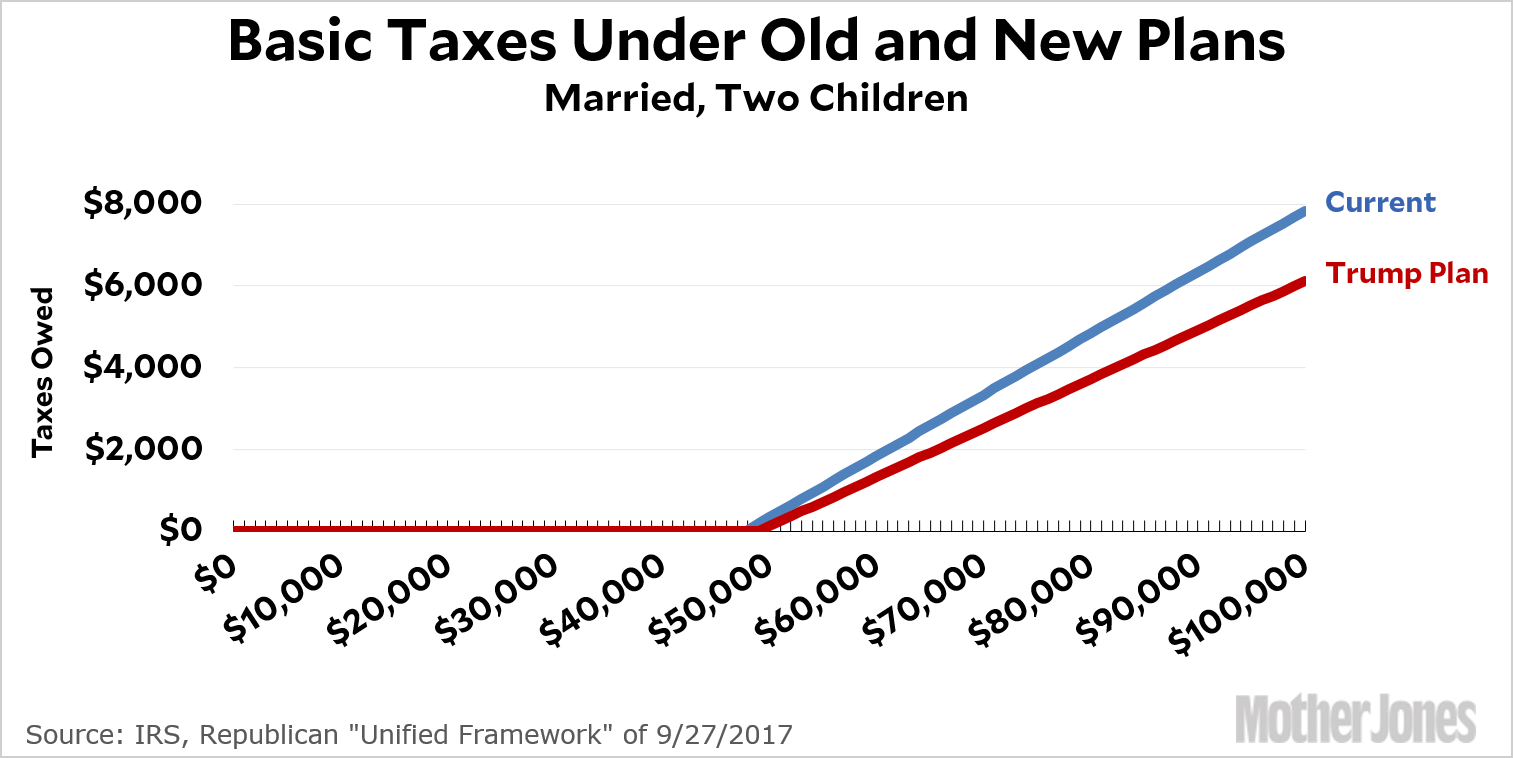
    But what about the rich? I figured you’d ask. As you can imagine, piddling little things like standard deductions and personal exemptions don’t matter to folks who make lots of money. It’s just noise. What matters is the rate: the Trump plan cuts the rate on high earners from 39.6 percent to 35 percent. This means that someone making $2 million per year saves nearly $100,000. Here it is chart form:
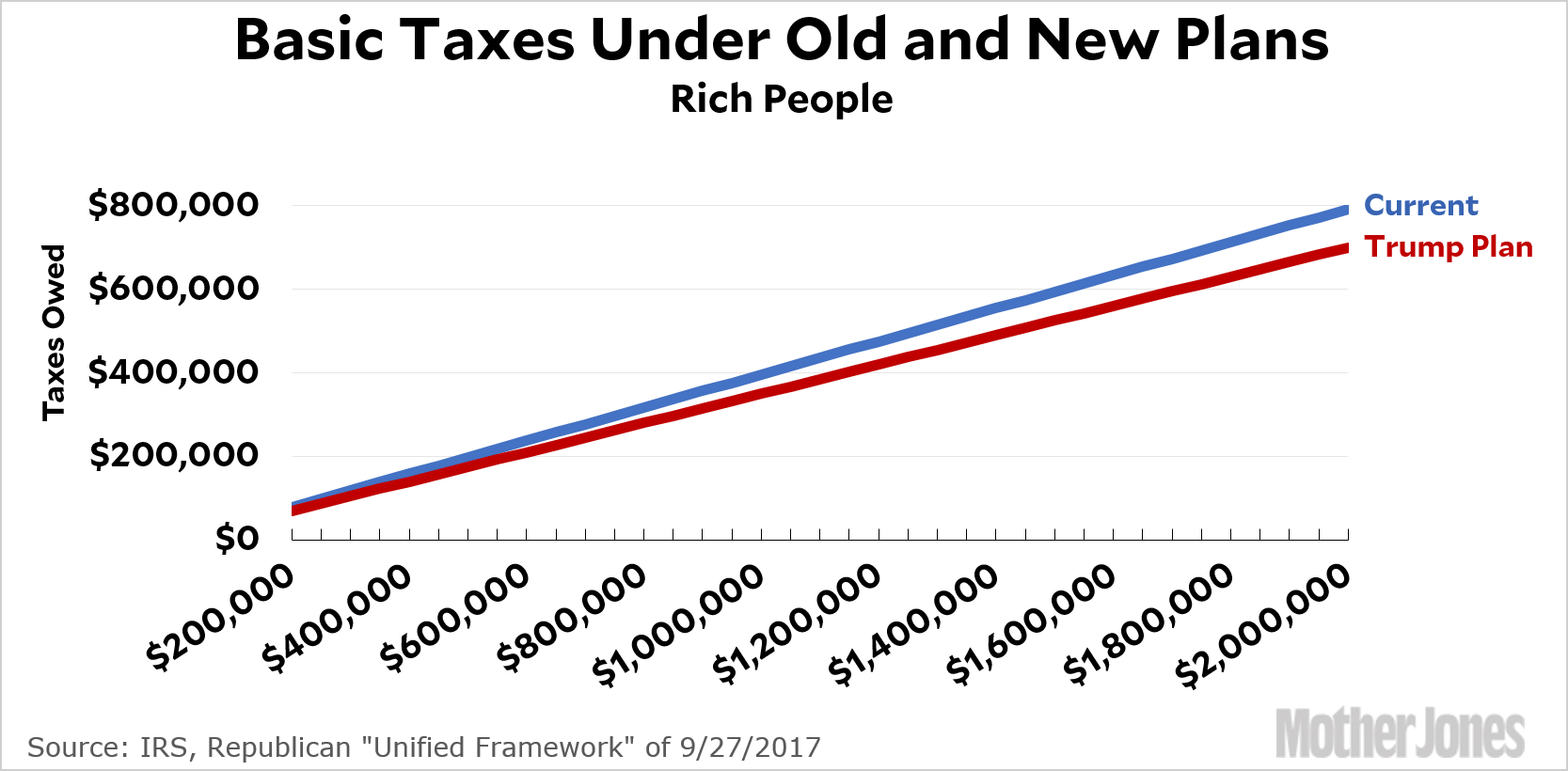
    The super-duper rich would also save money from the proposed elimination of the Alternative Minimum Tax and the estate tax.

    Bottom line: basic taxes go down for everyone. The working and middle classes might save anywhere from $500 to $2,000 or so. The rich will save anywhere from zero to infinity, depending.

    CAVEAT: This is just basic taxes. For the working poor and the working class, it doesn’t include things like the EITC or the mortgage interest deduction. For the rich, it doesn’t include the million-and-one things they can do to reduce their tax bill substantially. Trump promises to address this by eliminating lots of low-value deductions and repealing “numerous” other exemptions, deductions and credits. But he doesn’t say which ones, and we all know how that goes.

    So this shows just the basic rate structure. In practice, it will almost certainly play out a little differently. And once Congress gets done, it might not even look anything like Trump’s plan anyway.

  • Americans Eat 6 Hamburgers a Day, and It’s Making All of Us Sicker

    Krizde/Getty

    While Kevin’s on vacation, we’ve invited other Mother Jones writers to contribute posts.

    Loading up cows, pigs, and chickens with antibiotics to speed growth is a major cause of increasing antibiotic resistance and the emergence of terrifying drug-resistant bacteria that can jump from livestock to humans. If current growth continues, we’ll be using 53 percent more antibiotics on animals by 2030. With all those antibiotics out and about, we can only expect more drug resistance to follow.

    A new paper published today in Science explores ways to pull back. Conducted by members of the public health research organization the Center for for Disease Dynamics, Economics and Policy, along with researchers from Princeton University, the United Nations’ Food and Agriculture Organization (FAO), and others, the report outlines pathways to reduce antibiotic use in livestock by up to 80 percent by 2030, by:

    -Regulating antibiotic use: If the world’s heaviest users (like China and the US) can refrain from increasing their use at projected rates and cap usage at the current global average, the researchers estimate we’d consume 64 percent less antibiotics. Many European countries already have regulations mandating they use less than half the global average. But as the researchers point out, wider regulations would need strong enforcement, which could be cost prohibitive.

    -Charging more for antibiotics: The World Bank has endorsed a 50 percent surcharge on antibiotics used on animals. The extra billions in revenue could go into a global research fund targeting antimicrobial resistance and new antibiotics. (Though I wonder what steps could be taken to ensure human drugs weren’t diverted into a black market?)

    -Eating less meat: The study posits that “Limiting meat intake worldwide to 40 g/day—the equivalent of one standard fast-food burger per person—could reduce global consumption of antimicrobials in food animals by 66 percent.” This one caught my eye: do we really on average eat more than a burger a day? Turns out, according to the FAO, the global average of meat available per person per day in 2013 was around 42 grams, or about one fast-food burger patty. In the United States, the average is 260 grams a day—or six burgers. Given developing economies’ growing appetite for meat, it may be a stretch to believe that the globe could hold its meat consumption steady for the next 13 years. On the other hand, does a ration of one McDonald’s hamburger-worth of meat every day really sound so hard?

  • Working Parents are Clear Losers Under Trump’s Tax Plan

    President Donald Trump at September event with Spanish Prime Minister Mariano Rajoy.Mai/Zuma

    While Kevin’s on vacation, we’ve invited other Mother Jones writers to contribute posts.

    On Wednesday, President Donald Trump said he will not personally benefit from his new tax plan. He, of course, didn’t mention that the plan eliminates a provision that cost him $31 million in 2005—one of a just a handful of years for which any of the president’s tax information is publicly available. 

    “My plan is for the working people,” he boasted, “and I think very, very strongly, there’s very little benefit [in it] for people of wealth.”

    But back of the envelope math suggests the truth is that working-class Americans with kids could actually pay more, or negligibly less, under Trump’s plan.

    While administration officials have pledged everyone will end up getting a tax cut, the framework they’ve released is selectively specific: It clearly states how to cut taxes for the wealthiest Americans, while leaving the details of working-class tax cuts exceedingly vague.

    Trump’s plan reduces the seven tax brackets that exist today, which range from 10 percent to 39.6 percent, into just three brackets of 12, 25, and 35 percent. (Republicans have said they may add a fourth higher bracket.)

    While the plan technically doubles the standard deduction to $12,000 for individuals and $24,000 for couples, it, as Josh Barro and Daniel Hemel have pointed out, also eliminates personal exemptions of $4,050 per adult and child that are currently tacked on to the existing, smaller standard deductions. When those exemptions are taken away, the much-hailed doubled deduction packs a lot less punch.

    As a result, a married couple with two children making $50,000 per year would see their income taxes increase by nearly $900 under Trump’s plan. Republicans counter that they will “significantly” increase the current tax credit of $1,000 per child, but have yet to specify an amount. A June 2016 House Republican tax plan increased the credit by $500. If Republicans stick to that, that married couple would get a roughly $110 tax cut.

    People without kids fare a bit better, because they currently only claim one of the personal exemptions proposed for elimination, while their standard deduction would still double. An individual making $35,000 per year, for example, would save about $460.

    Regardless of Trump’s claims, the wealthiest Americans will benefit much more from his proposed tax plan than working Americans. A preliminary analysis from the left-leaning Center on Budget and Policy Priorities estimates that the top one percent of households would save about $150,000 per year—roughly 325 times what someone earning $35,000 would get. About 30 percent of all savings would go to households making over $3.8 million per year, with each getting and average annual tax cut of $800,000.

  • Housekeeping Update

    Thursday and Friday are travel days for us, so blogging will probably be light or nonexistent. Naturally, today’s lunchtime photo and tomorrow’s catblogging have already been scheduled and will appear as usual. I’ll be back online when we get to London, either late Friday or Saturday.

  • Russia Targeted Swing States With Trump-Friendly Fake News

    If you were Russia and you wanted to influence the American election, where would you target your efforts? Swing states, of course. Even Vladimir Putin knows that.

    And apparently that’s exactly what they did. Denise Clifton reports:

    Millions of tweets were flying furiously in the final days leading up to the 2016 US presidential election. And in closely fought battleground states that would prove key to Donald Trump’s victory, they were more likely than elsewhere in America to be spreading links to fake news and hyper-politicized content from Russian sources and WikiLeaks, according to new research published Thursday by Oxford University.

    Nationwide during this period, one polarizing story was typically shared on average for every one story produced by a professional news organization. However, fake news from Twitter reached higher concentrations than the national average in 27 states, 12 of which were swing states—including Pennsylvania, Florida and Michigan, where Trump won by slim margins.

    About a fifth of this traffic was generated by bots. As we used to say back in the day, read the whole thing.

  • And Now For Corporate Taxes

    OK, it’s time to run down the “unified framework” proposals for corporate taxes. I’m going to try to choose my bullet points carefully. Here are the framework’s concrete proposals:

    1. The tax rate for partnerships and S corporations is reduced to 25 percent. The tax rate for C corporations (which includes most big companies) is reduced from 35 percent to 20 percent.
    2. Capital investments can be written off immediately, rather than being depreciated over a period of years.
    3. C corporations will no longer be allowed to write off 100 percent of their interest expenses.
    4. Foreign earnings can be repatriated at a 0 percent rate.
    5. Going forward, foreign earnings of multinational corporations will be taxed “at a reduced rate and a global basis.”

    That’s the good news for corporations, and it’s presented with at least a little bit of detail. But then there are all the additional measures necessary to (partly) pay for this largesse. Here they are:

    1. In order to prevent millionaires from gaming the new lower rates, the framework “contemplates” that Congress will figure out measures to “prevent the recharacterization of personal income into business income to prevent wealthy individuals from avoiding the top personal tax rate.”
    2. Immediate expensing of capital investments is good, but maybe we need even more? Congress is expected to “continue to work” on enhancing expensing rules for small businesses.
    3. Corporations can no longer deduct interest expenses, but what about everyone else? “The committees will consider the appropriate treatment of interest paid by non-corporate taxpayers.”
    4. The framework keeps the R&D tax credit and the low-income housing credit. However, “numerous other special exclusions and deductions” will be eliminated.
    5. But not every special deduction will get the ax. Congress may decide to retain “some other business credits.” Naturally, this will be done only within existing “budgetary limitations,” which are not spelled out.
    6. And what about all the special deals for favored industries that litter thte tax code? The framework says only that it will “modernize” these special deals to ensure the tax code “better reflects economic reality.”
    7. Foreign profits of multinationals will be taxed at a reduced rate, but what about everyone else? The framework says that Congress will write rules to “level the playing field between U.S.-headquartered parent companies and foreign-headquartered parent companies.”

    This whole thing is a huge nothingburger. There are a handful of concrete proposals, all of which we’ve been talking about for months, and then a series of punts on every single other aspect of the plan. Basically, this brief document is little more than a tweetstorm to Congress laying out a few vague desires and telling them to work out the details. It reminds me of a high school student who hasn’t done the work and tries to hide it in a term paper that uses wide margins, lots of prefatory throat clearing, plenty of space between paragraphs, and frequent appeals to “disagreements between experts.” This is not progress.

  • Lunchtime Photo

    I promised a sunset one of these days, and today’s the day. This was taken from the beach in Waterville, looking across Ballinskelligs Bay toward Kildreelig. I took it on our first day in Kerry, and it’s the best sunset we’ve seen. Most of the time, the sky is too hazy/cloudy and the air is too clean to produce much color.

  • Donald Trump Releases Yet Another Vague Tax Proposal

    I’m a little tired right now, so I hope you’ll all excuse me if I don’t dive too deeply into Donald Trump’s newly-released tax plan right now. Wait. Sorry. It’s not a plan, it’s a “unified framework,” whatever that means. My best guess is that it means “this is a joke.”

    Take the section on individual taxes. It clocks in at two pages. With lots of white space. Here’s the whole thing:

    1. The personal exemption for dependents is eliminated and the standard deduction is doubled.
    2. Seven brackets are decreased to three. The bottom bracket goes up and the top bracket goes down.
    3. The framework proposes using a new measure of inflation—presumably chained CPI, though it doesn’t say so. If that’s what it is, it would make bracket creep worse and would steadily raise taxes on the middle class. It might also be a Trojan Horse, providing an excuse to apply it to Social Security as well, which would reduce the growth of Social Security payments. This one is a sleeper. Keep an eye out for what it turns out to be.
    4. The child tax credit is increased and it phases out more slowly. There’s a small new tax credit for non-child dependents.
    5. The estate tax and the Alternative Minimum Tax are eliminated, to the delight of millionaires everywhere.
    6. Itemized deductions are eliminated except for all the ones that matter: mortgage interest, charitable giving, the EITC, retirement accounts, and education accounts. Off the top of my head, I think these account for about 70 percent or more of all itemized deductions.

    That. Is. It. The New York Times calls this a “sweeping” change to the tax code, but I can’t figure out why. It looks to me like little more than a garden-variety Republican campaign document, with no detail and no willingness to tackle any of the hard stuff. Like most Republican tax proposals, it appears to be roughly neutral for middle-class families and a boon for the rich—though I’m sure the Tax Policy Center will provide the grim details soon. I can’t figure out why it’s taken Steve Mnuchin eight months to come with it.

    I dunno. Maybe the sweeping stuff is in the second section, which proposes changes to corporate taxes. It’s also two pages long, so it shouldn’t take too long to figure out. I’ll take a look later and let you know.

  • Chart of the Day: Thanks Obama!

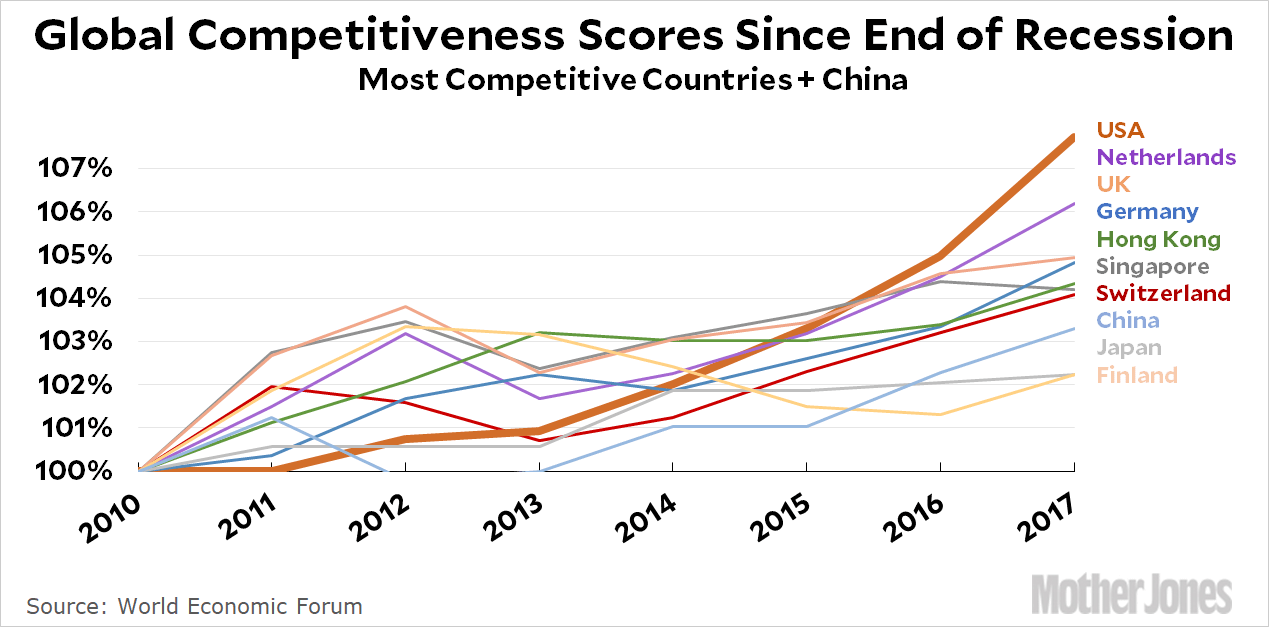
    The World Economic Forum released its latest global competitiveness scores yesterday, and the United States finished the Obama era on a strong note—coming in a very close second, only a hundredth of a point behind longtime champion Switzerland.¹ What’s more, US competitiveness has grown 7.7 percent since the end of the Great Recession, far better than any other country. Thanks Obama! This is the score to beat, Donald.

    ¹For now, I’m taking no position on whether these scores mean much. You may discuss this in comments.

  • Hillary Clinton For President!

    Mcs3 Andrew Schneider/Planet Pix via ZUMA

    Three days ago Hillary Clinton used Twitter—America’s official outlet for federal policy proposals—to suggest that President Trump send the USNS Comfort, a naval hospital ship, to Puerto Rico. This was apparently one of many things Trump hadn’t bothered to think about while he was busy lashing out at black athletes. Once there, it would join the USS Kearsarge and the USS Oak Hill, amphibious ships that have already landed Marines on the island to begin rebuilding efforts. The Washington Post reports that Clinton got results:

    Two days later, Federal Emergency Management Agency Director Brock Long announced that the Navy will soon do exactly that….It comes after days of critics saying that the U.S. government isn’t doing enough to support hurricane relief in Puerto Rico, a U.S. territory of nearly 3.5 million people that faces months without electricity and a long rebuilding process.

    ….[Clinton’s] call to action took off, with a petition on the website Change.org garnering more than 100,000 signatures in three days and critics expressing frustration with the hashtag #SendtheComfort.

    Since then, the call for the Comfort has come to symbolize something larger: A call for the Pentagon to send more.

    More food. More water. More generators. More aircraft.

    More everything.

    It kinda makes you think we should have just eliminated the middleman and elected Hillary Clinton in the first place. I’m pretty sure she could have failed to repeal Obamacare too.