Here is something to argue about. Believe me, it’s better than Donald Trump’s tweets, which are getting more unhinged almost daily.

Here is something to argue about. Believe me, it’s better than Donald Trump’s tweets, which are getting more unhinged almost daily.
So how’s the Syrian ceasefire going?
#Syria: Regime forces launched offensive on 3 axes to reduce #FSA pocket & 2 secure Khalkhalah & Marj Ruhayyil Airbases, ending #Ceasefire. pic.twitter.com/2tYBMUykE7
— Qalaat Al Mudiq (@QalaatAlMudiq) July 10, 2017
I think the regime’s official excuse is that they’re attacking ISIS, not rebels. Sure, maybe. I don’t know if this is a serious breach or not, but I imagine the ceasefire will end soon enough either way.
Tom Williams/Congressional Quarterly/Newscom via ZUMA
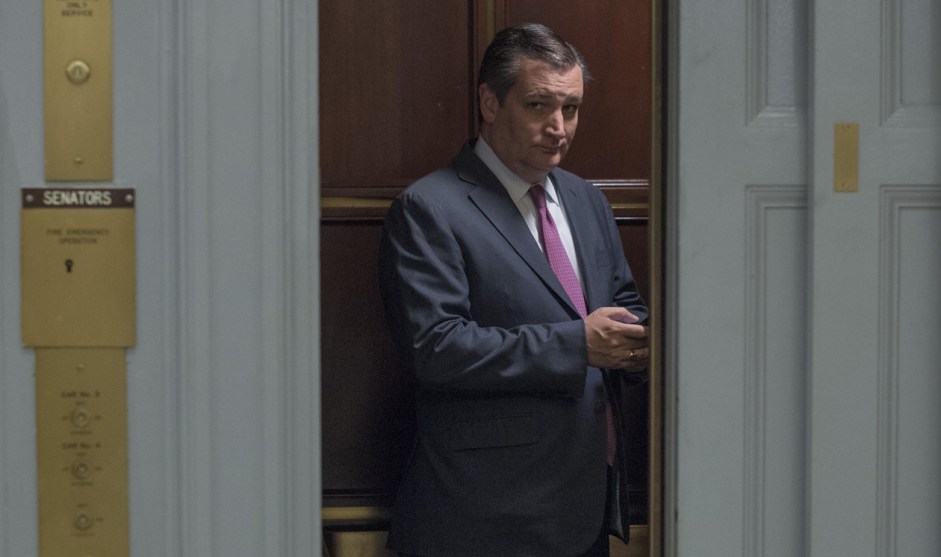
The latest health care hotness from Republicans is the Cruz Amendment. Official text hasn’t been released yet, but the basic idea is simple: it would allow states to reduce the essential benefits guaranteed by Obamacare as long as every insurer offered at least one plan that covered everything. It’s worth making clear exactly what this would accomplish.
Let’s use an extreme example to make it easy to see. Suppose an insurer offers two policies:
What happens? Nearly everyone who’s pretty healthy buys Policy A, because it’s much cheaper. Everyone who’s pregnant or over 50 or already sick has to buy Policy B, which would be astronomically expensive. And that’s the end of our example. Pretty simple, isn’t it?
If you have a pool of people who are all, almost by definition, either old or sick with expensive illnesses, premiums for that group are going to be enormous. Maybe $10,000. Maybe $20,000. In theory, the poor could still afford this since the Senate bill includes subsidies similar to Obamacare’s, but in reality these policies would have very high deductibles, making them prohibitive even for low-income workers. In other words, without actually saying that pre-existing conditions aren’t covered, the Cruz Amendment effectively means that pre-existing conditions aren’t covered.
This is not controversial. Conservatives understand it as well as liberals do.
The Cruz Amendment is one of those things that sounds like a good “compromise” to people who care only about politics. Some senators want cheap premiums. Some senators want full coverage. The Cruz Amendment has something for everyone! But to anyone who knows or cares about health care, it’s no compromise at all. It’s just something that would make a bad plan even worse without helping much of anyone.

Imago via ZUMA
Here was the big news Sunday morning:
Putin & I discussed forming an impenetrable Cyber Security unit so that election hacking, & many other negative things, will be guarded..
— Donald J. Trump (@realDonaldTrump) July 9, 2017
This is sort of like setting up a Carrot Security unit with Bugs Bunny, which is why it was almost universally mocked all day. Not in a “this is bad policy” kind of way, but in a “Donald Trump is the world’s easiest mark” kind of way. Twelve hours later Trump finally figured out that everyone was laughing at him, and the whole thing was sent unceremoniously down the memory hole:
The fact that President Putin and I discussed a Cyber Security unit doesn’t mean I think it can happen. It can’t-but a ceasefire can,& did!
— Donald J. Trump (@realDonaldTrump) July 10, 2017
It’s impenetrable! It will guard against negative things!
No, wait. It’s out of the question. Let’s talk about the Syrian ceasefire instead.
Until that goes south, of course. Then it will be time for another rant against the Fake News media. Look, Halley’s Comet!
Cheriss May/NurPhoto via ZUMA
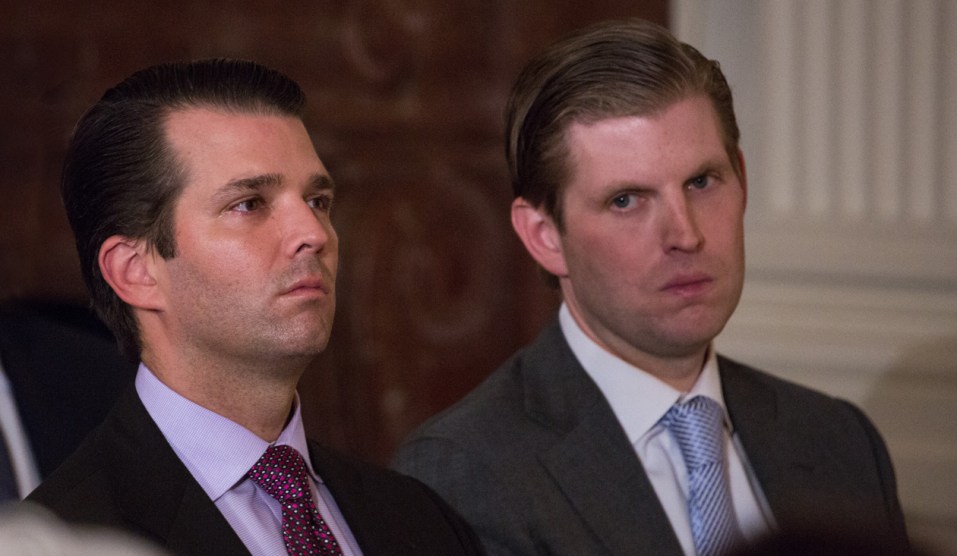
Yesterday the New York Times reported that Jared Kushner and Donald Trump Jr. met with a Russian national shortly after last year’s Republican Convention. The meeting was with Natalia Veselnitskaya, “a Russian lawyer who has connections to the Kremlin,” and it wasn’t disclosed until recently, when Kushner filed an amended version of his security clearance form. The subject of the meeting, according to Don Jr., was American adoptions of Russian babies.
That seems…unlikely, but the story nonetheless struck me as just another tiny brick in the Trump-Russia story that didn’t really add much to what we know. That changed today when the Times dished up some more details:
President Trump’s eldest son, Donald Trump Jr., was promised damaging information about Hillary Clinton before agreeing to meet with a Kremlin-connected Russian lawyer during the 2016 campaign, according to three advisers to the White House briefed on the meeting and two others with knowledge of it.
Hmmm. That’s more interesting, but it’s still based on anonymous sources who may or may not have an axe to grind. The only way we’d know for sure is if Don Jr. fessed up to it, and what are the odds of—
In a statement on Sunday, Donald Trump Jr. said he had met with the Russian lawyer at the request of an acquaintance. “After pleasantries were exchanged,” he said, “the woman stated that she had information that individuals connected to Russia were funding the Democratic National Committee and supporting Ms. Clinton. Her statements were vague, ambiguous and made no sense. No details or supporting information was provided or even offered. It quickly became clear that she had no meaningful information.”
He said she then turned the conversation to adoption of Russian children….“It became clear to me that this was the true agenda all along and that the claims of potentially helpful information were a pretext for the meeting,” Mr. Trump said.
OK then. Whether it was a pretext or not, the Trump folks really did take the meeting in hopes that a very plugged-in Russian lawyer could deliver some dirt on Hillary Clinton. This is hardly proof of collusion, but it certainly moves things a little further in that direction.
The Trump White House has been asked over and over about meetings between campaign aides and Russian nationals. This certainly counts, but they didn’t reveal it even to the government until recently, and didn’t disclose it publicly until the Times forced them to. Even then, Don Jr. insisted that the meeting was only about Russian adoptions until the Times once again forced him to admit that it had actually been arranged based on promises of Russian info about Hillary Clinton.
This kind of prevarication is what keeps this scandal going. Team Trump keeps swearing they’ve disclosed everything and there’s no there there. Then it turns out there’s something else. Then they lie about that something else until someone forces the truth out of them. This is not how innocent people act.
I’m wary of taking this too far. Hillary Clinton herself suffered during the campaign (and for years before that) from sometimes acting guilty even when she wasn’t. In the case of Clinton, I think this happened because of her profound distrust of the media. In the case of Don Jr., it could easily happen because he’s dumb enough to think he’s being clever. So it might not mean very much at all.
Still, it’s yet another part of the drip drip drip. I continue to believe there was no serious collusion between Trump and the Russians, mainly because I can’t believe anyone would be so stupid. But I admit this is not always a reliable heuristic. Plus, if there’s anyone who could be this stupid, it would be the extended Trump family.
I got nothing today. I just can’t bring myself to bother commenting on Donald Trump’s casual attitude toward Russian election hacking, especially since the reason for it is pretty obvious: It helped him win. Duh. I’m a little stumped about why this doesn’t get mentioned more frequently.
Instead, here’s a picture of the moon on Friday. We had a pinkish sunset, and that gave the moon a nice, bright, yellowish glow. Enjoy.

Bob Somerby is mad at me again. That’s nothing new, but this time it’s for saying that the only honest way to evaluate Trumpcare’s proposed Medicaid funding is by using inflation-adjusted numbers. What makes this odd is that Somerby agrees. He’s agreed about it for more than 20 years:
We first wrote about this particular type of confusion in 1995. The liberal world’s inability to settle this question with respect to the Gingrich Medicare proposal was one of the year-long gong shows which led us to start this site.
The problem, it turns out, isn’t that Somerby thinks I’m wrong, it’s that he doesn’t like the exact way I phrased it: namely that it’s a lie to say that Medicaid spending isn’t being cut in the Republican health care bill. And yet, back in 1996, when Republicans were peddling this same fiction about Newt Gingrich’s proposed Medicare cuts, he blasted them for it:
[Gingrich has] presented a profoundly misleading analysis, which has badly confused substantial segments of the public about the fundamental nature of his budget proposal….The analyst’s tool that is called “constant dollars” was devised just to deal with this kind of problem—to avoid the misunderstandings that inevitably arise in comparing budget figures from different years. By using constant dollars, or by accounting for inflation in some other way, budget analysts, every day, work to avoid the kind of confusion that Gingrich built into the misleading argument he has made over the past several years.
….When the GOP decided, in March 1995, that no one should use the term “Medicare cuts,” they were in fact creating a new micro-language, one very different from the one used before. In 1995, both parties proposed spending less in future years than it would cost to continue the existing Medicare program. This would not only mean reduced future spending; this would likely mean a reduction in services too. And this was a type of proposal that, reasonably enough, had always been described as a “cut.”
He says profoundly misleading, I say lie. Potato, potahto. But I suppose shooting wars have been started over less. In any case, that’s not really the point of this post. The point is that in his 1996 post Somerby quoted a book I’ve never read, Tell Newt to Shut Up! It’s fascinating. I always assumed that this nonsense about a cut not being a cut had just grown organically over time, but it ain’t so. It happened the same way we got “death tax” and “personal accounts” and “tax relief.” It came from a focus group and was very pointedly hammered into the media even though the GOP knew it was essentially bogus. The heroes of this story are Newt Gingrich; pollster Linda DiVall; RNC chair Haley Barbour; and House Budget Committee Chair John Kasich. Here are David Maraniss and Michael Weisskopf describing the events of early 1995, right after the Gingrich Revolution put Republicans in control of Congress. It’s worth your while to read the whole thing:
The rhetorical planning began one afternoon in March 1995, when Gingrich convened a group to discuss what words should used in the war….Everyone understood the perilous circumstances. The GOP needed to squeeze $270 billion from Medicare to fulfill its promise of a tax cut and balanced budget in seven years….But if Republicans were to succeed, revolutionary rhetoric had to replaced by soothing words that evoked stability….[DiVall] advised the group to be “leery” of the words “cut,” “cap,” and “freeze”—they would bring nothing but trouble and help Democrats define the process in negative terms.
….They spent late March and early April following up on DiVall’s presentation and trying to compile a group of words that could best impart the Medicare message. They knew that Gingrich was interested in a run of three words. He believed in the rhetorical power of threes, which had biblical connotations….The next day, Barbour met with Gingrich, who made the final call on the words….Gingrich told his communications director, Leigh Ann Metzger, “It’ll be preserve, protect, and improve.”
….As important to the Republicans as finding the right words was making sure that the press would not use the wrong ones. The ultimate wrong word was “cut.” Polls by DiVall showed that the public reacted negatively when told that Republicans would cut Medicare, but positively when informed that spending would increase but at a slower rate. “The phrase ‘spending would increase, but at a slower rate’ is literally 20% to 40% stronger than ‘reduce the rate of growth’ and certainly using the word ‘cut,’ ” a DiVall memo said.
House Republicans had already learned a lesson on cuts earlier in the session when Democrats battered them for “cutting” the popular school lunch program. After they lost that message war, when stories had appeared about hungry children and gleeful Democrats had posed for pictures holding ketchup bottles, Republicans vowed from then on they would not allow reductions in the rate of growth to be called “cuts.” From Barbour to CommStrat to committee chairmen to House members, the word went out that no statement or story using the word “cut” should go unanswered. “Don’t be school-lunched,” they warned each other. Barbour promised to raise “unshirted hell” with wayward members of the press.
To reinforce the point at a leadership meeting, Kasich threw a hat on the table and said, “The first guy who says the word ‘cuts’ has to throw a dollar in the hat.” As it turned out, Kasich was the first linguistic perpetrator. “Yeah, I threw in the first buck,” he acknowledged later. But he also pounded fiercely on the issue, calling reporters late at night or early in the morning to warn them off the dreaded word. “I worked them over,” he said. Barbour was equally vigilant. He called the anchormen at NBC and ABC and a correspondent at CBS and chided them for using the word. He held breakfasts and lunches with reporters at his conference table at the RNC to go over the difference between cuts and slowing the rate of growth.
Barbour was technically correct. Average spending per Medicare recipient in the Republican plan rose from the $4,800 to $6,700 in seven years, numbers that were etched in the mind of every Republican. But when quality of care was factored in, Democrats scored big. To provide today’s level of services seven years later would cost $8,000 per beneficiary.
….At the White House, advisers to President Clinton expressed admiration for Gingrich’s communications monolith, marveling at the way the Republicans pressured the news media to stop writing about cuts…. “Newt’s very good,” said [George] Stephanopoulos.
Newt was very good, but he still lost this battle. Bill Clinton and the Democrats continued to say that Republicans wanted to cut Medicare, and they portrayed their own cuts as cuts too. It worked. After several vetoes and a couple of government shutdowns, the final Medicare budget was much closer to Clinton’s than to Gingrich’s. In other words, using constant dollars and insisting that it’s dishonest to do otherwise won the day in 1996, and in 2017 the press remains generally willing to use constant dollars and CBO baselines as the measure of whether something is being cut. Perhaps they’re still stung by Gingrich’s obviously mendacious media hardball in 1995 and 1996.
Ironically, none of this mattered in the end. In the late 90s the economy boomed and health care inflation plummeted. By 1998 the federal budget was already in surplus and Medicare spending slowed down all by itself. A few years later this all changed when George Bush passed a couple of huge tax cuts and health care inflation bounced back. But that’s a tale for another time.
Moral of the story: Always use real, inflation-adjusted dollars when you’re comparing spending over time. Anything else is dishonest, and there’s no reason anyone should be afraid to say so.
Here’s a fascinating chart from Patrick Egan:
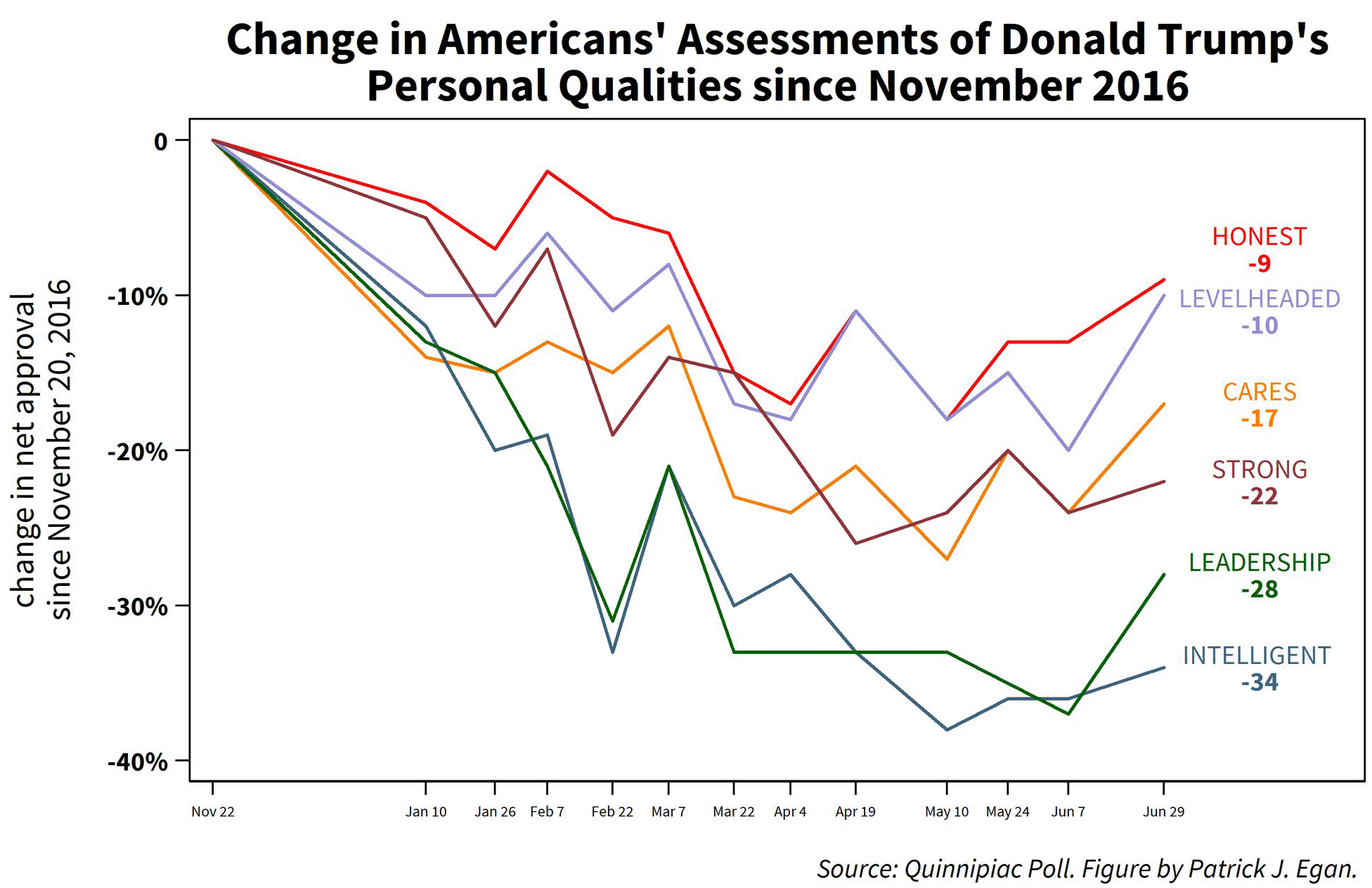
Everyone seems to have figured out that Trump is a moron, and they’re not too thrilled by his nonexistent leadership skills either. But how is it that he’s lost only a few points on honesty? He lied about his inauguration turnout. He lied about Obama wiretapping him. He lied about 3 (or 5) million votes from illegal immigrants causing him to lose the popular vote. He lied about London’s mayor because of a petty grudge. He lied (repeatedly) about saving money on an order for F-35 jets. Hell, the New York Times has a comprehensive list of hundreds of lies here.
Maybe he started from such a low base that he didn’t have very far he could fall? Ha ha. I’m just kidding. We all know the answer: Fox News. Anyone who watches Fox thinks all these things that Trump said are true. It must be nice being president in a country with a loyal state media. Just ask Vladimir Putin and Silvio Berlusconi.
Via Axios, here is some polling research from MIT professor Chris Warshaw about the popularity of major legislation passed or proposed since 1990:
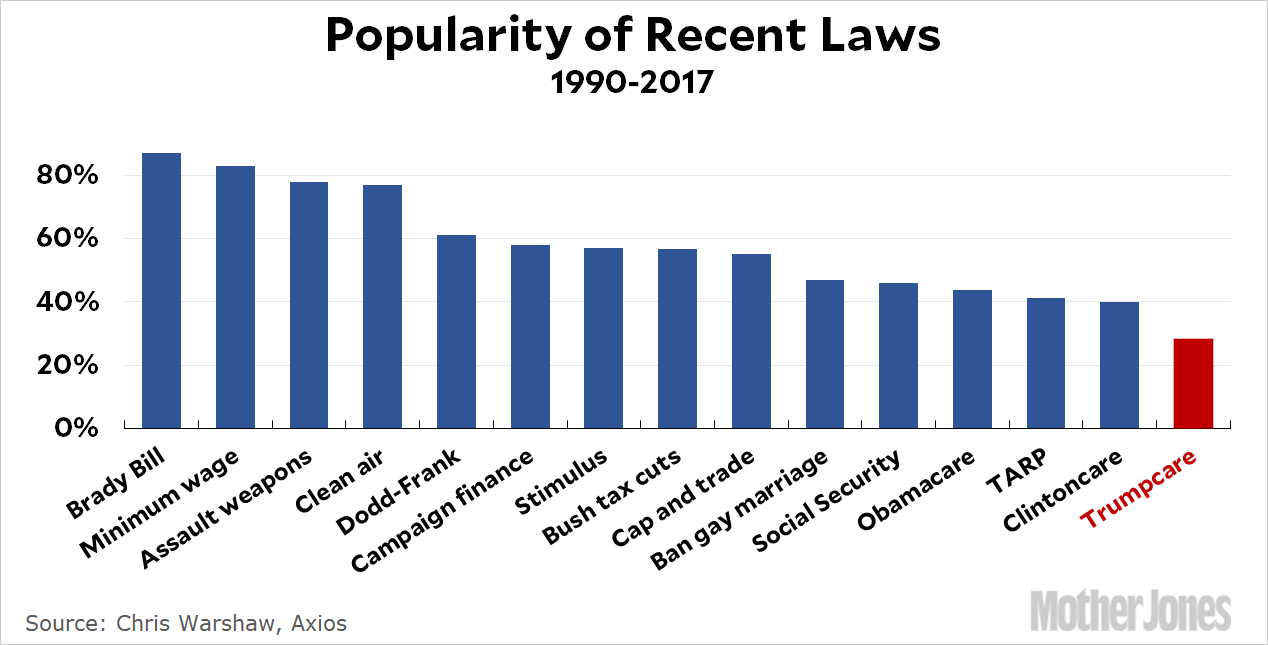
TARP and Clintoncare were two of the most reviled pieces of legislation in the past three decades. Trumpcare has them beat handily. Will Republicans really vote for a bill that even most Republicans aren’t very happy with? They might. Stay tuned.
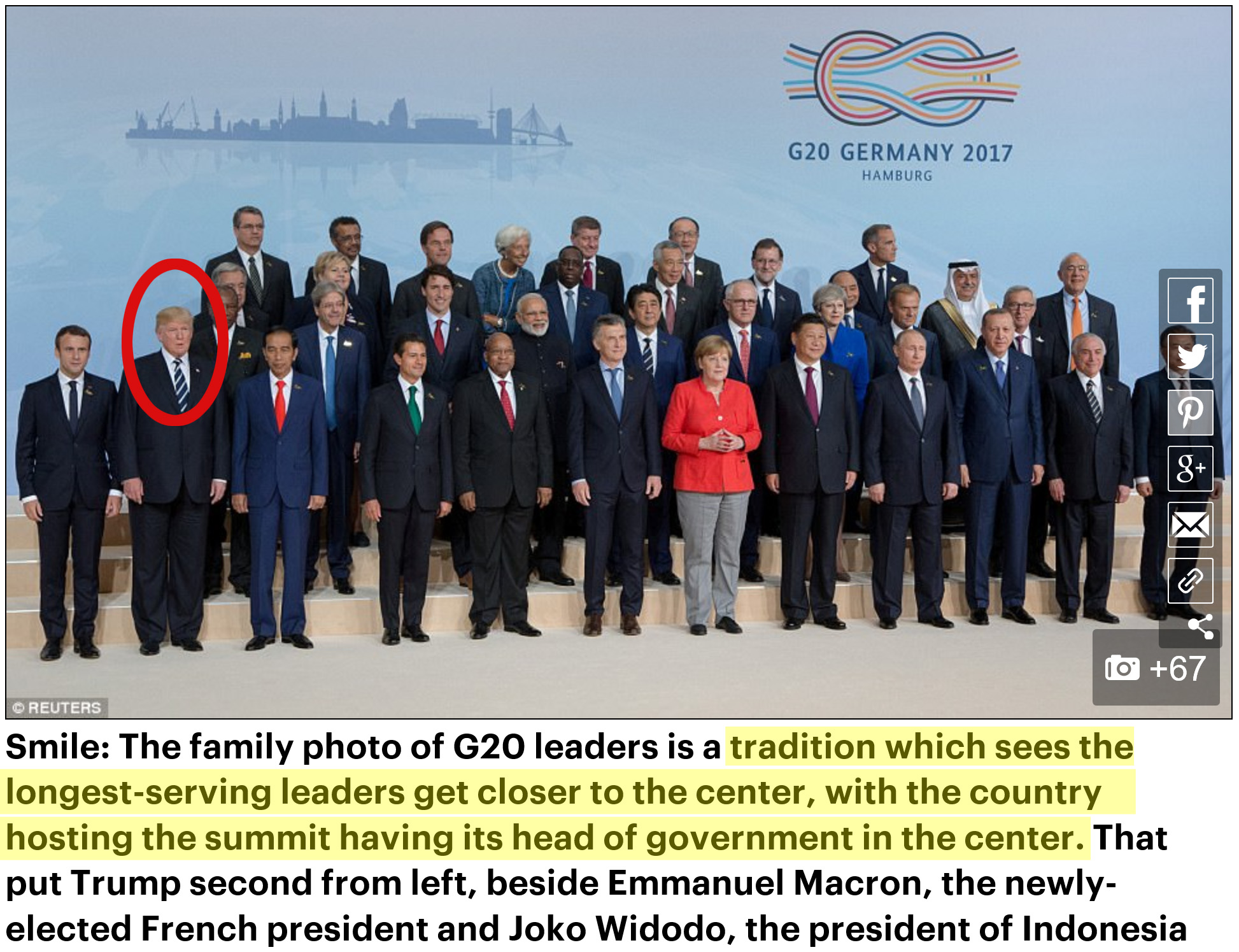
Before everyone starts cackling too much over Donald Trump’s exile to the lonely hinterlands of today’s G20 family portrait, keep in mind that the same thing happened to Obama in 2009. I’ll let the Daily Mail explain:
On the other hand, we’ll always have this:
A perfect metaphor of the United States right now. pic.twitter.com/hyotCHn4Zu
— shauna (@goldengateblond) July 7, 2017

Award-winning photojournalism.
Stunning video. Fearless conversations.


