• How Should Liberals Fight a Citizenship Question on the Census?

    Let’s suppose, as seems likely, that the Supreme Court lets Donald Trump go ahead with adding an obviously partisan citizenship question to the 2020 census. How should liberals react?

    • Mount a big educational campaign telling undocumented workers not to be afraid of telling census takers that they aren’t citizens.
    • Mount a big educational campaign telling undocumented workers to just go ahead and lie about being citizens.

    This is what makes the cynicism of modern conservatism so toxic. The best bet for liberals is almost certainly the second one, but that merely fights cynicism toward governance with yet more cynicism. When does it end?

  • How Much Do Teachers Earn?

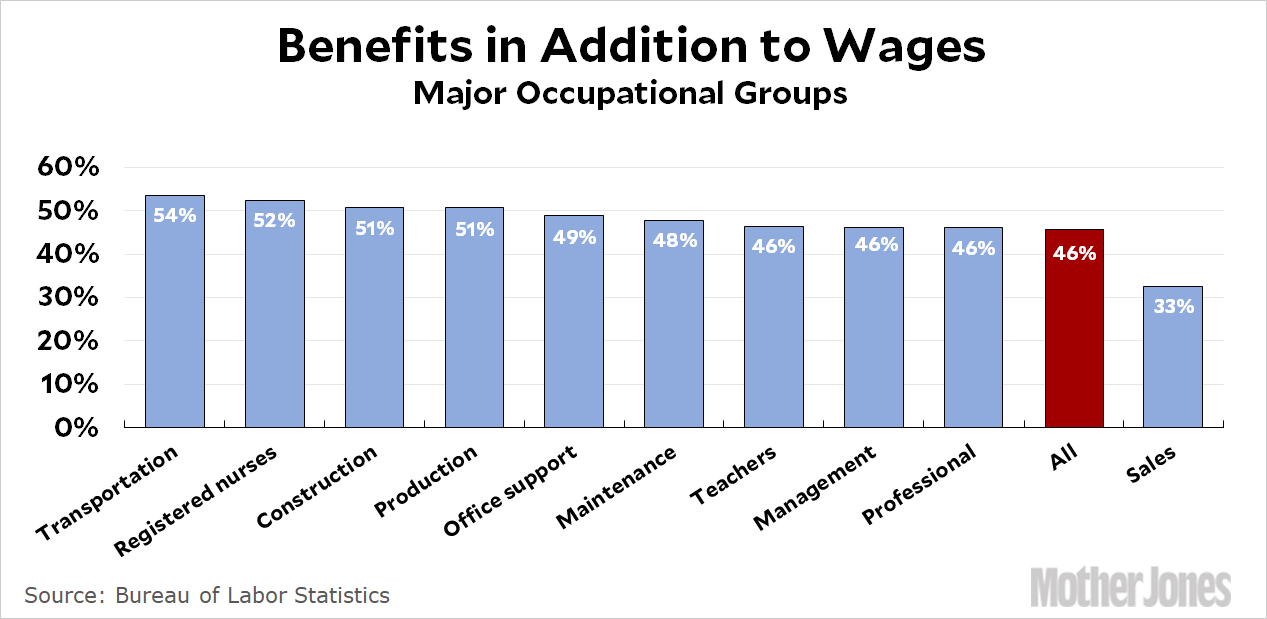
    How much are we all paid? More than you think! This chart shows how much we earn in benefits as a percentage of our cash wages. These are the ten major occupational groupings defined by the Bureau of Labor Statistics:

    The BLS provides average annual earnings for a wide variety of jobs here. All we have to do is add in the benefits based on which occupational group each job belongs to. This gives us a pretty close estimate of the total compensation for each job:

    You’ll occasionally be surprised by someone claiming that, say, the average teacher makes more than $90,000. But this true only if you’re talking about total compensation, which includes Social Security payments, health coverage, retirement contributions, vacation time, and so forth. There’s nothing wrong with talking about total comp, but only if you also provide some clear context for comparison. The average middle-school teacher does indeed earn $90,000 all-in—which sounds surprisingly high until you realize that by the same metric, programmers earn $150,000, registered nurses earn $115,000, loan officers earn $110,000, and plumbers earn $87,000. Most people don’t know that unless you point it out.

  • Most of Us Don’t Work More Than 40 Hours a Week

    Back when I worked in an office, it seemed like standard practice to claim long working hours. I was always pretty skeptical about that. When I came into the office an hour early, it was a morgue. If I left an hour late, it was a morgue. There just weren’t many people working substantially more than eight hours a day.

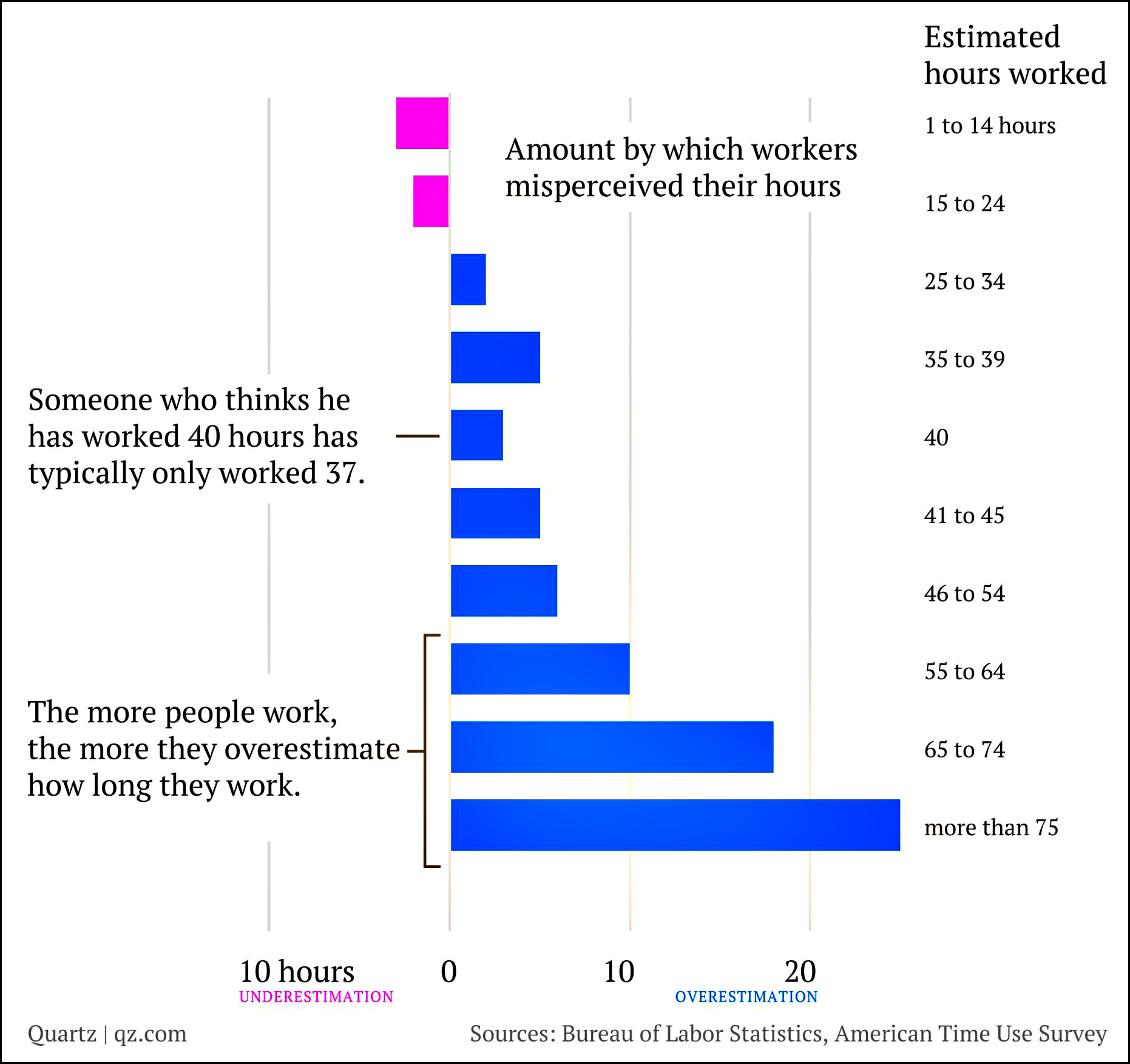
    Today I ran across an old article on Quartz that confirmed my skepticism. Apparently people routinely exaggerate the number of hours they work:

    So if someone says they work 50 hours a week, it’s probably more like 45. And that makes sense to me. I rarely saw people working an extra two hours per day for a full week, but an extra hour? Sure, maybe.

    So are people just mistaken about their work hours, or are they lying? My guess is that it’s mostly just misperception. If you’re tired and eager to get home, even an extra half hour can feel like you’re really putting your shoulder to the grindstone. Half an hour at both ends—especially if it means fussing around with childcare and eating schedules—can seem like an ordeal. So it feels like a lot of hours, even if it’s really not that much.

    Now, I’m not talking here about the freaks in Silicon Valley or Wall Street with cots in their offices. I just mean ordinary folks. Most of us probably don’t work as much as we think.

  • Lunchtime Photo

    And now for something completely different, here’s a picture of the Goodyear blimp. I took this photo out the car door window while I was speeding by on the 405 a few months ago.

    Technically, this is a “semi-rigid airship,” not a true blimp, but I think even Goodyear has given up fighting about this. If everyone calls it a blimp, then it’s a blimp.

    December 15, 2019 — Carson, California
  • We Have an Income Crisis, Not a Housing Crisis

    The New York Times reports that high rent is becoming a serious campaign issue:

    Renters hold little sway in Washington. They vote at lower rates than homeowners. They’re generally represented in Congress by homeowners. They have no deep-pocketed lobbyists. And their problems, if anyone considers them at all, are typically waved off as problems for local government.

    It’s striking, then, that several Democratic candidates for president are now approaching renters in a way they’ve seldom been treated before — as a voting bloc. Elizabeth Warren, Cory Booker and Kamala Harris, senators from some of the most expensive housing markets in the country, have proposed substantial bills to alleviate the housing crisis. They’re not talking in gauzy terms about homeownership, the rare housing topic that usually gets a nod. They see unsustainable, raw-deal, skyrocketing rents, and they’re not hesitant to sermonize about it.

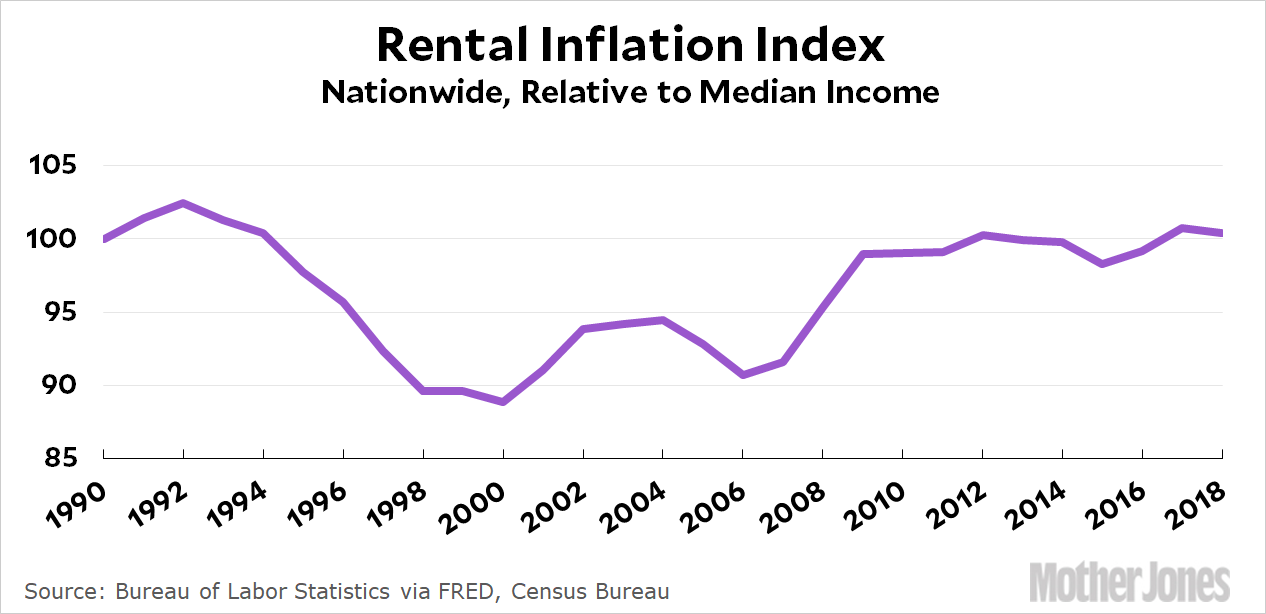
    You might be tired of me going on and on about this, but here’s one more go at it. Please read to the end before you get mad at me. First, here’s the inflation index for rents since 1990, adjusted for median income:

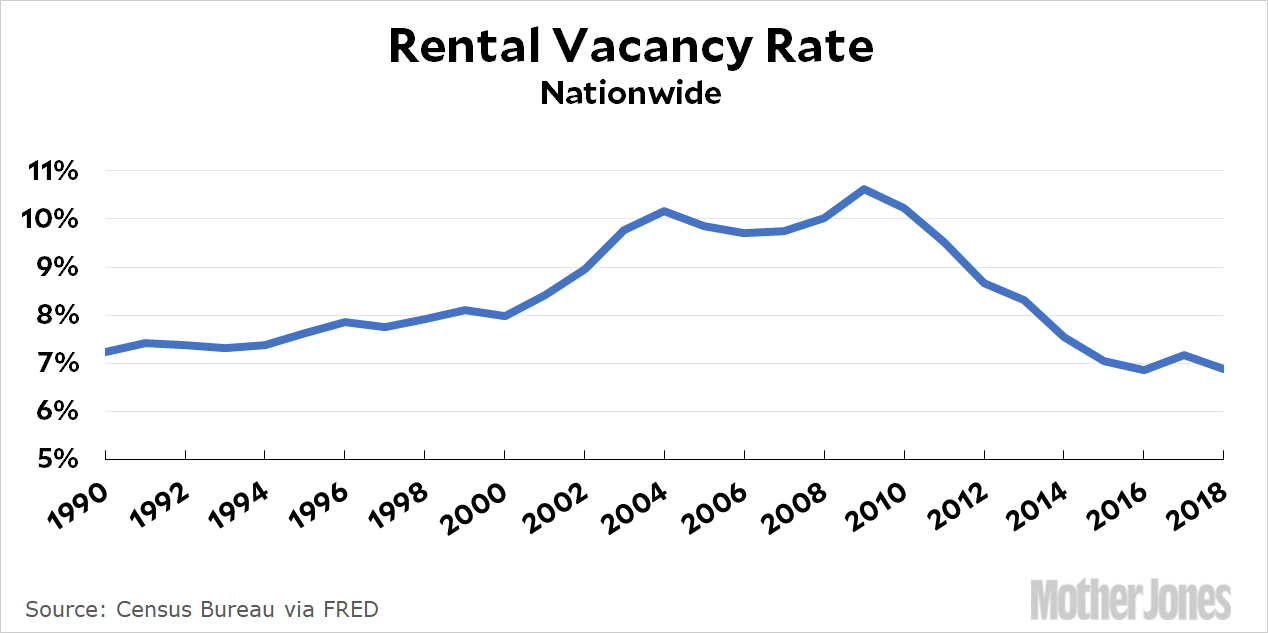
    There’s nothing there. Now here’s the rental vacancy rate:

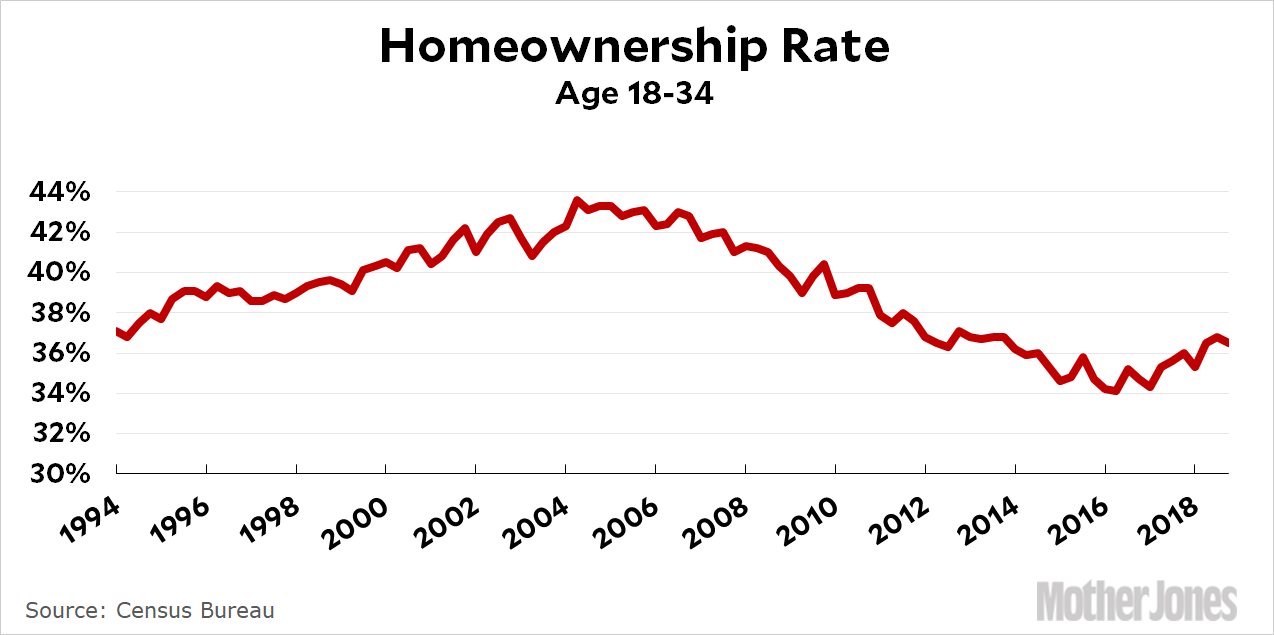
    The rental market doesn’t look especially tight. Following the housing bubble and the Great Recession, it’s now puttering along at about the same rate as in 1990. Here’s the homeownership rate for young households:

    This isn’t directly related to rents, but it does suggest that young families are renting and owning at roughly the same rate as they did in the mid-90s. Homeownership rates are a little lower than they were in 1994, but not a lot.

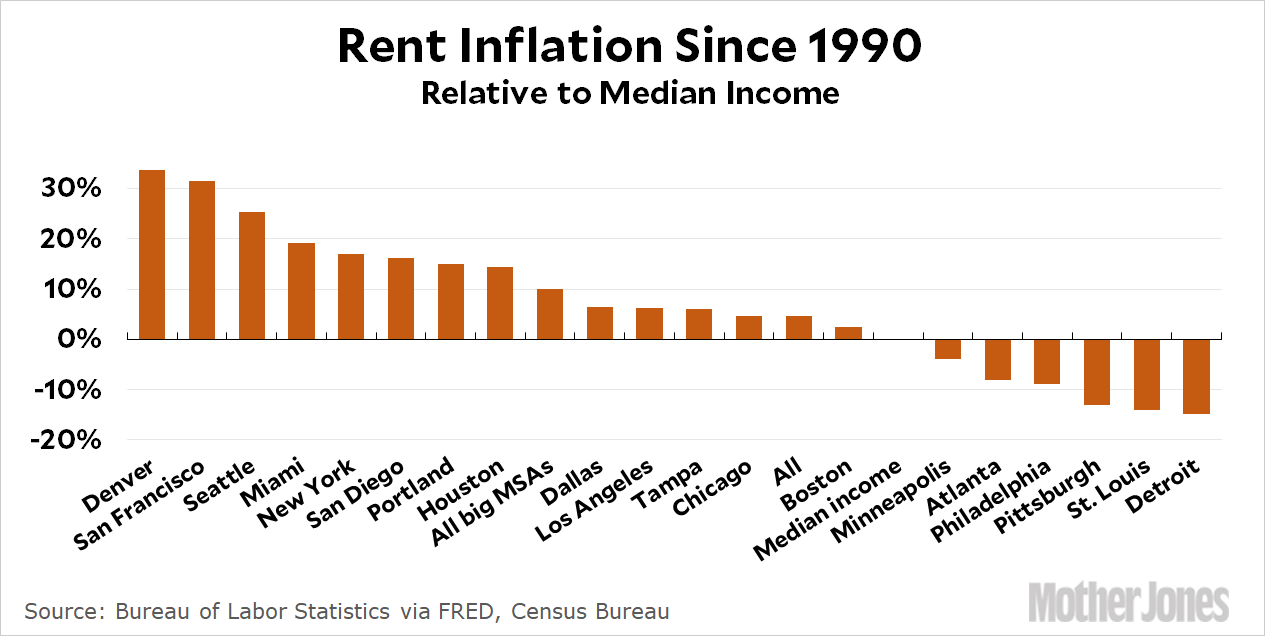
    All of this, of course, is nationwide data. What you really want to know is what rents look like in big cities. Here you go:

    There’s no question that rent has gone up substantially in some cities. And this data is for MSAs, which usually include the surrounding suburbs. If you want to live in Manhattan or downtown Seattle, rent inflation has probably been higher than this chart shows. Still, there are only six MSAs where rents have gone up more than 15 percent relative to the rise in incomes. And that probably overstates the problem since median incomes are higher in cities.¹

    The bottom line is that there isn’t any kind of nationwide rental or housing crisis. There’s a problem in six areas: Denver, San Francisco, Seattle, Miami, New York, and San Diego. And there’s probably a crisis in several downtown city areas—assuming that you consider it a crisis to be unable to live downtown even though you’d like to.

    It’s hard for me to see this as the problem that a lot of people make it out to be. And even if it is, I’d say the real crisis is income, not housing. Even the high-priced cities would be less of a problem if incomes hadn’t been stagnant since the year 2000—and actually down for young people. If we figure out how to solve the income problem, we’d solve a whole lot of other problems at the same time. Including the housing crisis.

    ¹I wish I could get data for median income by MSA, but I’ve never been able to find it in any kind of reliable and consistent form. Still, even if I could get it I’d be stuck with a chicken-and-egg problem anyway. Are incomes higher in cities because cities are more economicallly prosperous? Or because only affluent people can afford to live in big cities? There’s not really any way to tease this out.

  • Supreme Court Looks Ready to Support Republicans Yet Again

    Brian Cahn/ZUMA

    In oral hearings yesterday, the Supreme Court’s five conservatives made it pretty clear that they intend to allow Commerce Secretary Wilbur Ross to add a question about citizenship to the 2020 census. One of Josh Marshall’s readers offers a pointed and largely correct explanation of why this is so bad:

    Everyone knows that in the census case Ross “papered” a rationale to justify a decision made for other reasons. But the Court can overturn the decision without finding that he lied — simply by holding that it was arbitrary and capricious to sacrifice the accuracy of the count to obtain citizenship data that could be obtained (at least as accurately, and perhaps more accurately) through administrative records without adding a question to the census. That seems a pretty reasonable holding given that the Constitution itself focuses on an accurate count of the whole population.

    But if the Court goes the other way, it is truly an “emperor has no clothes” opinion. The Court will uphold the reasonableness of Ross’s “determination” even though everyone knows those were not his real reasons — in other words, basing its ruling on what everyone knows to be a fictional story, concocted to pass judicial muster. If the Court is willing to tolerate that, what won’t it tolerate?

    And then there are the plainly partisan consequences of the ruling. Combine it with the almost-certain rejection of constitutional challenges to gerrymandering, and other election-related decisions and everything points in the same direction — entrenchment of Republican power to resist the forces of demographic change.

    Ross lied initially about the citizenship question, saying it had been requested by the Justice Department even though it hadn’t been. Then he badgered DOJ into requesting it. Then he finally asked his own census experts to weigh in, and they said pretty clearly that they could get better data and a more accurate count without the citizenship question. However, they couldn’t be absolutely, positively, 100 percent sure of that, and that was enough for Ross to hang his hat on. If there was even a 1 percent chance of the citizenship question producing better data, then by God, the census would have a citizenship question.

    In the end, I suspect this will have less impact than liberals fear—partly because the nonpartisan wonks who just want an accurate count will figure out a way to get an accurate count. But Marshall’s reader is right: the evidence against Ross is pretty clear, and everyone knows exactly why he wants a citizenship question on the census. The hope is that undocumented residents will be afraid to talk with census takers, which will result in an undercount in states with a lot of undocumented residents. These are mostly blue states, so perhaps they’ll lose a seat or three in the 2020 redistricting? It’s worth a shot!

    Republicans know that they’re in a demographic death spiral, so they’ve been doing their best to nickel-and-dime additional votes over the past decade. They’ve tried voter ID laws, gerrymandering, targeting of black voters, and now the census. In every case, the Republican majority on the Supreme Court has taken their side. It’s hard to think of a series of cases that could more clearly demonstrate that Republicans on the Supreme Court are naked partisans when it comes to voting issues, but they don’t seem to care. This is why Mitch McConnell broke the Senate in order to get another Republican on the court, and it looks likely to pay off yet again.

  • Thanks to Donald Trump, Washing Machines Cost 12% More This Year

    "And if you buy now, we'll only charge you 12 percent more than we did last year!"Gene Blevins/ZUMA

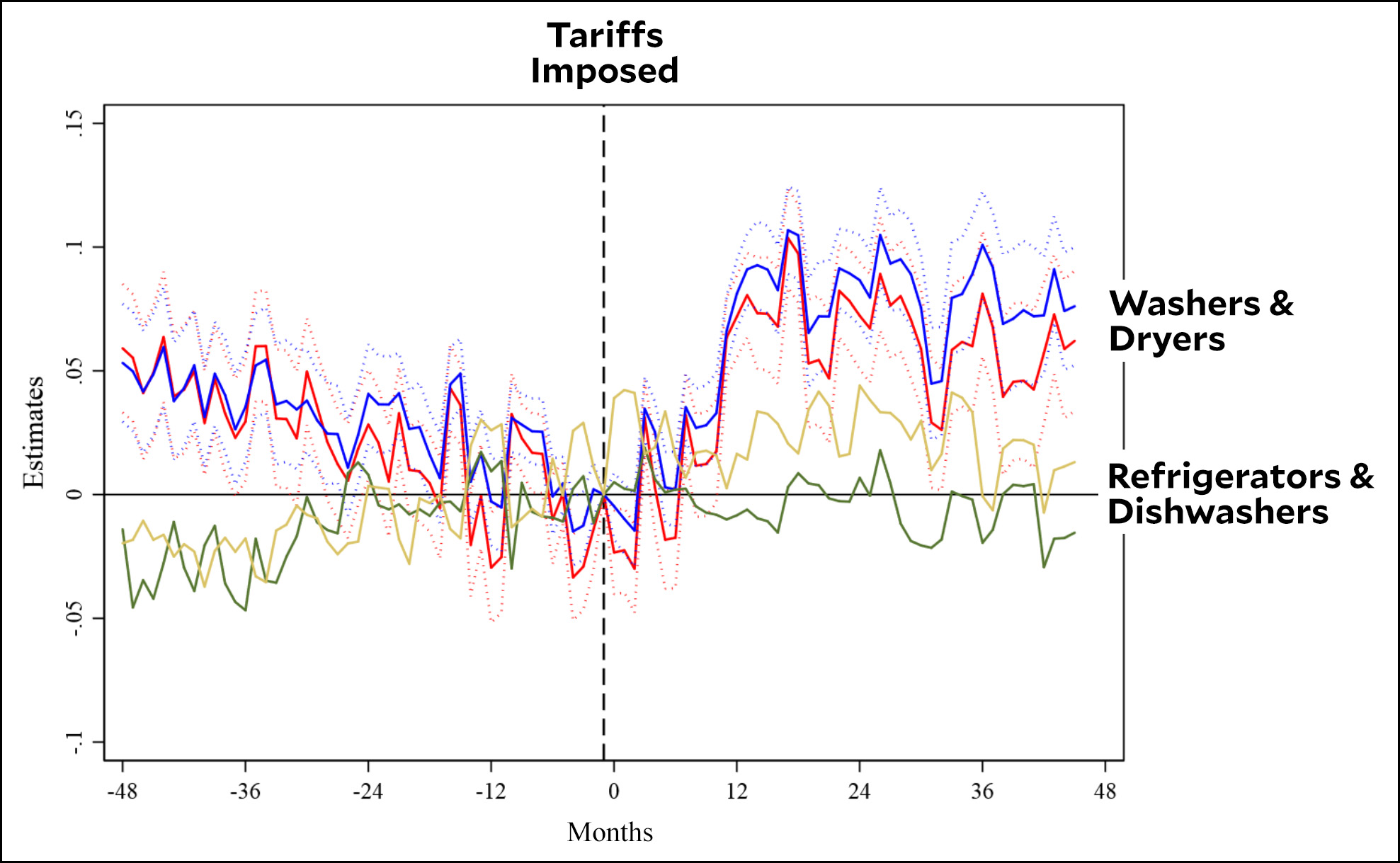
    Via Jim Tankersley, here’s a chart that shows what happened to the price of appliances after President Trump imposed tariffs on Chinese-made washing machines:

    The response of appliance manufacturers was simple: freed of competition from China, they raised the price of both washers and dryers (which are typically purchased together). Conversely, the price of refrigerators and dishwashers, which weren’t affected by the tariffs, stayed roughly the same.

    This comes from a paper written by Aaron Flaaen, Ali Hortaçsu, and Felix Tintelno, which you can read here. The authors calculate that manufacturers raised the price of washers and dryers sold in America by about 12 percent, which represents $1.5 billion in extra costs paid by consumers.

    Were there benefits? The authors estimate that the tariffs produced about 1,800 new jobs—and that’s it, since there’s no indication that factory wages increased. The vast majority of this extra money is additional profit since most of the washers and dryers would have been sold anyway regardless of Trump’s tariffs, but at a lower price. At a bare minimum, you can figure that (a) consumers paid 12 percent more for their washers and dryers and (b) manufacturers—most of whom are based overseas—raked in more than $1 billion in extra profits. In return, 1,800 Americans got new jobs.

    Your mileage may vary, but this sure doesn’t seem like a very shrewd deal to me.

  • Lunchtime Photo

    This is a great horned owl at the Orange County Zoo. I also have a photo of another, smaller owl, but I’m not sure if it’s a different kind of owl or just a juvenile great horned owl. I’ll let the hivemind decide someday.

    A question for bird people: are bird names capitalized or not? A quick Google search suggests that ornithologists capitalize bird names—or at least the first letter, anyway—but everyone else just uses lower case. Is this right? And where does it leave me?

    April 6, 2019 — OC Zoo, Orange County, California
  • Donald Trump Is Digging In For a Long Twilight Struggle

    Greg Sargent sums things up:

    In the past day or so, President Trump and the White House have instructed a former official not to comply with a House subpoena as part of an investigation into the dubious handling of security clearances. They’ve launched an unusual lawsuit to block House Democrats from accessing his finances. And they’re preparing to refuse to turn over his tax returns, which will likely violate the law.

    Plainly, Trump is determined to treat any and all oversight as illegitimate — even though this is a core institutional function of Congress — with the goal of keeping his seemingly bottomless corruption shielded from public view.

    This is obviously all a delaying game. It doesn’t matter if Trump wins these battles as long as they take more than a year to play out. In the meantime, it’s obvious that Trump is hellbent on preventing any oversight of his presidency at least until Election Day next year. After that, Democrats can do anything they want and it won’t matter. If Trump loses, then Democrats will stop on their own accord. If he wins, he’s safe from everything since Republicans will never agree to impeach him even if he shoots someone on Fifth Avenue.

  • What Does Ross Douthat Really Think?

    Ross Douthat says the terrorists who bombed churches in Sri Lanka over the weekend believe that “Western Christianity and Western liberal individualism are the conjoined enemies of their longed-for religious utopia….Tourists and missionaries, Coca-Cola and the Catholic Church — it’s all the same invading Christian enemy, different brand names for the same old crusade.” Perhaps so, but Douthat also says—well, I’m not quite sure what he says. I’ll just let you read it for yourself:

    [There is] a way in which liberal discourse in the West implicitly accepts part of the terrorists’ premise — by treating Christianity as a cultural possession of contemporary liberalism, a particularly Western religious inheritance that even those who no longer really believe have a special obligation to remake and reform. With one hand elite liberalism seeks to keep Christianity at arm’s length, to reject any specifically Christian identity for the society it aims to rule — but with the other it treats Christianity as something that really exists only in relationship to its own secularized humanitarianism, either as a tamed and therefore useful chaplaincy or as an embarrassing, in-need-of-correction uncle.

    I’ve read this several times, and I still can’t quite figure out what he’s trying to say. This happens a lot when I read pieces by Christian apologists. They twist and turn and wrap themselves into pretzels so much that, in the end, I’m never quite sure precisely what their point is. I wish they’d just come out and say it, whatever it is.¹

    In this case, my best guess is that Douthat believes that (a) liberals are mostly agnostics who reject a Christian identity and (b) liberals also dislike full-throated Christianity and would like Christians to tone things down and do their praying quietly. If I have this right—and I’m not at all sure I do—then there’s supposed to be some kind of tension between these two views. But I’m not sure what it is.

    In the end, I guess this is really his main point:

    One of the basic facts of contemporary religious history is that Christians around the world are persecuted on an extraordinary scale — by mobs and pogroms in India, jihadists and United States-allied governments in the Muslim world, secular totalitarians in China and North Korea. Yet as an era-defining reality rather than an episodic phenomenon this reality is barely visible in the Western media, and rarely called by name and addressed head-on by Western governments and humanitarian institutions. (“Islamophobia” looms large; talk of “Christophobia” is almost nonexistent.)

    Hmmm. I don’t think we should count China or North Korea since they’re obviously equal-opportunity persecutors. As for India, Muslim-Hindu violence massively outweighs violence against Christians. That leaves only the Islamic world, where there’s little question that Christians are persecuted de jure in ways that virtually no Western nation persecutes Muslims. In the end, then, what we’re left with on the Christian persecution front is that many Muslim-majority countries are theocracies that prohibit the practice of any other religion, while the secular West generally allows substantial amounts of freedom to all religious sects.

    Douthat thinks liberals are unwilling to talk much about this, and perhaps he’s right. Jihadists certainly see the world in apocalyptic Muslim-Christian terms, and it strikes me as unwise to help them along by agreeing with them. I would very much like to see Saudi Arabia and Iran and all their poisonous progeny become modern secular states, and the best way to make this happen is probably not to encourage their current worldview by playing a role in their clash-of-civilizations game. If this makes me a typical atheist liberal mushball, so be it.

    Speaking for myself, I dislike all organized religions, but only to the extent that they do things in the real world that I dislike. I don’t like Islam in the Middle East because it tends to have hateful views toward women, gays, Christians, and anything else that a bunch of old men have decided violates the teachings of the Koran. I don’t like evangelical Christianity in my own country because it opposes abortion, gay marriage, contraceptives, and lots of other things that a bunch of old men have decided violates the teachings of the Bible. I probably have issues with Hindus and Buddhists too, but they’re mostly far away and don’t bother me too much.

    And that’s that. I’m a secular humanist—what else could a secular person be?—but I don’t object to other people having different beliefs. I just wish you’d all calm down and leave everyone else alone. Sadly, that’s not likely to happen anytime soon.

    ¹I run into this problem myself, almost always when I’m trying too hard to make sure I don’t offend anyone. Eventually I’ve tap-danced and acknowledged exceptions and just generally nuanced myself into incomprehensibility. It’s always a good idea to account for other people’s views and to avoid gratuitously offending them, but it’s not so good to be bullied into being too scared to say what you think.