• The Feds Should Quietly Allow Colorado and Washington to Experiment with Marijuana Legalization

    Colorado and Washington both passed ballot measures legalizing marijuana in last week’s election, and in both cases the new laws include product-labeling requirements, a ban on sale to minors, and substantial taxes. Mark Kleiman, co-author of Marijuana Legalization: What Everyone Needs to Know, says he’d like to know how this kind of a regulatory regime works out, and all the studies in the world won’t tell us. You just have to try it and find out what happens. So he hopes that President Obama will quietly allow the two states to give it a try:

    The federal government could shut down both of those experiments, if it were determined to do so….But it would make it impossible to learn anything useful from the Colorado and Washington experiments.

    So why shouldn’t the federal government cut Colorado and Washington some slack? As long as those states prevent marijuana grown under their laws from crossing state lines and thereby subverting marijuana prohibition in the rest of the states, the Justice Department could step back and let the consequences of the new policies play themselves out. They might succeed, or they might fail. In either case, the rest of us could learn from their experience.

    I doubt that either state can effectively prevent locally-grown marijuana from crossing state lines, but hell, they can’t prevent it now either. So I’m with Mark: there’s no need to announce any public change of policy, but Obama should tell DEA to lie low for a while and see how Colorado and Washington do. A controlled experiment like this is the best way of finding out the effect of full legalization of marijuana. Does it lead to higher consumption? Is it a gateway drug? Will it reduce consumption of alcohol?

    Three years ago, in a story given the most peculiar headline ever by my editors, I predicted that the answers would be (a) yes, moderately; (b) no; and (c) quite possibly. And since substitution of alcohol consumption with marijuana use would probably be a net positive, it’s well worth a try.

    I also predicted this would take a while: “Ten years from now,” I concluded, “as the flower power generation enters its 70s, you might finally be able to smoke a fully legal, taxed, and regulated joint.” If the feds agree to back off, I will have been seven years off. At least for some of us.
  • The Democrats’ Southern White Problem

    One of the key takeaways from the 2012 election is the fact that President Obama did well among blacks, Hispanics, and Asians, but poorly among whites. According to the national exit polls, Obama won only 39 percent of the white vote. That compares to 43 percent in 2008 and 41 percent for John Kerry in 2004.
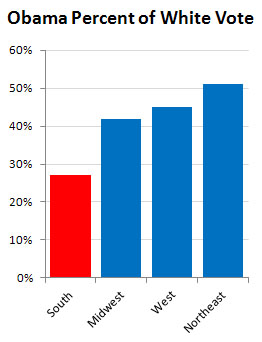
    But that’s misleading. I don’t have access to the internals of the exit polls, but Pew did a survey shortly before the election that showed Obama winning by three percentage points. This is pretty close to the final result, so their detailed breakdowns are probably pretty accurate too. So what do they say about the white vote? Here it is in colorful bar chart format.

    One of these bars is not like the other. Obviously Democrats could stand to do better with white voters in the West and Midwest, but the real reason for their poor national showing among whites is the South. Overall, Obama won about 46 percent of the white vote outside the South and 27 percent of the white vote in the South. That’s a difference of nearly 20 points. In other words: Democrats don’t have a white problem. They have a Southern white problem, and that’s a whole different thing. The press should be more careful about how they report this.

  • Fear of Obamacare Plummets After Election

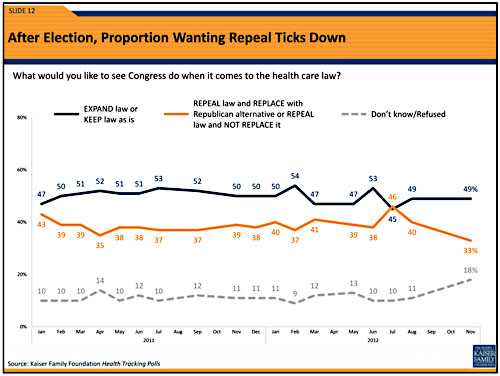
    Sarah Kliff—who really should be working the fiscal cliff beat, no?—highlights an interesting survey result today. In its latest healthcare tracking poll, the Kaiser Family Foundation finds that 49 percent of the public wants to keep or expand Obamacare, while 33 percent want to repeal it. This is down considerably from August (the most recent previous poll), when 40 percent of the public wanted to repeal Obamacare. Likewise, overall unfavorability ratings are also down, from 43 percent to 39 percent.

    As the chart below shows, this mostly happened all at once. The sentiment for repeal stayed pretty steady at around 40 percent for two solid years, and then suddenly dropped right after the election. The mere fact that Obama won, and therefore Obamacare was here to stay, apparently changed a lot of minds. Elections really do have consequences.

  • It’s Time for the Republican Freakout Over Susan Rice to Stop

    The Washington Post, in a piece about how President Obama’s national security team is likely to shake out in the wake of David Petraeus’s departure and the expected resignation of Hillary Clinton, says that Susan Rice is his top pick to take over the State Department. But there might be trouble brewing:

    Rice, one of an inner circle of aides who have been with Obama since his first presidential campaign in 2007, is under particular fire over the Benghazi incident, in which U.S. Ambassador J. Christopher Stevens and three other Americans were killed.

    Some Republican lawmakers have suggested that she was part of what they suspect was an initial election-related attempt to portray the attack as a peaceful demonstration that turned violent, rather than what the administration now acknowledges was an organized terrorist assault.

    Rice’s description, days after the attack, of a protest gone wrong indicated that she either intentionally misled the country or was incompetent, Sen. Lindsey O. Graham (R-S.C.) said Sunday. Rice, he said, “would have an incredibly difficult time” winning Senate confirmation as secretary of state.

    But several White House officials said Obama is prepared to dig in his heels over her nomination to replace Hillary Rodham Clinton, who has long said she will serve only one term.

    I hope Obama does dig in his heels over this if he really thinks Rice is the right person for the job. The Republican freakout over Benghazi has been shameful, and their insane scapegoating of Rice’s appearances on the Sunday chat shows a week after the attacks has been doubly so. Republicans—aided and abetted at times by reports in the mainstream media—decided to pretend that Rice had blamed the Benghazi attack entirely on a YouTube video, which they took as dark evidence of a coverup designed to protect Obama. But the truth is that Rice flatly did nothing wrong, a point that bears repeating. She did nothing wrong. Here’s an instant replay of what happened, which I originally posted three weeks ago:

    • The CIA’s collective judgment on Saturday the 15th, when Rice taped her interviews, was that the protests earlier in the week in Cairo — which had been inspired by the video — had also inspired protests in Benghazi. Later, extremist elements hijacked those protests to storm the consulate. The CIA subsequently backed off its belief that there had been protests in Benghazi, but that only happened later. On Saturday, the CIA told Rice there had been protests, and that’s what she said on TV.
    • The evidence to this day suggests that, in fact, the YouTube video did play a role in the attacks. It’s simply not true that Rice invented or exaggerated about that.
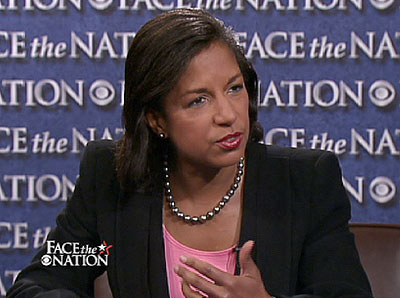
    • Rice was, in fact, properly cautious in her TV appearances. The transcripts here are crystal clear. On Face the Nation, for example, she carefully told Bob Schieffer that she couldn’t yet offer any “definitive conclusions,” but that “based on the best information we have to date” it appeared that there had been a spontaneous protest in Benghazi “as a reaction to what had transpired some hours earlier in Cairo where […] there was a violent protest outside of our embassy sparked by this hateful video.” She then immediately added: “But soon after that spontaneous protest began outside of our consulate in Benghazi, we believe that it looks like extremist elements, individuals, joined in that effort with heavy weapons of the sort that are, unfortunately, readily now available in Libya post-revolution. And that it spun from there into something much, much more violent.” When Schieffer pressed her on whether the attack had been preplanned, or whether al-Qaeda was involved, she said directly that we simply didn’t know yet.

    Graham and the rest of the Republican caucus appear to still be in election season attack dog mode, and it’s time for this to stop. They have every right to investigate Benghazi, which might very well have been handled poorly in some respects and which might have been a case of poor anticipation of an attack that should have been expected. But Rice’s conduct was fine. She very carefully, and very professionally, passed along what was, at the time, the considered judgment of the intelligence community. Some of it was wrong, but there was no coverup. There was just new information and new analysis over time, which is exactly what you’d expect following an incident like this. It’s long past time for conservatives to acknowledge this.

  • The FBI Can Trawl Through Your Email Archives Anytime it Wants


    Here’s a surveillance state factlet that I think I knew at one point, but have since forgotten:

    Under the 1986 Electronic Communications Privacy Act, federal authorities need only a subpoena approved by a federal prosecutor — not a judge — to obtain electronic messages that are six months old or older. To get more recent communications, a warrant from a judge is required. This is a higher standard that requires proof of probable cause that a crime is being committed.

    ….The chairman of the Senate Judiciary Committee, Patrick Leahy, has proposed changing the law to require a warrant for all Internet communications regardless of their age. But law enforcement officials have resisted because they said it would undercut their ability to catch criminals.

    As it happens, news reports suggest that the FBI did indeed get a warrant in order to trawl through the emails from Paula Broadwell and David Petraeus that are at the center of the current FBI/CIA scandal. But that shouldn’t change anything. The six-month rule simply has no reasonable basis. The FBI needs a warrant to look through my physical belongings regardless of how old they are, and that’s how it should be. Email shouldn’t be any different.

    UPDATE: Julian Sanchez tweets some additional context: “Technically accurate but misleading: Subpoena for e-mail ALWAYS requires prior notice to user, opportunity to quash….For access without notice, judicial order always acquired—though not necessarily a probable-cause warrant.”

    UPDATE 2: Never mind. Julian Sanchez tweets again to say prior notice isn’t required after all: “I was mistaken. The provision is confusingly framed, with “delayed notice” attatched to the “court order” subsection….But on a second look, 2705 allows delay for either orders or subpoenas. Embarrassing goof on my part; apologies….Though my understanding is that many providers will balk at turning over contents in response to a subpoena.”

  • How the CIA Became the 6th Branch of the Military

    Robert Wright, in an obvious effort to use Petraeusgate to draw attention to a boring subject that has nothing to do with sex, says the real scandal here isn’t Petraeus leaving the CIA, it’s the fact that he arrived there in the first place:

    When, in the fall of 2011, David Petraeus moved from commanding the Afghanistan war effort to commanding the CIA, it was a disturbingly natural transition. I say “natural” because the CIA conducts drone strikes in the Afghanistan-Pakistan region and is involved in other military operations there, so Petraeus, in his new role, was continuing to fight the Afghanistan war. I say “disturbingly” because this overlap of Pentagon and CIA missions is the result of a creeping militarization of the CIA that may be undermining America’s national security.

    The militarization of the CIA raises various questions. For example, if the CIA is psychologically invested in a particular form of warfare—and derives part of its budget from that kind of warfare—can it be trusted to impartially assess the consequences, both positive and negative, direct and indirect?

    And then there’s the transparency question. [A piece in the Washington Post] noted concerns among some activists that “the CIA now functions as a military force beyond the accountability that the United States has historically demanded of its armed services. The CIA doesn’t officially acknowledge the drone program, let alone provide public explanation about who shoots and who dies, and by what rules.” Indeed, only a few months ago, in compliance with the War Powers Resolution, the Obama administration reported (vaguely) on targeted killings in Somalia and Yemen that had been conducted by the military, but not on those conducted by the CIA.

    ….The circumstances of Petraeus’s departure from the CIA are a little alarming; you’d rather your chief spy not be reckless. But the circumstances of his arrival at the CIA a year ago were more troubling. Yet no alarm was sounded that was anywhere near as loud as the hubbub surrounding Petraeus now. That’s scandalous.

    As near as I can tell, drone warfare was largely handed over to the CIA precisely in order to avoid normal military accountability. That really is scandalous, but it attracted only fleeting notice. It’s probably too much to hope that the Petraeus scandal will cause anyone to rethink this, but rethink it we should. Wright has more at the link.

  • Another Shoe Drops in Petraeusgate Investigation


    I’ve been wondering why Jill Kelley hired a lawyer after Petraeusgate broke, since she was merely a victim of some harassing emails and wasn’t under investigation for anything. Maybe because of this?

    The FBI probe into the sex scandal that led to the resignation of CIA director David Petraeus has expanded to ensnare Gen. John R. Allen, the commander of U.S. and NATO troops in Afghanistan, the Pentagon announced early Tuesday.

    According to a senior U.S. defense official, the FBI has uncovered between 20,000 and 30,000 pages of “potentially inappropriate” emails between Allen and Jill Kelley, a 37-year-old Tampa woman whose close friendship with Petraeus ultimately led to his downfall….The senior defense official said the voluminous collection of emails sent between Allen and Kelley occurred between 2010 and this year, but did not give details. The official also declined to say whether Allen sent or received any of the messages from his military or government email accounts, or if classified material was compromised.

    That works out to about 20 pages of emails per day for the past three years. WTF?

  • Does Anyone in Washington Understand the Simpson-Bowles Plan?

    Steve Benen draws my attention to Sen. Lindsey Graham’s comments on Face the Nation yesterday regarding a “grand bargain” on deficit reduction:

    “Say yes to Simpson-Bowles, Mr. President. I’m willing to say yes to Simpson-Bowles,” Graham said. Graham said Washington needs more revenue, but that the revenue should come from closing tax loopholes and deductions for the rich, not from raising tax rates. “Mr. President, if you will say yes to Simpson-Bowles when it comes to revenue, so will I and so will most Republicans. We can get revenue without destroying jobs,” Graham said.

    Really? Most Republicans will agree to this? Can we talk?

    First: Of the $2.1 trillion in discretionary spending cuts proposed by Simpson-Bowles, we’ve already enacted $1.5 trillion of them. That doesn’t count any of the fiscal cliff/staircase stuff, either. It’s all solid cuts. So if we “say yes” to Simpson-Bowles, it means we’re saying yes to only a small amount of additional discretionary cuts. (There are also some Social Security and Medicare proposals in the plan, but for now I’m just focusing on the tax and discretionary spending stuff.)

    Second: Has Graham actually read the tax proposal in Simpson-Bowles? I’ve annotated it below for easy reference, but just to hit some of the highlights:

    • Itemized deductions go away completely, replaced by a tax credit capped at 12% of income.
    • The capital gains rate would increase from 15% to 28%.
    • On average, about a quarter of the value of your health benefits would be subject to tax. This would go up over time.
    • Tax-free municipal and state bonds would be eliminated.
    • “Nearly all other” tax expenditures would also be eliminated. This sounds easy when you put it like that, but every one of those tax expenditures has a constituency. Just because you’ve never heard of them doesn’t mean no one cares about them

    Does Graham really think Republicans would agree to this? It’s true that ordinary income tax rates would go down under this proposal, but total taxes paid would go up significantly, especially at the high end. House Republicans refused to support this back when it was first proposed, and I can’t think of any reason they’d support it now. Especially when this $2.6 trillion tax increase would be complemented by only modest additional discretionary spending cuts. What does Graham think he knows that I don’t?

  • The Microscope Moves From David Petraeus to the FBI

    A couple of days ago I wondered out loud how a few harassing emails received by Jill Kelley had prompted the FBI to open a full-bore cyberstalking investigation, something that I suspect they don’t do routinely. Turns out I had no idea just how odd this was. Here’s what we learned today about Kelley’s complaint to her FBI agent friend:

    The emails that Jill Kelley showed an FBI friend near the start of last summer were not jealous lover warnings like “stay away from my man,” a knowledgeable source tells The Daily Beast….“More like, ‘Who do you think you are? … You parade around the base … You need to take it down a notch,’” according to the source, who was until recently at the highest levels of the intelligence community and prefers not to be identified by name

    ….When the FBI friend showed the emails to the cyber squad in the Tampa field office, her fellow agents noted that the absence of any overt threats.  “No, ‘I’ll kill you’ or ‘I’ll burn your house down,’” the source says. “It doesn’t seem really that bad.”

    The squad was not even sure the case was worth pursuing, the source says. “What does this mean? There’s no threat there. This is against the law?” the agents asked themselves by the source’s account. At most the messages were harassing. The cyber squad had to consult the statute books in its effort to determine whether there was adequate legal cause to open a case. “It was a close call,” the source says.

    What tipped it may have been Kelley’s friendship with the agent. The squad opened a case, though with no expectation it would turn into anything significant.

    Ah yes, Kelley’s friendship with the agent. What’s up with that, anyway?

    The FBI agent who started the case was a friend of Jill Kelley….That agent referred it to a cyber crimes unit, which opened an investigation. However, supervisors soon became concerned that the initial agent might have grown obsessed with the matter, and prohibited him from any role in the investigation, according to the officials.

    The FBI officials found that he had sent shirtless pictures of himself to Ms. Kelley, according to the people familiar with the probe.

    And here’s a bit more about our besotted FBI agent:

    Later, the agent became convinced — incorrectly, the official said — that the case had stalled. Because of his “worldview,” as the official put it, he suspected a politically motivated cover-up to protect President Obama. The agent alerted Eric Cantor, the House majority leader, who called the F.B.I. director, Robert S. Mueller III, on Oct. 31 to tell him of the agent’s concerns.

    If the Washington Post is to be believed, this agent’s conspiratorial worldview (thanks, Fox News!) is what caused the whole thing to unravel. The FBI was apparently ready to close the case after it concluded that no laws had been broken and national security hadn’t been compromised, but that was before our dittohead FBI agent decided he needed to make sure Obama paid for his misdeeds:

    At some point during the summer, the Tampa FBI agent whom Kelley had first approached for help […] got in touch with the office of Rep. Dave Reichert (R-Wash.). Reichert passed the information on to House Majority Leader Eric Cantor (R-Va.).

    “I was contacted by an F.B.I. employee concerned that sensitive, classified information may have been compromised and made certain Director Mueller was aware of these serious allegations and the potential risk to our national security,” Cantor said in a statement.

    Cantor contacted FBI Director Robert S. Mueller III on Oct. 31, and a week later [James] Clapper told Petraeus he needed to resign. “I don’t know if it would have taken this course without Cantor,” a person close to the inquiry said.

    This is pretty rich. If you connect the dots, it seems as if this whole thing got started by a smitten FBI agent; would have been closed without charges; but then got reenergized by some Benghazi-fueled (?) concerns that Petraeus was covering up for Obama. Or something. In the end, Petraeus was undone by the wingnuts.

    I’m not usually all that super fascinated by tittle tattle, but something about this investigation just screams that there’s more here than meets the eye. I’m not sure there was anything especially scandalous about all this—though there might be!—but I’d sure like to know more about how the whole thing unfolded.

  • Peak Texting Still Years in the Future


    Tyler Cowen highlights this headline in the New York Times:

    Text Messaging Declines in U.S. for First Time, Report Says

    At first, I figured this was probably just raw math. If you multiply the total number of teenagers times the total number of hours per day times the number of text messages it’s possible to send per hour, that has to be a hard limit, right? And maybe we’ve finally reached that limit, where teenagers are now spending 99.9% of their waking hours texting each other.

    But no. It turns out that texting hasn’t declined. Only a particular kind of texting has declined:

    In the third quarter of this year, cellphone owners sent an average of 678 texts a month, down from 696 texts a month in the previous quarter….[Chetan Sharma] noted that Internet-based messaging services, like Facebook messaging and Apple’s iMessage, had been chomping away at SMS usage. He said the decline would become more pronounced as more people buy smartphones.

    ….The seemingly imminent decline of text messaging, which is highly lucrative for carriers, doesn’t mean they need to lose much sleep. Big carriers like AT&T and Verizon Wireless are still posting healthy profits, largely because of revenue from mobile data plans, the fees people pay to use the Internet over their networks. Among the top three carriers, mobile data accounts for about 45 percent of the average amount of money made from each customer, Mr. Sharma said.

    So peak texting isn’t imminent yet. You may go about your business. Nothing to see here.