• Today in Grandstanding Senators


    The Economist’s Jon Fasman reports on the latest political pandering from a member of the Greatest Deliberative Body On Earth:

    On Wednesday David Vitter (pictured), a Republican senator from Louisiana, proposed—and the Senate agriculture committee accepted—an amendment to the farm bill that would, in Mr Vitter’s words, “prohibit convicted murderers, rapists and pedophiles from receiving food stamps.” It’s not hard to see why this amendment passed. All Mr Vitter needed to do was propose it []. Then the tacit question arises: Does anyone in this chamber want to stand up and say that taxpayers should feed murderers, rapists and pedophiles? No? Of course not.

    This is revolting. It obviously has no fiscal impact worth mentioning, and just as clearly does nothing to reduce the future rate of murder, rape, or pedophilia. It’s just pure political grandstanding from a guy who knows an amendment like this will play well with the rubes back home. It’s a mindless glorification of barbarism for the sake of a few votes.

    If you think the current sentencing standards for murder, rape, and pedophilia are too lenient, then lobby to change them. Until then, though, anyone who’s released from prison is someone who’s done their time and paid their debt. Their punishment at the hands of the justice system is sufficient. They don’t deserve more at the hands of every showboating senator with his next election on his mind.

  • Chart of the Day: Sequester Cuts Are Starting to Bite


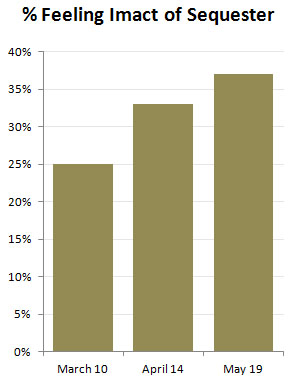
    The number of people who are feeling the effect of the sequester continues to rise. It’s now up to 37 percent, and unsurprisingly, that’s affecting what people think of it:
    More Americans continue to disapprove than approve of sequestration, now by 56-35 percent — again, a view influenced by experience of the cuts. Eight in 10 of those who report serious harm oppose the cuts, as do about two-thirds of those slightly harmed. But the majority, which has felt no impacts, divides exactly evenly — 46 percent favor the cuts, vs. 46 percent opposed.

    Further, this poll, produced for ABC by Langer Research Associates, finds that 39 percent overall “strongly” disapprove of the cuts — but that soars to 66 percent of those who say they’ve been harmed in a major way.

    Despite these results, I’ll stick to my earlier prediction: this isn’t enough to affect Congress. Overall, disapproval of the sequester has gone up only three points since March, and by the time that number gets much higher, September will be here and the dumb sequester cuts will be gone. Congress will replace them with more targeted cuts in the FY2014 budget, and those targets will be selected to minimize the yelling from interest groups they care about. Republicans may need to gut things out a bit this summer, but they’ll manage to hang on.

  • Sadly for Republicans, Obamacare Not Likely to Be a Train Wreck


    Is Obamacare fated to be a “train wreck”? Matt Yglesias says no, but warns us of what to expect as it rolls out:

    You have to remember a few basic facts about ACA implementation coverage over the next 18 months. One is that the media has a large negativity bias. The other is that the aspirations of the law are quite high, and the status quo is quite bad. That means any time the situation improves but doesn’t improve as much as the Obama administration wanted things to improve, that will tend to be covered as “bad news for Obamacare.” That tendency will be re-enforced because Republicans will be eager to trumpet Obamacare’s shortcomings (to make Obama look bad), and advocates for the poor will also be eager to trumpet Obamacare’s shortcomings (to build pressure for improvement). So you’ll hear lots of completely accurate stories about things not working quite as well as proponents had hoped. Just recall that this is always how things go.

    Obamacare will suffer from what I call the “big country problem”: in a big country, even a tiny percentage is a big absolute number. This means that even something rare can be made to look common. Obamacare is a classic case: it’s a gigantic, bureaucratic program that affects tens of millions of people, and that means it will inevitably run into lots of problems. A 99 percent success rate, after all, would still mean hundreds of thousands of horror stories. This is going to give the Fox News set plenty of opportunities to insist that the sky is falling.

    But it probably won’t be. Obamacare will have plenty of growing pains, and on a broader scale it will have unintended effects that genuinely need to be addressed. This will be harder to do than usual since Republicans are rooting for failure and will be generally unwilling to tweak the law to improve it. Hopefully this will change over time as constituent pressure mounts, but we’ll have to wait and see about that.

    In the meantime, if you want to know where the “train wreck” metaphor came from in the first place, and how it’s been mangled beyond recognition over the past few months, Dave Weigel has you covered.

  • Leaks and the First Amendment


    I hate to say this, but the media is losing me. I’m mostly on their side when it comes to subpoenaing journalists’ phone records, but the level of outrage and special pleading has gotten so palpable that I’m starting to waver. Aren’t they supposed to at least feign objectivity, even when the subject is something that affects the press?

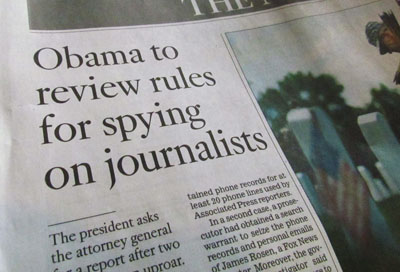
    It’s worse in some places than others. Roger Ailes, for example, released a histrionic statement yesterday about “the administration’s attempt to intimidate Fox News.” Sure, Roger. Other places it’s only slightly more subtle. This morning’s LA Times, for example, greeted me with the headline on the right. If the subject were, say, wiretaps on organized crime rings, would the Times have written a headline about “spying on mafia dons”? I don’t think so.

    I’m not sure what precisely has caused the big increase in leak investigations during the Obama administration. Maybe it’s because electronic communication makes it easier to investigate them. Maybe it’s because electronic communication makes it easier to leak in the first place, so there are more leaks. And certainly some cases are more troubling than others. The harassment of Thomas Drake, for example, is hard to defend. Conversely, the prosecution (though not always the treatment) of Bradley Manning is entirely justified.

    The two cases that have everyone exercised at the moment mostly seem to be justified. As Cheryl Rofer points out, Stephen Jin-Woo Kim basically acted like an idiot, apparently leaking information to James Rosen without even quite realizing how damaging it was. There’s no government in the world that would tolerate that kind of behavior from someone in a sensitive position who knew the rules. We know less about the AP case, but it certainly seems to have involved the release of information (the existence of an Al Qaeda mole) that the government had a legitimate reason for keeping secret.

    Does this mean the government should be able to pursue these cases by getting warrants for reporters’ phone records? I think the bar should be very, very high for that. Should the government be able to prosecute reporters for publishing classified information? I’d say the bar should be almost insurmountable for that. Even making the suggestion in a warrant application, as they did in the case of Rosen, is going too far for my taste.

    Nevertheless, the government has an obvious interest in trying to keep its intelligence operations secret. The existence of an Al Qaeda mole and the existence of high-level sources within North Korea are both classic cases of this. There’s no whistleblowing or government misconduct here. When those kinds of secrets are blown, the feds legitimately want to know which nitwit is doing it. Sometimes that may justify getting a warrant to look at journalists’ phone records. The rules for this ought to be more stringent than they are, but the First Amendment isn’t a magic pass here.

  • Obamacare Gets Some Good News From California


    A few days ago I mentioned some good news out of Oregon: competition among health insurers was forcing down the price of coverage on the state’s new Obamacare exchanges. Yesterday we got more good news from a much bigger state: mine. Wonkbook has the deets:

    In 2009, the Congressional Budget Office predicted that a medium-level “silver” plan — which covers 70 percent of a beneficiary’s expected health costs — on the California health exchange would cost $5,200 annually. More recently, a report from the consulting firm Milliman predicted it would carry a $450 monthly premium. Yesterday, we got the real numbers. And they’re lower than anyone thought.

    As always, Sarah Kliff has the details. The California exchange will have 13 insurance options, and the heavy competition appears to be driving down prices. The most affordable silver-level plan is charging $276-a-month. The second-most affordable plan is charging $294. And all this is before subsidies. Someone making twice the poverty line, say, will only pay $104-a-month.

    Sparer plans are even cheaper. A young person buying the cheapest “bronze”-level plan will pay $172 — and that, again, is before any subsidies.

    For some people—mostly young people with good incomes—individual rates may go up from what they’re paying now, though that depends on what kind of coverage they select. The table on the right shows a few selected rates for a silver plan in California’s biggest cities. (Tax credits will lower these rates further for residents with moderate incomes.)

    Nonetheless, competition seems to be doing its job on the exchanges and this is generally good news. Healthcare still costs too much, but if these early results hold up, Obamacare’s structure seems to be doing a pretty good job at its core mission of controlling prices.

  • Obama Nominates Benghazi Scapegoat for Promotion


    Oh yeah, this is going to be fun:

    The State Department spokeswoman who earlier this month found herself in the middle of the controversy surrounding key revisions to the Benghazi talking points appears to be in line for a promotion. The White House announced Thursday that President Barack Obama intends to nominate Victoria Nuland as assistant secretary for European and Eurasian affairs, a position that requires Senate confirmation.
    On a substantive basis, I know nothing about Nuland and have no opinion about whether she’s well qualified for this position. On a political basis, hoo boy. Obama is waving a red cape in front of a bull here. The only question is, on a scale of 1 to 10, just how loathsome and shameless can the attacks from the Fox News set get over this? I’m going to predict it’ll be about an 8. Give Ted Cruz a few minutes to warm up and he’ll be claiming that Nuland’s suggested changes to the Benghazi talking points should be prosecuted as a war crime.

    What’s more, this comes on the heels of rumors that Obama plans to appoint Susan Rice as his National Security Advisor. Rice, of course, has already been attacked by Republicans about as viciously and shamelessly as any State Department lieutenant in recent memory. But it’s worth keeping in mind that there is a difference between the two women. In the Benghazi affair, Rice did nothing wrong, but she also did nothing especially noteworthy. Nuland, as near as I can tell, actually did yeoman work. The first draft of the CIA talking points was sloppily drafted and full of information that needed to be kept classified. Nuland firmly pushed back on this stuff, and eventually got it removed—which is exactly what she should have done. No good deed goes unpunished, of course, as I think we’re all about to find out.

    On a gossipy note, this sure seems to suggest that Obama is tired of kowtowing to the know nothings in the GOP. And good for him. This is obviously a political risk, but apparently he doesn’t care anymore. He thinks Nuland is the best person for the job, so he’s nominating her. If the whackjobs start frothing at the mouth over it, let ’em froth.

  • Obama Kinda Sorta Narrows the Scope of the War on Terror


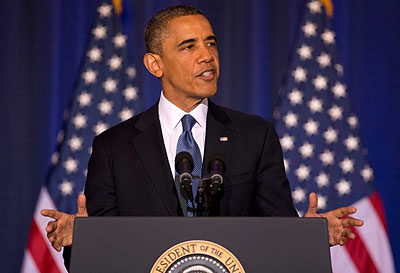
    A couple of hours ago I had a choice to make: spend the next hour writing a reaction to President Obama’s big national security speech, or go to lunch. I went to lunch.

    That was all for the best, since I had mixed reactions to the speech and wasn’t quite sure what to say about it. It was long and thoughtful, and in a lot of places its tone was welcome: Al-Qaeda is on the run, Obama said, and the danger we now face is of a much smaller scale than it was 12 years ago. So it’s time to rethink just how we want to prosecute our eternal war against terrorists:
    America is at a crossroads. We must define the nature and scope of this struggle, or else it will define us, mindful of James Madison’s warning that “No nation could preserve its freedom in the midst of continual warfare.” Neither I, nor any President, can promise the total defeat of terror. We will never erase the evil that lies in the hearts of some human beings, nor stamp out every danger to our open society. What we can do — what we must do — is dismantle networks that pose a direct danger, and make it less likely for new groups to gain a foothold, all while maintaining the freedoms and ideals that we defend. To define that strategy, we must make decisions based not on fear, but hard-earned wisdom. And that begins with understanding the threat we face.

    Afterward, administration officials told reporters that Obama had announced a new drone policy in his speech, though you could be excused for missing it: in the future, “strikes will be authorized only against militants who pose ‘a continuing, imminent threat,’ aides said, instead of ‘a significant threat,’ which had been the previous standard.” That’s a mighty thin difference, especially with no external oversight to ensure that it’s followed. And aside from that there were damn few specifics. Generally speaking, Obama defended drone attacks, defended the targeting of U.S. citizens abroad, and defended his aggressive prosecution of leakers. And while he suggested he was open to both more executive oversight and to a change in tactics, I think Dave Weigel was shrewd to highlight Obama’s insistence that he couldn’t do this on his own. Ed Kilgore summarizes:

    Obama four times shifted responsibility for current dilemmas at least partially to Congress: on drones (where he insisted the appropriate congressional committees have known about every single strike); on embassy security; on the 9/11-era legal regime that still governs anti-terrorist efforts; and on Gitmo (where Republicans have repeatedly thwarted effort to transfer detainees to U.S. prisons). [And a fifth: a media shield law to protect journalists who report classified information. –ed.]

    Is this a reflection of reality or an example of buck passing? I’m not sure we know yet. As someone who has consistently highlighted the power of Congress over policy—even foreign policy—I’m inclined to say the former. But it all depends on exactly what Obama does going forward. If Congress takes him up on his offer to rein in executive power and provide more oversight, will he cooperate or fight? He didn’t say enough today to make that clear. He just said he was ready for a conversation.

    So let’s have it. As Heather Hurlburt points out, Obama’s speech was a beginning, not an end. David Corn has more here.

  • Conspiracy Theory Watch: Hillary Sold Stingers to Al Qaeda!


    Seriously. This is the latest fever dream from the right. They believe that the reason Ambassador Chris Stevens was in Benghazi on September 11 was to negotiate the return of Stinger missiles that Hillary Clinton had sold to Al Qaeda groups over the objections of the CIA.

    I am not making this up.

    Why couldn’t the wingers be happy with their old complaint: that Obama had done too little after the Libya war to secure Muammar Qadafi’s arsenal of shoulder-mounted antiaircraft missiles,1 thus allowing them to fall into the hands of assorted bad guys in the Middle East? That’s at least based on a kernel of truth. Beats me. Because it didn’t involve Hillary Clinton, I guess, and therefore wasn’t a perfect conspiracy theory.

    1For the record, old Russian SA-7s, not Stingers. More here.

  • A Brief Primer on Where the Whole “YouTube Video Thing” Came From


    Bob Somerby catches Greta Van Susteren asking House Speaker John Boehner about Benghazi last night:

    VAN SUSTEREN: Have you determined why the whole YouTube video thing was brought up in Benghazi in the first place, whose idea it was, and why they seized upon it and held onto it for so long?

    BOEHNER: Don’t know yet, but we’re going to find out.

    VAN SUSTEREN: You have no sort of conceivable theory about, like, you know—

    After more than eight months of investigation, neither Van Sustern nor Boehner has even a clue about where the “YouTube video thing” came from! So let’s make this as easy as possible for them. Here’s what the CIA talking points said in the very first draft. This is before anyone else had seen them, commented on them, or asked for changes to be made:

    We believe based on currently available information that the attacks in Benghazi were spontaneously inspired by the protests at the U.S. Embassy in Cairo and evolved into a direct assault against the U.S. Consulate and subsequently its annex.

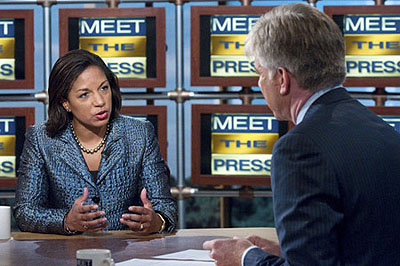
    This is also what the final draft of the talking points said. And here is Susan Rice on Meet the Press a few days after the attacks:

    Putting together the best information that we have available to us today, our current assessment is that what happened in Benghazi was in fact initially a spontaneous reaction to what had just transpired hours before in Cairo, almost a copycat of the demonstrations against our facility in Cairo, which were prompted, of course, by the video.

    Rice said basically the same thing on the other Sunday shows too. And here is David Kirkpatrick of the New York Times reporting directly from the scene a month after the attacks:

    To Libyans who witnessed the assault and know the attackers, there is little doubt what occurred: a well-known group of local Islamist militants struck the United States Mission without any warning or protest, and they did it in retaliation for the video….The fighters said at the time that they were moved to act because of the video, which had first gained attention across the region after a protest in Egypt that day.

    Bottom line: The CIA said Benghazi was inspired by the Cairo protests. That’s precisely what Rice said on the Sunday shows, noting correctly that the Cairo protests were prompted by the video. What’s more, the Benghazi fighters themselves claimed that they were motivated by anger over the video. That’s where the “YouTube video thing” came from. There’s no mystery here.

    Now, was the CIA correct? Were those on-the-ground reports correct? To this day, we don’t know for sure. But it doesn’t matter. At the time, that was the intelligence community’s best assessment. And that’s why Susan Rice said what she said. So once and for all, can we please stop pretending we have no idea where she came up with this stuff?

  • A Brief History of IRS Witch Hunts

    <a href="http://www.shutterstock.com/gallery-81193p1.html?cr=00&pl=edit-00">Cheryl Casey</a>/Shutterstock.com


    Perhaps this is just because I read David Foster Wallace’s posthumous novel The Pale King recently, but I actually feel kind of sorry for the IRS. Frankly, their job seems almost impossible. Think about it: they have to process over a hundred million claims a year, several million of which are highly complex. That means they need a huge number of people. And these people need to be fairly smart, because this isn’t simple work. But it is boring work. In other words, the IRS needs tens of thousands of people who are (a) smart, (b) willing to do really tedious work, (c) for moderate wages, (d) while working for a soul-crushing bureaucracy, and (e) being loathed by all right-thinking people.

    Does this sound to you like a recipe for disaster? Me too. Frankly, the biggest surprise about the tea party targeting scandal isn’t that it happened, but that there haven’t been a lot more like it. After all, it wouldn’t take much. Nobody ever lost an election by demagoguing the IRS, which means they’re always under a high-powered microscope from ambitious politicians. Or in some cases, under something more like a proctoscope, as in the case of the infamous 1998 Roth hearings, described here by yours truly a while back:

    One of the great scams of the 90s was the Roth Hearings, a brilliant piece of performance art staged by Senator William Roth as an attack on the Internal Revenue Service. The hearings were deliberately dramatic: Roth held them in a committee room designed to block electronic eavesdropping and had guards search everyone before they entered the chamber. IRS employees called as witnesses were blocked by black curtains and had their voices electronically altered, like mobsters afraid of being murdered in their sleep.

    The testimony was equally dramatic: IRS agents, they said, routinely made false accusations against people, busted into people’s homes and waved guns in their faces, and once even forced a girl caught in a raid to change her clothes while agents watched.

    As it happens, virtually none of this was true, but that didn’t matter. Republicans lined up to denounce the IRS as “Gestapo-like” and a law was quickly passed that handcuffed agents and slashed the budget for audits and enforcement, especially against high-income taxpayers. It was a boon for the rich in the same way that it would be a boon for drug dealers and street criminals if Congress slashed the budgets of local police departments.

    Generally speaking, the end result of all this was a reduced auditing budget, which made life much easier for America’s millionaires and billionaires, and a reined-in operating budget, which made the IRS less able to do its job efficiently and more likely to screw up in some kind of spectacular way. Mission accomplished! Noam Scheiber reviews the recent cuts in the IRS budget since Republicans took over the House in 2010 and concludes that they had pretty much the same effect:

    The just and logical result of this chain of events would be to discredit the people intent on starving government. Instead, the [tea party targeting] scandal has become a convenient talking point for opponents of government itself. The IRS uproar “probably represents the last shovelful of dirt on the central mission of Barack Obama’s presidency: rehabilitating Big Government’s reputation as a necessary first step toward a new Progressive Era,” wrote the economics commentator James Pethokoukis in National Review. More alarmingly, mainstream pundits are echoing this conclusion. “The IRS flap eats away at the underpinnings of what President Barack Obama promised when he first ran in 2008,” wrote the centrist columnist Jerry Seib the following week. “A revival of confidence that government is capable of solving problems in a smart and nonideological manner.” 

    I’m afraid Seib is right. As it’s currently playing out, the scandal probably is sapping confidence in government. But how we got to this point is no accident. It was the plan all along. 

    I’m happy to have the tea party targeting scandal thoroughly investigated. It looks to me mostly like a failure of management and overworked staffers, not a partisan hit job, but hey—you never know until you investigate. So investigate away. But I sure hope this doesn’t turn into a rerun of the Roth hearings. Those were not just a travesty, but a travesty that’s all too likely to repeat itself since no one, Democrat or Republican alike, ever wants to stick their necks out for the universally reviled IRS. Because of that, this could turn into a Roth-esque feeding frenzy just through sheer unchecked momentum. Hopefully, there’s someone in Congress with the guts to keep this investigation on track, even if it does mean running the risk of being branded pro-IRS.