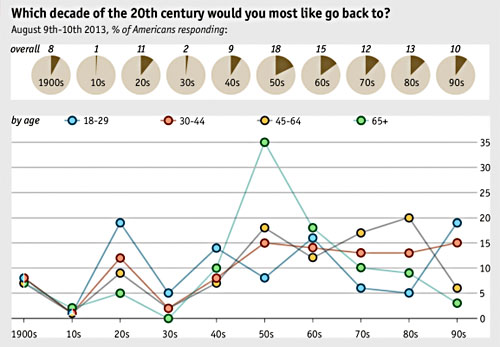
• America’s Elderly Really Love the ’50s


    The Economist asked people, “Which decade would you like to go back to?” and Matt Yglesias chides respondents for preferring the 40s (big war! carpet bombing! nukes!) to the 90s (great economy! jobs for all!). But there’s no surprise about this. Why would you want to go back to a decade that you’ve not only already experienced, but experienced recently? There’s not even nostalgia to draw you back.

    What’s more interesting, I think, is looking at the poll by age. The most popular choice of seniors by far was the 1950s. In fact, if you discount the ’20s, which probably just seem like an interesting, faraway decade, the most popular choice of nearly every age group is a decade of their youth. millennials like the ’90s, when they were growing up. My generation likes the ’80s, when we were just out of college. Only the thirtysomethings seem not to care, showing no particular preference for any decade between the ’50s and ’90s.

    But it’s the nostalgia of seniors for the ’50s that intrigues me the most. I’d love to see a demographic breakdown of that. I assume that nonwhites aren’t pining away for that era, which means that white seniors must really be in love with it to produce such a high overall number. Likewise, I’d guess that women might not be too thrilled with it. If that’s true, it means that white male seniors must be nostalgic for the ’50s in fantastic numbers. In one sense that’s easy to understand, but in another it’s not. If it’s just nostalgia for their youth, that’s one thing. But what about older seniors? Are they really that eager to go back to the era of Joe McCarthy, suburban lawns, and duck-and-cover drills? Apparently so.

  • The Paranoia State Gets Cranked Up Another Notch


    In the wake of the Boston bombings, the NFL has cracked down on what fans can bring into stadiums:

    Shoulder bags, backpacks, briefcases, fanny packs, camera and binocular cases and even diaper bags are now forbidden. Coolers, thermoses and seat cushions with zippers are also banned. Blankets are still allowed, as are gloves, hats and other items that can be stuffed in pockets or worn.

    “We are looking at this as a progressive and reasonable step in light of current events,” said Brian McCarthy, a spokesman for the N.F.L. “Most people aren’t affected, and there’s a lot of room for everyone with a bag.”

    ….“The N.F.L. is on the cutting edge, a leader in the sports industry in terms of looking at policies and procedures,” said Lou Marciani, the director of the National Center for Spectator Sports Safety and Security at the University of Southern Mississippi. “This way, for sure, you’re cutting down the risk and satisfying the demand of fans to get into the stadium faster.”

    I’m not sure which is worse: the fact that our level of security paranoia gets cranked up a notch every time some lunatic kills a few people, or the smarmy Stepford Wives spin that everyone puts on it. “Progressive and reasonable.” “Cutting edge.” “Most people aren’t affected.”

    I dunno. Is it reasonable? I react so viscerally to stuff like this that I feel like I’ve lost the ability to think rationally about it. Comments?

  • One Last Time: Here’s the Real Reason the Pentagon is Facing $20 Billion in Extra Cuts Next Year


    Why is the Pentagon facing an “extra” $20 billion in cuts under sequestration next year? Yesterday I said that it was due to a redefinition of “security” in the budget language between 2013 and 2014. Today, CAP’s Michael Linden tells me that although it’s possible this played a role, the real answer lies elsewhere. What follows is fairly number-heavy, and if you don’t want to read it, I don’t blame you. But I’ll try to keep it as simple as I can.

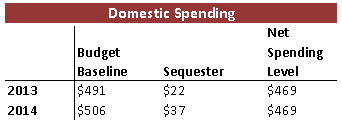
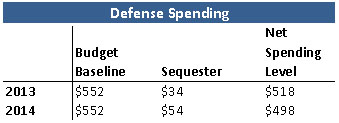
    Here’s the main issue: it turns out that under the Budget Control Act, the baseline budget for domestic spending goes up between 2013 and 2014. But it stays flat for defense spending. In addition, the amount of the sequester goes up because (a) it’s for a full 12 months, and (b) the fiscal cliff deal reduced the 2013 sequester levels.

    For 2014, the sequester amount is roughly $54 billion for both domestic and defense. However, about $17 billion of the domestic sequester is for mandatory spending (primarily in reduced Medicare reimbursements). Once that’s all netted out, here are the numbers for domestic discretionary spending:

    As you can see, the net spending level in 2014 is the same as 2013 because the budget baseline went up enough to make up for the increased sequester. But here are the numbers for defense discretionary spending:

    The net effect of all this is that defense spending has to decrease by $20 billion compared to last year, while domestic spending stays at the same level. This is a one-time effect, since the baselines for both domestic and defense spending rise slightly each year in 2015 and beyond.

    So that’s the story. If you’re sorry you asked, join the club.

  • Here’s the Latest Fizzle in the IRS “Scandal”


    Accounting Today reports today on the latest in the IRS scandal. Yes, Accounting Today. Apparently no one else was interested, which I suppose might actually be a good sign.

    Anyway, it seems that the tireless Sander Levin has unearthed yet another IRS PowerPoint presentation from around 2010 that tells screeners to watch out for groups asking for tax-exempt status who might actually be primarily engaged in political activities. Here are the relevant slides:

    Aside from providing yet more evidence in favor of a federal ban on PowerPoint presentations, the astute observer will note that the first slide features both an elephant and a donkey. (Sorry, Green Party.) The next slide does indeed list Tea Party, and then Patriots and 9/12 Project. But guess what? Next up are Emerge, Progressive, and We the People. This sure doesn’t look like an IRS jihad against conservative organizations, does it?

    This comes via Steve Benen, who apparently reads Accounting Today as part of his morning routine. OK, probably not. But it wouldn’t surprise me. Here’s his final comment:

    This would a time for at least some accountability. There were countless Republicans and mainstream pundits — left, right, and center, from Limbaugh to Jon Stewart — who were absolutely convinced that this story was legitimate and President Obama bore responsibility for the wrongdoing we now know didn’t exist.

    And yet, the scandal that evaporated into nothing has led to precious little introspection among those who demanded the public take it seriously. The political world flubbed this one, and instead of acknowledging that, it’s simply moved on as if it hadn’t made a mistake.

    It’s a real shame.

    So, I guess we’ll start hearing more about Benghazi again soon?

    Look! Up in the sky! It’s Benghazi!

  • Hooray for Carbon Taxes!


    Tyler Cowen recommends “Carbon Taxes vs. Cap and Trade: A Critical Review,” by Lawrence Goulder and Andrew Schein of Stanford University. This is right up there with “lead abatement” on the yawn scale, but wait! There will be no long, wonky excerpts. Instead, let’s get straight to the meat. Here’s their list of pros and cons:

    It sure looks like a carbon tax is the winner, doesn’t it? But that’s because Goulder and Schein are economists, and economists almost universally prefer a tax to an emissions trading scheme. One way to come to that conclusion is to ignore the single biggest factor in favor of cap-and-trade: namely that it actually caps emissions with certainty. Goulder and Schein don’t ignore this, but they do manage to turn it on its head. In the table above, it’s cleverly hidden in the box called “Weitzman issue (price vs. emissions uncertainty),” which makes it into an economically tractable issue and, in an amazing feat of magic, converts it from an advantage of cap-and-trade to an advantage of a carbon tax. How? By assuming that the danger of allowing emissions to get too high is less than the danger of allowing the carbon price to get too high. So that’s that. As long as you assume the damage from greenhouse gas emissions isn’t that big a deal—not as big a deal as high energy prices, anyway—then cap-and-trade looks like a lousy deal.

    Why am I being so snarky here? I don’t know. I’m in a bad mood, I guess. It’s unfair. There really are good reasons to prefer a carbon tax, even if I think that Goulder and Schein have their thumbs on the scale by assuming low administrative costs and better Weitzman efficiencies. What’s more, the truth is that I don’t care anymore. I have a modest preference for cap-and-trade precisely because it caps emissions, which is my highest priority. It also provides trading flexibility, which Goulder and Schein acknowledge. But honestly, the differences are small. If we could actually get stronger political support for a carbon tax, that would be fine with me. Any kind of carbon pricing is fine with me at this point.

    But that’s not very likely. If Republicans are unalterably opposed to cap-and-trade because it’s really cap-and-tax, what are the odds that they’d support something that just admits it’s a tax up front? Not very good. Even as part of a tax reform package that lowers marginal income tax rates, something that you’d think nobody in either party would oppose, it seems pretty unlikely.

    But if this is ever on the table, I’m all for it. It’s the most no-brainer form of tax reform I can think of. And even allowing for their thumbs on the scale, Goulder and Schein make a good case for a carbon tax. Too bad about all those Republicans, eh?

  • Tanning Beds are Very, Very Bad for Teenagers


    Is diet soda bad for you? Who knows. It might be in large quantities, but the evidence is pretty thin. On the list of things to get outraged about, it probably ranks somewhere near the bottom of the Top 100.

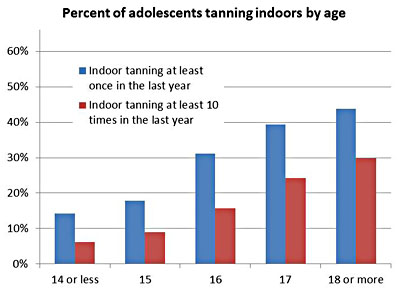
    Indoor tanning, on the other hand, is just plain horrifically bad. Aaron Carroll provides the basics: indoor tanning before age 25 increases the risk of skin cancer by 50-100 percent, and melanoma risk (the worst kind of skin cancer) increases by 1.8 percent with each additional tanning session per year. Despite this, the chart on the right shows the prevalence of indoor tanning among teenagers. It’s high! Aaron is appalled:

    This is so, so, so, so, so, so, so bad for you. Why don’t I see rage against this in my inbox like I do for diet soda? Why can’t people differentiate risk appropriately?

    And who would fight a tax on this?

    Answer: lots of people, including every single member of the Republican Party. Next question?

  • I Am the Ghost of Barry Eichengreen


    Today’s nerd game of the moment is “Which Economist Are You?” This involves answering questions that have previously been posed as part of the IGM Economic Experts Panel and then seeing which economist your answers match best. I got bored after 19 questions, and then skipped around and answered a few more randomly. The machine appears to think I am most like Barry Eichengreen, which is pretty good company, I think, so I’m happy. You can try it out yourself here.

    FUN NOTE: If you go down the list and blindly agree (“strongly agree,” actually) with the first 20 questions, then you are Hyun Song Shin. If you strongly disagree with the first 20 questions, you are Hyun Song Shin. If you are uncertain about all 20, you are Hyun Song Shin. Apparently Hyun Song Shin is the ideal median economist.

  • Snowden Wars Episode V: The Surveillance State Strikes Back


    Alan Rusbridger, editor of the Guardian, tells a story about the newspaper’s ongoing exposure of Edward Snowden’s surveillance files:

    A little over two months ago I was contacted by a very senior government official claiming to represent the views of the prime minister. There followed two meetings in which he demanded the return or destruction of all the material we were working on. The tone was steely, if cordial, but there was an implicit threat that others within government and Whitehall favoured a far more draconian approach.

    The mood toughened just over a month ago, when I received a phone call from the centre of government telling me: “You’ve had your fun. Now we want the stuff back.” There followed further meetings with shadowy Whitehall figures. The demand was the same: hand the Snowden material back or destroy it. I explained that we could not research and report on this subject if we complied with this request. The man from Whitehall looked mystified. “You’ve had your debate. There’s no need to write any more.”

    During one of these meetings I asked directly whether the government would move to close down the Guardian’s reporting through a legal route — by going to court to force the surrender of the material on which we were working. The official confirmed that, in the absence of handover or destruction, this was indeed the government’s intention. Prior restraint, near impossible in the US, was now explicitly and imminently on the table in the UK. But my experience over WikiLeaks — the thumb drive and the first amendment — had already prepared me for this moment. I explained to the man from Whitehall about the nature of international collaborations and the way in which, these days, media organisations could take advantage of the most permissive legal environments. Bluntly, we did not have to do our reporting from London. Already most of the NSA stories were being reported and edited out of New York. And had it occurred to him that Greenwald lived in Brazil?

    The man was unmoved. And so one of the more bizarre moments in the Guardian’s long history occurred — with two GCHQ security experts overseeing the destruction of hard drives in the Guardian’s basement just to make sure there was nothing in the mangled bits of metal which could possibly be of any interest to passing Chinese agents. “We can call off the black helicopters,” joked one as we swept up the remains of a MacBook Pro.

    Rusbridger’s conclusion:

    The state that is building such a formidable apparatus of surveillance will do its best to prevent journalists from reporting on it. Most journalists can see that. But I wonder how many have truly understood the absolute threat to journalism implicit in the idea of total surveillance, when or if it comes — and, increasingly, it looks like “when”.

    We are not there yet, but it may not be long before it will be impossible for journalists to have confidential sources. Most reporting — indeed, most human life in 2013 — leaves too much of a digital fingerprint. Those colleagues who denigrate Snowden or say reporters should trust the state to know best (many of them in the UK, oddly, on the right) may one day have a cruel awakening. One day it will be their reporting, their cause, under attack. But at least reporters now know to stay away from Heathrow transit lounges.

    Remember back when the internet was supposed to make the state obsolete? That was always laughable, just as the 90s-era cluetrain nonsense about the internet making traditional marketing obsolete was laughable. In both cases, exactly the opposite has happened. Sure, the internet empowers individuals in certain ways, both in their relation to the market as well as in their relation to the state, but the overall impact has been in exactly the opposite direction. Just as multinational firms almost effortlessly comandeered the internet as a marketing vehicle after only a few years of confusion, governments quickly learned that any sufficiently motivated state can use the capabilities inherent in an omnipresent digital network to exercise far more control over their territory and their citizens than they give up. The only question is how motivated the state is.

    Anyone who thinks otherwise is confused about how the virtual world works. Sure, the internet’s protocols make top-down control difficult, as does the decentralization of its infrastructure. But those are just speed bumps. As everyone should understand by now, the virtual world is virtual only at a very shallow level. Dig an inch deep and guess what? Your iPhone is a physical object. Routers are physical objects. Fiber optic cables are physical objects. Computers are physical objects. And governments have control over the physical world.

    I don’t know how this turns out any more than you do. In the end, maybe the centrifugal forces of the internet really will win the day. After all, as Rusbridger pointed out to the GCHQ folks, destroying a few hard drives in London didn’t make the slightest difference to the Guardian’s ability to report the Snowden story.

    On the other hand, Snowden himself is bottled up in Russia. Julian Assange is trapped like a rat in the Ecuadorian embassy in London. WikiLeaks has been crippled by concerted international sanctions. Bradley Manning will spend the rest of his life in jail. And even the thickest-skinned journalists will think twice before tackling sensitive subjects now that they know their spouses, family, and friends are considered fair game for harassment by any sufficiently annoyed security agency. If even the president of Bolivia can’t escape harassment, what chance do you have?

  • Here’s Why the Pentagon Is Facing $20 Billion in Extra Cuts Next Year


    Earlier today I passed along the news that the Pentagon is facing some extra big cuts next year under the terms of the sequester. But why? Via Twitter, Matt Glassman explains: “The 2011 BCA sets up different def of ‘security spending’ for FY12/13 and for FY14+, result is up % DoD cuts.”

    Aha! The Congressional Research Service explains further:

    For FY2012 and FY2013, the spending limits were divided into “security” and “nonsecurity” categories, with security defined broadly to include the Departments of Veterans Affairs (VA), Homeland Security (DHS), and State, in addition to the Department of Defense….However, [after 2013] these terms are redefined, so that “security” consists only of budget function 050 (effectively, the Department of Defense), and “nonsecurity” includes all other government spending (including the VA, DHS, and State). The distinction between security and nonsecurity (as redefined) remains for each of FY2014-FY2021.

    So there’s your answer. In the 2013 sequester, “security” was trimmed about $55 billion in annual terms, but some of that went to cuts at the VA, DHS, and State. In 2014, the entire $55 billion gets taken from the Pentagon budget. Apparently that adds up to about $20 billion more in pure defense cuts.

    Just thought you’d like to know.

    UPDATE: It turns out this is wrong. The real story is here.