I’ve been wondering since this morning what excuse the White House would invent to walk back Donald Trump’s suggestion that Puerto Rico’s debt needs to be wiped clean. It turns out they didn’t bother. Here’s the walkback from budget director Mick Mulvaney:
“I wouldn’t take it word for word with that,” Mulvaney said on CNN.
So that’s that. Not even a pretense that Trump was actually saying something plausible. Just a bald admission that Trump talks a lot of shit and no one should take him seriously.
Hooray! The transit strike scheduled for Thursday has been called off. Tube trains will continue whisking Londoners across the city so fast they can barely tell what station they’re in.
Can you tell what station we’re in? I’ll give you a hint: It’s on the District Line.
Yesterday I wrote a post criticizing the Washington Post for the way it reported some new statistics on family wealth. After a Twitter conversation with the reporter and editor, I promised to analyze the raw data myself and report back. I’ve now done that.
The Post reported that the share of white millionaires (by wealth) has increased from 7 percent in 1992 to 15 percent in 2016. This looked to me like a case of not adjusting for inflation, but I was wrong. After crunching the numbers myself, I got the same result: even after adjusting for inflation, the percentage of whites with a net worth over $1 million has indeed doubled. My apologies for the error.
But at the risk of sounding grudging, I still have several issues with the story. Here they are:
The whole frame of “how many whites are millionaires?” is a peculiar choice. It makes for a dramatic headline, I suppose, but why not just report the basic data on the level and growth of net worth?
If you are going to use the “millionaire” frame, then you need to report the figures for blacks and Hispanics too. The story says, “The percentage of black and Hispanic households worth more than $1 million has remained around or below 2 percent since 1992,” and the accompanying chart confirms this visually. The numbers are so low that growth does indeed seem flat unless you look carefully at the labels. In fact, though, the share of black millionaires has tripled from 0.64 percent in 1992 to 1.9 percent in 2016. The share of Hispanic millionaires has gone up by half, from 1.53 percent to 2.26 percent.
All of us seem to agree that the right way to report average wealth is to use median values. But for some reason, white wealth is reported as a mean: $930,000. Only in a parenthetical is the reader told that median white wealth is $171,000. If medians are the right way to report this, why not use that as your primary number? Why report the mean at all? It seems like a cheap attempt to make average white wealth look a lot higher than it is.
In the tenth paragraph, an increase of white wealth since 2013 is interpreted as showing “a recovery from the Great Recession.” Black and Hispanic wealth also rose, “but remained below 2007 values.” This is a misleading way of presenting the data, since everyone saw their wealth rise compared to 2013 and everyone was still below 2007 values. In fact, black and Hispanic wealth grew faster than white wealth over the past three years. In the longer term, families of every race are still about 10 percent below their 2007 wealth.
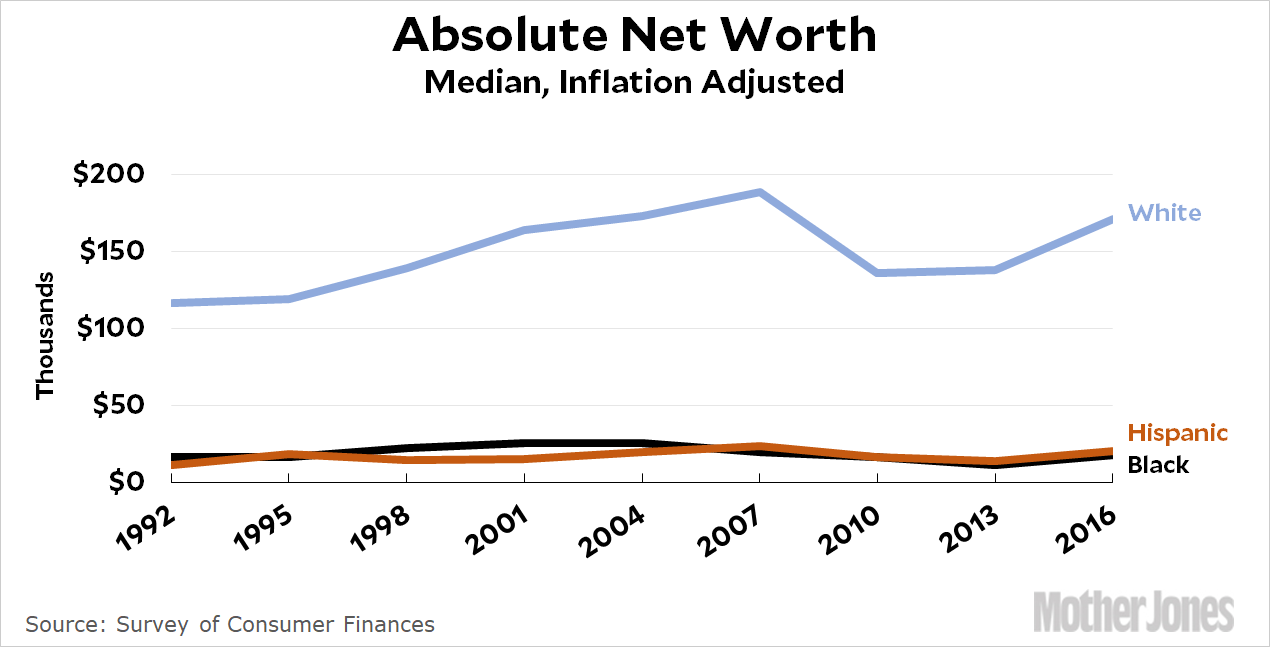
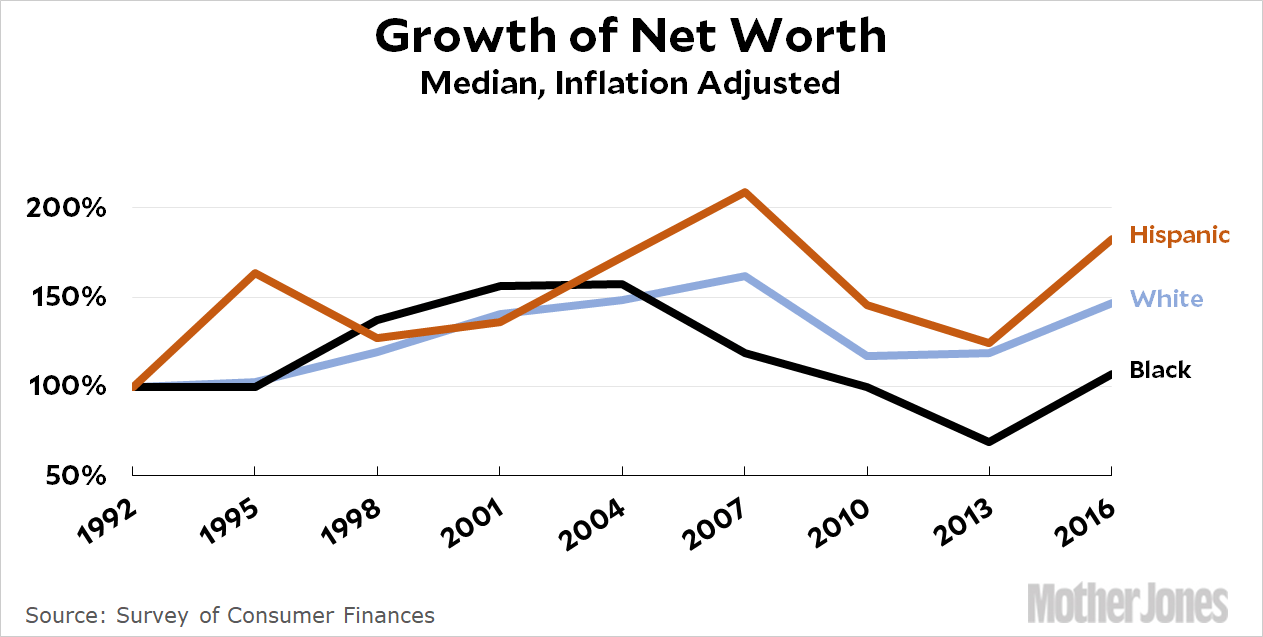
None of this was necessary. I’ll repost the basic chart on net worth that that I put up yesterday:
The numbers for black and Hispanic wealth are so low that this would be the primary story no matter what. There’s no reason to spin things to make it look even worse.
Republican leaders are backing away from a proposal to fully repeal an expensive tax break used by more than 40 million tax filers to deduct state and local taxes amid pushback from fellow lawmakers whose residents rely on the popular provision.
….The White House and Republican lawmakers are considering alternatives to an outright repeal, including allowing taxpayers to choose between deducting their mortgage interest or state and local taxes, a limit on the deduction or a special tax break for middle-class families that live in areas with high property taxes.
Representative Chris Collins, Republican of New York, said in an interview on Tuesday that party leaders had assured him “there’s not going to be full repeal” of the state and local tax deduction….He said both Mr. Brady and Mr. McCarthy acknowledged that full repeal would be a “nonstarter” with a large bloc of Republicans in the conference, and that “it’s safe to say, we’re no longer going to be talking about a full repeal.”
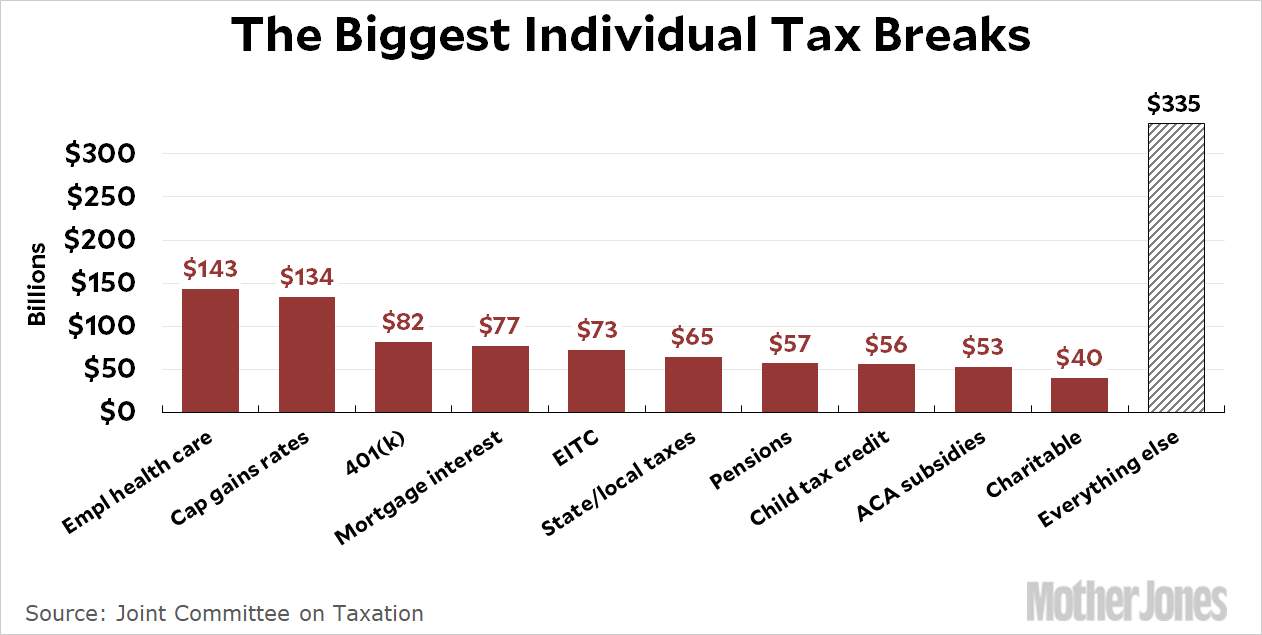
Republicans have now backed down on the following tax breaks:
The top ten tax breaks are in red, and they add up to nearly $800 billion. Although Republicans might—might—still find ways to reduce them a bit, they’ve all but given up on eliminating any of them. That’s nearly three-quarters of all the tax breaks in the individual tax code. There’s nothing more to go after except for the hundreds of piddly little things that would each represent a huge fight that isn’t worth it.
And yet we’re still supposed to believe that on the corporate side Republicans are going to show some backbone and eliminate tons of tax breaks to make up for their huge rate cut. Sure they are.
From President Trump, in an interview with Geraldo Rivera that aired last night on Hannity:
They owe a lot of money to your friends on Wall Street and we’re going to have to wipe that out. You’re going to say goodbye to that, I don’t know if it’s Goldman Sachs but whoever it is you can wave goodbye to that.
I love the reference to “your friends” on Wall Street, as if Trump himself is a Bernie-crat who loathes high finance. In reality, of course, he tried to hire Anthony Scaramucci and succeeded in hiring Steve Mnuchin, Wilbur Ross, Gary Cohn, and Dina Powell. Despite that, Wall Street tycoons are “your friends,” not his.
We’ll see. Trump could prove his alleged populist bona fides by truly pushing to wipe out Puerto Rico’s debt. But I wouldn’t bet the ranch on that. I’m sure we’ll soon have a “clarification” from the White House that Trump was just joking, or referring to ongoing restructuring negotiations, or only talking about debt owed to China. Or something.
Fascinating tidbit: Rivera himself clearly understands that Trump is wading into dangerous territory and cuts him off before he can cause himself more trouble. What a friend!
If you’re up for it, you can hear Trump talk about Puerto Rico’s debt starting around 3:20 in the interview below. Trigger warning: the interview starts with Trump droning on yet again about what a fabulous job he’s done in Puerto Rico and how he’s not getting enough credit for it.
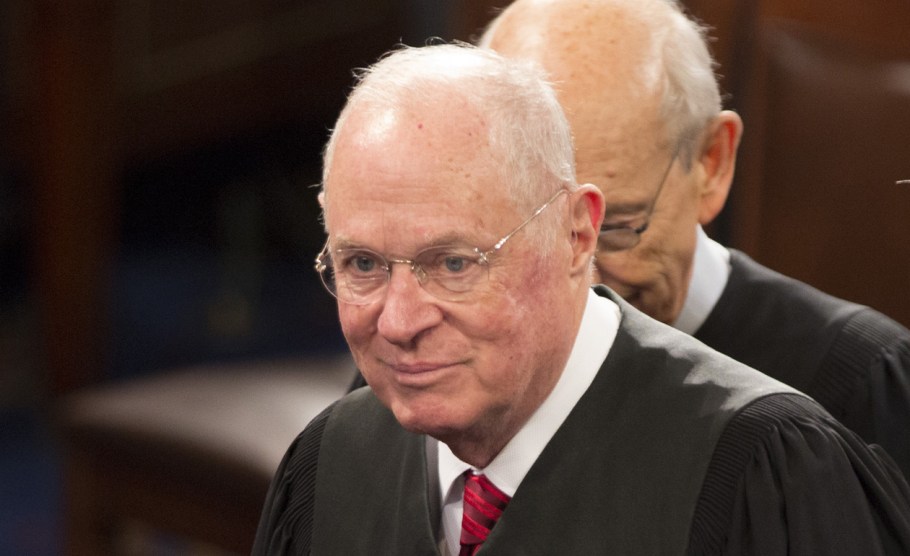
Supreme Court justice Anthony Kennedy has long been the only conservative justice who’s sympathetic to arguments against gerrymandering. The problem is that, like the other conservatives, he’s been unable to figure out a concrete standard to use. How do you tell if a map is gerrymandered so much that it’s unconstitutional?
Today’s big gerrymandering hearing went much the same way. Ari Berman reports:
Kennedy was the first justice to ask a question in Tuesday’s opening arguments in the case, Gill v. Whitford. “Suppose the Court…decided that this is a First Amendment issue?” Kennedy asked Wisconsin’s solicitor general, implying that extreme partisan gerrymandering could violate the right to free speech by preventing those in the minority—in this case Wisconsin Democrats denied representation—from having an equal say in the political process.
Kennedy also seemed to suggest that the court could set a standard for when gerrymandering crosses a line….Kennedy [suggested] that a manageable standard could be whether a map was drawn with the “overriding concern ” to “have a maximum number of votes for party X or party Y.” He asked whether such a scenario would violate the First Amendment or the Equal Protection Clause of the 14th Amendment.
The Supreme Court usually sets standards in fairly non-concrete ways, so I’m not sure why gerrymandering should be any different. Kennedy’s proposed standard probably is manageable.
But the thing that surprises me is that no one mentioned what I consider the big issue in gerrymandering: computers. When gerrymandering was a human exercise, there were effectively limits on just how bad it could be. With computerization, it takes only a few seconds to produce the most highly gerrymandered map possible. This is an example of a quantitative change so big that it become qualitative—and the court should respond to that. But how? I happen to favor a standard called the “partisan symmetry rule,” which I described earlier this year:
If gerrymandering is now a brute-force, computer-driven activity, the best answer is a brute-force computer-driven rule. A few decades ago, applying the partisan symmetry rule would have been all but impossible, but today it’s easy. It’s also something that can be easily defined, and is therefore pretty easily managed by the courts.
Whether the court adopts a specific rule or a more general standard, it’s time to do something about this. Times have changed, and extreme partisan gerrymandering is just too easy. One way or another, they need to agree on a way to rein it in.
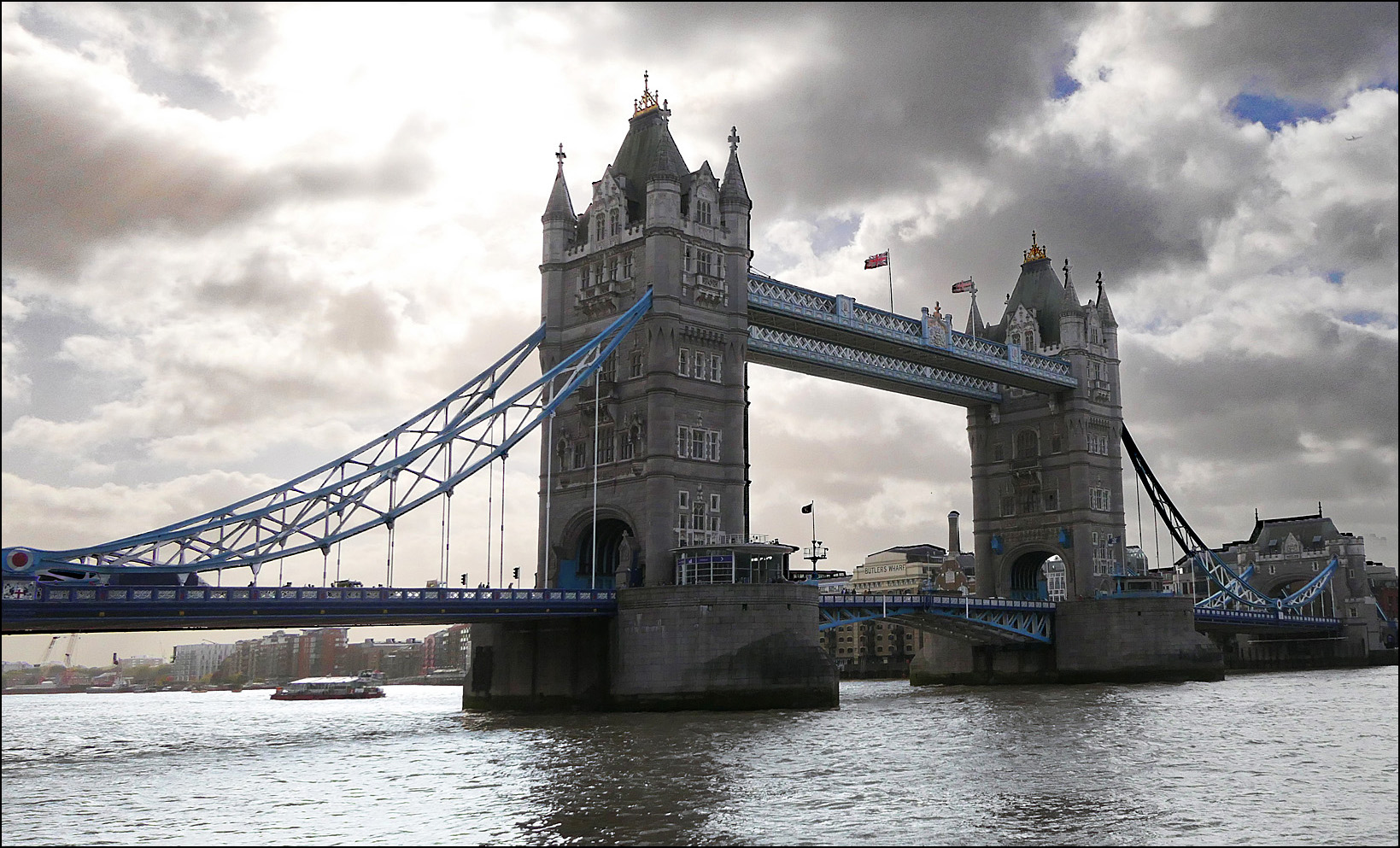
I feel like I need to put up a really London-esque picture today to fully capture our change of venue. But I have surprisingly little to choose from. Saturday was spent at Hampton Court Palace. Sunday was a bus tour. Monday was a short boat trip and then some piddling around in Kensington, where we’re staying.
So how about the Tower Bridge? That screams London. This picture is a poor attempt at massive, manual, HDR, aka “High Dynamic Range.” Basically, HDR is useful when you have one subject (the bridge) that requires a certain exposure and another subject (the sky) that requires a very different exposure. My camera’s built-in HDR was nowhere near up to this task, so I made two shots at very different settings and then merged them manually.
Unfortunately, I didn’t have a tripod with me, so the two photos aren’t identical. Even after my best merging attempts, not everything registered properly In particular, the buildings on the bottom right were misaligned, so you can see remnants of the sky photo behind the bridge photo. Other dark bits are also visible throughout the image.
The share of white millionaires in the United States has doubled in the last quarter century, with one in seven white families now worth more than $1 million, according to new Federal Reserve data. Fifteen percent of white families reported being millionaires, compared to only 7 percent in the Fed’s 1992 Survey of Consumer Finances.
….Much of the growth in white wealth during the past two decades comes from the doubling of financial assets, including stocks and bonds, as well as pensions and retirement accounts, according to a Washington Post analysis of Fed data.
Come on. The doubling of white wealth is primarily because of inflation, which has nearly doubled since 1992. And the reason that 15 percent of white families have a net worth of $1 million is because about 15 percent of white families had a net worth of $500,000 back in 1992.
CORRECTION: According to the Post, the share of white millionaires has doubled to 15 percent after adjusting for inflation. I didn’t notice the note in their chart, and assumed these were nominal numbers since median real wealth hasn’t increased nearly that much. The presentation here is confusing, but I’ll see if I can dive into it further tomorrow. And now, back to our story. More here.
Not that this matters, since nobody uses average wealth for this kind of comparison anyway. Averages are heavily skewed by folks like Warren Buffett and Bill Gates, so you use medians instead. Here’s how wealth has really grown since 1992¹:
In the Post’s hands, the data on white and nonwhite wealth produces sentences like this:
Among American households invested in the market, the median value of white-owned investments rose to $50,000 in 2016, indicating a recovery from the Great Recession. The median value of black-owned and Hispanic-owned investments remained around $12,000, which was below 2007 values.
This could just as well be:
Among American households, black net worth rose more than 50% in 2016, indicating a recovery from the Great Recession. Median white net worth was about $170,000, which was below 2007 values.
What’s the point of all this? Why use nominal values to make it look like white net worth has skyrocketed? Why use averages to make it look five times higher than it is? Why cherry pick dates, comparing white growth since 2013 with black growth since 2007? None of it is necessary since the simple facts are all you need:
White wealth has grown by about half since 1992. That’s not horrible, but it’s not great. Black wealth has grown less and Hispanic growth has grown more. What really matters, however, is that over the course of more than two decades, the absolute wealth of both blacks and Hispanics has been so close to zero you can hardly tell the difference. You really don’t need to cherry pick anything or spin the statistics to make that point.
Andrew Sprung calls Obamacare “London after the Blitz.” It’s still standing, but the damage done by the Trump administration is already severe:
Uncertainty over CSR reimbursement and enforcement of the individual mandate have themselves driven premiums up by over 20% in 2018 (Gaba’s estimate) and driven many insurers out of the individual market.
Those premium hikes will probably knock several million unsubsidized buyers out of the individual market. Weakened mandate enforcement, real or perceived, will probably reduce the numbers of people enrolled not only in the individual market but also in employer-sponsored insurance and Medicaid. An increased percentage of unsubsidized enrollees in the individual market who do stay in will probably be underinsured, pushed into bronze plans and/or overburdened by the combination of rising premiums and out-of-pocket costs. Poor-to-nonexistent outreach from HHS may result in many current marketplace enrollees failing to shop anew and so re-enrolling in a suboptimal plan. Trump’s threat to issue an executive order that reportedly would empower association health plans to evade state regulation via ERISA could bleed health enrollees out of the individual market.
Red states, meanwhile, are lining up to accept HHS’s invitation to propose work requirements, time limits and more frequent enrollment redeterminations on Medicaid enrollees, which will likely inhibit reduce Medicaid takeup.
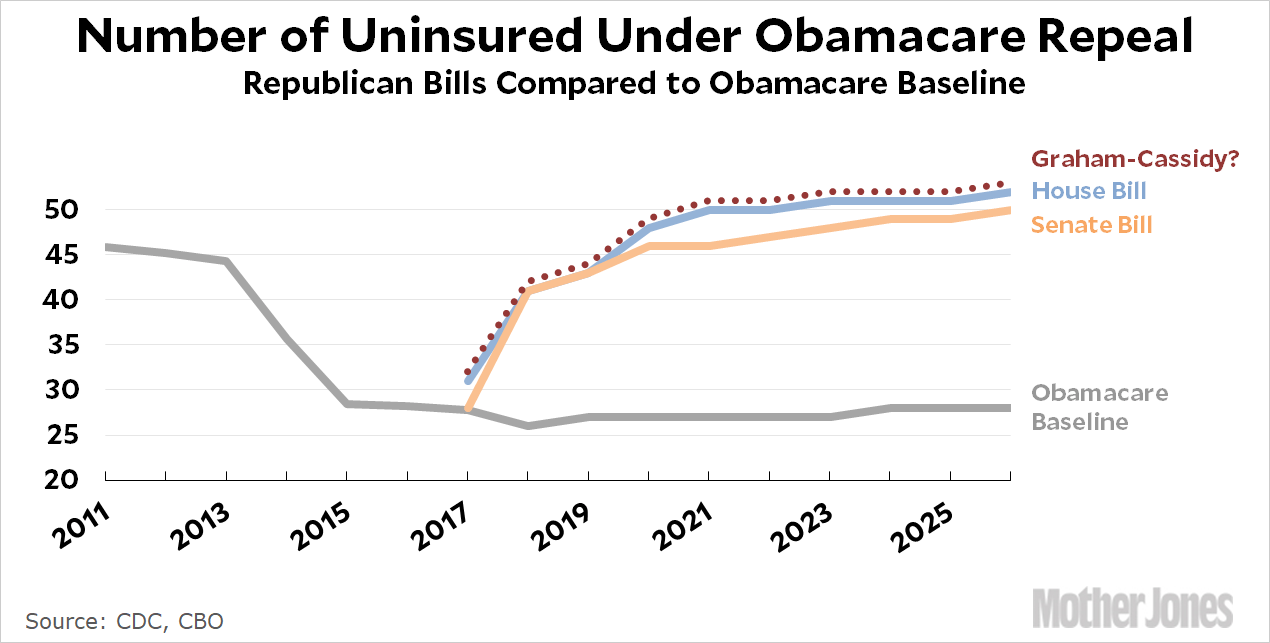
It’s easy to blame the media for everything, but this act of petty revenge is pure Trump. That said, it’s a little shocking that this hasn’t gotten more press attention. A president of the United States, acting out of pique, has undertaken a deliberate and calculated plan to undermine a program that provides health care to 20 million Americans at a very reasonable price. There is no feasible replacement in the works, and Republican efforts over the past year have demonstrated that even if there were, it would still take a toll of 20 million or more people:
And it just keeps coming. CSR games were just the start. They’ve been followed by a nearly weekly parade of sabotage: cutting the enrollment period, slashing the outreach budget, shutting down the website once a week, and now by a transparent invitation to cut back on Medicaid.
I know that not everything I think is important is big news. But this is astonishing stuff: a president deliberately undermining a successful program that provides access to health care for millions. And there are new announcements every few days, so it’s not like you’re stuck for ideas after you’ve written the story once.
I suppose a big part of the blame here is with Democrats. They should be screaming blue murder and forcing this to become news. For some reason, they aren’t. What are they waiting for?
While Kevin’s on vacation, we’ve invited other Mother Jones writers to contribute posts.
In an interview on Fox News last month, Treasury Secretary Steve Mnuchin made a sales pitch for the GOP’s tax reform plan—specifically, its plan to cut corporate taxes. “Most economists believe that over 70 percent of corporate taxes are paid for by the workers,” he said. His implication, in laymen’s terms: Regular workers would get 70 percent of the benefit of corporate tax cuts.
Five years ago, the Obama-era Treasury department found the exact opposite. A research paper on the topic concluded that corporate tax cuts would overwhelmingly benefit owners of capital, rather than workers. Those findings have been removed from the Treasury Department’s website, reported theWall Street Journal late last week. Dozens of working papers on other topics, somedating back to 1974, are still available on the agency’s website.
The 2012 paper by the Office of Tax Analysis concluded that workers pay for only 18 percent of corporate taxes, meaning that they’d only get about 18 percent of the benefit of a tax cut. Owners of capital, on the other hand, pay for 82 percent, the paper found—meaning they would get the vast majority of the benefit from the GOP tax reform plan’s proposed corporate tax cuts. Under the current plan, the corporate tax rate would decrease from 35 percent to 20 percent.
A Treasury spokeswoman told the Wall Street Journal that “the paper was a dated staff analysis from the previous administration. It does not represent our current thinking and analysis.”
In 2012, the Congressional Budget Office came to a similar conclusion about corporate tax cuts. The CBO found that about 75 percent of the burden of corporate taxes are borne by owners, and only 25 percent by workers. In 2013, the nonpartisan Joint Committee on Taxation performed it own analysis, and came to the exact same conclusion as the CBO.
Back in August, Jared Bernstein, former Vice President Joe Biden’s ex-chief economist, predicted this flawed line of reasoning on corporate tax cuts from the Trump Treasury Department in a Washington Postop-ed. “If you’re not wealthy, and you hear team Trump/Mnuchin/Ryan/Brady trying to sell a corporate tax cut on the basis of how much it’s going to help you,” Bernstein wrote, “tell them [economist] Adam Smith told you they were full of it.”
And we respect that! But maybe you’re of a mind to support our work directly instead? We have until December 31 to raise the last $400,000 we need to keep our nonprofit newsroom running at full strength into 2026. Will you make a gift today?
We noticed you have an ad blocker on. Can you pitch in a few bucks to help fund Mother Jones' investigative journalism?
Billionaires own the media,
but they don’t own us.
At Mother Jones we know these aren’t conventional times, and they require unconventional coverage. That’s what deliver every day: fierce, independent journalism you can’t find elsewhere. Perhaps never in the history of our country has that been more necessary than now. But we can’t do it without reader support—your support. Please chip in today.
Billionaires own the media,
but they don’t own us.
At Mother Jones we know these aren’t conventional times, and they require unconventional coverage. That’s what deliver every day: fierce, independent journalism you can’t find elsewhere. Perhaps never in the history of our country has that been more necessary than now. But we can’t do it without reader support—your support. Please chip in today.