• Trump Team Hired Firm to “Get Dirt” on Obama’s Iran Negotiators

    Colin Kahl with President Obama aboard Air Force One in 2015. The rest of Obama's foreign policy team is now insanely jealous of Kahl, wondering why they didn't make Trump's enemies list.Pete Souza/The White House/ZUMAPRESS

    On Saturday the Guardian Observer ran a story saying that Team Trump had hired an Israeli private intelligence agency to orchestrate a “dirty ops” campaign against some of the Obama folks who helped negotiate the Iran deal:

    People in the Trump camp contacted private investigators in May last year to “get dirt” on Ben Rhodes, who had been one of Barack Obama’s top national security advisers, and Colin Kahl, deputy assistant to Obama, as part of an elaborate attempt to discredit the deal….Among other things they were looking at personal relationships, any involvement with Iran-friendly lobbyists, and if they had benefited personally or politically from the peace deal.

    The story was just vague enough that I put it on the back burner, waiting to see if anyone else corroborated it. And someone did. Here’s a Twitter thread that Colin Kahl posted last night:

    The worst part of this is yet to come. That will be when this gets more attention and all the usual slimeballs chime in to say that there was nothing wrong with this at all. Oppo research is a normal part of politics, and checking to see if the Iran negotiators had a personal stake in the deal is perfectly reasonable. Nothing to see here, folks.

    I can hardly wait.

    UPDATE: The latest development is that Trump probably hired the same firm that Harvey Weinstein used to dig up dirt on the women he assaulted. However, they deny it.

  • Mueller Probe To Go Dark for Elections?

    From the Wall Street Journal:

    Mueller Probe Might Have to Go Dark for Midterm Election

    With six months to go until November’s midterm elections, Mr. Mueller’s investigation into Russian meddling in the 2016 presidential campaign…will reach a point this summer when Justice Department habits dictate that he will have to either finish his inquiries or go dark and stretch out his work until past November so he doesn’t appear to be trying to sway voters’ decisions, which would be at odds with Justice Department guidelines for prosecutors.

    Hahahaha. He doesn’t want to appear to be trying to sway voters’ decisions. Of course not. That would be at odds with DOJ guidelines. So very much at odds. Totally at odds. We can’t have that, can we?

  • Alfie Evans Is the Latest Martyr of the Pro-Life Movement

    Omar Marques/SOPA Images via ZUMA

    Alfie Evans was a two-year-old British infant who suffered from an irreversible neuro-degenerative disease that destroyed his brain and caused persistent seizures. His doctors eventually concluded that Alfie had lost all brain activity and recommended he be taken off life support. His parents fought this, but lost in court. At the end, they asked for permission to transfer him to a Vatican hospital, but that was refused too. Alfie died two days after his respirator was unhooked.

    Megan McArdle wrote a column suggesting that in cases like this the wishes of the parents should be given greater weight. In a follow-up, she wrote this:

    If a court is going to overrule parents who are trying to keep their child alive, then for the reasons laid out in the column, I demand a high burden of proof….This, I think, was part of the vitriol I triggered. After years of writing about health care, I have a great respect for doctors. But I also respect the limitations of what they can know. And I think a grave mistake of late modern liberalism is to overestimate the powers of science and expertise.

    Those powers are great, mind you; through science and expertise, we have conquered all sorts of disease and hunger and general human misery. I admire these achievements as much as anyone. But it’s no good tearing down ignorance and superstition if we just erect an idol to science in its place — which some of my interlocutors seemed perilously close to doing. Imperiously informing me that the courts were very careful and serious about their decision does not go very far towards proving that those judges were right. Stating that all the experts agreed about the decision simply begs us to ask the question: “Experts in what?”

    Alfie’s case is not the first of this type. And who knows? Maybe British law should be changed. But Alfie was examined by nearly a dozen doctors. Consultants from outside were called in. Alfie’s parents retained their own doctors. All of them concluded the same thing, based on MRI scans, EEGs, and various other tests. The judge in the case summarized it like this:

    The scan of 2 February 2018 confirmed the progressive destruction of the white matter of the brain which Dr R interpreted as now appearing almost identical to water and cerebrospinal fluid (CSF). In addition, new areas of signal abnormality were demonstrated in the deep grey matter of the basal ganglia. The thalami, which I have been told fire the pathways within the white matter which generate sensory perception is, Dr R points out, effectively invisible in the scan. In simple terms the thalami, basal ganglia, the vast majority of the white matter of the brain and a significant degree of the cortex have been wiped out by this remorseless degenerative condition.

    One of Alfie’s primary doctors said this:

    I believe that it is unlikely that Alfie feels pain or has sensation of discomfort but I cannot be completely certain of this….The continuation of active intensive care treatment is futile and may well be causing him distress and suffering. It is therefore my opinion that it is not in Alfie’s best interests to further prolong the current invasive treatment.

    This is not a case in which “experts in what?” is a reasonable question. The burden of proof wasn’t just high, it was immense—and yet there still wasn’t the slightest dispute. Alfie Evans was not “disabled.” He was brain dead:

    Professor Cross was clear that there was little in the way of reactive response. The EEG she told me was “markedly attenuated” which she clarified as “essentially flat.

    Despite this, Alfie became a cause célèbre on the pro-life right. The general tenor of their criticism was that the abortion lobby was no longer satisfied with killing infants in the womb. Now they wanted to kill them after they were born based on nothing more than their opinion about Alfie’s quality of life.

    I find it puzzling that this is a hill they want to die on. It’s much like the Terry Schiavo case, and in both cases the pro-life folks were defending the notion that a person could still be alive even if their brain was all but destroyed. Why? There are always judgment calls to be made about when life ends, but lack of brain activity is pretty clear cut. In the case of Alfie Evans, his parents were effectively performing an experiment to see how long a brain-dead child’s heart can be kept beating.

    In the past week conspiracy theories have flourished. Alfie was killed by a nurse while the parents were out of the room. Alfie was given a cocktail of four mysterious drugs shortly before he was taken off the ventilator. Alfie was killed by aluminum from vaccines. This is pizzagate territory, and it’s put hospital staff in considerable danger. There’s a real cost to this stuff.

    Still and all, there’s one more thing: why weren’t Alfie’s parents allowed to transfer him to the Vatican hospital? It would have been paid for privately, after all. What’s the harm?

    I don’t know. If I were the judge, maybe I would have allowed it. But this case was heard by half a dozen different courts, all of which ruled the same way. The evidence was absolutely clear that nothing could help Alfie, not in Britain and not in the Vatican. And keep in mind that the law is designed to protect more than one interest. For example, the law is designed to protect patients from charlatans who make promises they can’t deliver. A judge will naturally consider whether the pro-Alfie forces actually had Alfie’s best interests at heart, or if they were cruelly prolonging his parents’ pain for little more than cynical ideological purposes. A judge will also bring a certain distance to the case. It’s natural that parents will never give up on a sick child, but when that child is effectively dead it might be time for someone to gently but firmly insist that they face the truth and move on.

    Is that the place of a judge? We can have that argument. But wouldn’t it be better to have that argument in a case that’s genuinely on the bubble rather than a case in which it’s absolutely indisputable that the child’s brain is gone? Why is the pro-life right so attached to cases like this? Keeping the heart beating in a brain-dead child really doesn’t seem to serve anyone’s purpose.


  • Behold the Great Rudy Giuliani Apology Tour

    Remember all that weird stuff Rudy Giuliani spouted on Wednesday? The following morning Donald Trump wholeheartedly agreed with it, but the two of them must have gotten a very stern talking-to later in the day. Today Giuliani took it all back.

    Trump knowing about the Stormy Daniels hush money? Inoperative.

    The hush money being related to the campaign? Not at all. It would have happened regardless.

    Trump firing James Comey because he wouldn’t publicly exonerate Trump? He misspoke.

    Trump himself, of course, is now pretending that he never concocted this idiot plan with Rudy and that Rudy just screwed up when he went on TV:

    What an incredible bunch of morons. I guess what I’m really curious about is why they didn’t just fess up about the hush money in the first place, declare it as a campaign expense, and then pay whatever fine the FEC levied? It’s a fine. Who cares? Instead they’ve gotten themselves mired in a fantastical string of lies that change every day and are now threatening to derail Trump’s presidency.

    I dunno. They’re morons. I guess that’s all the explanation we need.

  • Friday Cat Blogging – 4 May 2018

    Say hello to Moloko, Professor Marc’s new cat. Isn’t he gorgeous?

    Prof M. has had a tough time lately. Mrs. M is allergic to cats, so they’re limited to Siberians. That has turned into a horrible succession of Siberians with inherited disorders, all from allegedly reputable breeders. Only one has survived and recovered. However, this disorder shows up young, so they finally went looking for an older cat. Moloko is seven years old, and his owner wanted to give him up to another home after their other cat died and Moloko seemed lonely. So Prof M and Mrs. M introduced Moloko to Mocha and the M household now has two cats again, both having fun chasing each other around. Don’t you love it when a story finally has a happy ending?

  • Let’s Not Celebrate the 3.9% Unemployment Rate

    There are lots of headlines today that are focused on the headline unemployment rate falling to 3.9 percent. I guess that’s why they call it the headline unemployment rate.

    But this month it’s a mirage. Here’s an excerpt from the household survey that the BLS uses to calculate the unemployment rate:

    Take a look at those numbers. The number of unemployed is indeed down by 239,000, but where did they go? Not to the ranks of the employed, which rose by only 3,000. It turns out they left the labor force entirely, which is why the civilian labor force fell by 236,000 even though the total population grew.

    So, sure, the unemployment rate is down, but it’s because 236,000 people gave up and quit looking for work—which means they no longer get counted as unemployed. This is bad news, not good.

  • My Lost Relativity Masterpiece, Explained

    This common illustration of how gravity works in general relativity is possibly the worst scientific analogy ever invented. It should be banned forever.

    Yesterday I mentioned in passing that the product of my dex-fueled nights a couple of years ago was a tutorial on special and general relativity. Why? Beats me. Ask the dex.

    Several people have asked me to post this masterpiece of pop science, but I’m afraid I can’t do that. Before I explain that, though, here were my goals. I wanted to explain relativity without using a number of tropes that are almost universal in relativity books:

    • No coordinate systems
    • No inertial frames
    • No aether
    • No observers—only measuring devices
    • No trampolines to explain gravity
    • No math more complicated than a square root

    Beyond this, my overarching goal was to try to persuade readers that time and space really are inextricably linked together. That is, I wanted to do it in a way that threaded through the entire tutorial and eventually made sense emotionally, not just mathematically. This is, I think, not truly possible thanks to the wiring of our brains, but I wanted to get close.

    Now, some of these tropes, like the first two bullets, are just plain hard to understand if you don’t have any background. That’s why I wanted to avoid using them. Some, like the traditional “trampoline” to illustrate gravity in general relativity, are wildly misleading. And the last bullet is a two-edged sword: there’s no hard math, but there is math. I’m not convinced that you can do even a modestly decent job of explaining relativity with literally no math.

    Anyway, I mostly accomplished this, although I think I may have caved in and finally mentioned inertial frames toward the end. So why can’t I post it? Is it because I’m embarrassed to let people see my writing? Please. Is it because I’m afraid of criticism? Nah. My overarching goal, after all, was to talk about relativity very differently than it’s normally talked about, and this is bound to attract boatloads of criticism.¹ It’s all part of the job.

    No, the problem is that my tutorial is wrong. At least, I’m pretty sure it’s wrong. There were some parts at the beginning that I never did quite manage to pound into shape before my doctor stopped the dex and I lost interest. There are also one or two things later on that might be right, but might also be wrong, and I never quite figured them out. I don’t mind getting beat up for being wrong, but I’m not really willing to publish stuff that I already know is probably wrong.

    On the bright side, in a couple of weeks I’ll be taking the evil dex once a week, which means I’ll have one night a week that I’m wide awake and twiddling my thumbs looking for something to do. So maybe I’ll take another look and see if I have some new ideas for how to fix it up. If I do, you’ll be the first to know.

    ¹This is especially true among relativity mavens, who all seem to have an almost religious view of the “proper” interpretation of the math.

  • Chart of the Day: Net New Jobs in April

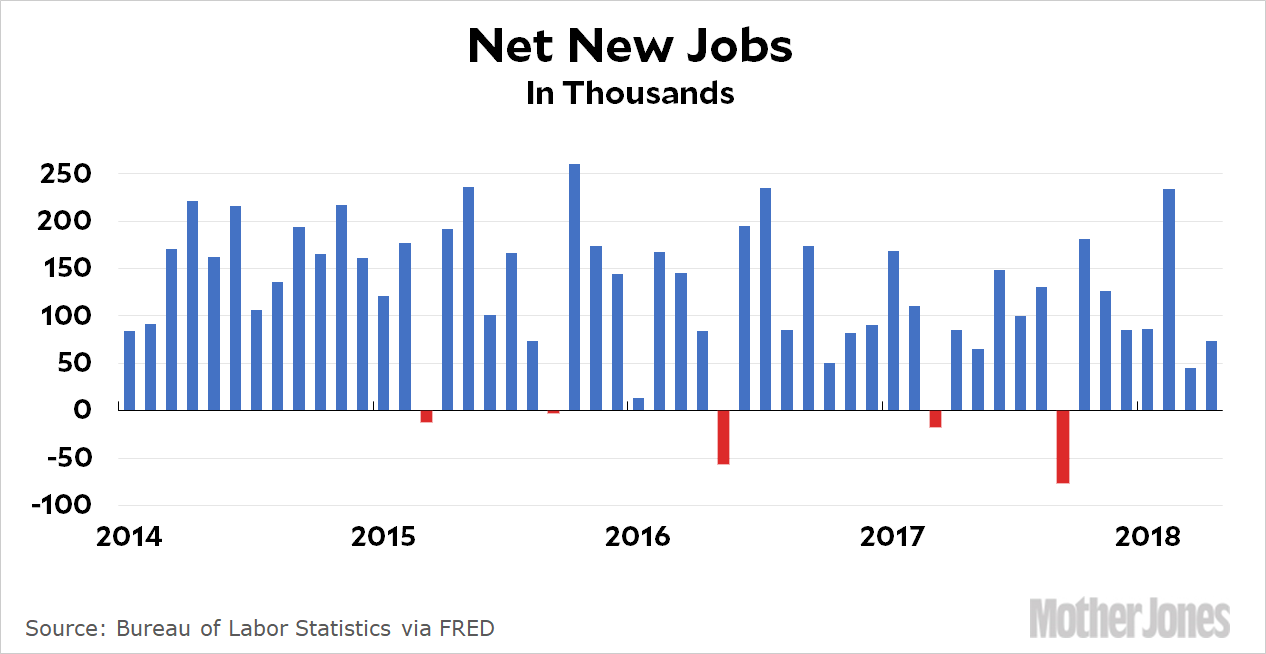
    The American economy gained 164,000 jobs last month. We need 90,000 new jobs just to keep up with population growth, which means that net job growth clocked in at a so-so 74,000 jobs. The headline unemployment rate dropped to 3.9 percent, but this was entirely due to people dropping out of the labor force. The number of employed workers stayed exactly the same and the employment-population ratio dropped slightly. Wages of production and nonsupervisory workers were up 2.8 percent. That’s a little higher than the rate of inflation, so blue-collar workers saw a bit of a pay increase last month.

    This was a pretty weak jobs report. Blue collar wages rose decently, but the drop in the unemployment rate is illusory, generated not by more people working but by more people dropping out of the labor force. The number of new jobs was OK, but nothing to write home about. The whole thing was very meh.

  • Are Millennial Men Slackers? Here’s Another Look.

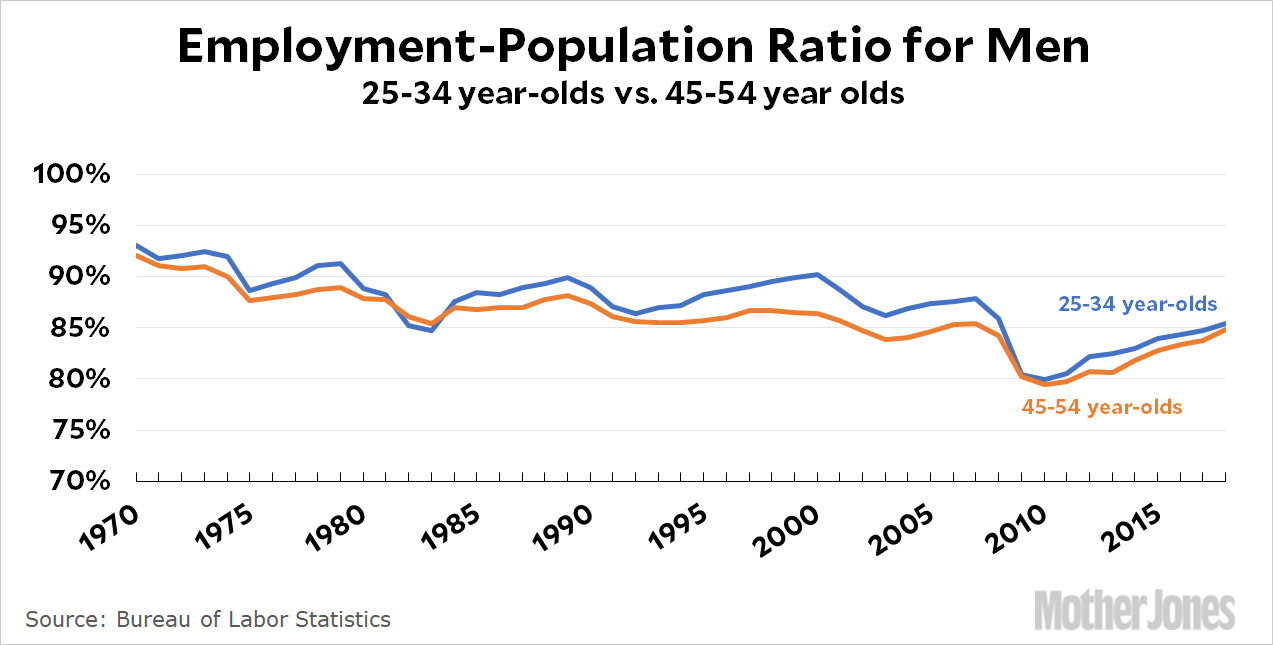
    Yesterday I took up the critical question of whether millennial men really are slackers. Their unemployment rate is pretty normal these days, but I also wanted to check out their employment rate compared to an older generation. I couldn’t quite find what I wanted, but a reader nudged me to try harder, and I eventually found the BLS data I needed. Here it is:

    As we know, the employment-population ratio for men has been declining steadily for decades. The question is, is it declining faster for young men than for older men? The answer is no: both are declining at exactly the same rate. Back in the 70s, young men had a higher employment ratio than middle-aged men by about 1 percentage point. Today, they also have a higher employment ratio by about 1 percentage point.

    So purely in terms of having a job, today’s young men are about the same as young men half a century ago. There’s no evidence of an increase in slackerism.