Fierce, investigative journalism doesn’t happen by accident—it happens because readers like you make it possible. Every dollar you give before midnight Friday to support our nonprofit newsroom will be matched dollar-for-dollar. We can’t do our work without you. Don’t miss this chance!
The deadline’s almost here! Fierce, investigative journalism doesn’t happen by accident—it happens because readers like you make it possible. Every dollar you give before midnight Friday to support our nonprofit newsroom will be matched dollar-for-dollar. We can’t do our work without you. Don’t miss this chance!
I feel like I need to remind people of this periodically:
Donald Trump’s tweets are not aimed at you and me, and analyzing them as if they were will lead you badly astray. They are aimed solely at his core supporters in the electorate and the media.
In other words: don’t think of them as endlessly outrageous and provocative (“How can he say something like that?!?”). That gets you nowhere because you’re starting from the wrong premise. Think of them instead as routine communiques that Trump thinks are necessary to retain his base support. This allows you to analyze their meaning both more accurately and far more interestingly.
A couple of weeks ago Martin Scorsese declared that Marvel superhero movies weren’t cinema. This prompted the usual tiresome round of social media outrage, even though it was obvious from the start that Scorsese’s point depended entirely on the meaning of “cinema.” Sure enough, the whole affair went pffft when he eventually explained what he meant. His generation of filmmakers, Scorsese said, considered cinema to be high art. “There was some debate about that at the time, so we stood up for cinema as an equal to literature or music or dance.”
Since even ardent fans can’t seriously consider Marvel superhero movies to be high art, that was the end of this little kerfuffle. But then Scorsese said something more:
So, you might ask, what’s my problem? Why not just let superhero films and other franchise films be? The reason is simple. In many places around this country and around the world, franchise films are now your primary choice if you want to see something on the big screen. It’s a perilous time in film exhibition, and there are fewer independent theaters than ever.
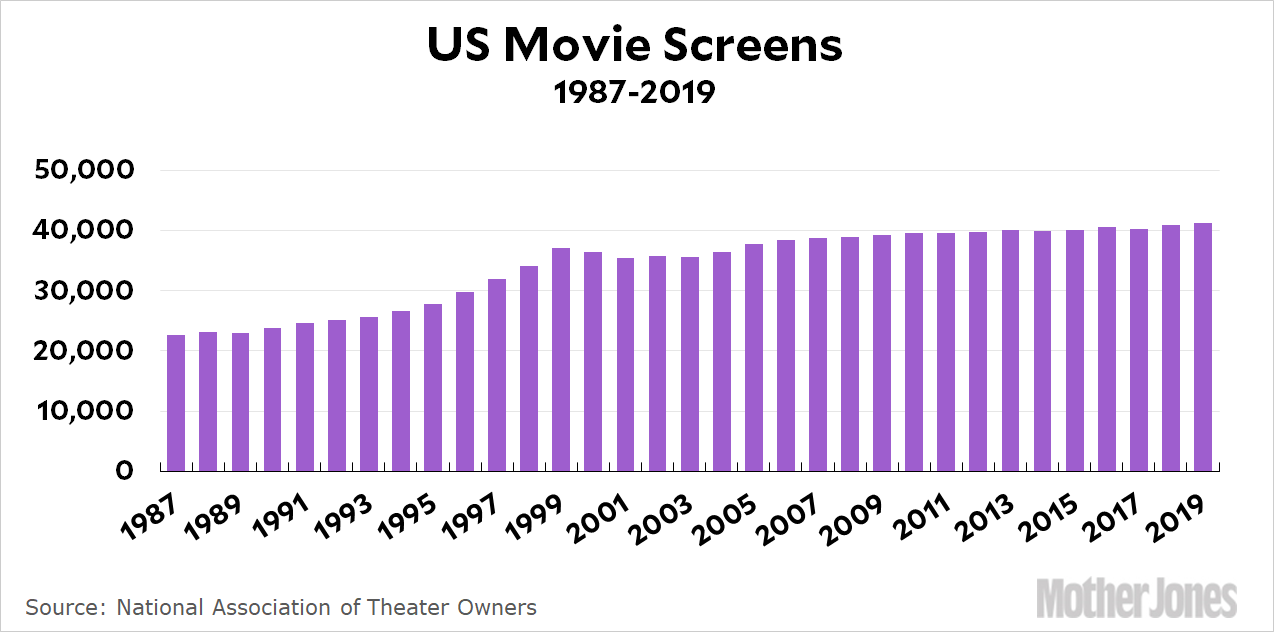
In other words, big tentpole movies are taking over the multiplex and leaving no room for small, high-quality films. But this got me thinking. Is it really true that Scorsese’s kind of cinema is being crowded out these days? Here are a few data points to consider. First, the total number of movie screens has increased steadily over the past few decades:
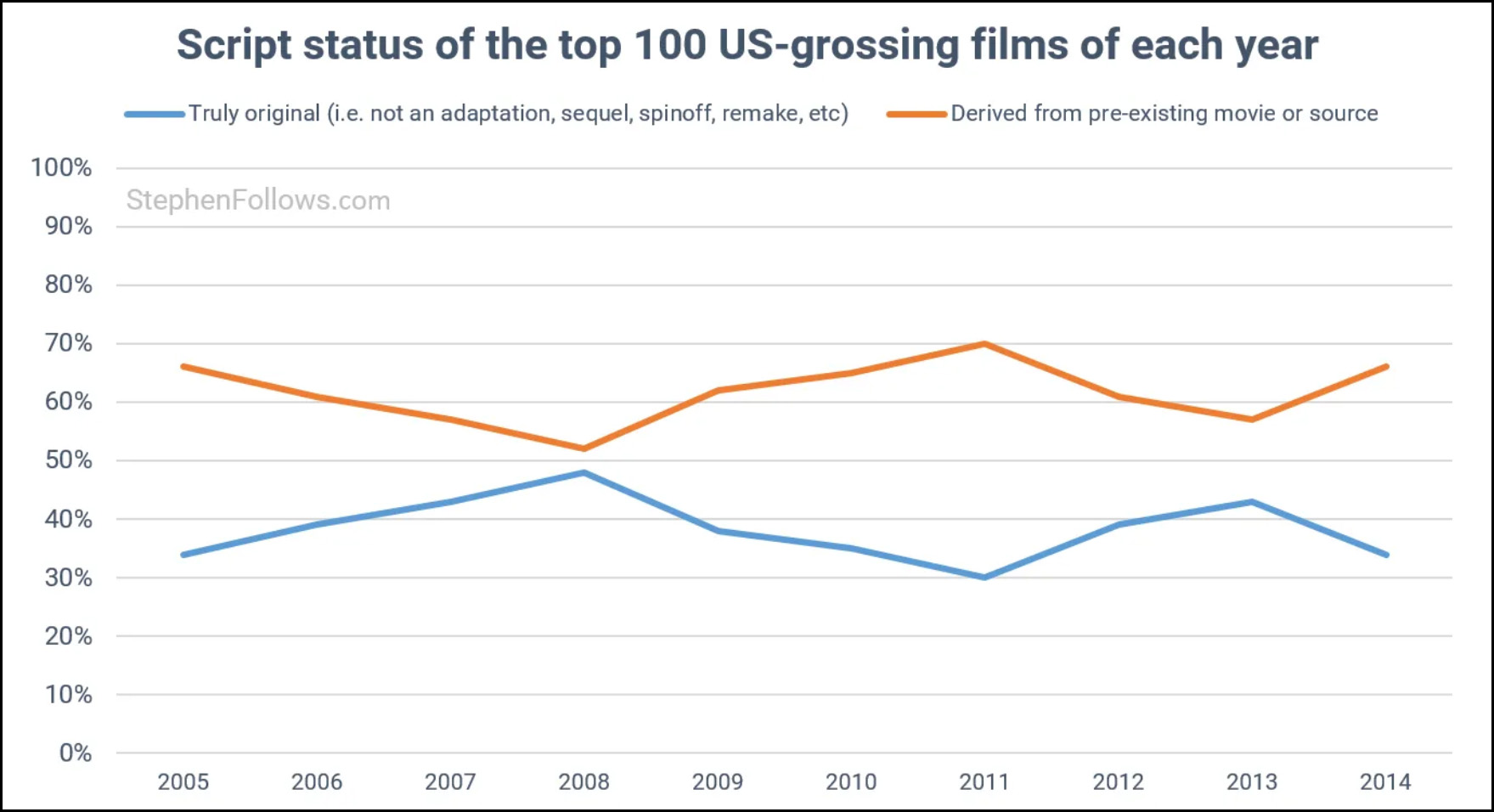
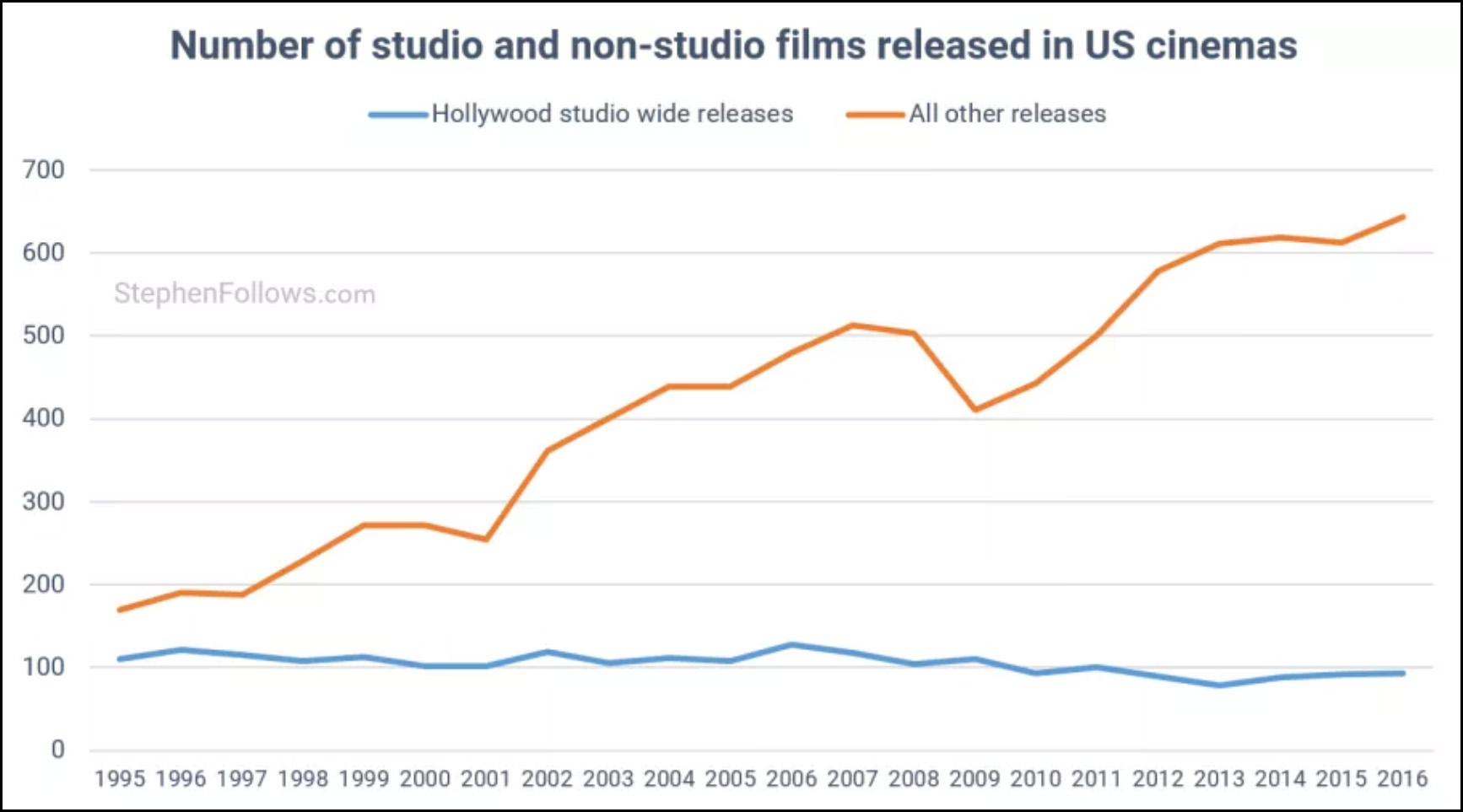
None of this gets us precisely to the problem Scorsese is talking about: namely that franchise movies are taking up all the screens. After all, the number of big studio releases may be the same as it was a couple of decades ago, but they open on more screens than they used to. Without more data, it’s impossible to say for sure how many screen-days are being dedicated to franchises vs. smaller pictures.
Still, given that the number of releases has been stable while the number of screens has doubled, the data suggests that tentpoles and franchises probably aren’t hogging up a bigger share of screens than in the past. Besides, if screens were truly becoming a lot scarcer, it’s hard to explain why the number of indie releases has tripled in the past two decades.
Don’t take any of this as conclusive. It’s just what I was able to find without going too far down a rabbit hole. If anyone knows where to find better data, let me know.
This is another picture of Professor M’s cat Moloko. He is a photographer’s dream: I have dozens of photos of him, and I swear it’s practically impossible to take a bad picture. Moloko is absolutely gorgeous no matter what he’s doing or what angle you’re shooting from.
Real interest rates in the eurozone area have been negative for a while. The proximate cause is simple: Eurozone growth is tepid and inflation is subdued, which has caused the European Central Bank to set its policy rate low as a way of stimulating the economy. The current interest rate is -0.5 percent, and once you account for inflation it’s even lower.
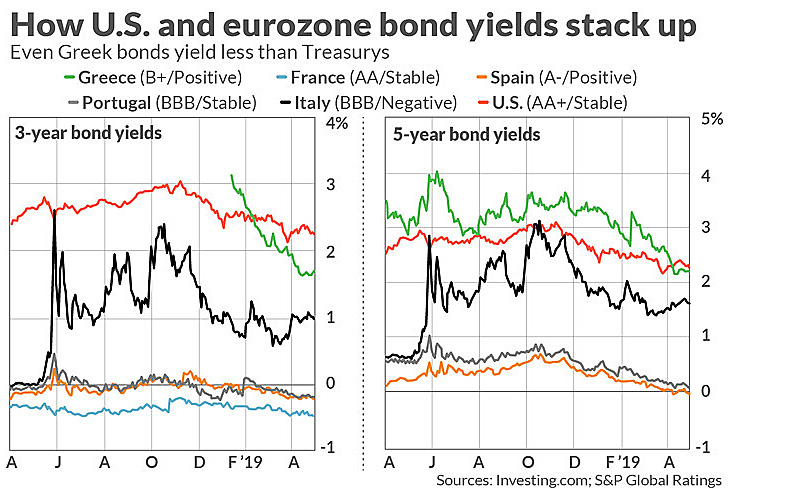
This has a different impact in different countries. In Germany, for example, government bond yields are literally negative. In Greece, which is not as economically stable, yields are positive, but only barely: Greek bonds still pay less than US treasurys.
I was cogitating on this the other day and wondering how this could be. The ECB can set interest rates wherever it wants, but it does no good unless people are willing to buy eurozone bonds with low or negative yields. Why, I wondered, would investors accept a lower yield on the Greek bond than on US treasurys? And why are they willing to accept the even lower yields on the bonds of other eurozone governments? It was all above my pay grade, so I googled to get an expert view. Here is Ashoka Mody:
Even if we stipulate that Greece’s government is, in fact, as creditworthy as the U.S. government, why would investors accept a lower yield on the Greek bond? And why are they willing to accept the even lower yields on the bonds of other eurozone governments?
This made me feel better. Even Mody is confused. He offers up a couple of possible reasons for this state of affairs, but concludes that they make no sense. In the end, the question stands. Why would anyone in their right mind accept a lower yield on a Greek bond than a US bond? Or even a German bond, for that matter? Treasurys are the strongest, safest investments around, and the US economy is in better shape than pretty much any European economy.
So: why does anyone buy Greek bonds? Why isn’t there a huge stampede at every auction of Treasurys? Can anyone point me to a nice, simple explainer on this topic?
As you may have heard, an upcoming film set in the Vietnam era will star James Dean, brought back to life through the magic of CGI. Not everyone was thrilled by this news, and today the filmmaker begged for sympathy:
“We don’t really understand it. We never intended for this to be a marketing gimmick,” director Anton Ernst tells The Hollywood Reporter in response to negative criticism on Dean’s posthumous casting.
If there is a God, Ernst should be struck down where he stands. Is there a single person on the planet who thinks this was anything other than a marketing gimmick?
I dunno. Maybe this is the Trump influence at work. In the past, you had to make your lies at least superficially plausible, but Trump has taught us that this isn’t necessary. In fact, the dumber the lie the better.
Still, this is not as bad as it could be. In another decade or so, the big marketing gimmick will be to use an actual human being to play a small role in a movie. Probably a Kardashian or something.
House Republicans’ latest plan to shield President Trump from impeachment is to focus on at least three deputies — U.S. Ambassador to the European Union Gordon Sondland, Trump’s lawyer Rudolph W. Giuliani, and possibly acting White House chief of staff Mick Mulvaney — who they say could have acted on their own to influence Ukraine policy….The GOP is effectively offering up the three to be fall guys.
So we’ve gone from it didn’t happen to it happened but it’s no big deal to it happened but it was all Rudy’s fault. I wonder what excuse #4 is going to be when this one inevitably collapses?
This is a chaparral sweet pea, also known as a San Diego Sweet Pea, Wild Sweet Pea, Bolander’s pea, Canyon Sweet Pea, Common pacific pea, Pacific peavine, and San Diego Pea. That seems like an awful lot of names for an otherwise unremarkable plant.
April 20, 2019 — Laguna Coast Wilderness Park, Orange County, California
For almost two years, I have complained at intervals that Elizabeth Warren is faking it on healthcare — that is, blaming U.S. healthcare dysfunction entirely on the rapine of health insurers and pharma, while giving healthcare providers a pass.
In presenting her plan to finance Bernie-brand Medicare for All, Warren leads with this rhetorical reflex but then, finally, departs from it. She has to, as the plan’s viability depends on cutting off providers’ most lucrative revenue sources.
Sprung is right, and no universal health care plan will succeed unless it addresses our real problem. Here’s an example:
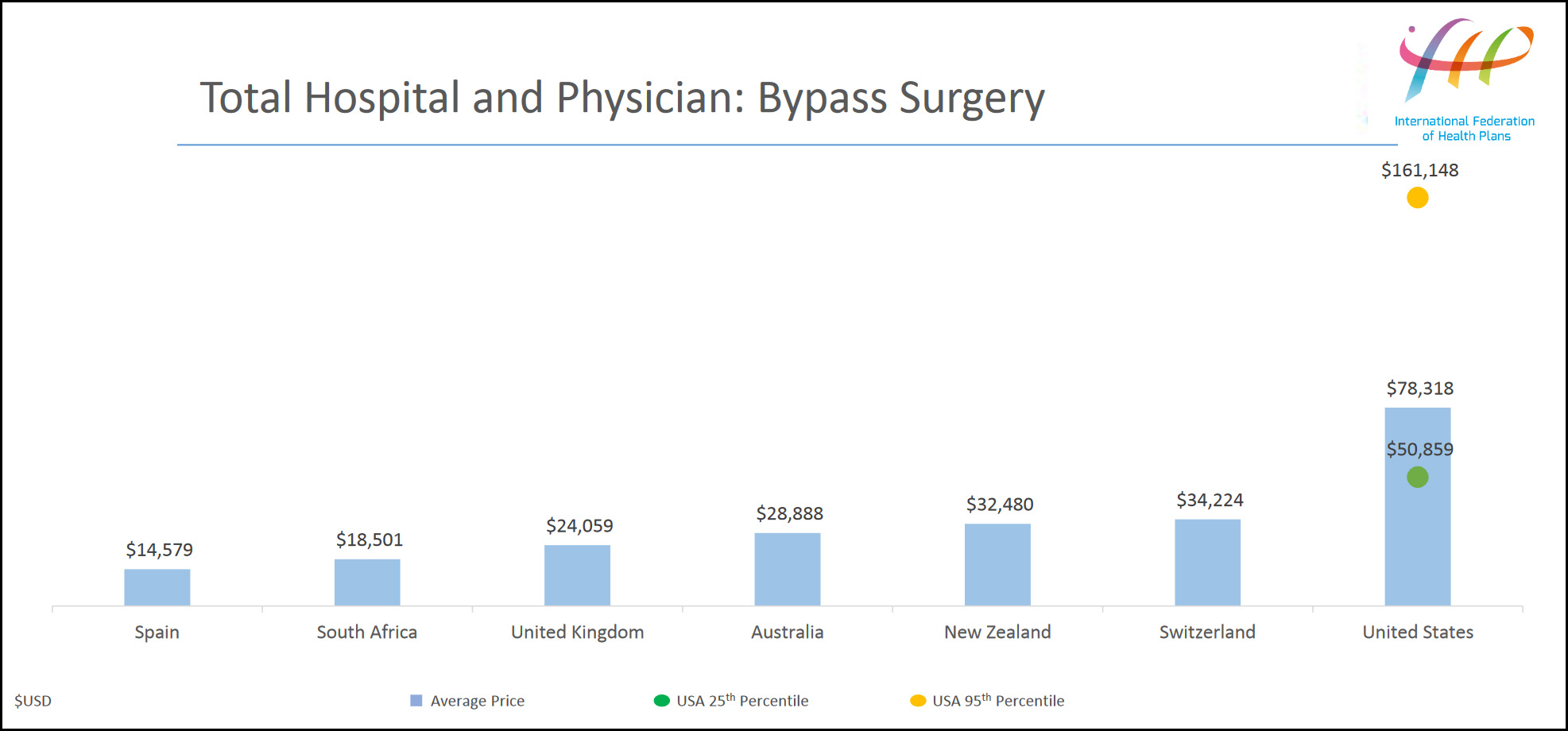
In Britain, a heart bypass costs $24,000. In America the average price is $78,000, and that can skyrocket to $161,000 or more if you’re unlucky enough to get treated at an expensive hospital.
Why? Because heart surgeons in America are paid more. Hospital rooms cost more. Drugs cost more. And, yes, admin costs are higher. This can’t be cured overnight even with the best health care plan, but it can be slowed down and addressed over time. That should be a goal of any universal health care plan worth the name.
As you can see, this donkey did not want to cross the road. And as you might expect, it didn’t. Eventually, though, its owner led it a few hundred yards away and then, for some reason, the donkey was happy to cross the very same road. Mysterious are the ways of donkeys.
UPDATE: This is apparently not a donkey after all. Probably a horse? Opinions differ.
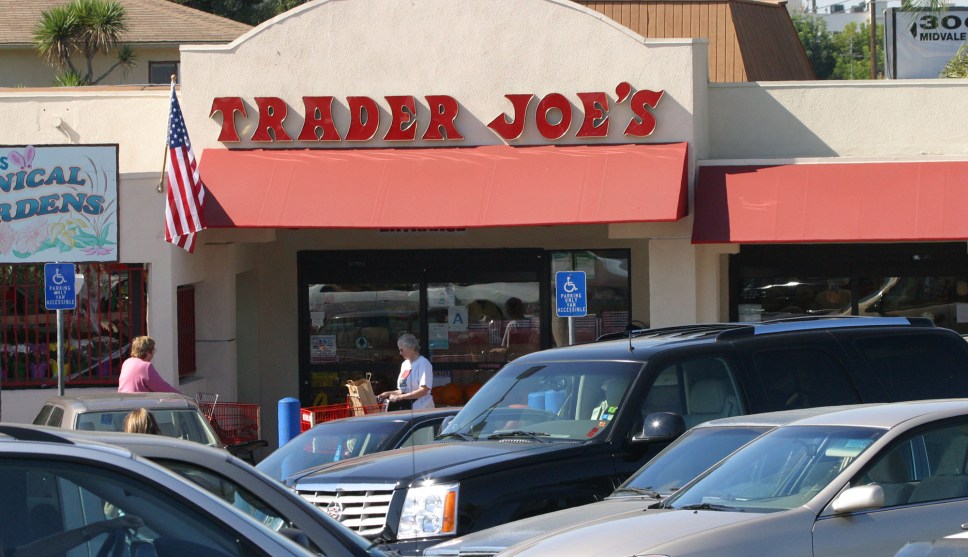
I’ve always been a little curious about how and why Trader Joe’s has acquired such a cultlike status, and over at Vox this morning Rebecca Jennings tells all:
Trader Joe’s does not participate in traditional advertising, never has sales, and is known for frustrating product shortages…. The majority of its products are private label, a.k.a. “generic”…. While most grocery stores carry about 50,000 units of product in store at once, Trader Joe’s typically only has around 4,000…. “People don’t think of [Trader Joe’s products] as generic,” Mark Gardiner, author of the book Build a Brand Like Trader Joe’s told Eater. “[They think] ‘it’s Trader Joe’s — that’s the brand,’ and it’s a special brand that you can only get here. The truth is that almost all of this is stuff that you can probably get at another store within a few miles of that Trader Joe’s in a different package with a different name.”
Basically, they sell a limited selection of generic stuff but they put fun labels on it. Huh.
Can you pitch in a few bucks to help fund Mother Jones' investigative journalism? We're a nonprofit (so it's tax-deductible), and reader support makes up about two-thirds of our budget.
We noticed you have an ad blocker on. Can you pitch in a few bucks to help fund Mother Jones' investigative journalism?