• Republicans Are Sneering at Impeachment. It Will Backfire.

    Tom Williams/Congressional Quarterly via ZUMA

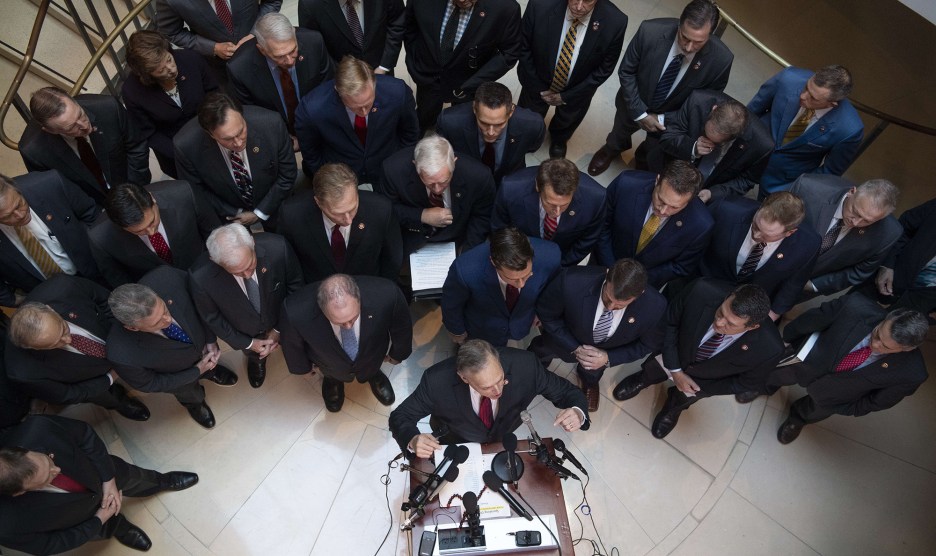
    Marc Thiessen has taken on the thankless task of defending the ridiculous riot Republicans staged on Wednesday, as they gathered in the Capitol basement to protest closed impeachment hearings being held in a SCIF, a room specially designed to be immune to electronic eavesdropping. Let’s hear his case:

    Let’s be clear: There is nothing wrong with holding hearings behind closed doors as long as there is due process. During the Nixon impeachment much of the evidence was presented in closed-door sessions. But there was not a flood of leaks from those executive sessions, as we are seeing today. And unlike today, the minority could issue subpoenas, and the president’s counsel was present to cross-examine witnesses and present evidence. Secrecy and fairness go hand in hand. One without the other is corrupt.

    Funny thing: Thiessen mentions Watergate but fails to mention the Clinton impeachment. Why? Because in 1998 the House barely even bothered to hold impeachment hearings, relying instead on the Starr Report to do its work for them. And needless to say, there were no national security implications to Bill Clinton’s semen stains, and therefore no need for closed hearing held in a SCIF.

    As for leaks, permit me a huge guffaw. Since there were no hearings to speak of in Clinton’s case, there were no leaks either. But that’s because Ken Starr’s shop had been leaking with abandon for months and months while it compiled its report. And let’s not even get started on Republican leaking during the Benghazi and Hillary email affairs. It’s a wonder Washington DC ever dried up after those House investigations.

    Thiessen also says this:

    As American Enterprise Institute President Robert Doar has pointed out, the Nixon inquiry was a model of bipartisan cooperation. The Democratic chairman of the House Judiciary Committee, Rep. Peter Rodino (N.J.), assembled a unified staff (including Doar’s father, John, a Republican whom Rodino appointed as special counsel). The full House voted on authorizing the inquiry. Etc.

    This would be a good point except that what’s changed in the past half century isn’t the partisanship of Democrats but that of Republicans. Faced with overwhelming evidence of presidential malfeasance toward Ukraine, Republicans so far have unanimously refused to give the investigation the time of day. Instead they complain about process; they pass along absurd conspiracy theories on Fox News; and they insist that extorting a foreign country for help with a presidential campaign is a mere peccadillo, not impeachable at all.

    In other words, Thiessen is right about the “partisan nature” of the Trump impeachment proceedings, but the partisan nature is almost entirely on the Republican side. There are a dozen Republicans in the SCIF who have heard all the evidence and participated in the questioning. If there were anything in the testimony so far that was favorable to the president, I can pretty much guarantee they’d be leaking it gleefully. If they haven’t, it’s because there’s been nothing but bad news for Trump so far.

    Let’s cut the crap. These are preliminary hearings. Republicans are participating. They’re being held in a SCIF because there are potential national security issues involved. The evidence against Trump so far is overwhelming. And yet, Republicans refuse to take it seriously. To paraphrase Thiessen himself, “If the facts are on the Republicans’ side, they have nothing to fear from serious and thorough cooperation.” So far we’ve seen nothing of that.
  • A Brief Ukrainegate Timeline

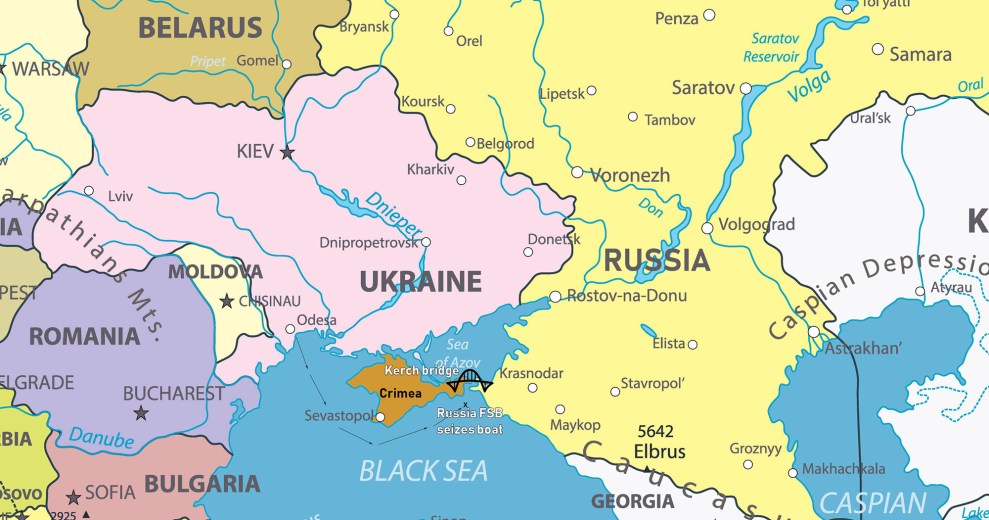
    Ukraine is the big pink country on this map. This is what the articles of impeachment are about.

    Here’s a timeline of the Ukrainegate affair. It is not exhaustive—not even close. There’s a reason for this, but first let’s refresh everyone’s memories:

    Late 2018: Rudy Giuliani talks on the phone with Victor Shokin, the former prosecutor general of Ukraine, who was fired in 2016 because he was so deeply corrupt. Giuliani tells Shokin he’s looking for two things: an investigation into the DNC server hack, which is part of a lunatic right-wing conspiracy theory; and dirt on Hunter Biden and Burisma.

    January 2019: Giuliani meets in New York with Yuriy Lutsenko, the current prosecutor general of Ukraine.

    February: Giuliani meets with Shokin in Warsaw

    April 21: Volodymyr Zelensky is elected the new president of Ukraine.

    May 1: The New York Times reports that Giuliani has discussed the Bidens with Ukrainian prosecutors several times. Giuliani acknowledges that he has kept President Trump abreast of these conversations.

    May 9: Giuliani sets up a trip to Kiev to discuss the Bidens. After his plans become public, Giuliani cancels the trip and reschedules it for Spain. In an interview a few months later, Giuliani at first denies that he asked anyone to investigate Joe Biden, but then turns around and says, “Of course I did!”

    May 20: Marie Yovanovitch, the US ambassador to Ukraine, is recalled because she is seen as a roadblock in the way of getting Ukraine to reopen the Biden investigation.

    Mid July: Trump holds up a military aid package to Ukraine that has already been approved by Congress. He instructs his chief of staff, Mick Mulvaney, to lie to Congress about the reason for the holdup.

    Mid July: A flurry of text messages are exchanged between three men: William Taylor, the new ambassador to Ukraine; Gordon Sondland, a Trump donor who was named ambassador to the EU; and Kurt Volker, a special envoy to Ukraine. Taylor concludes the conversation by saying, “I think it’s crazy to withhold security assistance for help with a political campaign.” In testimony before Congress, he confirms that this was the clear subject of the conversation. In addition to the military aid, the three had also discussed holding up a visit by Zelensky to the White House.

    July 25: Trump talks on the phone with the President Zelensky of Ukraine. After Zelensky says that Ukraine is ready to receive the military aid package, Trump responds, “I would like you to do us a favor, though.” There are two parts to the favor: investigating the DNC server hack and investigating the Bidens.

    July 29: Attorney General William Barr meets with UK intelligence officials about the origins of the Russia collusion investigation. The goal is to cast doubt on the entire Ukrainegate affair by showing that it was an outgrowth of the Russia investigation, which Barr thinks was itself the result of a criminal conspiracy against Trump.

    Early August: The Ukrainians, who have mostly been confused up until now, finally figure out that Trump is withholding the military aid package until they re-open the investigation of the Bidens.

    Late September: Barr visits the Italian spy chief to discuss the Russia investigation.

    October 17: Mick Mulvaney admits at a press conference that the Ukraine aid was held up because Trump wanted Ukraine to investigate the DNC server hack.

    October 23: Ambassador Taylor testifies that President Trump told Gordon Sondland that military aid would be at a “stalemate” unless Zelensky played ball. Trump insisted that Zelensky “go to a microphone and say he is opening investigations of Biden and 2016 interference.”

    My point here is not to recap every detail of how Ukrainegate has played out. My point is to show that this was no spur-of-the-moment outburst from President Trump. He’s clearly been obsessed by it for nearly a year, and he’s involved a wide cast of characters: Giulani, Taylor, Sondland, Volker, Mulvaney, Barr, Yovanovitch, Shulkin, Lutsenko, and a number of others.

    This is what makes Ukrainegate such a big deal. It would be bad enough if it were just a typical Trump outburst, soon forgotten by all involved. But it wasn’t: it’s been a wide-ranging, year-long effort to extort a foreign country to smear a political opponent. If that’s not impeachable, nothing is.

  • Algorithms Can Be Racist, But At Least They Can Be Fixed

    Octavio Jones | Times/Tampa Bay Times via ZUMA

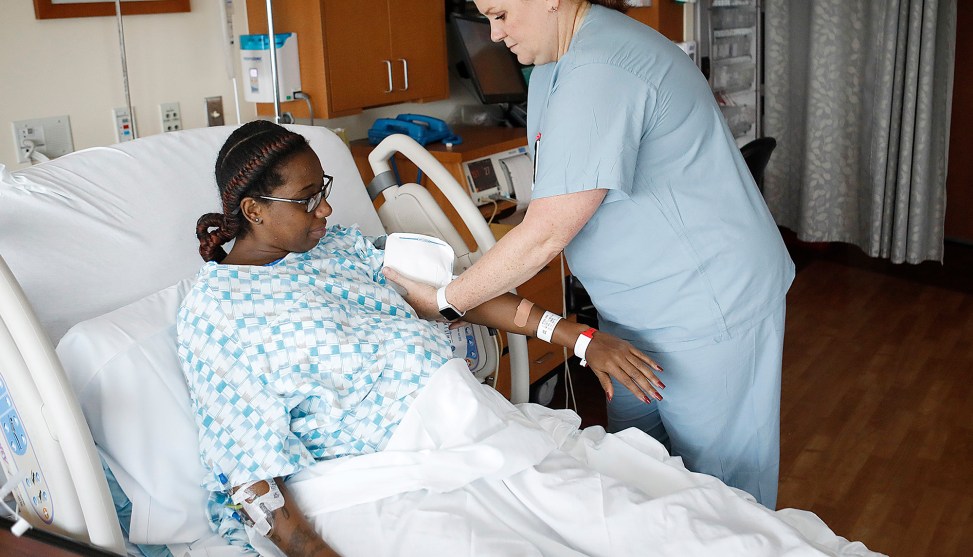
    The Washington Post reports today on a piece of research that detected a racial bias in a widely-used algorithm that predicts which patients need extra medical attention:

    The algorithm wasn’t intentionally racist — in fact, it specifically excluded race. Instead, to identify patients who would benefit from more medical support, the algorithm used a seemingly race-blind metric: how much patients would cost the health-care system in the future. But cost isn’t a race-neutral measure of health-care need. Black patients incurred about $1,800 less in medical costs per year than white patients with the same number of chronic conditions; thus the algorithm scored white patients as equally at risk of future health problems as black patients who had many more diseases.

    There’s both good news and bad news here. The bad new is obvious: it’s hard to know which seemingly race-neutral metrics might, in fact, rely indirectly on race. In this case, by using dollar amounts, the algorithm favored white patients who are generally more affluent and spend more on health care to begin with.

    The good news is a little more subtle, but still genuinely good. The alternative to algorithms, of course, is human judgment. But human judgment also tends to be racist, even among those who have only the best intentions. The difference is that it’s really hard—close to impossible in many cases—to change human behavior in the short or medium term. So the racism continues even if we know it’s there.

    With a computer algorithm, however, careful study can often identify biases—and once those biases are uncovered, they can be fixed. In this case, developers are already at work on a better algorithm. Compare that to the years and years it would take to fight human racism with bias training and diversity programs and so forth, with no guarantee even then of success.

    So two cheers for the algorithm revolution. Digital algorithms aren’t perfect, but they’re a damn sight better than most wetware algorithms.

  • Lunchtime Photo

    This is a picture of the Spectrum, a local shopping center, taken through the window of a new parking structure at the south end. I was there one day and saw this view and thought it looked interesting, so the next time I had business at the Spectrum I brought my camera.

    As is so often the case, getting this picture right was harder than I expected. Not just any window would do, it turned out, and once I found the right one I had trouble with placement and focal length and several other things. I had figured it would be a two-minute operation, but I ended up spending more than half an hour on it.

    Was it worth it? Well, I was there anyway and I didn’t have any pressing business at home, so I guess so. At the very least, it was good practice.

    July 18, 2019 — Irvine, California
  • IG Says VA Whistleblower Office Mostly Screwed Whistleblowers

    Brittany Murray/SCNG via ZUMA

    Ukrainegate is deservedly monopolizing the headlines right now, but let’s not forget all the garden variety corruption still going on under the Trump administration. Take the Department of Veterans Affairs, for example. A couple of years ago President Trump set up an office to protect VA whistleblowers and encourage them to come forward. That’s a great idea for an agency that’s obviously had a lot of problems.

    But Trump, of course, has a very personal view of whistleblowing: it only counts if it’s whistleblowing against enemies, not friends. The guy in charge got the message loud and clear:

    The office’s first executive director, Peter O’Rourke, instead used his position to stifle claims and retaliate against the employees the new organization had been designed to protect, the IG report found. Mr. O’Rourke, who once directed a conservative political action committee and then consulted for the VA, leveraged his power as head of the whistleblower office to end investigations into allies and failed to provide basic reports to Congress on the office’s operations, investigators said.

    Mr. O’Rourke eventually rose to acting secretary of the VA before leaving the department last year. He is now the executive director of the Florida Republican Party.

    Even Richard Nixon never quite leveraged the federal bureaucracy to screw his enemies as systematically as Trump seems to have done. It’s really pretty remarkable.

  • Ukraine Knew All About Trump Extortion

    Yuri Gripas/Zuma

    Everyone already knows about this, but since I was out of pocket yesterday I’m going to mention it just for the sake of keeping a complete impeachment record. The Trumpsters claim that Ukraine never had any idea why their military aid package was being held up, but Ken Vogel reports that, as usual, they’re lying:

    Word of the aid freeze had gotten to high-level Ukrainian officials by the first week in August, according to interviews and documents obtained by The New York Times. The problem was not bureaucratic, the Ukrainians were told. To address it, they were advised, they should reach out to Mick Mulvaney, the acting White House chief of staff, according to the interviews and records.

    ….As Mr. Taylor’s testimony suggests, the Ukrainians did not confront the Trump administration about the freeze until they were told in September that it was linked to the demand for the investigations. The Ukrainians appear to have initially been hopeful that the problem could be resolved quietly and were reluctant to risk a public clash at a delicate time in relations between the two nations.

    And what’s the Republican response to this? About what you’d expect:

    Senate Judiciary Chairman Lindsey O. Graham (R-S.C.) advertised a news conference Thursday to announce a resolution condemning the House impeachment inquiry, as partisan rancor continued to escalate over the Ukraine scandal.

    “Partisan rancor.” Uh huh.

  • Lunchtime Photo

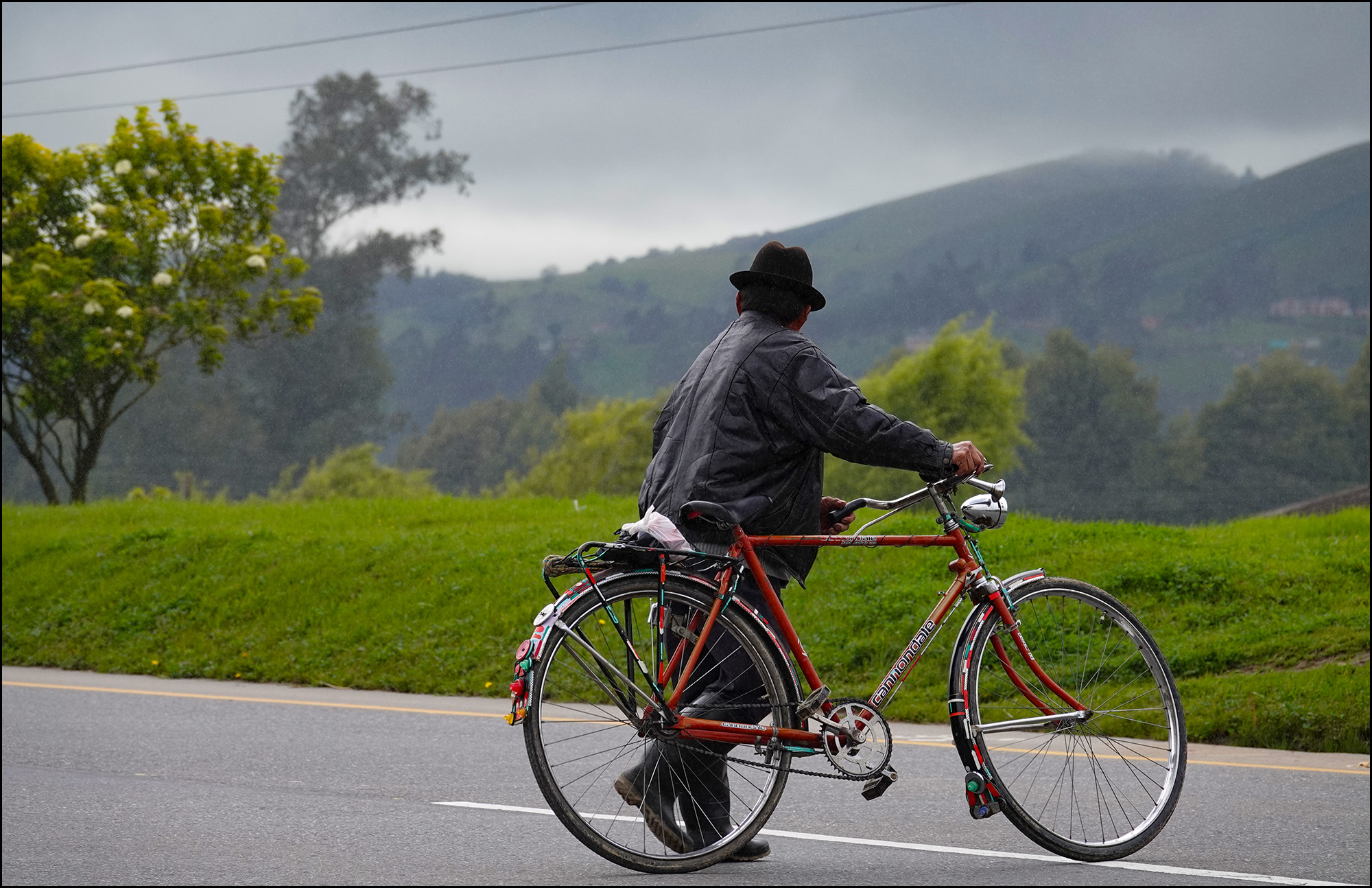
    This is a picture of a bicyclist crossing the highway near Chocantá, Colombia. I’m not quite sure why it appeals to me so much. The composition is good, and the hazy background is nice. Beyond that, though, I feel as if I like it more than I should. De gustibus.

    August 5, 2019 — Chocantá, Colombia
  • Ukraine Ambassador: Yes, There Was a Direct Quid Pro Quo

    Tom Williams/Congressional Quarterly via ZUMA

    Bill Taylor, our ambassador to Ukraine—i.e., our actual ambassador, not one of the many hangers-on who screwed around there like callow children—testified before Congress that, hell yes, President Trump held up aid to Ukraine until they agreed to investigate Joe Biden’s son:

    In a 15-page opening statement, obtained by The Washington Post, Taylor repeatedly expressed his shock and bewilderment as he watched U.S. policy toward Ukraine get overtaken by Trump’s demand that newly elected president Volodymyr Zelensky “go to a microphone and say he is opening investigations of [Democratic presidential candidate Joe] Biden and 2016 election interference.”

    “ ‘Everything’ was dependent on such an announcement, including security assistance,” Taylor said he was told by Gordon Sondland, U.S. ambassador to the European Union.

    If Republicans want to keep on pretending that this didn’t happen, I suppose there’s no way to make them stop. But obviously it happened. The evidence is overwhelming.

  • Lunchtime Photo

    This is a California shrub deerweed. I saw several of these in Colombia too, though I suppose it might have been the very similar coastal deer broom. Unfortunately, I didn’t take a picture, so I’ll never know for sure.

    April 20, 2019 — Laguna Coast Wilderness Park, Orange County, California