• Pharoahe Monch’s “Fight” Takes a Torch to the Moving Targets of American History

    Pharoahe Monch and Th1rt3en; Marcus Machado and Daru Jones

    On the morning after media outlets reported that Joe Biden had won the 2020 election, Pharoahe Monch tweeted a parting message to the dearly departing 45th president: “SIMON SAYS! GTF(OUT)!” The hip-hop luminary shared a video of voters dancing in the streets of New York City to a verse made immortal by Monch, with everyone chanting, “Simon says, Get the fuck up! Throw your hands in the sky.”

    “It’s an honor to be a part of the global soundtrack” of celebration and repudiation, Monch said, telling me days later about the thrill of hearing his signature sounds lit up by voters affirming “their choice in a democracy with this record.”

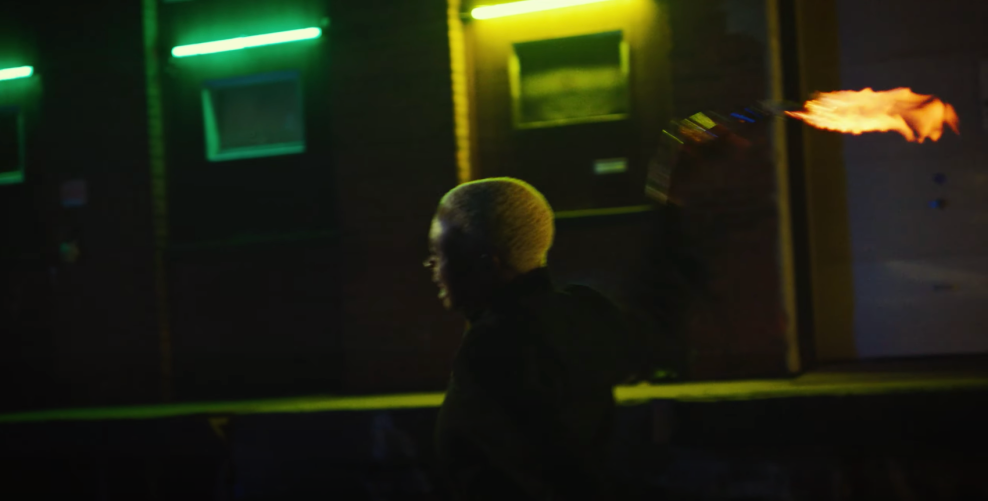
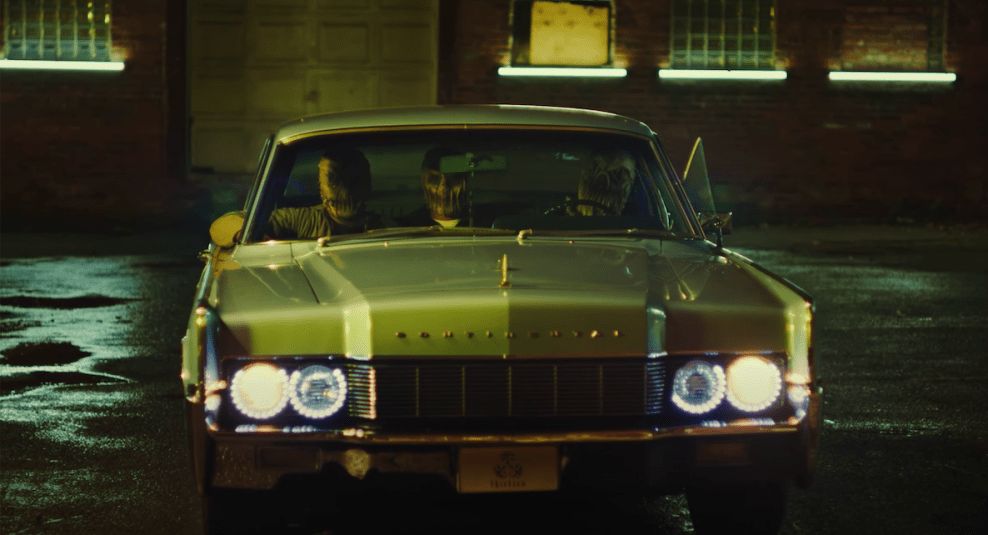
    His latest single, “Fight,” expands his range as emcee and filmmaker in a fiery collaboration with Cypress Hill. It’s an explosive song set to a short film of a Molotov cocktail hurling in slow motion. The lyrics and visuals are all flames—action, horror, vengeance, Klan robes set ablaze. But what makes “Fight” so intricate, and Monch so subtle a storyteller, isn’t the imagery alone; it’s the scrambling of storyline, themes, and characters. Just as the Molotov is thrown in what looks like the direction of a cop’s house, with his family inside, there’s a hard pivot. The plot changes. Targets and concepts move. The near-flattening of action into a binary—heroes and monsters, saints and sinners—takes a detour. “Fight” becomes a call to action, but it’s a call to get the targets right.

    Pharoahe Monch and Th1rt3en
    Pharoahe Monch and Th1rt3en
    Pharoahe Monch and Th1rt3en
    Pharoahe Monch and Th1rt3en

    The originality of “Fight” is in its use of an external fight to wage an internal one, an unpacking of what justice can look and sound like. “We were shooting this scene of a young lady lighting a Molotov,” he tells me. “It’s shot really slow. She throws it a couple times. She’s apprehensive, tired. She’s lighting it, lighting it.”

    “Cut!” Monch approaches her. “When you throw this bottle, throw that shit! Throw it with who you are.”

    After another take, “she started to tear up. She broke down. There’s a young kid on the set looking at me, and she’s crying too. The assistant director was like, ‘Do you know what we just got here?’ Then I started crying. It was powerful.”

    The production coordinator, Zoi Ellis, tells me about the pin-drop silence, the emotional and historical weight of the moment: “It was the most incredible production I’ve ever been a part of…There weren’t many dry eyes on the set.”

    “That’s what we were dealing with,” Monch says. “They’re like, ‘Yo, Pharoahe’s crying too.’ That was just another fucking dope thing. We were all in tears. I still feel this energy, the vibrations and rhythm that feel like a pendulum swinging back and forth. America is so divided right now.” Asked how to build a movement of unity through music, he points away from the trappings and tripwires of social media: “So much nuance is lost there, but music can bring that conversation with nuance. It feels like we’re designed to be divided purposefully.”

    “This Trump guy, knowing who he is and how he riled up his base, I have a more spiritual and global humanity and want to think collectively, like how do you exorcise the darkness that has transpired?”

    Our conversation veers from rap to film to jazz in a three-way call with another filmmaker, Nat Livingston Johnson of the directorial duo Peking. I invited Johnson into the call to hear two of today’s talented filmmakers trade notes about their storytelling styles: similarly raw emotional depth, intricate detail, tense pacing, cinematically tight story arcs. Answering a question from Johnson about how to reconcile rap’s roots of justice with a few hip-hop stars’ endorsements of Trump, Monch doesn’t single anyone out. Instead he critiques the warping effects of fame and fortune: “We’re all jaded with the pretentiousness of hip-hop and art in general right now. When you look at art, you have to ask yourself, ‘Are you trying to fool me? Are you trying to get me to buy something? Are you trying to get me to click somewhere? What is this?’”

    “If you’re this huge star and live in the hills and have a mansion, I don’t understand what I’m even looking at,” Monch says. “I don’t understand why I’m supposed to be invested in that. I’m like, yo, let’s go heavy art instead and campaign with it and move to the person who appreciates that type of musicianship that evokes that I’m serious about this shit.”

    Monch has built the loyalty and trust of diehard fans by opening up about his struggles and growth. “But it took me time to be like, yo, I’m not lying. I’m sending this shit to all my friends. I discovered some shit and I want to share it with someone. I want that feeling.”

    “Fight” is both hip-hop power and rock-star eruption, fueled by the guitar of Marcus Machado and the drums of Daru Jones. Beyond rap and film, Monch has recorded with jazz musicians Robert Glasper and Marcus Strickland and absorbed elements of John Coltrane’s tenor. “Coltrane was one of my main influences when I was developing my voice. His bending the note, breath control, his sheer expression of emotion.”

    Breath control means survival for Monch, who’s lived with asthma since childhood, a condition he raps about in “Still Standing”:

    13 months old with a lung disease
    That almost took my life twice,
    Brought me to my knees,
    A system not designed for you to achieve.

    If “Still Standing” is a story of breathing to survive, “Fight” is about surviving to breathe, persevering under the threat of cop corruption away from cameras:

    This little piggy killed a minor.
    Same piggy got paid to stay home.
    This next pork chop removed his bodycam
    And he aimed his Glock at my dome.

    Monch moves “beyond the pen and paper,” he tells me. “It’s how you express yourself in the literature and tones.” He welcomes “coming to your own conclusions” about whether “Fight” resolves or reinforces the tension it shows. “I like that about art generally. At its best, you’re standing in a museum looking at a painting for 15 or 20 minutes and think about what it means to you, and someone can look over your shoulder and see something completely different.”

    Th1rt3en’s debut record, A Magnificent Day for an Exorcism, is scheduled to be released on January 22, 2021.
  • Banjo Player Jake Blount Challenges Genres and Questions Historical Narratives in “Spider Tales”

    For nearly a century, the musicians playing and promoting old-time string band and bluegrass music have tended to be white. That’s not merely a cultural trend, explains Jake Blount, a Black fiddler and banjo player who also has a degree in ethnomusicology. As he told me for a recent piece:

    In the 1920s, record labels began differentiating between “race records” and “hillbilly music,” sometimes erasing Black musicians from the hillbilly records by not crediting them. “They recorded Black people playing blues and jazz, and white people playing fiddle and banjo music. They marketed the Black people to Black people and the white people to white people,” Blount says. “By doing that, they created a financial incentive for those traditions to stop interweaving with one another and stop communicating.”

    This segregation catalyzed a Black exodus from old-time music during the 20th century, even though Black musicians were the ones who had helped alchemize the homegrown concoction of English ballads, Celtic fiddle songs, blues and spirituals, and African instrumentation that eventually gave rise to country and bluegrass music.

    Blount is part of a new generation of artists picking up where their ancestors left off. With his 2020 album, Spider Tales, one of my favorite of the year, Blount summons a rich history of American folk songs written and sung by Black and Indigenous musicians, tunes that have been there throughout the history of this country even if they were obscured, underpromoted, or drowned out, or audiences simply weren’t paying enough attention. “I see my role as someone who’s in the middle of all of those genres,” Blount says, “to start to undo that damage and put these things back in dialogue with one another.”

    Listen to some of Blount’s songs and read my interview with the musician here.

  • Before You Clock Out of 2020, Catch Saxophone Giant Frank Morgan’s Birthday Celebration

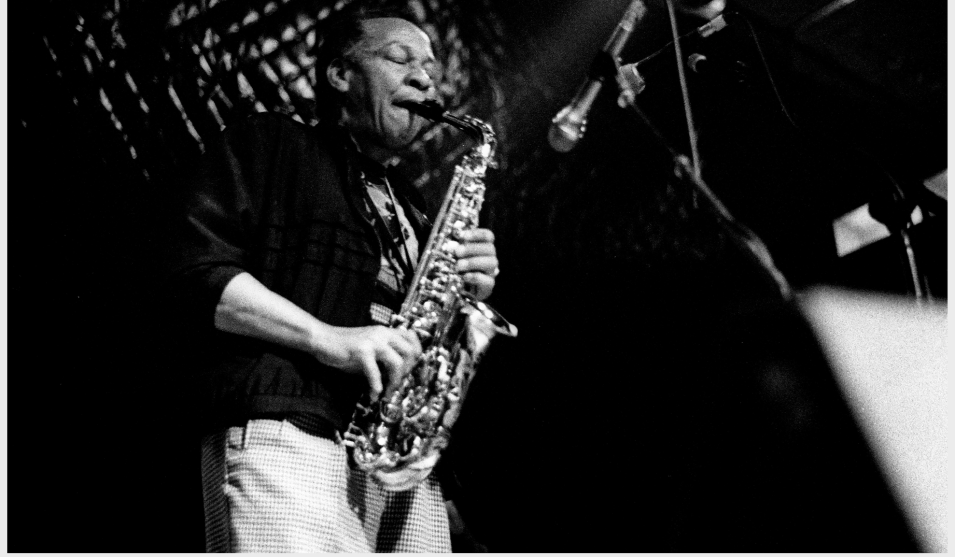
    Alto saxophonist Frank MorganJazz Services/Heritage Images/Getty

    “The last time I saw Frank Morgan onstage, he, at one point, put down his sax and asked the crowd, ‘It feels great to be alive, doesn’t it?’” wrote Tempo magazine’s Deonne Kahler in 2006, perfectly summing up the alto pioneer’s approach to sound and connection. Morgan got his start as Charlie Parker’s protege and shared stages with Billie Holiday and Lionel Hampton, sculpting alto improvisations that were ethereal, loosely lyrical, and conversational. He played with ease. He soloed like speaking, and he had range, from the uptempo pivots of bebop to the quieter ballad touch on collaborations with Abbey Lincoln, who sings on his Antilles album A Lovesome Thing. (Morgan also plays on her 1997 Who Used to Dance, worth catching, with saxophone turns by Oliver Lake and Steve Coleman.)

    In honor of Morgan’s birthday today (he died in 2007), the Frank Morgan Taos Jazz Festival premieres online, entering its fifth year remotely during the pandemic, at 9:30 p.m. ET / 6:30 p.m. PT. Keep an eye out for Grace Kelly with George Cables. Here’s a start, if you’re new to the alto giant. Birthday wishes welcome: recharge@motherjones.com.

  • A Drive-Thru Customer Attacked a Worker for Unwanted Ice in a Drink. Thousands in Tips Rolled In.

    Who in their right mind throws a soda at someone working in a fast-food restaurant’s drive-thru window—a worker who is six-months pregnant, during a pandemic, no less—all because they didn’t want ice in that drink? Tips rolled in from across the world after a witness saw what happened and asked if she could help. She’d approached the worker in suburban Atlanta, saw that she was shaken and soaked, and offered to support her. A social media post drew a huge response, reported by Tricia Escobedo of CNN. “I have a surprise for you,” the witness told the worker before mailing an envelope of cash.

    “She gave me the envelope and I couldn’t do nothing but cry because I wasn’t expecting that,” the worker said. A hat tip to Escobedo for amplifying the story. I’d shared this summer the news of a customer berating a barista for asking her to wear a mask, followed by $32,000 in tips; a $1,300 tip for a Texas server; an Arkansas worker landing a customer’s $1,200 stimulus check; bakery workers scoring a $1,000 tip in Florida; $93,000 for a server who’d defended customers on the receiving end of drunkenly spewed racist comments by another customer; $3,000 on a $124 tab for a New Orleans bartender; $1,600 on a $99 tab in Ottawa; $1,000 on a $43 tab at a New Jersey restaurant; $330 from one server to another; and a pizza deliverer welcoming $100 on a less-than-$30 tab.

    But the underlying pay structures, working conditions, and health care access aren’t equitable or sustainable, giving occasion to these headlines in the first place. If you have stories of support and solidarity, send them this way: recharge@motherjones.com.

  • From Our Archives, Roger Wilkins’ “White Out”

    Each Friday, we pull articles from our archives to propel you into the weekend.

    “I knew no black people—young or old, rich or poor—who didn’t feel injured by the experience of being black in America,” wrote Roger Wilkins in his 1982 biography. In 1973, he won a Pulitzer Prize for his editorials about the Watergate scandal. In the 1960s, he worked in the Lyndon B. Johnson administration. His close personal mentor was Thurgood Marshall. Wilkins was also a regular contributor here at Mother Jones.

    He wrote for this magazine in 1992 a piece titled “White Out.” In it, he describes “an even bigger hurdle” than 1960s segregation, to his mind: “the power of whites to define blacks.” (Throughout, when quoting, I am adopting Wilkins’ use of a lowercase “b” for Black; our magazine’s style now, and my belief, is that an uppercase Black is better suited.)

    He describes how he’d noticed, from talking with his white students (Wilkins taught at George Mason), that “many suburban racial attitudes have actually rolled back to something like the fifties.” He remembers how in more “innocent” days, before integration, racism would be thought of not as systemic, but as “individual.”

    “We believed that the power to segregate was the greatest power that had been wielded against us,” he writes. “It turned out that our expectations were quite wrong. The greatest power turned out to be what it had always been: the power to define reality where blacks are concerned and to manage perceptions and therefore arrange politics and culture to reinforce those definitions.”

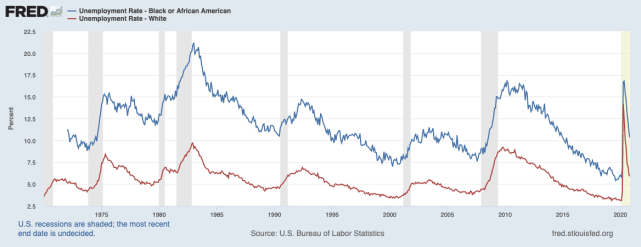
    It reminded me of the argument made in a recent essay for this magazine that so-called “cultural” concerns cannot be so easily cleaved from the material. They are intertwined. For example, Wilkins notes that the Black unemployment rate in the United States in the early 1990s had never gone below 10 percent since the early 1970s.

    I looked up the current numbers. That’s no longer true. It has gone below 10 percent. But, still, look at the vast gulf over the past 50 years between the Black unemployment rate and the white one.

    Except at the very peak of the pandemic, the Black unemployment rate is close to double the white one. As the economy has pseudo-normalized into its active inequality, that gap has reasserted itself.

    Wilkins, in discussing racism, never separates these two concerns; he wants to change material policies: “For me and other black people, there is nothing to do but stay the course. That means, more than anything else right now, fighting to get decent jobs for poor blacks, fighting for support for poor families and for good education for black children,” he writes. And he wants to enact cultural change. “What can I say to decent white people? I think the best answer is what so many whites invariably preach to us—self-help… We can’t save white folks’ souls. Only they can do that.”

  • Prince, Quincy Jones, Madonna: Looking Back at the Music of 1984

    Just 14 days left in 2020. Speed things along with a round of recharges:

    1. Michaelangelo Matos’ phenomenal new book is out. Can’t Slow Down: How 1984 Became Pop’s Blockbuster Year is a detail-rich read on the constellation of music that shaped a moment, and how a moment shaped the music. His scene-setting, pattern-matching, vivid turns of phrase, and historical vision are every bit as electrifying as the music he’s immersed in. A deeper-dive review in the weeks ahead.

    2. Gabi Yetter, a Recharge reader and founder of “The Good in Us,” a Facebook group dedicated to deeds of solidarity worldwide, has published her first novel. Whisper of the Lotus is set in Cambodia, where Yetter used to live. All proceeds from the first two months of book sales go to the antitrafficking organization Justice and Soul.

    3. In a crowded field of candidates for funniest folks of 2020 who’ve made the best of an excruciating year, comedian Leslie Jones stands out.

    4. If you haven’t spelunked yet through Yesterday’s Print, dig in. Archival news clips with a bite. From 1918: “The man who is unwilling to wear a flu mask usually is of the kind who expects everybody to listen to him when he speaks.” Also from 1918: “Don’t throw away the masks. Two of them tied together will make excellent ear muffs later on.”

    5. A headline that sands down the cynicism of any cold news-junky heart: “Over 900 Cars Paid for Each Other’s Meals at a Dairy Queen Drive-Thru in Minnesota.” What? What? And no one called me? I don’t like Dairy Queen anyway. “What started as a random act of kindness…resulted in over 900 cars also taking part in the pay-it-forward chain,” reports CNN’s Alisha Ebrahimji.

    6. The Arizona Daily Star and ProPublica teamed up yesterday to host a livestream of stories about developmental disabilities, boosted by the National Center on Disability and Journalism.

    7. “A small dam but a big deal,” a colleague told me in celebrating the news of a 100-year-old dam’s removal from a former golf course to improve salmon migration.

    Share your own good news at recharge@motherjones.com.

  • Roasting Cable News With Top Tweets From Comedian Leslie Jones

    Thank us later, but right now you have some gifts to unwrap: 15 below, each a bitingly funny video by the comedian and Saturday Night Live alum Leslie Jones. Your mileage will not vary; these are guaranteed howlers, home recordings of Jones watching cable news and adding piercing commentary about broadcasters’ home-video backgrounds:

    Take 1, to which her target and friend Tim tweets back, “Every time you tweet about my ponytail it only gives it more strength.” Leslie: “You can be you Tim you can be you the schuchie ain’t you.”

    Take 2, with love lost for intercoms.

    Take 3, with love gained for storage rooms.

    Take 4, with love lost for purple ties.

    Take 5, with love…gained? lost?…for an office library.

    Take 6, with love of a kind for James Carville.

    Take 7, an expression worth a million retweets.

    Take 8, with love (love?) for skeletons.

    Take 9, with no apologies to kitchens.

    Take 10, with an eye for eyeglasses.

    Take 11, an interior design salute to the Costa family.

    Take 12, an interior design salute to the Pettypiece family.

    Take 13, for when you live in a courthouse.

    Take 14, for when you wear bowties at home.

    Take 15, “Landlines are always my jam!!”

  • Day Care Workers Are Saving Lives and Risking Their Own. A Striking New Film Highlights 3 of Them.

    The timing couldn’t be better for Through the Night, released days ago as an intimate and urgent portrait of three women crossing paths at a day care center. Directed and produced by Sundance fellow Loira Limbal, the story highlights a mother working overnight at a hospital, another working three jobs to support her family, and a woman who’s been caring for kids for 22 years. As personal and situational as the story is, it’s a call to action for supporting the millions of front-line workers outside the film’s frame. The pacing, arc, and treatment of themes around economic and social struggle, and the mutual recognition and resilience, are a fitting mirror to the tail end of 2020.

    The trailer and full film are here. A portion of ticket sales is donated to the Essential Care Fund in support of child care providers nationally.

  • A Holiday Email Accidentally Sent to the Wrong Recipient Turns Up a Surprise Gift

    Just 17 days left in 2020. Enter the final lap with a story from reader Tammy Maitland of Albuquerque, New Mexico, who writes in to say that instead of trading holiday gifts, she suggested her family “make donations to nonprofit organizations in each other’s names.” But she accidentally emailed a different person with her brother’s name. The unintended recipient was 5,200 miles away in Stockholm (her siblings are in Boston). “He let me know, and I apologized, but a few days later he wrote back to say that he was inspired to make his own donation to an organization that helps homeless children.”

    “It really gave me a boost that he did that,” she said. “Maybe this story could help people get inspired to make donations if they are able.” And if you’re not able, forward this to one person you know or don’t know. More lifts to enter the week:

    100th birthday. Happy centennial to Clark Terry. The trumpeter lit up more than 900 recordings as one of the most prolific musicians in jazz, sharing stages with Count Basie and Duke Ellington, and mentoring Miles Davis and Herbie Hancock. “Since your phoenix-like recovery from serial ills—one of the more astonishing and upbeat stories of the year—I’ve found myself thinking a lot about what you have meant and continue to mean to jazz,” Gary Giddins wrote in 2002, when he saluted Terry as musician of the year. “The dramatically launched high notes, the terse, bent tones that round the corner from one note to the next like a motorcycle zooming around a curve…My wish for you on this birthday and every one to follow is good health, good chops, and a full dose of the joy you have given the rest of us all these years.” Here’s Terry with Peterson in 1965.

    Northern lights. The Guardian has published a selection of “the best images” of the breathtaking sky. Photos here.

    Cracking the code. A Zodiac breakthrough of sorts. One of the serial killer’s cyphers has been solved, thanks to a code-breaking team from the United States, Australia, and Belgium. Not much to go on; his letter is light on disclosures and clues, and characteristically boastful, but it’s one fewer mystery, a small step in breaking his shield. I was on the Chronicle staff when the Zodiac film was made and interviewed one of the original detectives and an eyewitness. While re-reporting the story, I discovered something curious stuck between archival photos in the newspaper’s library. I turned it over to top editors and we agreed to pass it along to handwriting experts and forensics authorities, all on the record and reported. Have a backstory if you’re into not-so-cold cases. I’ll fill you in if you drop a note to recharge@motherjones.com.

  • Listen to the Newly Unearthed Recording of Bill Evans From 1968

    The music on the newly unearthed recording Bill Evans: Live at Ronnie Scott’s came to us through a number of coincidences.

    At first, it seemed there were no clear recordings of the four weeks in 1968 when a “mythic” but short-lived jazz trio—Evans, the pianist famous for his work on Miles Davis’ Kind of Blue; the bassist Eddie Gomez; the godly drummer Jack DeJohnette—descended on a London club.

    There were recordings of the trio before and after. In those, you can hear Evans—by the late ’60s, too expertly comfortable in his swooning ballads he’d put behind Davis—tested. DeJohnette’s percussion urges him on. (Evans later said that DeJohnette woke up his sleepy piano.) With this trio, Evans always said he’d played with greater vibrance. I never totally heard that on what’s come out before, when I first heard the trio a few years ago. At least to me, there was always a hint of more.

    “It was a good run,” DeJohnette said in 2017 of the gig at Ronnie Scott’s. What did that sound like? It seemed unlikely I’d ever know. In 2016, DeJohnette found a recording of the Ronnie Scott’s show. He’d set up his personal tape deck between the drums and piano. But when he sent it over to Resonance Records’ Zev Feldman, it seemed unusable. Feldman said it “sounded like I was listening through a sock.” That, they thought, would be the end of it.

    But in 2018, Feldman came up to DeJohnette’s basement in New York. “We listened to the same tape that he had sent to me in 2016,” he said. “Except it turned out that the first time we listened to it we weren’t doing it right—it was a four-track recording which had parts running in different directions or something—and this time, lo and behold, there was music on the tape!”

    Now you can hear the Ronnie Scott’s recording in impressive clarity. It is decidedly live; you can make out the scuttle of the room in which they’re playing. The drums are louder, especially on “‘Round Midnight.” It is, to my mind, the waking up of Bill Evans, in motion. And it really is a delight. Adding to his signature sweep of modal tones, impressionistic chords, and lyrical runs are higher-energy chunks of sound than his earlier recordings. It’s a bit more alert than his Verve and Emarcy sessions.

    You cannot stream it. Buy the record from Resonance for yourself or the holidays.

  • Noam Chomsky Turns 92 Today. He’s Celebrating With a Livestream on Planetary Peril and Democratic Uprisings.

    It was just seven years ago that Mother Jones ran an article by Noam Chomsky titled “Destroying a Planet Without Really Trying.” In his sights: “dangers like pandemics.” He saw epidemiological and environmental threats as intertwined, on top of oil profiteering, labor exploitation, Indigenous rights violations, and institutional inaction and obstacles. “That’s what the future historian—if there is one—would see,” he wrote.

    “If you ask what the world is going to look like, it’s not a pretty picture. Unless people do something about it. We always can.”

    That last bit—we always can—is the takeaway not just of his 2013 article, but of his life’s work. If there’s a throughline in his canon of criticism of imperialism and capitalism’s wreckage, it’s that idea. Action is takable. Solutions are available. “It’s not that there are no alternatives. The alternatives just aren’t being taken.”

    Chomsky marks his 92nd birthday today with a livestream on “the future of democracy, nuclear threat, and the looming environmental catastrophe in a post-Trumpian world.” The video is here. His 2013 article is here. Chomsky sipping coconut water through a straw is here. If you’re a glutton for archival punishment, his 1969 autopsy of William F. Buckley Jr. is here.

  • From Our Archives, an Incredible Cover

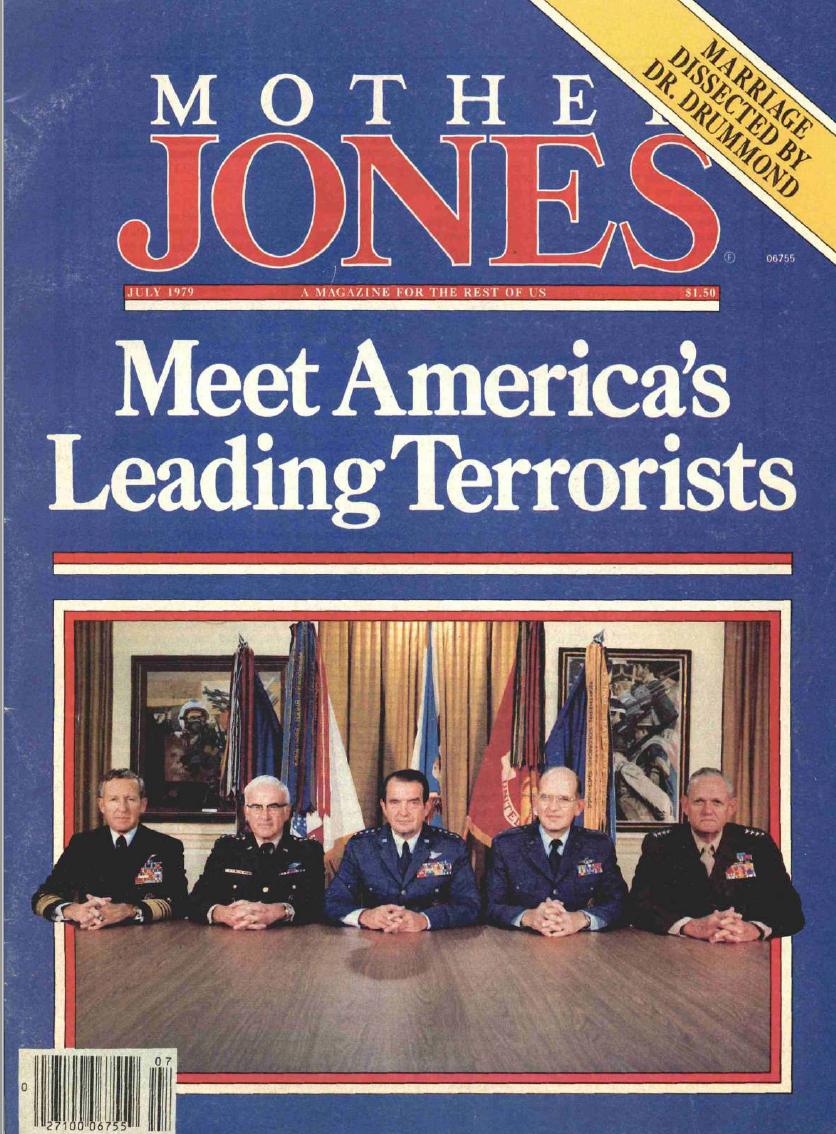
    In July 1979, this magazine ran a series of articles about the United States’ plans for a nuke war. As usual in a Mother Jones piece of the era, writers dove into wonky policy while finding a straightforward and biting tone to match the horror of what they were reporting. It was solid investigative work. And it has some fun stuff in there about how moving to the suburbs meant we might not have anywhere to hide if bombs dropped.

    But you don’t really need to know all that. I’m talking to you about this issue because…check out the cover! It’s a formal portrait of military leaders with the headline “Meet America’s Leading Terrorists.”

    I don’t have a ton to say here. It seems that, at the time, we cared a lot more about nukes than now. Another issue that year had President Jimmy Carter on the cover, as we prodded his administration’s nuclear policy. But, at least until something happens like oh I don’t know a war with Iran, our nuclear policies are not top of mind for anyone in the United States at the moment. I dearly hope that does not change.

    However, the other article mentioned on the cover—“Marriage Dissected”—will perhaps be more directly relevant to your daily lives. It’s a doctor arguing, basically, that “marriage has not been healthy for women.” One of its standout lines is quite the turn of phrase: “Marriage seems to be good for men and bad for women. The obvious public health conclusion from this is that men should marry other men and leave women alone.”

  • A Call for Reader Recharges: Let Us Know Where, and How, You Find Strength as the Year Wraps Up

    As we close the books on 2020, or try to, chapters of new devastation keep appearing: Just yesterday the United States saw its highest single-day death toll in the pandemic yet, and the number is expected to climb rapidly. But that’s exactly why our newsletter ends each day with a story of strength gained, justice achieved, or stamina built. Or at least good music. A reminder that today brings the livestream launch party for Thulani Davis’ Nothing But the Music, at 7:30 p.m. ET. Story here, register here.

    It’s also why our priorities at Mother Jones are to keep shining a light not just on abuses of systems and power, and on systems themselves, but on ways that change and justice happen. As the year kicks and screams, starts and stops, and crashes on its final lap, let us know how you’re getting a recharge. Our Recharge team knows that so many of you are showing up for each other, and fighting for change, and we want to highlight your stories from time to time. Tell us your good news or how you recharge someone else at recharge@motherjones.com.

    Music and more at 7:30 p.m. ET.

  • If There’s One Creative Livestream You Join All Week, Month, or Year, Make This It

    In celebration of the interdisciplinary artist and historian Thulani Davis’ new poetry collection, Nothing But the Music, a launch party of performances and conversations is set for tomorrow, December 3, at 7:30 p.m. ET. The occasion is as historic and thrilling as the lineup of artists joining the livestream: Roscoe Mitchell of the Art Ensemble of Chicago, Greg Tate of Burnt Sugar the Arkestra Chamber, Pulitzer-winning composer Anthony Davis, author Tobi Haslett, Yale theater professor Daphne A. Brooks, playwright Jessica Hagedorn, and NYU performance studies professor Fred Moten.

    Davis’ poetry is as vivid and profound as her subjects: the sounds, contours, and characters of avant-garde jazz and soul of the ’70s and ’80s. The many instruments and registers she excels at—playwright, journalist, librettist, novelist, and screenwriter—converge in her current role as Afro-American Studies professor at the University of Wisconsin, Madison. But she’s been a public educator since long before the academy, awards, and articles. For Davis, a pioneering Village Voice editor and writer, the act of writing is an act of discovery and recovery—of history, information, and places. It’s also an act of documentation in a democratic sense. Her genealogy-memoir, My Confederate Kinfolk: A 21st-Century Freedwoman Discovers Her Roots, reveals the entrenched dynamics of power around family, race, and gender.

    Though best known for her librettos in Amistad and Malcolm X and her Maker of Saints and 1959, she’s increasingly recognized as a visionary in the Black Arts Movement alongside Jayne Cortez, Sonia Sanchez, and Davis’ longtime friend Ntozake Shange. I could go on—about the care, the craft, the eye for joy, grief, and resilience—and I will in an upcoming dive into Davis’ works. For now, register for the Zoom. Pick up Nothing But the Music from Blank Forms Editions.

  • Mother Jones’ Sinduja Rangarajan Wins a National Reporting Award From the Asian American Journalists Association

    A big shoutout to senior data journalist Sinduja Rangarajan for winning a national award from the Asian American Journalists Association. Her extensive reporting and wrangling of datasets in collaboration with Reveal at the Center for Investigative Reporting, where Sinduja worked before joining Mother Jones, shines a crucial light on challenges for H-1B visa holders. The Trump administration tightened restrictions, creating obstacles for highly skilled immigrants, largely from India and China, who often use the coveted visas as a path to residency in the United States.

    Sinduja assembled a first-of-its-kind database of H-1B lawsuits against the administration, showing a substantial uptick in applications being rejected for reasons that appear deliberately arbitrary and misapplied federal law. It was Sinduja’s first big series for Mother Jones, the culmination of a long look into the Trump era’s stealth strategy of cracking down on the visa program stemming from complaints aired by Stephen Miller and Jeff Sessions in contradiction to Trump’s own claim that he wanted to help “totally brilliant people” work in the country.

    Trump himself is totally brilliant people, so I should trust 45, but, you know, I just don’t. Melania herself is here on a special-case “genius” visa, as it happens. Rather trust solid datasets from reporters who show their methodology transparently. Sinduja has built a living archive for the public to expand on. She shares the award with Mother Jones deputy editor Dave Gilson and producer James West, along with Reveal’s Teresa Cotsirilos, Brett Myers, Al Letson, Jim Briggs, Fernando Arruda, and Amy Mostafa.

    And today is Giving Tuesday. For those of you who can, consider pitching in to support investigations like it, and join the award celebration on Friday, December 12, 5–6:30 p.m. PT.

  • Help for Musicians and Other Post-Thanksgiving Leftover Hope

    The devastating toll of the pandemic on gigging musicians continues to upend artistic communities, but relief efforts are also growing. I got an encouraging email last week from the jazz drummer and singer Rie Yamaguchi-Borden. The nonprofit she launched, Gotham Yardbird Sanctuary, with her husband, Mitch Borden (founder of the legendary jazz clubs Smalls and Fat Cat), helps musicians hardest hit by the coronavirus. “Even COVID-19 hasn’t completely broken our hearts,” she said. “As long as we are alive, we will never stop thinking about playing.”

    The group provides paid gigs with physical distancing in place throughout New York. More than 60 percent of musicians surveyed by the Jazz Journalists Association said their income this year is less than half of last year’s. More than 70 percent said they have no live gigs lined up for next year. Relief groups like GYS and the Jazz Foundation of America are meeting the moment with fundraisers and livestreams. Starting December 5, GYS hosts a Yardbird Jam program at Bodeguita in Brooklyn at 6 Suydam St., and every Saturday from 6 to 9 p.m., Yamaguchi-Borden hosts jam sessions for a wide range of musicians. The schedule is here, and donations for the Yardbird Jam are welcome here.

    More Recharges to enter the week:

    Fowl headlines: “Lame Duck Pardons Turkey.” Credit where it’s due: “All hail great copy editors (in this case, the Washington Post’s Doug Norwood),” tweeted Post editor Marc Fisher.

    Take two: “Lame Duck Pardons Turkey.” Thanks Guardian.

    Take three: “Lame-Duck President Pardons Turkey.” Thanks Reuters.

    Climate win: Goldman Environmental Prize winners were celebrated in a virtual ceremony hosted by Sigourney Weaver, with appearances by Jack Johnson, Robert Redford, Danni Washington, and Lenny Kravitz. Winners include the innovative activists Chibeze Ezekiel of Ghana, Kristal Ambrose of the Bahamas, Leydy Pech of Mexico, Lucie Pinson of France, Nemonte Nenquimo of Ecuador, and Paul Sein Twa of Myanmar.

    Season of firsts: The American Ballet Theater welcomes Calvin Royal III as its first Black male principal in more than two decades. “Whether I was being featured or not over the years, I pushed myself and strived to be the best version of myself on stage and off,” he said, “so to finally make it to principal with ABT, it was a dream come true.” Hat tip to Venu Gupta for the story, and if you haven’t yet, check out our colleague Cathy Asmus’ insightful take on how dance studios are adapting to the pandemic.

  • What Giving Thanks Can Look Like This Weekend

    As you gather with the ones you love in person or remotely or not, it is worth reflecting on the words of Edgar Villanueva—author, activist, founder of the Decolonizing Wealth Project, an Atlantic Fellow for Racial Equity, and, in full disclosure and celebration, a new member of Mother Jones’ board—from a conversation in Yes! magazine headlined “Healing From Colonization on Thanksgiving and Beyond”:

    As a Native American, I’m often troubled by the way that Americans approach Thanksgiving. By holding onto an idealized image of a harmonious feast between the Pilgrims and Wampanoag, we’ve overlooked the brutality that Native people have faced since the arrival of Europeans. For many Native Americans, Thanksgiving is a day of mourning and remembrance—a reminder of the genocide of our people, the loss of our way of life, and the theft of our ancestral lands.

    I propose seven steps to healing: grieve, apologize, listen, relate, represent, invest, and repair. I initially developed these steps in relation to my professional field of philanthropy, but they are also applicable to a personal process of decolonization.

    The steps Edgar proposes are not easy, but I imagine they have the cumulative effect of bringing forth the actual goal of Thanksgiving—gratitude.

    Gratitude for the opportunity to cross a bridge that you may not have known was there, or one you thought you couldn’t cross. Gratitude for the Navajo communities that organized get-out-the-vote efforts during a devastating pandemic that has imperiled the Navajo Nation at a disproportionate rate. Gratitude for the Gwich’in Native community in the Arctic for protecting the planet, risking life and livelihood. Gratitude for the Federated Indians of Graton Ranchería for supporting ways all of us can keep learning about wisdom that existed before so many of us arrived.

    Happy healing and giving of thanks in the many ways we can and have yet to pursue.

    —Venu Gupta is Mother Jones’ Midwest regional development director. Share your stories of gratitude and Thanksgiving with her at recharge@motherjones.com.