
Julia Whitty

Julia Whitty

Environmental Correspondent

Julia is an award-winning author of fiction and nonfiction (Deep Blue Home, The Fragile Edge, A Tortoise for the Queen of Tonga), and a former documentary filmmaker. She also blogs at Deep Blue Home.

Full Bio | Get my RSS |

Julia is a writer and former documentary filmmaker and the author of The Fragile Edge: Diving & Other Adventures in the South Pacific, winner of a PEN USA Literary Award, the John Burroughs Medal, the Kiriyama Prize, the Northern California Books Awards, and finalist for the Dayton Literary Peace Prize, and Deep Blue Home: An Intimate Ecology of Our Wild Ocean. Her short story collection A Tortoise for the Queen of Tonga won an O. Henry and was a finalist for the PEN Hemingway Award. She also blogs at Deep Blue Home.

Invasive Crab Restoring Cape Cod's Dwindling Salt Marshes

| Wed Apr. 3, 2013 7:51 AM PDT
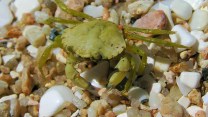
European  green crab, at juvenile stage where it appears greenEuropean green crab, at juvenile stage where it appears green:

The European green crab—an invasive species in North America and one of the "worst 100" invaders on the Global Invasive Species Database—may not be the utter evil we once thought. A couple of new papers (here and here) from a team at Brown University detail how they're actually helping the dwindling salt marshes of Cape Cod recover. It's a fascinating detective story—from the frontlines of an emerging field known as historical ecology—and it's rife with plot twists and red herrings, which begins like this: 

  1. People built mosquito ditches into Cape Cod's salt marshes in the 1930s to drain flooded mosquito breeding habitat 
  2. Which resulted in the appearance of corridors of low marsh cordgrass in areas formerly dominated by high marsh plants 
  3. Coastal development ramped up big-time after World War II, with the permanent human population on the Cape doubling every 20 years from 1939-2005
Purple marsh crab
Purple marsh crab: Photo courtesy of Mark Bertness

Enter a mysterious die-off of Cape Cod low marsh cordgrasses that began decades ago. Researchers eventually traced the culprit to the native purple marsh crab, photo above, which was eating through the cordgrasses at alarming speed.

But why had this good crab suddenly gone bad? The researchers kept researching. Turns out that predators of those crabs—blue crabs and striped bass—were being overfished by recreational fishers. In the course of 337,000 fishing trips to Cape Cod annually, these fishers had triggered a trophic cascade.

That's when the removal of predators messes up the ecosystem two or more trophic links removed. In other words, a system-wide meltdown of a  functioning ecosystem. And one unlikely to recover its former state.

Turns out the mosquito ditches, which had seemed more or less harmless since their installation decades earlier, were accomplices in this trophic cascade. That's because the ditches had facilitated corridors of low marsh cordgrasses. As striped bass and blue crabs were being overfished, purple crabs were experiencing a fourfold increase in population. Suddenly these corridors of low marsh cordgrasses became superhighways for hungry purple crabs to eat themselves into a novel state of hyperabundance.

At developed sites with increased accessibility and fishing pressure (a), the purple marsh crab (S reticulatum, [c]) is released from predatory control (eg blue crab [Callinectes sapidus] and striped bass [Morone saxatilis], [b]) and consumes cordgrass (S alterniflora, [d]) along creek and ditch banks
At developed sites with increased accessibility and fishing pressure (a), the purple marsh crab, [c]) is released from predatory control (eg blue crab and striped bass, [b]) and consumes cordgrass , [d]) along creek and ditch banks: TC Coverdale, et al. Frontiers in Ecology and Evolution. DOI:10.1890/120130

But wait. The story's not over. Enter the introduction of an invasive species, the European green crab with a reputation for biological badassness. According to the findings of the researchers, just published in Ecology, these unwanted invaders (they probably got to Cape Cod as stowaways on ships) discovered the banquets of incredibly yummy (okay, I surmised that part) purple crabs that almost no one else was eating. Nature being what it is, the badass crab struck hard.

Hard enough to begin to reverse the decades'-long decline of Cape Cod's salt marshes. Which, BTW, keep the Cape from eroding off into the Atlantic Ocean. The authors write:

Our results show that, despite previous evidence of negative impacts on native species throughout its introduced range, [the European green crab] is well suited to accelerate the recovery of heavily degraded salt marsh ecosystems in New England.

The effect of the invasive crab doesn't even have to involve actually eating all that many native purple crabs, lead author Mark Bertness tells me. "Fear of being eaten can be a stronger ecosystem effect than being eaten, because predation happens one event at a time whereas a single predator can scare away dozens of prey yielding much larger ecological effects." Though he adds this caution: "Marsh recovery driven by fear of green crabs is superficial and doesn't replace the centuries of accretion and carbon sequestration taken to build Cape Cod marshes."

Advertise on MotherJones.com

Arctic Sea Ice Reaches Winter Max and It's Dismally Low

| Wed Mar. 27, 2013 11:06 AM PDT
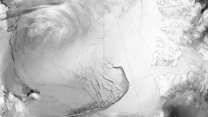
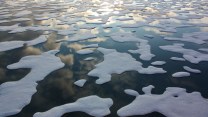
Arctic sea iceArctic sea ice:

The Arctic Ocean reached the most frozen it's going to get this year on 13 March. Now the melt season begins, predicts the National Snow and Ice Data Center (NSIDC). The seasonal stats were gloomy. The max sea ice area of 2013 was was 5.84 million square miles (15.13 million square kilometers). That's the sixth lowest extent on record and a whopping 283,000 square miles (733,000 square kilometers) below the 1979 to 2000 average maximum. 

Interestingly this year's max fell five days later than the 1979 to 2000 average date of March 10. NSIDC says the date's highly variable, with the earliest max in the satellite record falling on 24 February 1996 and the latest on 2 April 2010.

Arctic sea ice extent as of March 24, 2013, along with daily ice extent data for the previous five years. The 1979 to 2000 average is in dark gray
Arctic sea ice extent on March 24, 2013, along with daily ice extent data for the previous five years. The 1979 to 2000 average is in dark gray: National Snow and Ice Data Center

Keep in mind that the Arctic Ocean froze a bigger extent of water than ever before this past autumn—a record 4.53 million square miles (11.72 million square kilometers). But that's only because it had to make up for the insane lack of sea ice that beset the Arctic (and all its ice-dependent flora and fauna) last summer. I wrote about that during my October cruise through the Arctic Ocean aboard the US Coast Guard icebreaker Healy (Arctic Ocean Diaries). 

So what the past 12 months add up to is a wild pendulum: the lowest ever summer ice followed by the biggest ever winter freeze-over, which still only managed a dismally low winter cover, composed of thin one-year-old ice destined to melt super fast this summer. Everything has become more extreme. 

So even though this year was *only* the sixth lowest winter max, the Arctic is likely on course for another epically low summer ice-scape, because almost all its frozen ocean is now newborn baby ice. 

World's Grooviest Endangered Frog Bred in Captivity for First Time

| Fri Mar. 22, 2013 11:28 AM PDT
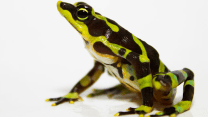
Limosa harlequin frog (Atelopus limosus)Limosa harlequin frog (Atelopus limosus):

Great news today that the endangered limosa harlequin frog (Atelopus limosus) has been bred in captivity for the first time. This unbelievably groovy-looking character is native to the tropical lowland forests of eastern Panama. Six partner organizations forming the Panama Amphibian Rescue and Conservation Project have been caring for 65 adult limosa harlequin frogs, including:

  • Figuring out how to arrange rocks in the breeding tank to create the submerged caves like those the frogs prefer in the wild
  • Getting the right highly oxygenated, gently flowing water between 22 and 24 degrees Celsius (71-75 degrees Fahrenheit)
  • Recreating the tadpoles' natural food—algal film growing on submerged rocks—by painting petri dishes with a solution of powdered spirulina algae and allowing it to dry

In other words, awesome Mary Poppins babysitting duties.

The project has successfully bred other challenging endangered species, including crowned treefrogs (Anotheca spinosa), horned marsupial frogs (Gastrotheca cornuta), and toad mountain harlequin frogs (A. certus).

"These frogs represent the last hope for their species," says Brian Gratwicke (see him in the the video below), international coordinator for the project and a research biologist at the Smithsonian Conservation Biology Institute, one of the six project partners. "This new generation is hugely inspiring to us as we work to conserve and care for this species and others."

The limosa harlequin frog is deemed "Endangered" on the IUCN Red List because: 

[I]ts Extent of Occurrence is less than 5,000 km2 (1,930 square miles), its distribution is severely fragmented, and there is continuing decline in the extent and quality of its forest habitat in Panama.

It's also a victim of the fungal disease, chytridiomycosis, caused by the water-borne pathogen, Batrachochytrium dendrobatidis (Bd). This worldwide amphibian plague is a real terror. From Amphibiaweb:

Bd may be responsible for the greatest disease-caused loss of biodiversity in recorded history. Over just the past 30 years, Bd has caused the catastrophic decline or extinction (in many cases within a single year) of at least 200 species of frogs, even in pristine, remote habitats. These rapid, unexplained declines have occurred around the world. Recently Bd has been implicated in the unexplained disappearances of Central American salamanders as well. While diseases have previously been associated with population declines and extinctions, chytridiomycosis is the first emerging disease shown to cause the decline or extinction of hundreds of species not otherwise threatened. Currently over 350 amphibian species are known to have been infected by Bd.

Worldwide distribution of Batrachochytrium dendrobatidis (Bd), the amphibian chytrid fungus
Worldwide distribution of Batrachochytrium dendrobatidis (Bd), the amphibian chytrid fungus: Credit: Fisher et al (2009); DOI: 10.1146/annurev.micro.091208.073435

It's still up for scientific debate whether the lethal explosion of chytridiomycosis worldwide is a result of:

  1. African frogs being traded around the world for scientific research and pregnancy testing starting in the 20th century
  2. Climate change
  3. Both 

Whatever the ultimate cause(s), nearly a third of Earth's amphibian species are now at risk of extinction. 

The mission of the Panama Amphibian Rescue and Conservation Project is to rescue amphibian species that are in extreme danger of extinction throughout Panama. They're focused on establishing assurance colonies and developing methodologies to reduce the impact of the amphibian chytrid fungus so that one day captive amphibians may be reintroduced to the wild. Current project partners include Cheyenne Mountain Zoo, Houston Zoo, Smithsonian’s National Zoological Park, Smithsonian Tropical Research Institute, and Zoo New England.

WTF? Now Manatees Are Dying off Both Florida Coasts

| Tue Mar. 19, 2013 3:06 AM PDT
Two Florida manatees holding flippers:Florida manatees:

A record number of manatees—more than 180, and counting—have died so far this year from a red tide off the southwest Florida coast. These tides are caused by blooms of the alga, Karenia brevis, which produce a suite of neurotoxins (brevetoxins) deadly to fish, sea turtles, birds, and marine mammals. Red tides are harmful to people too, if you breathe enough of the aerosolized toxins or eat enough infected fish or shellfish. Now, from Craig Pittman at the Tampa Bay Times, we learn that a mysterious ailment is killing manatees off Florida's other (east) coast too. There's no red tide bloom underway there and no winter cold snap either:

So far... no sick manatees have been rescued, availing biologists with a live specimen to study for clues. They suspect the manatee deaths may be connected to back-to-back blooms of a [another species of] harmful algae, one that has stained the Indian River Lagoon a chocolate brown. Over the past two years the blooms wiped out some 31,000 acres of sea grass in the 156-mile-long lagoon that stretches along the state's Atlantic coast. Manatees eat sea grass, but with the sea grass gone, they may have turned to less healthful sources of nutrition.

Karenia brevis, as seen through a scanning electron micrograph:
Deadly little plant beasties, Karenia brevis, as seen through a scanning electron micrograph: MyFWC Research at Flickr

The dead manatees on Florida's east coast appear to have gone into shock and drowned after eating algae. Researchers surmise the deaths are related to this abrupt dietary change. Furthermore, Pittman reports, more than 100 brown pelicans have been found dead in that same area since the start of 2013:

"The pelicans were emaciated and full of parasites. So far biologists don't know what killed them or if there could be any connection with the dead manatees."

There's one big difference between the algae blooms on the east and west coasts—and that's what's causing them. The eastern bloom is fueled by nutrient pollution from storm runoff: a Miracle-Gro of fertilizers, sewage, manure, and pet wastes that fuels algae blooms. The cause of the western red tide is more muddled. According to the Mote Marine Laboratory:


In contrast to the many red tide species that are fueled by nutrient pollution associated with urban or agricultural runoff, there is no direct link between nutrient pollution and the frequency or severity of red tides caused by K. brevis. Florida red tides develop 10-40 miles offshore, away from manmade nutrient sources. Red tides occurred in Florida long before human settlement, and severe red tides were observed in the mid-1900s before the state's coastlines were heavily developed. However, once red tides are transported inshore, they are capable of using manmade nutrients for their growth.

NOAA reports that red tides off southwest Florida caused mass die-offs of endangered manatees in 1963, 1982, 1996, 2002, and 2003. ​So these episodes seem to be increasing in frequency. Florida's manatee population is estimated at 4,000 to 5,000 individuals—about half the total world population of the species, according to the IUCN Red List.

The Most Radioactive Man on Earth Has the Kindest Heart

| Tue Mar. 12, 2013 3:40 AM PDT
Naoto Matsumura with cows near Fukishima, Japan.Naoto Matsumura, a 53-year-old fifth-generation rice farmer, returned to his contaminated home near Japan's Fukushima power plant to care for his cows:
 
UPDATE: Many of you asked where to donate to help Naoto and the animals he's caring for. VICE told me this: "This is the NPO organization that Naoto and his supporters run: http://ganbarufukushima.blog.fc2.com/. It's a Japanese website but on the middle-left there is donation information in English."
 

This 18-minute video by VICE Japan profiles Naoto Matsumura, a 53-year-old fifth-generation rice farmer who went back into the dead zone around Japan's Fukushima nuclear power plant to take care of his cows (and pigs, cats, dogs, and ostriches), and then stayed there. If you're wondering why anyone would live in a place with >17 times normal radiation, Naoto, in the video, explains his rationale on moral grounds. Including this:

Our dogs didn't get fed for the first few days. When I did eventually feed them, the neighbors' dogs started going crazy. I went over to check on them and found that they were all still tied up. Everyone in town left thinking they would be back home in a week or so, I guess. From then on, I fed all the cats and dogs every day. They couldn’t stand the wait, so they’d all gather around barking up a storm as soon as they heard my truck. Everywhere I went there was always barking. Like, 'we’re thirsty' or, 'we don’t have any food.' So I just kept making the rounds."

As for the filmmakers, Ivan Kovac and Jeffrey Jousan, here's some of what they had to say:

The radiation dosage per hour inside Naoto’s house, as measured by the Geiger counter we brought with us, is two microsieverts per hour, and outside our reader spiked to seven microsieverts. When we asked Doctor Hiroyuki Koide at the Kyoto University Research Reactor Institute how bad this was for Naoto, he said, "Japanese law states that any location with an hourly dosage exceeding 0.6 microsieverts [per hour] should be designated as a radiation-controlled area and closed off to the general populace. Once inside a radiation-controlled area you can’t drink the water, and you really shouldn’t eat anything. It’s inconceivable to me that a normal person could live there."

All of the other ~15,000 residents of Naoto's town still live in shelters—except for Naoto and his animals. And they're not going anywhere, say the filmmakers.

Tue Apr. 10, 2012 12:25 PM PDT
Fri Apr. 6, 2012 1:37 PM PDT
Wed Apr. 4, 2012 2:27 PM PDT
Mon Apr. 2, 2012 2:58 PM PDT
Thu Mar. 29, 2012 1:07 PM PDT
Mon Mar. 26, 2012 2:48 PM PDT
Mon Mar. 26, 2012 12:51 PM PDT
Fri Mar. 23, 2012 12:12 PM PDT
Wed Mar. 21, 2012 11:03 AM PDT
Tue Mar. 20, 2012 11:34 AM PDT
Mon Mar. 19, 2012 11:18 AM PDT
Wed Mar. 14, 2012 11:29 AM PDT
Tue Mar. 13, 2012 10:44 AM PDT
Fri Mar. 9, 2012 2:35 PM PST
Thu Mar. 8, 2012 1:20 PM PST
Tue Mar. 6, 2012 3:29 PM PST
Mon Mar. 5, 2012 2:52 PM PST
Fri Mar. 2, 2012 1:20 PM PST
Tue Feb. 28, 2012 3:46 PM PST
Fri Feb. 24, 2012 1:06 PM PST
Thu Feb. 23, 2012 1:17 PM PST
Wed Feb. 22, 2012 3:37 PM PST
Fri Feb. 17, 2012 1:07 PM PST
Wed Feb. 15, 2012 2:52 PM PST
Mon Feb. 13, 2012 1:00 PM PST
Fri Feb. 10, 2012 1:41 PM PST
Thu Feb. 9, 2012 11:36 AM PST
Mon Feb. 6, 2012 1:29 PM PST
Mon Jan. 30, 2012 1:58 PM PST
Fri Jan. 27, 2012 3:07 PM PST
Thu Jan. 26, 2012 3:53 PM PST
Tue Jan. 24, 2012 2:20 PM PST
Fri Jan. 20, 2012 11:50 AM PST
Wed Jan. 18, 2012 1:26 PM PST
Tue Jan. 17, 2012 1:48 PM PST
Fri Jan. 13, 2012 1:48 PM PST
Thu Jan. 12, 2012 3:23 PM PST
Tue Jan. 10, 2012 1:31 PM PST
Mon Jan. 9, 2012 1:19 PM PST
Fri Jan. 6, 2012 4:04 AM PST
Thu Jan. 5, 2012 12:13 PM PST
Tue Jan. 3, 2012 1:49 PM PST
Wed Dec. 28, 2011 1:59 PM PST
Thu Dec. 22, 2011 12:20 PM PST