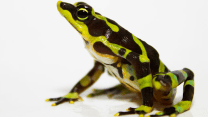


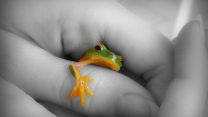
Great news today that the endangered limosa harlequin frog (Atelopus limosus) has been bred in captivity for the first time. This unbelievably groovy-looking character is native to the tropical lowland forests of eastern Panama. Six partner organizations forming the Panama Amphibian Rescue and Conservation Project have been caring for 65 adult limosa harlequin frogs, including:
Figuring out how to arrange rocks in the breeding tank to create the submerged caves like those the frogs prefer in the wild
Getting the right highly oxygenated, gently flowing water between 22 and 24 degrees Celsius (71-75 degrees Fahrenheit)
Recreating the tadpoles' natural food—algal film growing on submerged rocks—by painting petri dishes with a solution of powdered spirulina algae and allowing it to dry
In other words, awesome Mary Poppins babysitting duties.
The project has successfully bred other challenging endangered species, including crowned treefrogs (Anothecaspinosa), horned marsupial frogs (Gastrothecacornuta), and toad mountain harlequin frogs (A. certus).
"These frogs represent the last hope for their species," saysBrian Gratwicke (see him in the the video below), international coordinator for the project and a research biologist at the Smithsonian Conservation Biology Institute, one of the six project partners. "This new generation is hugely inspiring to us as we work to conserve and care for this species and others."
The limosa harlequin frog is deemed "Endangered" on the IUCN Red List because:
[I]ts Extent of Occurrence is less than 5,000 km2 (1,930 square miles), its distribution is severely fragmented, and there is continuing decline in the extent and quality of its forest habitat in Panama.
It's also a victim of the fungal disease, chytridiomycosis, caused by the water-borne pathogen, Batrachochytrium dendrobatidis (Bd). This worldwide amphibian plague is a real terror. From Amphibiaweb:
Bd may be responsible for the greatest disease-caused loss of biodiversity in recorded history. Over just the past 30 years, Bd has caused the catastrophic decline or extinction (in many cases within a single year) of at least 200 species of frogs, even in pristine, remote habitats. These rapid, unexplained declines have occurred around the world. Recently Bd has been implicated in the unexplained disappearances of Central American salamanders as well. While diseases have previously been associated with population declines and extinctions, chytridiomycosis is the first emerging disease shown to cause the decline or extinction of hundreds of species not otherwise threatened. Currently over 350 amphibian species are known to have been infected by Bd.
Worldwide distribution of Batrachochytrium dendrobatidis (Bd), the amphibian chytrid fungus: Credit: Fisher et al (2009); DOI: 10.1146/annurev.micro.091208.073435
It's still up for scientific debate whether the lethal explosion of chytridiomycosis worldwide is a result of:
African frogs being traded around the world for scientific research and pregnancy testing starting in the 20th century
Climate change
Both
Whatever the ultimate cause(s), nearly a third of Earth's amphibian species are now at risk of extinction.
The mission of the Panama Amphibian Rescue and Conservation Project is to rescue amphibian species that are in extreme danger of extinction throughout Panama. They're focused on establishing assurance colonies and developing methodologies to reduce the impact of the amphibian chytrid fungus so that one day captive amphibians may be reintroduced to the wild. Current project partners include Cheyenne Mountain Zoo, Houston Zoo, Smithsonian’s National Zoological Park, Smithsonian Tropical Research Institute, and Zoo New England.
A record number of manatees—more than 180, and counting—have died so far this year from a red tide off the southwest Florida coast. These tides are caused by blooms of the alga, Karenia brevis, which produce a suite of neurotoxins (brevetoxins) deadly to fish, sea turtles, birds, and marine mammals. Red tides are harmful to people too, if you breathe enough of the aerosolized toxins or eat enough infected fish or shellfish. Now, from Craig Pittman at the Tampa Bay Times, we learn that a mysterious ailment is killing manatees off Florida's other (east) coast too. There's no red tide bloom underway there and no winter cold snap either:
So far... no sick manatees have been rescued, availing biologists with a live specimen to study for clues. They suspect the manatee deaths may be connected to back-to-back blooms of a [another species of] harmful algae, one that has stained the Indian River Lagoon a chocolate brown. Over the past two years the blooms wiped out some 31,000 acres of sea grass in the 156-mile-long lagoon that stretches along the state's Atlantic coast. Manatees eat sea grass, but with the sea grass gone, they may have turned to less healthful sources of nutrition.
Deadly little plant beasties, Karenia brevis, as seen through a scanning electron micrograph: MyFWC Research at Flickr
The dead manatees on Florida's east coast appear to have gone into shock and drowned after eating algae. Researchers surmise the deaths are related to this abrupt dietary change. Furthermore, Pittman reports, more than 100 brown pelicans have been found dead in that same area since the start of 2013:
"The pelicans were emaciated and full of parasites. So far biologists don't know what killed them or if there could be any connection with the dead manatees."
There's one big difference between the algae blooms on the east and west coasts—and that's what's causing them. The eastern bloom is fueled by nutrient pollution from storm runoff: a Miracle-Gro of fertilizers, sewage, manure, and pet wastes that fuels algae blooms. The cause of the western red tide is more muddled. According to the Mote Marine Laboratory:
In contrast to the many red tide species that are fueled by nutrient pollution associated with urban or agricultural runoff, there is no direct link between nutrient pollution and the frequency or severity of red tides caused by K. brevis. Florida red tides develop 10-40 miles offshore, away from manmade nutrient sources. Red tides occurred in Florida long before human settlement, and severe red tides were observed in the mid-1900s before the state's coastlines were heavily developed. However, once red tides are transported inshore, they are capable of using manmade nutrients for their growth.
NOAA reports that red tides off southwest Florida caused mass die-offs of endangered manatees in 1963, 1982, 1996, 2002, and 2003. So these episodes seem to be increasing in frequency. Florida's manatee population is estimated at 4,000 to 5,000 individuals—about half the total world population of the species, according to the IUCN Red List.
Naoto Matsumura, a 53-year-old fifth-generation rice farmer, returned to his contaminated home near Japan's Fukushima power plant to care for his cows:Courtesy of VICE.
UPDATE: Many of you asked where to donate to help Naoto and the animals he's caring for. VICE told me this: "This is the NPO organization that Naoto and his supporters run: http://ganbarufukushima.blog.fc2.com/. It's a Japanese website but on the middle-left there is donation information in English."
This 18-minute video by VICE Japan profiles Naoto Matsumura, a 53-year-old fifth-generation rice farmer who went back into the dead zone around Japan's Fukushima nuclear power plant to take care of his cows (and pigs, cats, dogs, and ostriches), and then stayed there. If you're wondering why anyone would live in a place with >17 times normal radiation, Naoto, in the video, explains his rationale on moral grounds. Including this:
Our dogs didn't get fed for the first few days. When I did eventually feed them, the neighbors' dogs started going crazy. I went over to check on them and found that they were all still tied up. Everyone in town left thinking they would be back home in a week or so, I guess. From then on, I fed all the cats and dogs every day. They couldn’t stand the wait, so they’d all gather around barking up a storm as soon as they heard my truck. Everywhere I went there was always barking. Like, 'we’re thirsty' or, 'we don’t have any food.' So I just kept making the rounds."
As for the filmmakers, Ivan Kovac and Jeffrey Jousan, here's some of what they had to say:
The radiation dosage per hour inside Naoto’s house, as measured by the Geiger counter we brought with us, is two microsieverts per hour, and outside our reader spiked to seven microsieverts. When we asked Doctor Hiroyuki Koide at the Kyoto University Research Reactor Institute how bad this was for Naoto, he said, "Japanese law states that any location with an hourly dosage exceeding 0.6 microsieverts [per hour] should be designated as a radiation-controlled area and closed off to the general populace. Once inside a radiation-controlled area you can’t drink the water, and you really shouldn’t eat anything. It’s inconceivable to me that a normal person could live there."
All of the other ~15,000 residents of Naoto's town still live in shelters—except for Naoto and his animals. And they're not going anywhere, say the filmmakers.
Admiral Samuel J. Locklear, commander of the Pacific Command, talks to Sailors aboard Arleigh Burke-class guided-missile destroyer USS Barry:US Department of Defense
As I wrote in Full Green Ahead in the current issue of Mother Jones, the US Navy is paying close attention—and giving far more than lip service—to the problems underway from a changing climate. But until now no one's said it quite so loudly as Admiral Samuel Locklear, commander of the US Pacific Command.
Locklear met privately with scholars at Harvard and Tufts universities on Friday and said that the biggest long-term security threat in the Pacific region is climate change, reports the Boston Globe, and that significant upheaval related to the warming planet is:
"Probably the most likely thing that is going to happen... that will cripple the security environment, probably more likely than the other scenarios we all often talk about." Locklear continued: "People are surprised sometimes, [but] you have the real potential here in the not-too-distant future of nations displaced by rising sea level. Certainly weather patterns are more severe than they have been in the past. We are on super typhoon 27 or 28 this year in the Western Pacific. The average is about 17."
What's really interesting here is that the US has declared the Asia Pacific region (and all its security issues from North Korea, China, Japan, and the South China Sea) its primary security focus. "After a decade in which we fought two wars that cost us dearly in blood and treasure," President Obama told the Australian Parliament in 2011, "the United States is turning our attention to the vast potential of the Asia Pacific region." Now Admiral Locklear is saying that among all those juicy potentials, climate change is likely to be the single biggest piece of trouble.
Cyclone Sandra in the South Pacific on 10 March 2013: NASA image courtesy Jeff Schmaltz
To get a sense of how huge that is, listen to Ret. Rear Admiral Dave Titley, whom I interviewed for my Navy piece last spring, when he was Oceanographer of the Navy and director of Task Force Climate Change. He was pretty forthright then about the giant issues facing the Navy from rising sea levels and a melting Arctic (more here). So this is what he had to say Monday about Locklear's precedent-setting statement in Boston:
For those that follow climate change and national security, having the Commander of the US Pacific Command (Admiral Sam Locklear) highlight climate change as a significant 'threat' to his area of responsibility is a big deal. While other 'Combatant Commanders (specifically Africa and US Northern Commands) have talked about Climate Change, the Pacific Command (and its Commander) are a 'big deal' in the security world. This is the command that deals with China, the South China Sea, the Korean Peninsula, Japan, etc. every day. So to put Climate Change on a par with those challenges—is very significant.
US Navy photo by Mass Communication Specialist 3rd Class Ryan Mayes; white flag by Jan Jacobsen via Wikimedia Commons.
I reported in the current issue of Mother Jones on the US Navy's aggressive goals to reduce dependence on foreign oil and fossil fuels (My Heart-Stopping Ride Aboard the Navy's Great Green Fleet). These targets include testing and scaling up of biofuels and conserving whatever energy the Navy does procure by using new technologies and good-old common sense—plus training a new generation of officers as "energy warriors."
So what's the sequester going to do to those initiatives, which former Secretary of Defense Leon Panetta described as among his most important? I spoke with Tom Hicks, Deputy Assistant Director of the Navy for Energy. He told me that at this point all Department of Navy and Department of Defense programs are subject to cuts and civilian furloughs. But some programs weigh more importantly than others:
At this time of declining budgets, investments in the efficiency of our ships and airplanes and in developing alternative fuels becomes more important than ever. In many ways those investments provide savings to the Navy's fleet and to the Navy ashore. The way we budget, we've already accounted for the savings that were expected to be made in fiscal year 2013. If those investments don't happen we'll experience additional costs that we'll have to find a way to pay for in future years. So in a very real way we're going to be facing some bigger budgetary issues if we can't find ways to make those investments.
I know that energy remains one of the top priorities with the Secretary [of the Navy, Ray Mabus]. Certainly shipbuilding is probably foremost among his priorities. But energy is up there as well, in part because of what it provides us. For the fleet it provides additional combat capability and mission effectiveness, and it reduces our vulnerability to increasingly volatile petroleum markets. We had the [amphibious assault ship] USS Makin Island that just recently completed its maiden nine-month deployment. It went out with $32 million fuel budget and it returned back with $15 million saved over its planned fuel usage. That's because it has a hybrid electric drive [part gas-turbine-electric and part diesel-electric] and many other efficiency measures on board that allows it to reduce the amount of energy it needs to conduct its missions. To us, to the Secretary of the Navy, it's now more important than ever to maintain our level of investment in energy.
According to theWashington Guardian, the Navy is forecasting an $8.6 billion budget shortfall by the end of 2013, with plans to shut down four air wings, cancel or delay deployments of up to six ships, dock two destroyers, and defer a planned humanitarian mission by the hospital ship USNS Comfort to Central and Latin America, plus furloughs among its civilian workforce. So far, no mention of axing energy programs.