




Julia Whitty

Julia Whitty

Environmental Correspondent

Julia is an award-winning author of fiction and nonfiction (Deep Blue Home, The Fragile Edge, A Tortoise for the Queen of Tonga), and a former documentary filmmaker. She also blogs at Deep Blue Home.

Full Bio | Get my RSS |

Julia is a writer and former documentary filmmaker and the author of The Fragile Edge: Diving & Other Adventures in the South Pacific, winner of a PEN USA Literary Award, the John Burroughs Medal, the Kiriyama Prize, the Northern California Books Awards, and finalist for the Dayton Literary Peace Prize, and Deep Blue Home: An Intimate Ecology of Our Wild Ocean. Her short story collection A Tortoise for the Queen of Tonga won an O. Henry and was a finalist for the PEN Hemingway Award. She also blogs at Deep Blue Home.

Ice Age Froze Europe In Months

| Wed Nov. 11, 2009 6:58 PM PST
466px-Scandinavia.TMO2003050.jpg

Freako-frakkin-nomics notwithstanding, climate change is a thing of violent swiftness. New research indicates it took only months for Europe to freeze solid 12,800 years ago.

The most precise analysis yet of the onset of the "Big Freeze" reveals that Europe froze not in a decade—as previously thought from analysis of Greenland ice cores—but in less than 12 months.

The Big Freeze was triggered by the slowdown of the Gulf Stream. It terminated the Clovis culture, the dominant culture in North America at the time. Once triggered, the cold persisted for 1,300 years.

New Scientist reports on the research of William Patterson of the U of Saskatchewan whose group studied a mud core from ancient Lough Monreagh in Ireland, slicing layers 0.5 to 1 millimeter thick to study three-month intervals. No prior measurements from this period have approached such fine detail.

Turns out, at the start of the Big Freeze temperatures plummeted and lake productivity ceased within months or a year at most. Patterson presented the findings at the BOREAS conference in Finland. According to him (via New Scientist):

"It would be like taking Ireland today and moving it up to Svalbard."

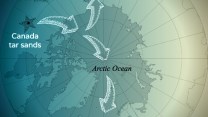
We know the Big Freeze was triggered when a glacial lake covering most of northwest Canada burst its banks and poured into the North Atlantic and Arctic Oceans, diluting oceanic salinity (I wrote of fears of this in MoJo's The Fate of the Ocean) and rerouting the oceanic currents that deliver climate to the Northern Hemisphere:

Two studies published in 2006 show that the same thing happened again 8,200 years ago, when the Northern hemisphere went through another cold spell. Some climate scientists have suggested that the Greenland ice sheet could have the same effect if it suddenly melts through climate change, but the 2007 report of the Intergovernmental Panel on Climate Change concluded this was unlikely to happen this century.

Well, that's out of date. We already know Greenland is turning to slush frighteningly fast.

Patterson's team have now set their sights on even more precise records of historical climate. They have built a robot able to shave 0.05 micrometer slivers along the growth lines of fossilized clam shells, giving a resolution of less than a day. "We can get you mid-July temperatures from 400 million years ago," he says.

Hey, Barack Obama, you know, The Day After Tomorrow could happen after all. On your watch. One season all balmy in the Northern Hemisphere. The next a frozen hell. Sure you don't want to go to Copenhagen before the glaciers block your route?
 

Advertise on MotherJones.com

Diagnosing Health Care's Carbon Footprint

| Tue Nov. 10, 2009 6:44 PM PST
800px-3205_-_Milano_Duomo_-_Giorgio_Bonola_-_Miracolo_di_Marco_Spagnolo_1681_-_Foto_Giovanni_DallOrto_6-Dec-2007.jpg

Ever wonder how much of the American carbon footprint is caused by the American health care system? In a research letter published in the Journal of the American Medical Association, U of Chicago researchers estimate for the first time. The result: a surprising 8 percent, or nearly a tenth of the country’s bindmogglingly fat CO2 emissions.

Interestingly, health care accounts for 16 percent of US gross domestic product. So are health care costs way out of whack? Or is the health care business unusually light on the C02?

Not hard to guess that one.

The biggest wastrel? Hospitals, with their high energy demands for temperature control, ventilation, and lighting.

Second biggest wastrel? The pharmaceutical industry, with its high energy costs of manufacturing and researching drugs, combined with high transportation costs for drug distribution.

Fixes? The authors suggest that hospitals create recycling programs (they don't have those already?) and buy goods and services from environmentally friendly suppliers.

As an example, the U of Chicago Medical Center's sustainability program created a plastic recycling program diverting more than 500 pounds of waste a day from landfills and mandating that 90 percent of cleaning supplies have Green Seal certification. These measures reduced waste costs from $55,000 to $35,000 a month. Apparently green is good for the medical greenback.

The Brits are assessing their health care footprint too. James Black blogging at Health and Environment says that Britain’s National Health Service (NHS) is Europe’s largest public sector contributor of CO2 emissions and accounts for a quarter of the UK’s total carbon footprint. He suggests this triage:

The average face to face staff meeting costs the NHS $415, and 82% of those attending meetings typically claim around $67 each in expenses. One meeting costs the Earth an average of 47kg of CO2. The NHS estimates that if just half of its management and frontline staff were to use video conferencing, 219,000 tonnes of CO2 emissions could be saved every year.

(Not that technological cures are carbonless.)

Jeannette Chung, lead author of the JAMA research letter, diagnoses the American system when she says:

"In this country, the primary focus is on issues surrounding patient safety, health care quality, and cost containment at this current point in time. The health care sector, in general, may be a bit slower than other sectors to put this [emissions] on their radar screen. But given the focus on health care policy and environmental policy, it might be interesting—if not wise—to start accounting for environmental externalities in health care.

Rx: Get wise. Fast.

Also, play more, get healthier.
 

Pundits Versus Data, the 5-Minute Smackdown

| Fri Nov. 6, 2009 6:34 PM PST

Ever wondered just how partisan or bipartisan Congress is now compared to then? Well, here's a series of visual representations of just that, thanks to Andrew Odewahn, who calculated Senatorial affinities over time and plugged the data into GraphViz.

This is another typically fun and speedy Ignite presentation: 1 speaker, 5 minutes, 20 slides auto-advancing every 15 seconds, whether the speaker keeps up or not. Thanks to my friend Sara Winge at O'Reilly Media, the home of Ignite, for the heads up on the video.


How to Bust an Escalator Addiction

| Thu Nov. 5, 2009 4:07 PM PST

The Fun Theory is, well, fun. I know this video made my rounds a couple of weeks ago, but not here (I don't think). For the students I met at Augustana College earlier this year, wrestling with their elevator addictions, this video offers a cool solution. I believe this is another example of the piezo-electric effect, powered by human feet, appearing in nightclubs in Europe.


Swine Flu Strikes Endangered Amazonian Tribe

| Thu Nov. 5, 2009 3:13 PM PST
Alto_orinoco5.jpg

I can't find this story anywhere in US news outlets. Whereas the BBC—twice as far away—features it on their online front page.

According to Survival International, swine flu has killed seven members of the Yanomami, an endangered Amazonian tribe. Another 1,000 Yanomami are reported to have caught the virulent strain. The regional office of the World Health Organization confirms swine flu.

Meanwhile, the Venezuelan government has sealed the area and sent in medical teams, amid fears the epidemic could kill many more Indians. According to Survival International:

In the 1980-90s, when goldminers invaded their land, one fifth of the Yanomami in Brazil died from diseases such as flu and malaria introduced by the miners. Stephen Corry, director of Survival said, "The situation is [now] critical. We could once more see hundreds of Yanomami dying of treatable diseases. This would be utterly devastating for this isolated tribe, whose population has only just recovered from the epidemics which decimated their population 20 years ago."

The Yanomami are the largest relatively isolated tribe in the Amazon rainforest, with a population of 32,000 straddling the mountainous border between Venezuela and Brazil. Because of this isolation, the Yanomami possess little resistance to introduced diseases. Furthermore, there's virtually no medical infrastructure in their forested homeland. Certainly not an ICU, I gather.
 

Tue May. 21, 2013 3:00 AM PDT
Tue Apr. 16, 2013 3:05 AM PDT
Fri Apr. 12, 2013 3:10 AM PDT
Fri Apr. 5, 2013 3:15 AM PDT
Fri Mar. 8, 2013 4:20 AM PST
Mon Feb. 11, 2013 4:02 AM PST
Thu Jan. 31, 2013 4:21 AM PST
Fri Jan. 18, 2013 2:37 PM PST
Fri Dec. 14, 2012 4:18 AM PST
Tue Nov. 27, 2012 4:13 AM PST
Thu Nov. 15, 2012 4:18 AM PST
Fri Nov. 9, 2012 4:03 AM PST
Tue Nov. 6, 2012 4:13 AM PST
Mon Oct. 22, 2012 12:18 PM PDT
Thu Oct. 11, 2012 3:00 AM PDT