

Mark Follman is a senior editor at Mother Jones. He is a former editor of Salon and a cofounder of the MediaBugs project. His reporting and commentary have also appeared in Salon, Rolling Stone, The Atlantic, Fox News, andNational Public Radio. The in-depth investigation into mass shootings he led for MoJo was honored with the 2013 Izzy Award.
Read on for our full coverage from Election Day 2012; a brief explainer on voter suppression follows below.
Update 15, 12:42 p.m. PST, November 7: Disproportionate disenfranchisement of minorities Black and Hispanic voters were more likely to enounter voting problems than whites in yesterday's election; see this AFL-CIO survey via Adam Serwer.
Update 14, 4:20 p.m. PST, November 6: Tales from the voting meltdown in Florida
Long lines continue to plague Florida voters, who have been forced to wait up to seven hours to cast their ballots today. Josh Harkinson has one woman's painful story, and more.
Update 13, 3:50 p.m. PST, November 6: Pennsylvania's voter ID law causes mayhem
Across the state of Pennsylvania voters have reported encountering signs and election volunteers requesting voter identification, even though a court ruling halted the state's voter ID law until after the election. Voters, needless to say, are confused and upset—many don't understand whether they are required to show ID. Erika Eichelberger and Josh Harkinson have more here.
Update 12, 2:56 p.m. PST, November 6: Parking signs at Pa. polling place attempt to block Democrats In Charleroi, Pennsylvania, five signs were placed on barricades near a polling station parking lot that read: "NO PARKING FOR DEMOCRATS - WALK THAT WILL BE THE MOST WORK YOU DO ALL DAY." Brett Brownell has more here.
Update 10, 2:20 p.m. PST, November 6: Pennsylvania voter purge?
"We suspect there has been an unreported purge of voters in Pennsylvania," Barbara Arnwine, head of the Lawyer's Committee for Civil Rights, tells Mother Jones. There are "too many voters being affected by this" in major urban areas like Philadephia and Pittsburgh "for us to think it’s voter error or voter confusion." The Committee's Jon Greenbaum, a former Justice Department attorney, said that the only other explanation for the reports was administrative error. Adam Serwer has more details here.
Update 9, 2:14 p.m. PST, November 6: Fox News' Black Panther bogeyman
2008 flashback! Fox News is once again hyperventilating about voter intimidation in Pennsylvania allegedly by the New Black Panther Party. As it was four years ago, the NBPP's actual presence at the polls is negligible. In fact, there was reportedly only one of them this time. Adam Serwer has more details here.
Update 8, 12:05 p.m. PST, November 6: Big problems with absentee ballots in Ohio?
A coalition of voter advocacy groups called the Ohio Fair Elections Network just held a conference call this afternoon in Columbus to provide an update on Election Day voting problems. The top concern involves a new program started by Secretary of State Jon Husted that mailed absentee ballot applications to nearly 7 million voters earlier this year. Because of various voting restrictions set in motion since 2008—and because some voters never received the absentee ballots they requested through the program—those voters will have to cast provisional ballots today unless they take their absentee ballots (if they received them) to their local board of elections office. And there are now red flags with Ohio's provisional ballot process, thanks to a controversial last-minute maneuver by Husted regarding voter IDs.
About 209,000 Ohio voters cast provisional ballots in 2008; Brian Rothenberg of ProgressOhio said he expects to see 30,000 to 50,000 more this year because of the new absentee ballot program. By state law, officials don't have to count provisional ballots until this November 17. After that, if Obama and Romney are within 0.25 percent of the entire state's vote a recount would be required.
Other problems today, which multiple representatives from the Fair Elections Network said were "isolated," have reportedly included malfunctioning optical ballot scanners, confusion over correct polling locations, and long lines, primarily in Cuyahoga and Summit Counties. Aside from the provisional ballot concerns, "things seem to be running smoothly," said Carrie Davis, a spokeserson for the League of Women Voters of Ohio.
Update 7, 11:20 a.m. PST, November 6: What was the deal with this Romney-loving voting machine? An electronic voting machine in Perry County, Pennsylvania that changed a President Obama vote to one for Mitt Romney is now back online, after officials received a complaint and recalibrated the machine, Mother Jones has confirmed. Watch the video that's been circulating this morning:
Update 6, 9:17 a.m. PST, November 6: Polling troubles emerge in key states; watchdogs report "thousands" of calls
The Lawyer's Committee for Civil Rights says it fielded thousands of calls Tuesday morning from voters around the country, including in Pennsylvania and Ohio: voters turned away from the polls because they lacked photo ID, voters facing polling places with inadequate staff and equipment, and voters whose polling stations opened late. Adam Serwer has more details here.
Update 5, 8:36 a.m. PST, November 6: Conservative group's poll-watching operations—focused on black neighborhoods—blocked in Ohio
True the Vote, a conservative group that sees itself as fighting voter fraud but that voting rights groups see as engaging in voter suppression, has been denied its application to place observers at polling places in Franklin County, Ohio, according to the Columbus Dispatch. The Franklin County Board of Elections said that the requests were not properly filed. Not only that, but the Dispatch reports that county officials said that some of the names on True the Votes applications may have been falsified, and that the group could be investigated after the election.
A crucial detail about True the Vote's intentions: Many of the requests, according to the Dispatch, were to observe polling stations in predominantly black neighborhoods. True the Vote emerged in the aftermath of the 2008 election, when many conservatives had been convinced that the now-defunct community organizing group ACORN had illegally influenced the outcome. They set a goal of fielding thousands of poll watchers in 35 states on Election Day.
Update 4, 4:30 p.m. PST, November 5: Could voting machines really be used to steal the election in Ohio?
According to Verified Voting, a nonprofit that advocates for more transparent elections, 25 percent of Americans will vote in this year's election on machines with no paper trails. That's led to fears that a few hacked machines in a decisive state could swing the entire election.
One popular conspiracy theory is that Mitt Romney's son, Tagg—who owns part of Hart InterCivic, a company with machines in two Ohio counties—plans to steal the election for his father. But as NPR reported, the theory has little connection with reality. Tagg Romney has only a tenuous connection to Hart: He owns the private equity firm Solamere Capital, which is invested in another firm, HIG Capital, that took over Hart's board last July.
Another conspiracy theory has been floated by the Columbus Free Press, which previously reported that a private IT firm helped steal Ohio from John Kerry in 2004. The Free Press claims it has confirmed that staffers in the Ohio secretary of state's office have added experimental software patches to machines in the state that could steal votes. That doesn't add up, according to Joseph Lorenzo Hall, a voting expert at the Center for Democracy and Technology in Washington, DC. "To be sure: voting systems are exceedingly vulnerable," he told the Awl, but there's "no contact between [a] voting system and reporting software."
Update 3, 2:50 p.m. PDT, November 5: Protecting the voting rights of people with mental disabilities
Fourteen states categorically bar people who are under guardianship or are judged to be mentally "incompetent" or "incapacitated" from voting. The laws "are based on a faulty stereotype" and violate constitutional guarantees of equal protection and due process, says one legal expert. Deanna Pan has more here.
Update 2, 1:30 p.m. PST, November 5: Ohio GOP's ID switcheroo, dirty robocalls against Dems in Arizona, intimidation in Pa.
Will this be the dirtiest election ever? Most people won't go to the polls until tomorrow, but reports of trickery aimed at would-be voters have have been piling up: A last-minute directive from Ohio's Republican secretary of state on voter IDs that could swing the election, epically long lines at early voting locations in Ohio and Florida, and GOP robocalls directing Democrats to the wrong polling places in Arizona. (For much more, explore the icons on the interactive map above.) And are the tea party's "election monitoring" efforts targeting African Americans? MoJo's Josh Harkinson has more details here.
Update 1, 10:45 a.m. PST, November 5: Voting chaos in Florida—no small thanks to Romney's man, Rick Scott
Mitt Romney's final pre-election visit to Florida on Monday morning included a surprise guest: the state's Republican governor Rick Scott. MoJo's Adam Weinstein runs down Scott's various moves during his administration to tighten voting restrictions, leading up to this weekend's mess with long lines and controversy over early voting.
MoJo's Brief Guide to Voter Suppression Tactics In our July/August issue, Kevin Drum investigated the decadelong campaign by Republicans to confront voter fraud. Despite the fact that incidents of in-person voter fraud in the United States are exceedingly rare, the GOP has used the issue to tighten election laws around the country, including pushing for controversial voter ID measures. Mother Jones has tracked this and other efforts apparently aimed at suppressing turnout among minorities, the elderly, and other voting constituencies that traditionally favor Democrats at the polls.
Here's more of our recent coverage to get you up to speed on voter suppression tactics that may affect Election 2012:
A look at 10 of the top dirty tricks used to swing elections, including deceitful robocalls and flyers, making voter registration more difficult, purging voter rolls, and deploying poll "watchers" with ulterior motives.
Felon disenfranchisement laws across most of the country have made significant populations ineligible to vote on Tuesday. The most stringent such laws are in Kentucky, and in the swing states of Florida, Virginia, and Iowa.
Check back regularly from now through Election Day—we will be updating this explainer and the interactive map above with more information as it emerges. Know of a voting problem in your area? Report it to Mother Jones here.
Need help finding your polling place? Try looking it up here:
The issue of gun violence, long stuck in an unvirtuous cycle of hardened rhetoric, tends to get ignored in national politics. But 2012 has been terrible with mass shootings, and an audience member raised the issue in Tuesday's town hall presidential debate, asking what will be done to limit the availability of assault weapons and keep them from criminals. President Obama, directly acknowledging the recent slaughter at a Colorado movie theater, called for a "comprehensive strategy" to deal with the problem.
Mitt Romney took a different approach, demonstrating that no issue is too peripheral for him to make false claims, dissemble, and utter comments likely to piss off women. (See also from Tuesday night: binders.) In less than three minutes, Romney bungled the facts on assault weapons, cited Fast and Furious as the nation's "greatest failure" on gun violence, and, more broadly, pointed the finger at single moms:
But let me mention another thing, and that is parents. We need moms and dads helping raise kids. Wherever possible, the—the benefit of having two parents in the home—and that's not always possible. A lot of great single moms, single dads. But gosh, to tell our kids that before they have babies, they ought to think about getting married to someone—that's a great idea because if there's a two-parent family, the prospect of living in poverty goes down dramatically.
That set up Romney's assertion that "we can make changes in the way our culture works to help bring people away from violence." (Watch his full remarks below.)
If it seems a little nutty to suggest that fewer unwed mothers is key to reducing carnage from AK-47s, consider that Romney also recently embraced a debunked conspiracy theory involving a United Nations plot to seize Americans' firearms. Moreover, Romney got his facts wrong Tuesday night, claiming in his initial response that it's "already illegal in this country to have automatic weapons." As the LA Times and other news outlets have since explained, automatic weapons can be possessed legally in the United States.
As for his declaring that the alleged Fast and Furious conspiracy is our nation's "greatest failure" on gun violence, Romney might want to speak with survivors of the mass shootings in Aurora and Tucson, as Obama has. After Romney made time in September for a long chat with the National Rifle Association's chief lobbyist, some of those survivors reached out to the GOP presidential candidate and asked for equal time. But as I reported recently, he has ignored them.
Not surprisingly, Romney wasn't always such a hard-liner on guns. As Obama himself pointed out Tuesday night, the former Massachussetts governor once signed a ban on assault weapons similar to the federal legislation that expired in 2004. Watch Obama call him on it:
And here are Romney's remarks in response to the town hall attendee's question about assault weapons:
Romney speaks at the National Rifle Association's annual meeting in Kentucky in 2008.Lexington Herald-Leader/ZUMA
When Mitt Romney and Barack Obama square off in the first presidential debate in Denver, they'll be doing so just a few miles from where a heavily armed young man unleashed a bloodbath inside a movie theater less than three months ago. It's unlikely that guns—and more specifically the frightening rise in mass shootings—will be a topic of debate on Wednesday night. But some survivors are pressing the candidates to explain what they intend to do about America's gun violence.
Other than expressing sorrow and general concern after the slaughter in the Denver suburb of Aurora in July, Obama has said little as president on the subject of guns. (His reticence has done nothing, of course, to reduce long-running chatter on the right that he has nefarious plans to disarm America en masse, a fear that Paul Ryan himself plays to on the campaign trail.)
Romney, on the other hand, has eagerly courted the pro-gun crowd. In a lengthy interview in September with Chris Cox, the chief lobbyist for the National Rifle Association, Romney aimed all the way to the right on an alleged United Nations plot to take away Americans' firearms. "I am troubled by this…I will never support or enforce any treaty that attempts to restrict our fundamental rights," he replied to a question about the discreditedconspiracy theory. He also endorsed federal legislation that would allow concealed weapons to be carried nationwide, and called for Attorney General Eric Holder to be fired over the Fast and Furious scandal-that-wasn't.
Moreover, Romney vowed that as president he would not back "any additional laws to restrict the right to keep and bear arms." Never mind that as governor of Massachusetts he signed a permanent ban on assault weapons similar to the federal legislation that expired in 2004.
Two survivors of recent mass shootings and the relatives of two victims want Romney to consider their perspective. On September 17, they sent a letter via email to the Republican candidateasking him for an opportunity like the one Cox got to ask Romney questions. " The truth is that while mass shootings get headlines, an average of 34 Americans are murdered every day with guns, most often by people who should never have had them in the first place," they wrote in the letter, a copy of which was provided to Mother Jones. "That's 12,000 of our fellow citizens every year—a staggering toll that could be reduced though common-sense solutions like better background checks and stronger enforcement of current laws."
Since 2009, the NRA and its allies in state capitols have pushed through 99 laws making guns easier to own, easier to carry in public—eight states now even allow them in bars—and harder for the government to track. More than two-thirds of the laws were passed by Republican-controlled legislatures, though often with bipartisan support. (Note: Click on the colored states for details on additional laws; info on a few particularly noteworthy ones follows below the map. Also see our related story on the frightening rise of mass shootings in the US.)
99 Laws Rolling Back Gun Restrictions, 2009-2012
Easier to Carry
Easier to Own
Harder to Track
Carry in Bars
All 99 Laws
GOP or Dem?
Some particularly noteworthy laws:
Bullets and booze: In Missouri, law-abiding citizens can carry a gun while intoxicated and even fire it if "acting in self-defense."
Child-safety lock off: In Kansas, permit holders can carry concealed weapons inside K-12 schools and at school-sponsored activities.
Short arm of the law: In Utah, a person under felony indictment can buy a gun, and a person charged with a violent crime may be able to retain a concealed weapon permit. Nebraskans who've pled guilty to a violent crime can get a permit to carry a gun.
Sweet Jesus! In Louisiana, permit holders can carry concealed weapons inside houses of worship.
Without a trace: Virginia not only repealed a law requiring handgun vendors to submit sales records, but the state also ordered the destruction of all such previous records.
Sources: The majority of the data used for this map is from the Law Center to Prevent Gun Violence, with additional research by Mother Jones. You can get further details about the laws, by year, on LCPGV's site: 2009-10, 2011, and 2012.
Additional research contributed by Deanna Pan and Gavin Aronsen.
In the fierce debate that always follows the latest mass shooting, it's an argument you hear frequently from gun rights promoters: If only more people were armed, there would be a better chance of stopping these terrible events. This has plausibility problems—what are the odds that, say, a moviegoer with a pack of Twizzlers in one pocket and a Glock in the other would be mentally prepared, properly positioned, and skilled enough to take out a body-armored assailant in a smoke- and panic-filled theater? But whether you believe that would happen is ultimately a matter of theory and speculation. Instead, let's look at some facts gathered in a five-month investigation by Mother Jones.
In the wake of the massacres this year at a Colorado movie theater, a Sikh temple in Wisconsin, and Sandy Hook Elementary School in Connecticut, we set out to track mass shootings in the United States over the last 30 years. We identified and analyzed 62 of them, and one striking pattern in the data is this: In not a single case was the killing stopped by a civilian using a gun. And in other recent (but less lethal) rampages in which armed civilians attempted to intervene, those civilians not only failed to stop the shooter but also were gravely wounded or killed. Moreover, we found that the rate of mass shootings has increased in recent years—at a time when America has been flooded with millions of additional firearms and a barrage of new laws has made it easier than ever to carry them in public places, including bars, parks, and schools.
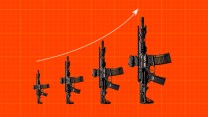
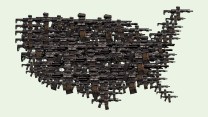
America has long been heavily armed relative to other societies, and our arsenal keeps growing. A precise count isn't possible because most guns in the United States aren't registered and the government has scant ability to track them, thanks to a legislative landscape shaped by powerful pro-gun groups such as the National Rifle Association. But through a combination of national surveys and manufacturing and sales data, we know that the increase in firearms has far outpaced population growth. In 1995 there were an estimated 200 million guns in private hands. Today, there are around 300 million—about a 50 percent jump. The US population, now over 314 million, grew by about 20 percent in that period. At this rate, there will be a gun for every man, woman, and child before the decade ends.
There is no evidence indicating that arming Americans further will help prevent mass shootings or reduce the carnage, says Dr. Stephen Hargarten, a leading expert on emergency medicine and gun violence at the Medical College of Wisconsin. To the contrary, there appears to be a relationship between the proliferation of firearms and a rise in mass shootings: By our count, there have been two per year on average since 1982. Yet, 25 of the 62 cases we examined have occurred since 2006. In 2012 alone there have been seven mass shootings, and a record number of casualties, with more than 140 people injured and killed.
Armed civilians attempting to intervene are actually more likely to increase the bloodshed, says Hargarten, "given that civilian shooters are less likely to hit their targets than police in these circumstances." A chaotic scene in August at the Empire State Building put this starkly into perspective when New York City police officers trained in counterterrorism confronted a gunman and wounded nine innocent bystanders in the process.
Surveys suggest America's guns may be concentrated in fewer hands today: Approximately 40 percent of households had them in the past decade, versus about 50 percent in the 1980s. But far more relevant is a recent barrage of laws that have rolled back gun restrictions throughout the country. In the past four years, across 37 states, the NRA and its political allies have pushed through 99 laws making guns easier to own, carry, and conceal from the government.
Among the more striking measures: Eight states now allow firearms in bars. Law-abiding Missourians can carry a gun while intoxicated and even fire it if "acting in self-defense." In Kansas, permit holders can carry concealed weapons inside K-12 schools, and Louisiana allows them in houses of worship. Virginia not only repealed a law requiring handgun vendors to submit sales records, but the state also ordered the destruction of all such previous records. More than two-thirds of these laws were passed by Republican-controlled statehouses, though often with bipartisan support.
The laws have caused dramatic changes, including in the two states hit with the recent carnage. Colorado passed its concealed-carry measure in 2003, issuing 9,522 permits that year; by the end of last year the state had handed out a total of just under 120,000, according to data we obtained from the County Sheriffs of Colorado. In March of this year, the Colorado Supreme Court ruled that concealed weapons are legal on the state's college campuses. (It is now the fifth state explicitly allowing them.) If former neuroscience student James Holmes were still attending the University of Colorado today, the movie theater killer—who had no criminal history and obtained his weapons legally—could've gotten a permit to tote his pair of .40 caliber Glocks straight into the student union. Wisconsin's concealed-carry law went into effect just nine months before the Sikh temple shooting in suburban Milwaukee this August. During that time, the state issued a whopping 122,506 permits, according to data from Wisconsin's Department of Justice. The new law authorizes guns on college campuses, as well as in bars, state parks, and some government buildings.
And we're on our way to a situation where the most lax state permitting rules—say, Virginia's, where an online course now qualifies for firearms safety training and has drawn a flood of out-of-state applicants—are in effect national law. Eighty percent of states now recognize handgun permits from at least some other states. And gun rights activists are pushing hard for a federal reciprocity bill—passed in the House late last year, with GOP vice presidential candidate Paul Ryan among its most ardent supporters—that would essentially make any state's permits valid nationwide.
Indeed, the country's vast arsenal of handguns—at least 118 million of them as of 2010—is increasingly mobile, with 69 of the 99 new state laws making them easier to carry. A decade ago, seven states and the District of Columbia still prohibited concealed handguns; today, it's down to just Illinois and DC. (And Illinois recently passed an exception cracking the door open to carrying). In the 62 mass shootings we analyzed, 54 of the killers had handguns—including in all 15 of the mass shootings since the surge of pro-gun laws began in 2009.
In a certain sense the law was on their side: nearly 80 percent of the killers in our investigation obtained their weapons legally.
We used a conservative set of criteria to build a comprehensive rundown of high-profile attacks in public places—at schools, workplaces, government buildings, shopping malls—though they represent only a small fraction of the nation's overall gun violence. The FBI defines a mass murderer as someone who kills four or more people in a single incident, usually in one location. (As opposed to spree or serial killers, who strike multiple times.) We excluded cases involving armed robberies or gang violence; dropping the number of fatalities by just one, or including those motives, would add many, manymorecases. (More about our criteria here.)
There was one case in our data set in which an armed civilian played a role. Back in 1982, a man opened fire at a welding shop in Miami, killing eight and wounding three others before fleeing on a bicycle. A civilian who worked nearby pursued the assailant in a car, shooting and killing him a few blocks away (in addition to ramming him with the car). Florida authorities, led by then-state attorney Janet Reno, concluded that the vigilante had used force justifiably, and speculated that he may have prevented additional killings. But even if we were to count that case as a successful armed intervention by a civilian, it would account for just 1.6 percent of the mass shootings in the last 30 years.