Fierce, investigative journalism doesn’t happen by accident—it happens because readers like you make it possible. Every dollar you give before midnight Friday to support our nonprofit newsroom will be matched dollar-for-dollar. We can’t do our work without you. Don’t miss this chance!
2X match ends Friday: Fierce, investigative journalism doesn’t happen by accident—it happens because readers like you make it possible. Every dollar you give before midnight Friday to support our nonprofit newsroom will be matched dollar-for-dollar. We can’t do our work without you. Don’t miss this chance!
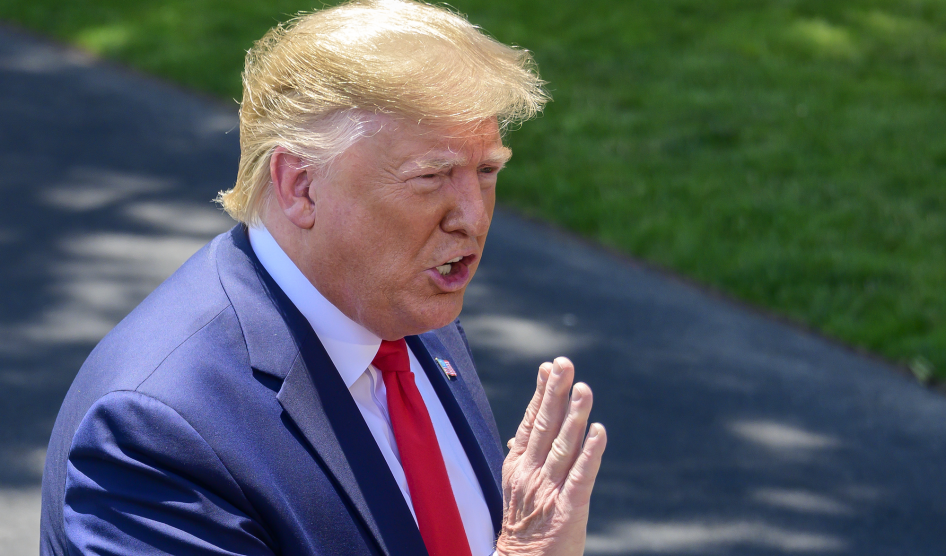
Labor Secretary Alex Acosta resigned Friday amid intense scrutiny of his role as a U.S. attorney a decade ago in a deal with Jeffrey Epstein that allowed the financier to plead guilty to lesser offenses in a sex-crimes case….As he prepared to leave the White House, Trump called Acosta a “great labor secretary, not a good one” and a “tremendous talent.”
“This was him, not me,” Trump said of the resignation decision.
Needless to say, this had nothing—nothing—to do with the fact that Acosta cut a sweetheart deal for Epstein when he was first charged with soliciting dozens of underage girls for prostitution back in 2007. Acosta just didn’t want a hailstorm of negative publicity to do any harm to the crucial work being done by Trump to make America great again.
Only Washington Can Solve the Nation’s Housing Crisis
In recent months America’s affordable housing crisis, a long-simmering issue for people of low and moderate incomes, has burst onto the front page. Rents are rising much faster than income, while the median home price in some 200 cities is $1 million….The private market is clearly failing. Although many city and state governments are motivated to take action, they have limited tools at their disposal….At its root, the crisis is a supply problem. Between 2011 and 2017, the country lost four million low-rent apartments. This has driven up demand for what remains, with the predictable result that a third of all households spend more than 30 percent of income for shelter. In many prospering cities, large numbers pay more than 50 percent.
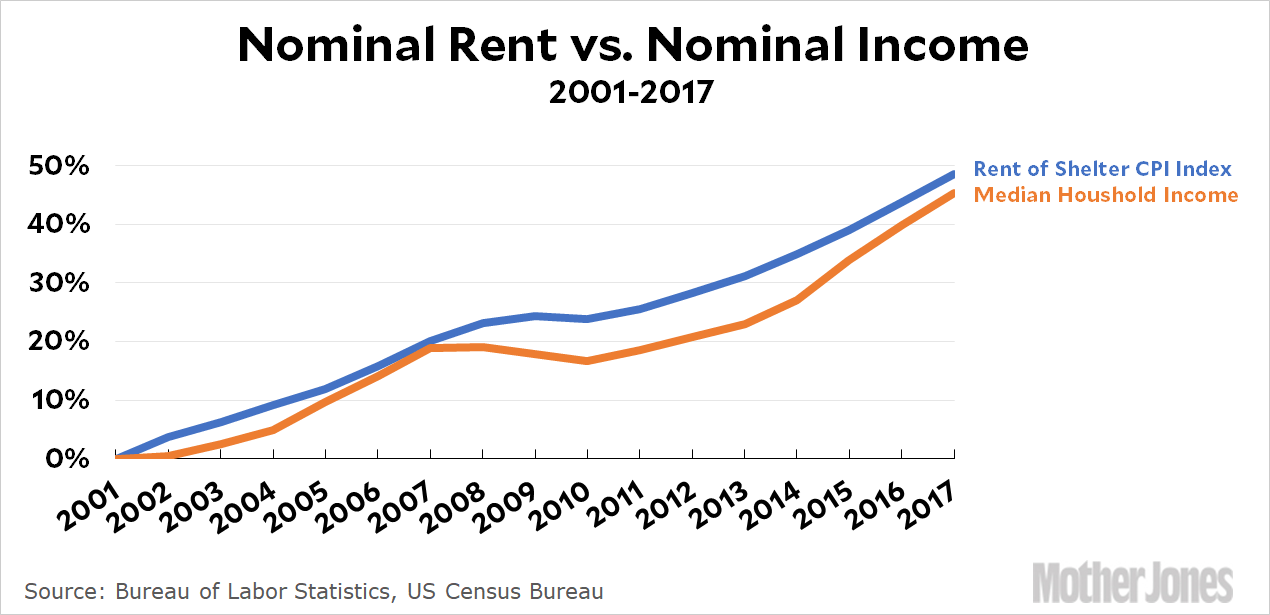
I feel like this stuff is manufactured in an underground factory somewhere and shipped out randomly to newspapers across the country. Does anybody even bother to compare it to the facts anymore? Let’s start with the claim that “rents are rising much faster than income.” Is that true?
Nope, this isn’t true. Rent has risen only slightly more than income since 2001, and has risen more slowly than income since 2010. Next up is “median home price in some 200 cities is $1 million.”
That’s true, but pretty meaningless. Click the link and the first example is Biltmore Forest, North Carolina. This is a tiny enclave of 1,300 on the outskirts of Asheville that’s built around the old Biltmore Estate and the Biltmore Forest Country Club. It’s millionaire country, just like most of the other cities on the list. In fact, a full quarter of them are just subdivisions of a single metro area: San Francisco and Santa Clara. Most of us would call that one place, not 46.
And needless to say, that $1 million figure hasn’t been adjusted for inflation over the years. It never is when someone wants a scary headline.
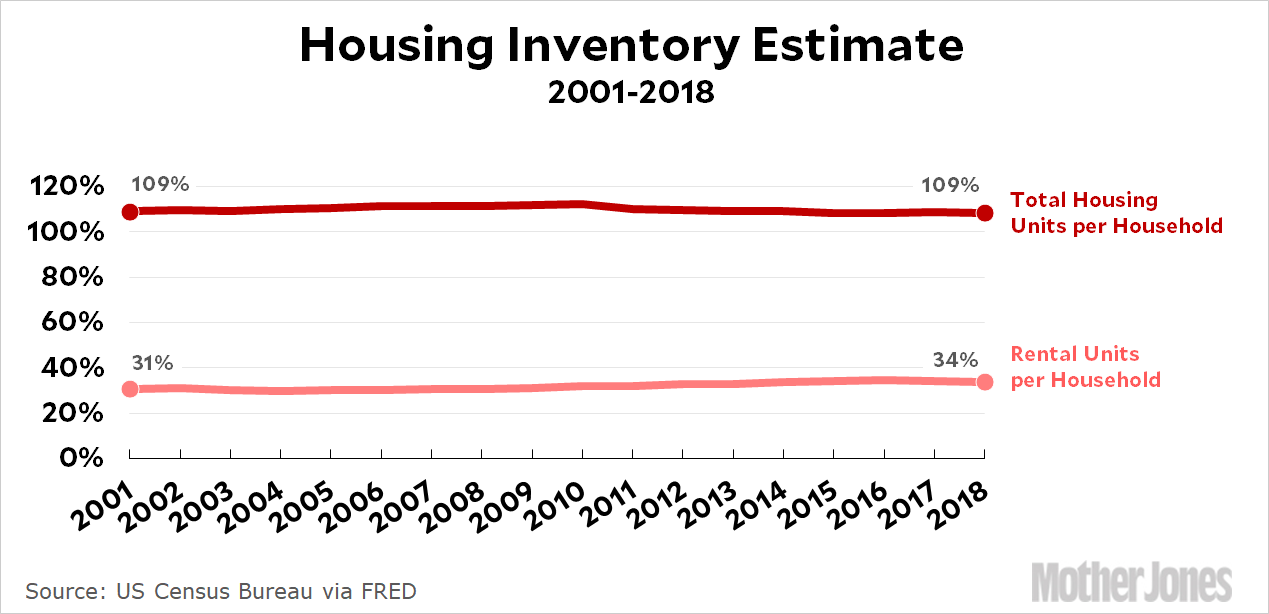
Next up is “the crisis is a supply problem.” Is it?
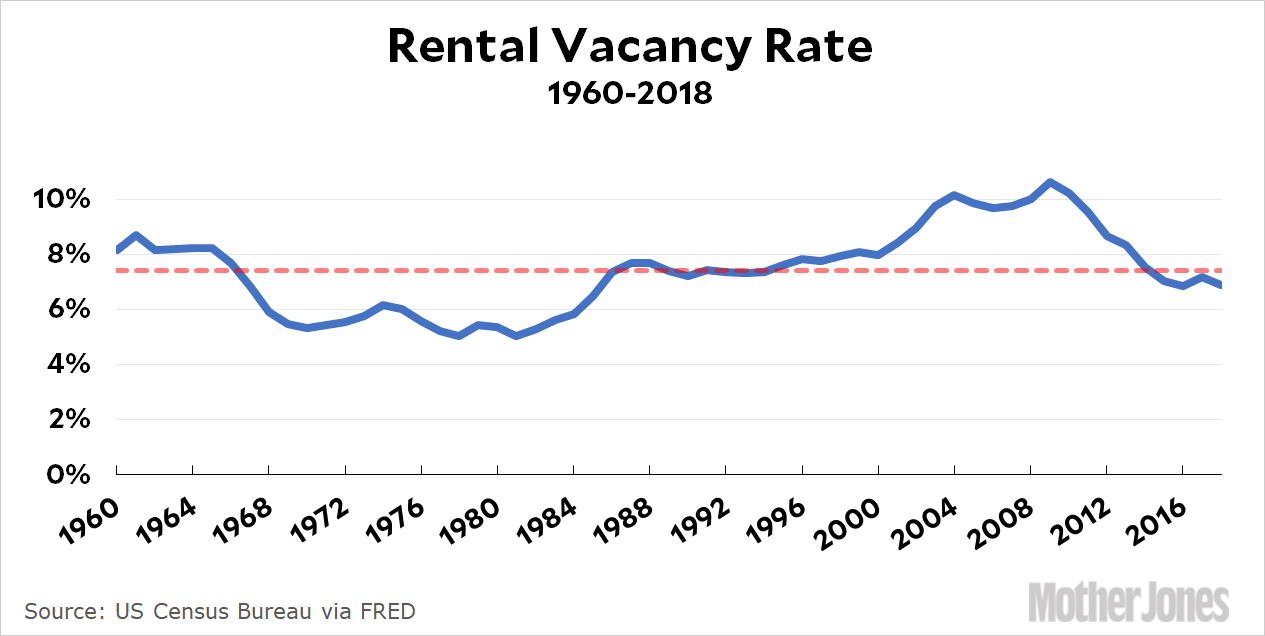
As of 2018, there were a total of 138 million housing units for 128 million households. That’s 9% more housing units than households, the same as in 2001. The number of rental units per household has gone up. And the rental vacancy rate is right at its long term average.
Nor has the nation “lost” 4 million low-rent apartments. What that probably means (though there’s no telling, really) is that 4 million apartments have crossed some arbitrary threshold defined as low-rent. But if you adjust for inflation, probably nothing much has happened at all. Those apartments are still around and still cost about the same as ever.
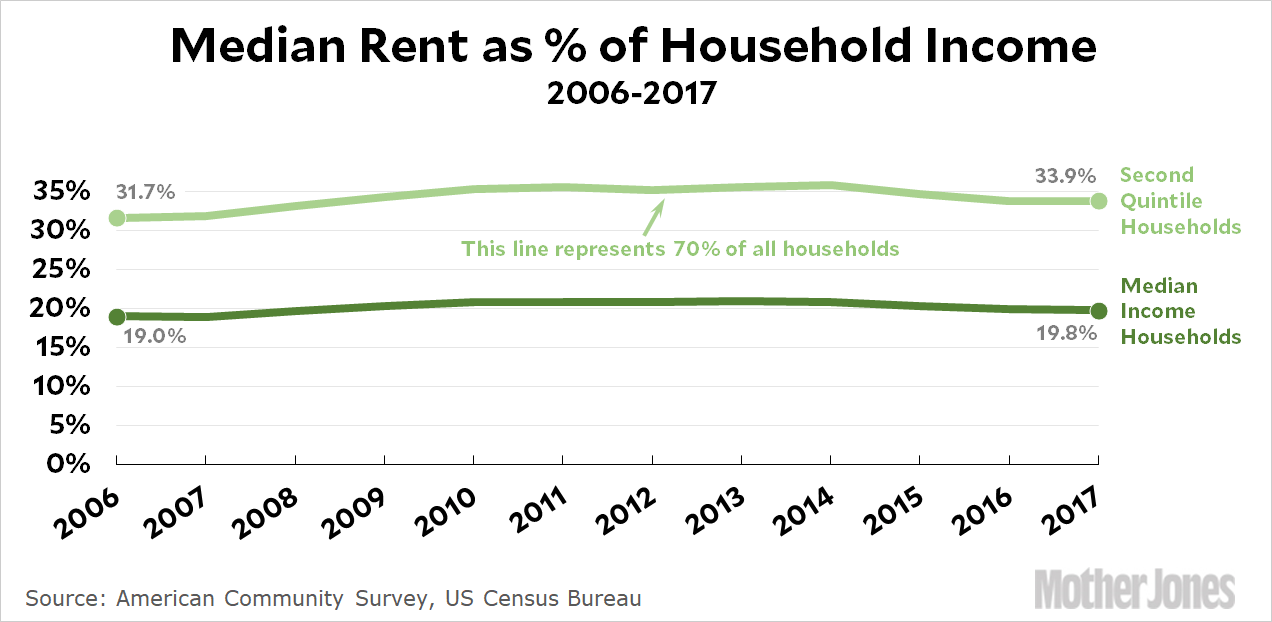
Next up is “a third of all households spend more than 30 percent of income for shelter”:
The median household pays about 20 percent of their income in rent and that hasn’t changed over the past decade. If you go all the way down to the average of the second income quintile—which is about a third of the way from the bottom—average rent has gone up slightly, from 32 percent of income to 34 percent. But that’s using the median rent. People at that income level mostly pay less than the median, which means that their rent is probably around 25-30 percent of their income.
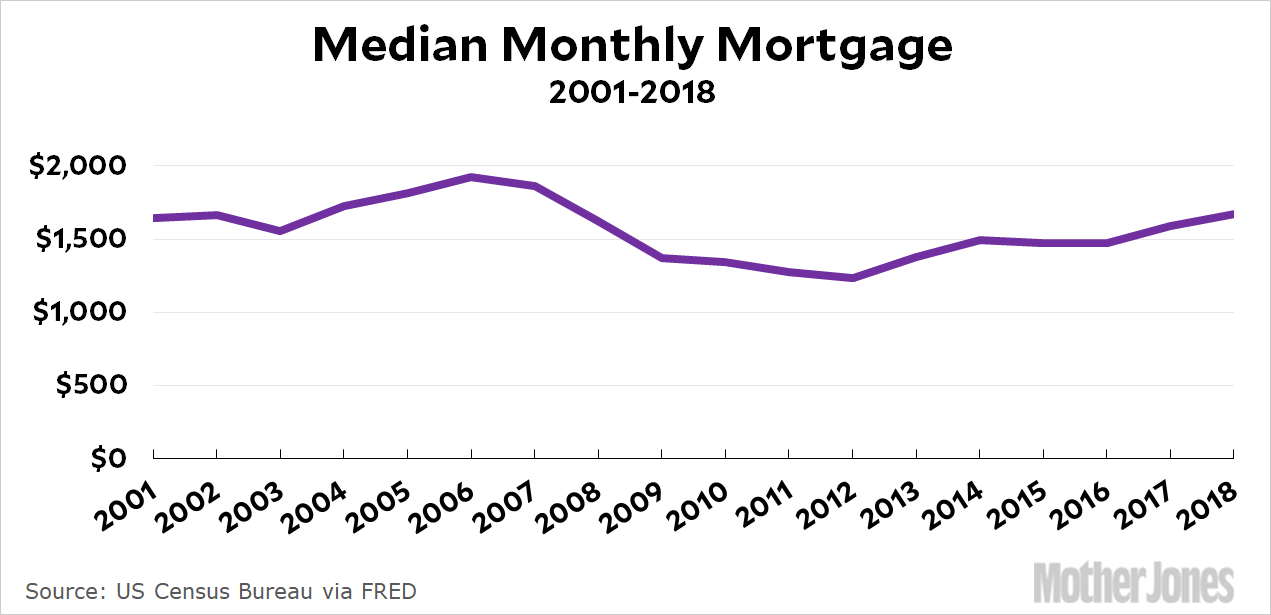
That accounts for 70 percent of all households. Some of the rest probably do pay more than 30 percent of their income in rent, but not all of them. The real number is most likely a quarter of households or less. And more to the point, it hasn’t changed other than slightly over the past decade. Just for comparison, here are average mortgage payments for homes sold over the past two decades:
There’s no change here either, and since rents and mortgages usually move together, it’s not surprising that rents haven’t increased significantly in recent years.
In other words, virtually nothing in the setup for this op-ed is true. Rents aren’t out of control; housing inventory isn’t low; and rent as a percentage of income is about the same as it was ten years ago. There is no generalized “rent crisis” in America.
Now, there’s no question that a few specific cities have seen big rises. The Bay Area is obviously one, Denver is one, and Seattle is another—though the market has responded recently in Seattle and housing development is now increasing. But if you look at big cities more broadly, there’s not even a generalized urban rent crisis.
I would be delighted to improve housing assistance to the poor, who certainly do pay a large percent of their income in rent. The waiting list for Section 8 housing vouchers, for example, is years-long in most cities, and god knows we should make this program more generous. But can we please stop inventing a “housing crisis” to justify it?
POSTSCRIPT: One thing worth pointing out is that it’s just about impossible to get reliable statistics that compare incomes of the poor to average rents of the poor. There’s no question that the poor pay a lot for housing in big cities, but it’s hard to say if that’s gotten significantly worse over the past few decades. It’s also hard to say just how much the average poor household pays.
President Trump is caving in to the Supreme Court. That’s too bad. I was hoping to watch the show. Instead he’s doing this:
Donald Trump is using his executive powers to order every department and agency in the federal government to provide the Department of Commerce with all records on the number of citizens and non-citizens in the U.S. pic.twitter.com/WBDQQwB6i2
Trump himself is typically incoherent trying to explain what this is all about, but Attorney General Bill Barr explained that they hope to use this information for apportionment. That is, they presumably want to apportion members of Congress by number of citizens per state, not number of residents. This is going to be tough sledding given the clear wording of the 14th Amendment:
Representatives shall be apportioned among the several States according to their respective numbers, counting the whole number of persons in each State, excluding Indians not taxed.
It says persons, not citizens, and the framers of the 14th Amendment clearly knew the difference. I suppose the Trumpies could try arguing that “Indians not taxed” really means “anyone not taxed,” and that “not taxed” means “not paying income tax” even though the income tax hadn’t been invented at the time. Other than that, I’m not sure how they could argue for apportionment based on citizens instead of residents. But that’s probably just because I’m not being creative enough.
Alternatively, Republicans could leave overall apportionment alone but try to draw congressional districts based on citizens, not residents. This would open up new avenues for gerrymandering that, for example, would probably keep Texas red for a while longer. The Supreme Court has previously signaled that it might be open to this kind of thing.
To me free speech is not when you see something good and then you purposefully write bad. To me that’s very dangerous speech and you become angry at it. But that’s not free speech.
In fairness, Trump says only that we should be angry at speech like this. He doesn’t say we should ban it.
On the other hand, he also says this isn’t “free speech.” As usual, who knows what he really thinks? Except for one thing: he’s obviously talking about people who criticize him even though he’s done something terrific—which includes everything he does. That kind of jealous sniping really needs to end, amirite?
Last night I asked my sister to pick a flower for today’s photo. How about a daisy? she said. Luckily I have one on tap, so today’s photo is a garland chrysanthemum, also known as a garland daisy, growing among the sunflowers in a scrubby patch of weeds at the Great Park in Irvine. According to Wikipedia, the leaves are “an important ingredient in Taiwanese oyster omelettes and, when young, are used along with stems to flavor soup and stir-fry.” Oyster omelettes?
The White House is pushing congressional leaders to strike a spending deal and increase the debt limit in the next two or three weeks, jolted by a recent report that found the Treasury Department was running out of cash much faster than previously forecasted….White House officials have said the debt ceiling must be raised by early September to ensure the government can pay its bills. And spending on many federal programs expires at the end of September, requiring a separate deal to prevent a government shutdown.
Democrats should offer Trump a deal: they’ll support a debt ceiling increase immediately if Trump will sign a bill guaranteeing humanitarian aid and better conditions on the border. Immediately. They should let him know privately that he can spin this any way he wants. If he wants to claim it was his idea, fine. If he wants to say he hates it but is being extorted by Democrats, fine. Whatever. But it’s a limited time deal, so act fast.
Maybe Trump's next big health care initiative will be a requirement that Medicare cover medical cannabis for all seniors. Winner!Rowan Griffiths/Mirrorpix/Newscom via ZUMA
The Trump administration has abandoned a centerpiece of its efforts to address high drug prices, backing away from requiring some discounts to be passed directly to consumers under Medicare that could have lowered their out-of-pocket costs. President Trump had announced the proposal with great fanfare in January as part of the administration’s efforts to deal with the rising costs of prescription drugs, which have fueled public outrage.
Here’s the scorecard:
If I have this right, this is where we stand on drug pricing proposals:
Eliminating rebates ❌
International Pricing Index ❓
List prices in advertisements ❌
Reform protected classes in part D ❌
Restricting prices in part D 🆕
The rebate proposal apparently went down in flames because it would have ended up costing some money—about $15-20 billion per year. As we all know, Trump is completely, totally, 100 percent dedicated to helping the forgotten men and women of the country . . . unless it actually costs something. If that’s the case, then you’re on your own, folks.
If it weren’t for the fact that this stuff hurts millions of real-life people, I’d get some mordant amusement out of the fact that Trump repeatedly can’t do even the smallest thing to improve American health care, but continues to tweet out crap about how he wants to eliminate Obamacare entirely because it would be the easiest thing in the world to replace it with something better and cheaper for everyone. Does even his base believe this swaggering rubbish any longer?
President Trump is expected to sign an executive action to attempt to add a citizenship question to the 2020 U.S. census, according to an administration official, a move that would prompt immediate challenges in court….“An executive order is the fastest way he can do something,” the administration official said Thursday.
I suppose speed is legitimately important, but my guess is that the real reason for an executive order is that it’s the most obvious way to show that nobody pushes around President Trump. At this point, impressing his base seems to be Trump’s primary motivation, and a boring rehash of the agency rulemaking process won’t do that. An executive order televised live on Fox and leading to an immediate battle with the Supreme Court will.
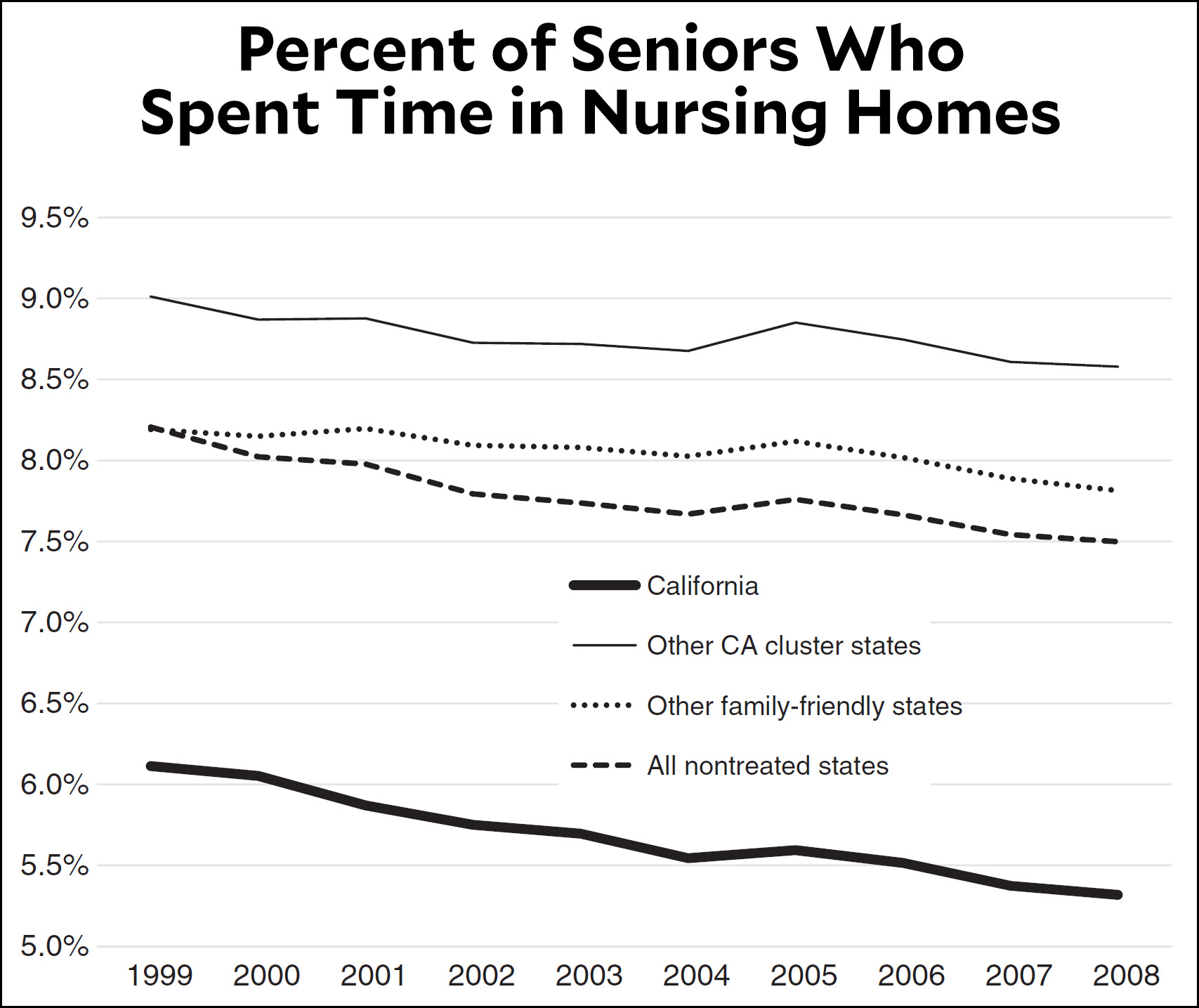
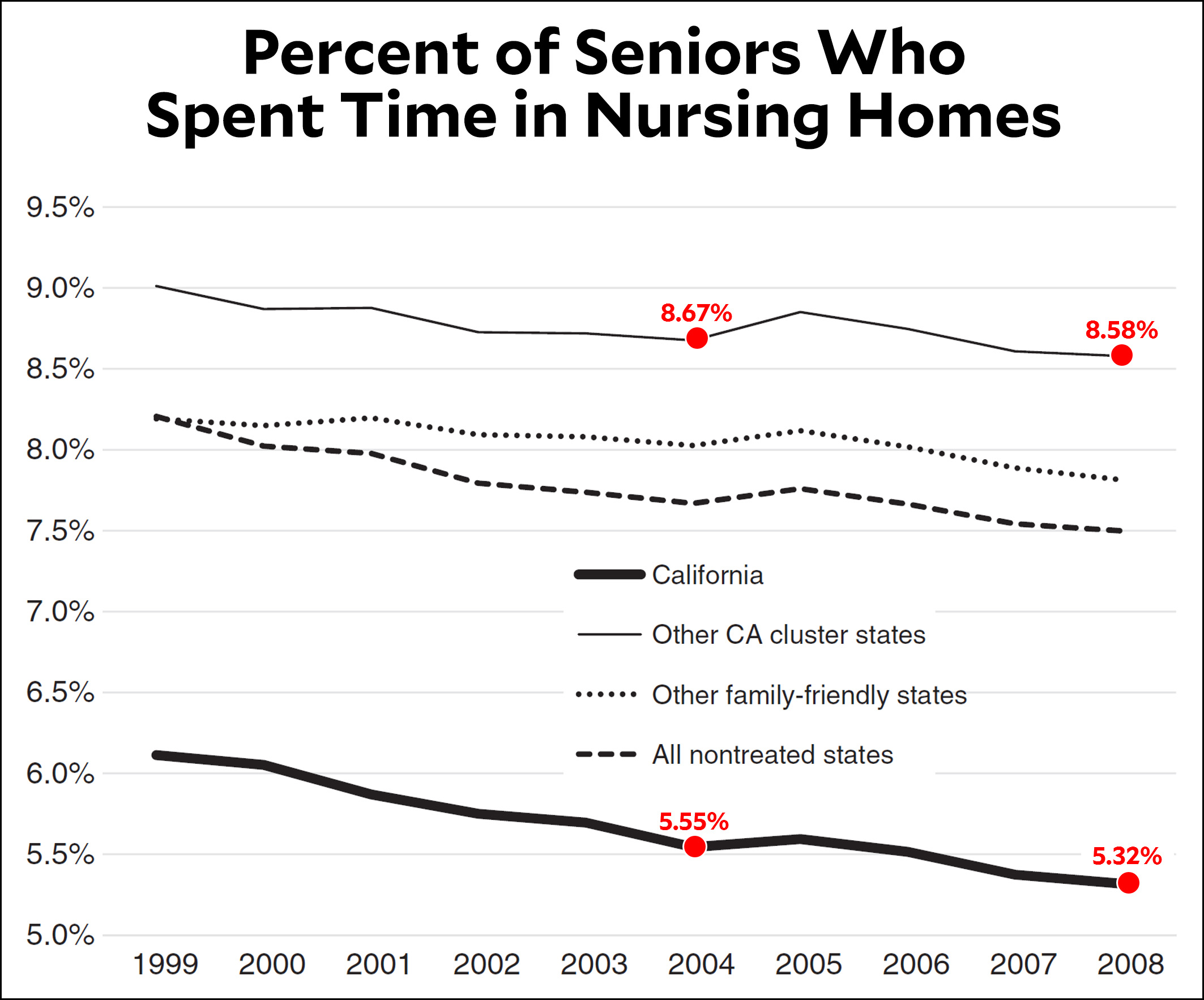
I’m curious to get a few comments about something. Brad DeLong reposted a link today to a year-old study about the effect of paid family leave on the use of nursing homes. The intuition here is that seniors often have short stays in nursing homes, and they might instead recuperate at home if caregivers were able to take time off work to look after them. California passed a family leave bill in 2004, so the study looks at what happened to nursing home use compared to similar states. Here’s the basic result:
As the authors note, there’s no obvious break in the trendline after 2004:
Figure 1 provides no apparent suggestion of a downward shift in California’s trend line beginning in 2005, the first full year of PFL implementation; instead, it appears that in comparison-group states the post-2004 trends lie above the pre-2004 trends.
But wait! If you take a closer look, here’s what you get:
California is down 0.23 percentage points. The comparable states are down by only 0.09 percentage points. Once you do all the official math, it turns out that California showed a big decline relative to other similar states:
PFL [paid family leave] reduced the annual proportion of elders in nursing homes in California by 0.0065, about two-thirds of a percentage point. While this reduction may appear small in size, its relative magnitude is substantial when compared to baseline nursing home utilization levels. In 2003, the year prior to PFL implementation, 5.7 percent of California’s older adults resided in nursing homes. Thus, our estimated PFL effect implies a relative decline of over 11 percent in the proportion of elderly in nursing homes in California….Our estimate is statistically significant at conventional levels.
So here’s what I’m curious about. Even if we accept the paper’s conclusions about statistical significance and so forth, it’s still the case that it’s all based on a tiny absolute difference in a real-world trendline that’s inherently noisy. So should we take this result seriously? Or should we be skeptics unless we get similar results from other states?
Can you pitch in a few bucks to help fund Mother Jones' investigative journalism? We're a nonprofit (so it's tax-deductible), and reader support makes up about two-thirds of our budget.
We noticed you have an ad blocker on. Can you pitch in a few bucks to help fund Mother Jones' investigative journalism?