• Star Wars on Christmas Eve

    LucasFilm

    No spoilers of course, but I have to say that my expectations for Rise of Skywalker were so low that it turned out to be pretty good, relatively speaking. It basically had the design esthetic, dialog esthetic, and plot esthetic of the original trilogy: that is, simple, fast-paced, and suitably finished up. It’s probably perfect for kids, who are, after all, the target audience. For the rest of us, if you enjoy sitting back and watching a movie made in the style of good ol’ Episodes 4-6 without oversized expectations, then you’ll be just fine with Episode 9.

  • Lunchtime Photo

    It’s Christmas Eve in Southern California! Isn’t it beautiful? Don’t you wish you were going to have an azure Christmas?

    But wait. This picture was taken last month, and the weather report says it’s going to rain tomorrow. What about that, Mr. Puffy Clouds and Long Exposure Ocean?

    Meh. Salesmanship has been part of California’s heritage ever since the Southern Pacific laid down tracks to Los Angeles. We’ve been boasting about our weather ever since and promoting pictures all over the country that exaggerate our already impressive natural beauty. Why stop now?

    November 29, 2019 — Laguna Beach, California
  • We All Spend More Time With Our Kids Except in France

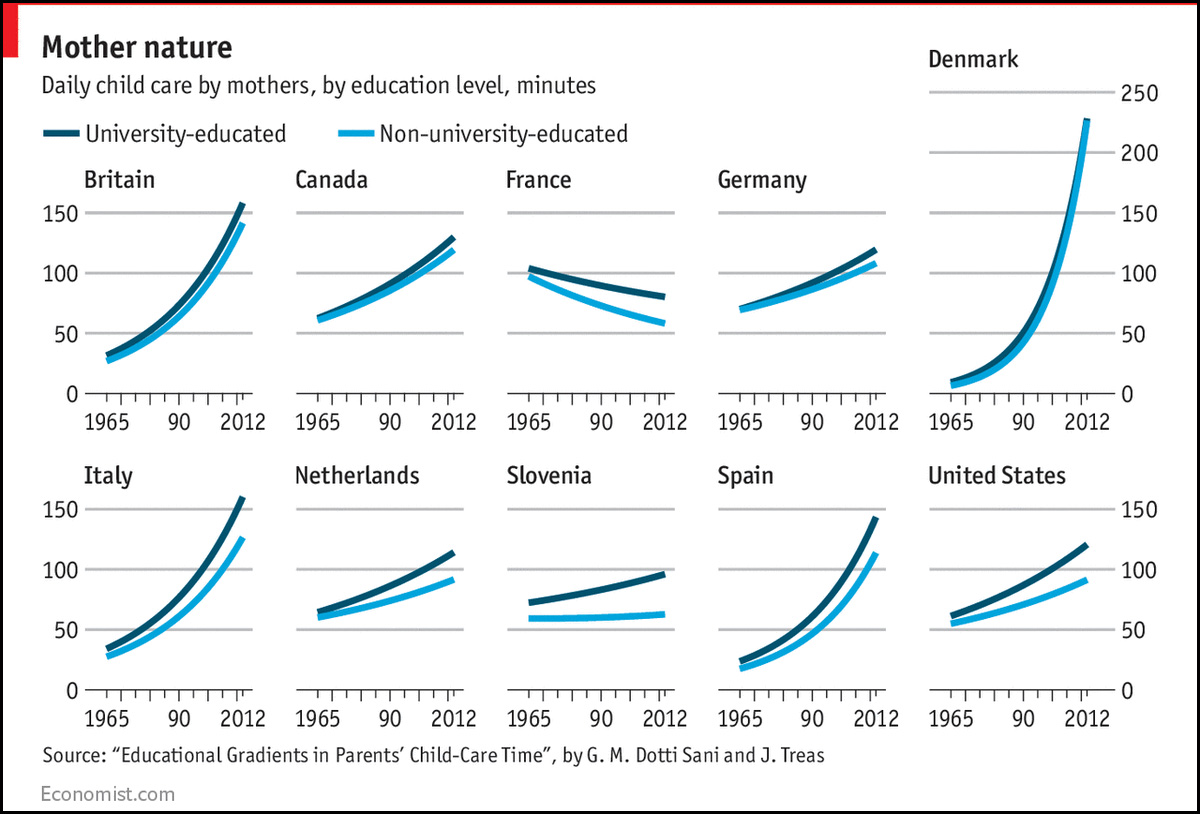
    Here’s an interesting chart presented recently by the Economist:

    There are two overall trends here: (1) over the past few decades, mothers are spending more and more time with their children, and (2) in most countries, mothers now spend about two hours a day with their kids.

    But if this data is accurate, there are two huge outliers, one in each direction. In France, childcare time has been declining and is now down to about an hour per day. In Denmark it’s skyrocketed, now averaging about four hours per day. And that’s not all: it’s skyrocketed from a 1965 base of about ten minutes per day. This seems rather unlikely, doesn’t it?

    There are several countries with large divergences between college-educated and non-college-educated mothers, but the largest divergence appears to be in the United States. College-educated mothers spend about 120 minutes per day with their kids while non-college-educated mothers spend about 90 minutes.

    What this shows, generally speaking, is that as mothers have spent less time on other housework thanks to both modern technology and work outside the home, they’ve filled up that extra time with childcare. That’s probably a good tradeoff. I still have a hard time figuring out how Danish mothers can manage to cram in four hours a day, though.

  • We Come to Bury Slack, Not to Praise It

    Mother Jones illustration; Getty

    Mother Jones is celebrating the end of the decade with a series of pieces called “Heroes and Monsters of the 2010s.” My favorite is Inae Oh’s serene meditation on the flaws of Slack, a group conversation app widely beloved in Silicon Valley and beyond. But Inae only hates 50 percent of Slack:

    Slack is where the very worst in a man comes out to play. Meet a mildly irritating man in person and know that his Slack presence borders on insufferable….Men will invest the merest passing thought with outsized, embarrassing importance, and Slack is the perfect medium for them to gather and preen together. Distract together. Light up unnecessary notifications together. Force better colleagues to stand witness to bad jokes and overwrought opinions together.

    But the circle jerk does more than just annoy people. Too often on Slack, it quite literally blinds men to the ideas of others while valuable voices are shut out in the process. It’s become routine to watch men firing off messages, failing to see a woman’s response somewhere in the thicket of madly spinning dicks but of course taking notice later on when a man chimes in with the very same response. The man gets praised for his brilliance, while the woman gets erased, along with the credit due to her. When I die, I want “SCROLL UP” tattooed on my forehead.

    For every bad dude flooding the zone with his performances, his ego, his contrarianism, know that there’s always a woman behind the scenes doing the damn work and getting shit done, wishing the whole platform would just collapse from the weight of self-important men.

    The only defense I can offer for Slack is that at least it’s an excellent mirror of the real world. The inability of men to notice when women say something is a longstanding feature of meetings in meatspace too, and apparently Slack has done nothing to improve that. On the bright side, however, it looks like Slack has done nothing to make it worse, either, which Twitter has shown is quite possible.

    I don’t use Slack since I’m off in my own little corner of the universe, but I can well imagine what it’s like. In fact, anyone who has ever participated in Usenet or IRC or anything similar can imagine what it’s like. And as much as I sympathize with Inae, I have to say that I probably hate 100 percent of Slack. The problem is basic economics: if you make something cheaper, you get more of it. Over the centuries, long-distance communication has evolved from papal bulls carried on horseback to the penny post to the telegraph to the telephone to the super-cheap telephone to email to text to Slack.¹ All of these innovations made communication cheaper and easier and therefore produced more and more communication.

    But is that good? Isn’t there some limit to how much communication we need before it becomes a bigger time sink than it’s worth? I figure that somewhere around the time of essentially free telephone calls and the explosion of email was probably where we went off the cliff edge. Now we communicate so madly that it’s a wonder we ever get anything done at all. If someone conducted a study showing that email and Slack and texting were responsible for the productivity slowdown of the aughts and teens, I’d probably believe it sight unseen. That’s trillions of dollars, people. Trillions!

    ¹Which is not so new as many people think. Remember Lotus Notes? It was pretty popular in its day and did many of the same things Slack does.

  • White Evangelicals Are Terrified That Liberals Want to Extinguish Their Rights

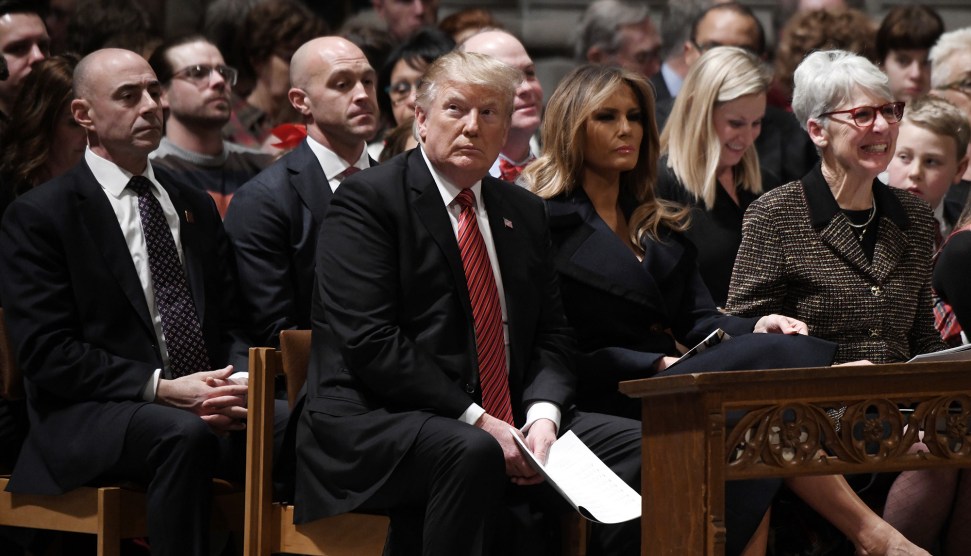
    President Trump at Christmas Eve services last year.Olivier Douliery/CNP via ZUMA

    As we all know, white evangelicals are convinced that their religious liberties are under attack from liberals and atheists. But are they really? Political scientists Ryan Burge and Paul Djupe looked at survey data to find out:

    [Among] white evangelical Protestants, we found that 60 percent believed that atheists would not allow them First Amendment rights and liberties. More specifically, we asked whether they believed atheists would prevent them from being able to “hold rallies, teach, speak freely, and run for public office.” Similarly, 58 percent believed “Democrats in Congress” would not allow them to exercise these liberties if they were in power.

    Is this true? The authors go to a second survey to find out, but it has different questions and different groups of respondents and doesn’t really address the question. Nonetheless they try to tease out an answer, and unsurprisingly the answer is no. Most atheists and Democrats are pretty tolerant of basic religious liberties even if they really, really hate evangelicals. Conversely, evangelicals who hate atheists are pretty intolerant of their religious liberties:

    Conservative Christians believe their rights are in peril partly because that’s what they’re hearing, quite explicitly, from conservative media, religious elites, partisan commentators and some politicians, including the president. The survey evidence suggests another reason, too. Their fear comes from an inverted golden rule: Expect from others what you would do unto them. White evangelical Protestants express low levels of tolerance for atheists, which leads them to expect intolerance from atheists in return. That perception surely bolsters their support for Trump. They believe their freedom depends on keeping Trump and his party in power.

    I’d add to this that it’s all unfolding against a background in which the biggest real-world fights are over abortion and contraceptives and cake decorators. Conservative Christians believe that their freedom to refuse these services is also a basic religious liberty, and there’s no question that liberals are pretty determined to take those particular liberties away. Given that, it’s a short step to believe that liberals might someday decide to remove their rights to “hold rallies, teach, speak freely, and run for public office.”

    In any case, this is something I’ve written about occasionally: it’s impossible to understand evangelicals and their support for Donald Trump without first understanding just how frightened they are of the steady liberal march toward secular hegemony. They consider the aughts and teens to have been a nearly complete disaster, capped by the 2015 Supreme Court ruling forcing states to recognize gay marriage. Many prominent evangelical leaders literally gave up after that, and the ones that didn’t had little hope for the future.

    Then, suddenly, Donald Trump showed up and promised them everything they wanted. In short order he became their Joan of Arc, rallying them back to a fight he assured them they could win as long as he was on their side. And rhetorically, at least, he delivered. The fight was back on.

    It’s not clear to me that there’s much we can do about this. We can’t do anything about the “inverted golden rule,” and we’re certainly not going to stop fighting for gay rights or reproductive rights. That leaves only a more concerted effort to assure evangelicals that they have nothing to fear regarding things like teaching, speaking, and holding rallies. And even that’s a tough nut when evangelicals can look to other countries and see that, in fact, those rights have occasionally been circumscribed to some degree. This may seem like a pretty small and distant issue, but I assure you that Fox News and talk radio report on every single example no matter how small, and they keep it front and center forever and ever.

    Understanding your opponents is usually useful because it provides some guidance about how best to respond. In this case I’m not sure it does, but it’s still good to know on the off chance that it might be helpful. Evangelicals are not generally engaged in faux outrage. They are truly scared silly that liberals will steadily and unrelentingly dismantle their rights if they ever get in power again. Just look what happened the last time.


  • Do 14% of NYT Readers Really Not Recognize Donald Trump?

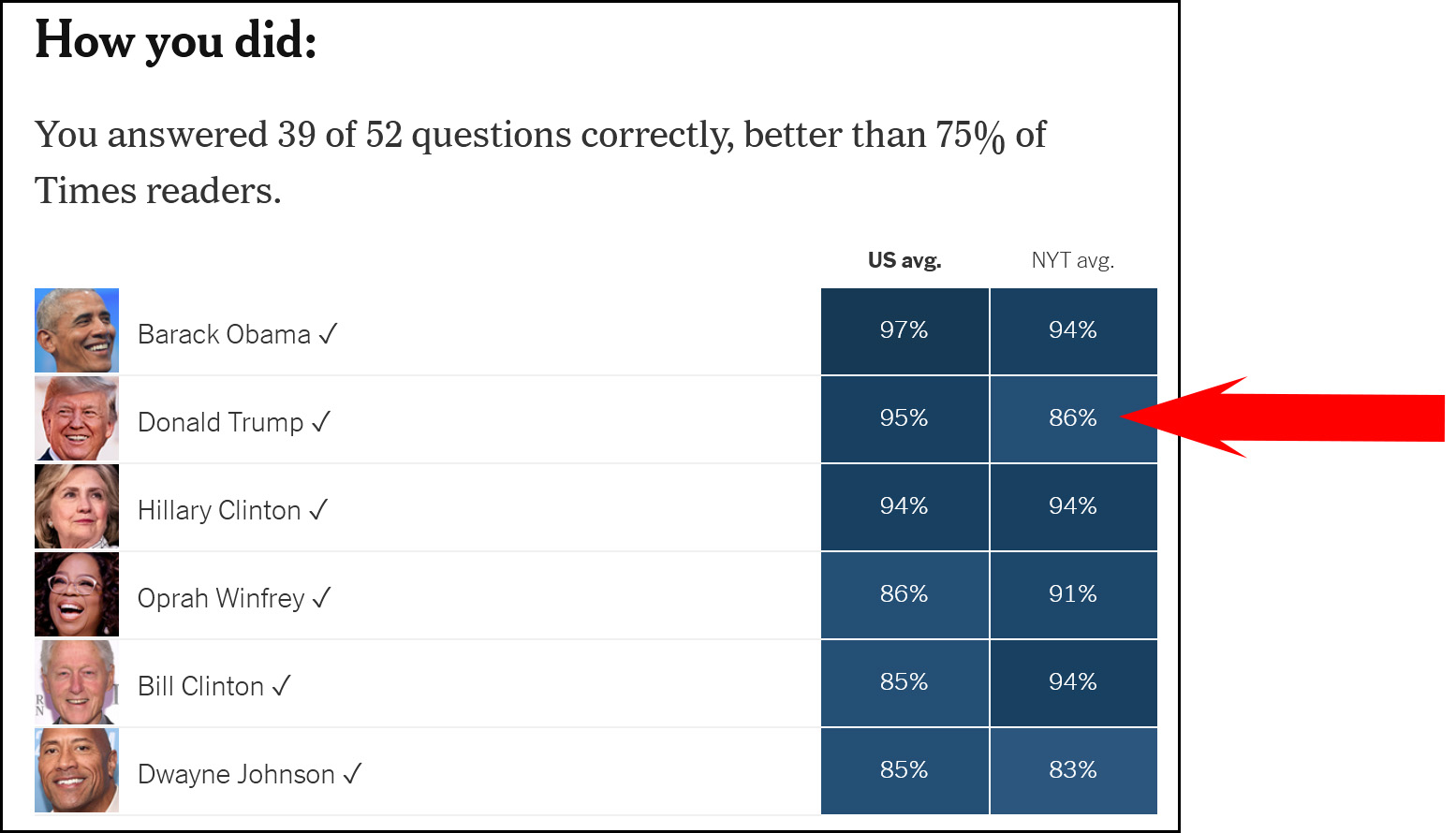
    The New York Times had a “Can You Identify These Celebrities” quiz on its home page today, and since I’ll be up all night and I’m bored, I took it. Here’s what it showed me at the end:

    Assuming they aren’t putting us on, only 86 percent of Times readers recognized Donald Trump. How is this possible? Trump has been a New York City fixture for decades and he is, as some of you may know, currently the president of the United States. I figure there are two possibilities:

    • About 14 percent of Times readers are the kind of annoying twits that simply refuse to acknowledge Trump’s existence even to the extent of typing his name in a box.
    • Times readers truly live in such a bubble that about 14 percent of them don’t recognize Trump.

    Opinions? Other alternatives? While you’re pondering this, you might also want to ponder this:

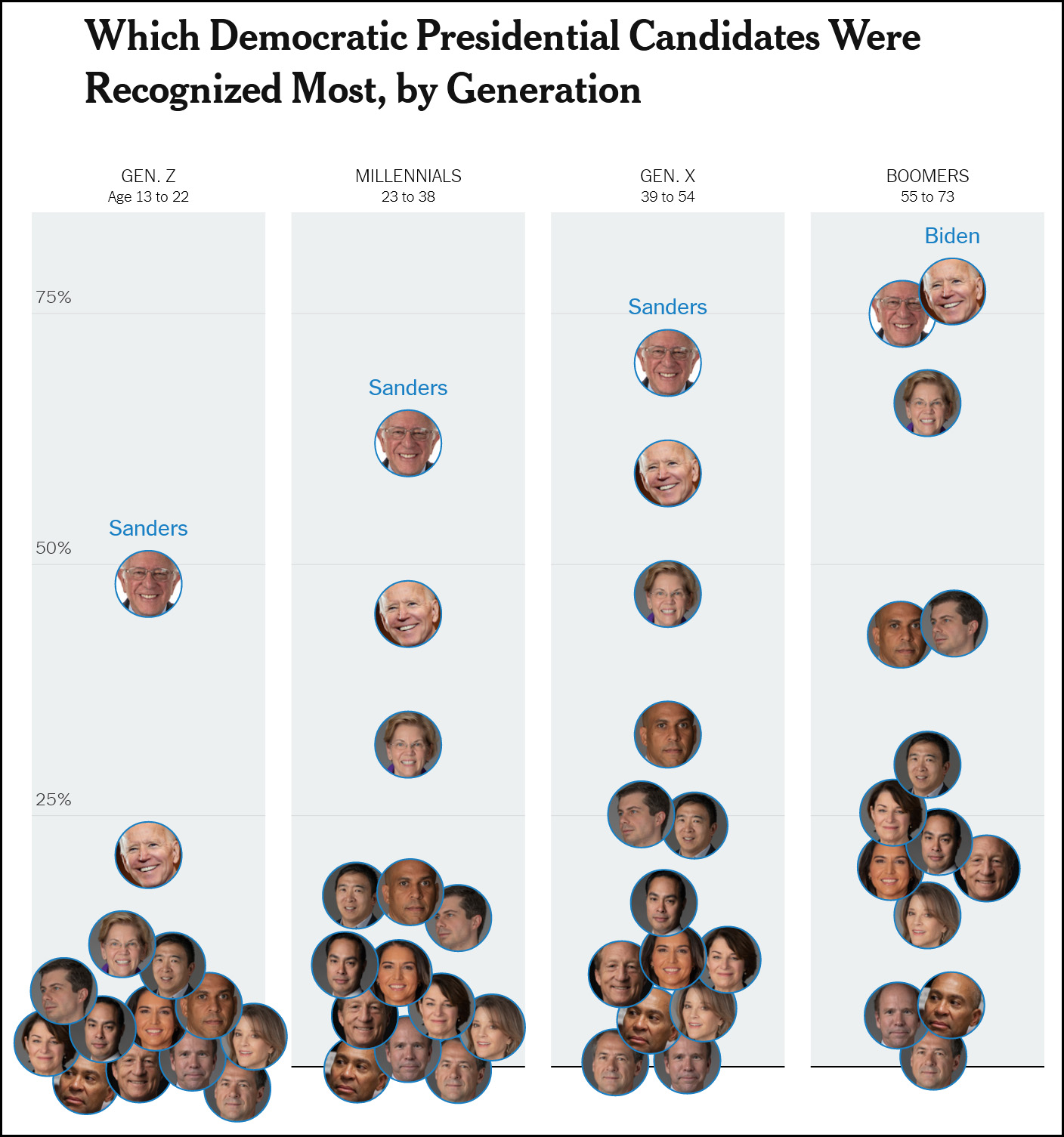
    The overall trend is clear: the younger you are, the fewer candidates you recognize, despite the fact that younger cohorts tend to be more Democratic and ought to have more interest in the Democratic primary. But only about 30 percent of Millennials recognize Elizabeth Warren and less than half recognize Joe Biden. Despite the hype, it appears that young people remain relatively uninterested in politics, just like they always have. They can “OK boomer” us all they want, but if they keep this up it’s boomers who are going to elect our next president, whether anyone likes it or not.

  • Trump’s Fumes, Possibly Explained Again

    Wait! We have a new entry on the list of possible explanations for President Trump’s blathering about wind turbines emitting “fumes” that harm everyone. Here it is:

    Sulphur hexafluoride, or SF6, is widely used in the electrical industry to prevent short circuits and accidents….However, the significant downside to using the gas is that it has the highest global warming potential of any known substance. It is 23,500 times more warming than carbon dioxide (CO2).

    ….“As renewable projects are getting bigger and bigger, we have had to use it within wind turbines specifically,” said Costa Pirgousis, an engineer with Scottish Power Renewables on its new East Anglia wind farm, which doesn’t use SF6 in turbines. “As we are putting in more and more turbines, we need more and more switchgear and, as a result, more SF6 is being introduced into big turbines off shore.

    Is it possible that someone put a bug in Trump’s ear about SF6 and he then garbled it in his usual way? Maybe! There’s a good chance we’ll never know, but this is certainly a possibility.

    POSTSCRIPT: Just so you know, SF6 is bad, and we probably ought to ban it. However, the total amount used is so small that even though it’s far more powerful than CO2, its overall impact on global warming is nonetheless about one-thousandth as much as CO2.

  • If Wages Are Up, Why Is Inflation So Low?

    Jared Bernstein says one of the most important lessons of the past decade is that unemployment can drop to very low levels without pushing up inflation. I’m less sure about that. During the dotcom boom of the late 90s, unemployment also dropped below 4 percent but inflation never got out of control. Ditto for the housing bubble of the aughts. Maybe the lesson isn’t so new after all?

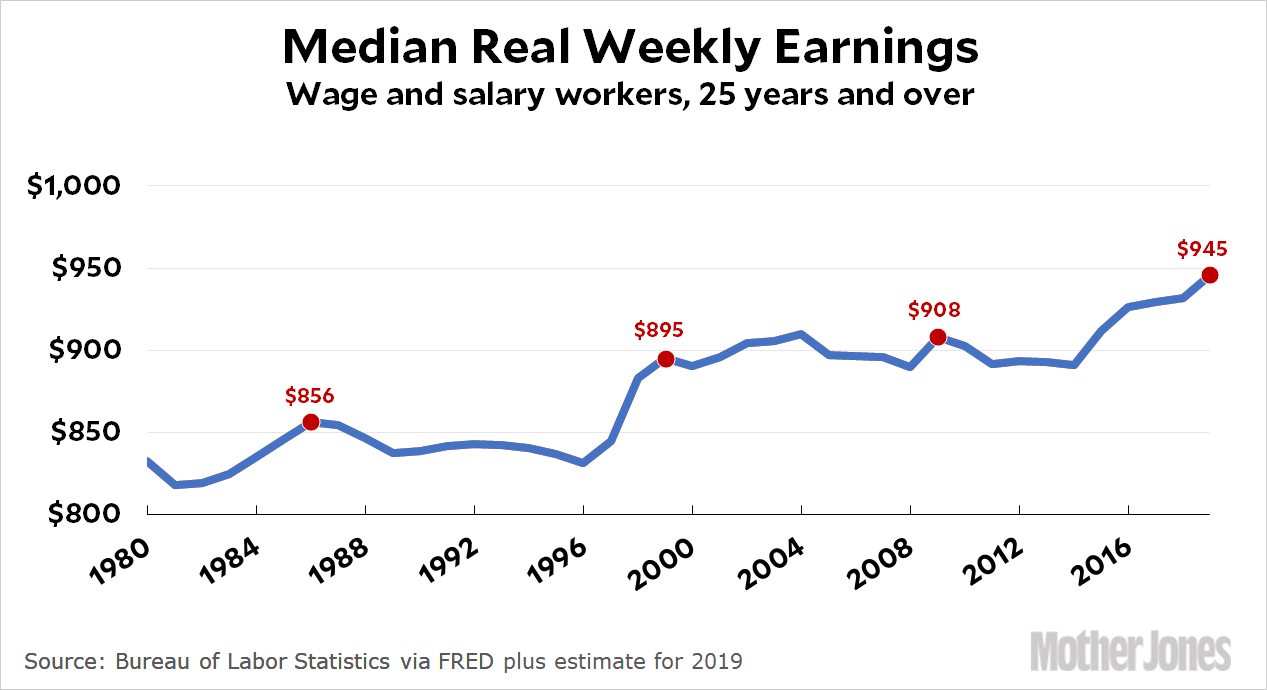
    So let’s step back and narrow our view. Instead of looking at broad inflation, let’s look at the precise thing that unemployment ought to affect: wages. Here are real weekly earnings over the past few decades, with the peaks of economic cycles noted in red:

    At the peak of the dotcom boom in 1999, real wages increased 4.5 percent from the previous peak. During the subsequent housing bubble wages increased hardly at all. And during our current economic cycle, real wages have increased 4.1 percent from the previous peak—so far.

    Now, there are lots of ways of measuring wages and lots of ways of measuring inflation, and you can get different results depending on which ones you use. I’m using usual weekly earnings for full-time employees and CPI-U-RS for inflation. However, I briefly looked at other measures and they weren’t very different. This one gives you a pretty good look at the general shape of things.

    And the bottom line is that, compared to historical figures, wages have increased substantially since 2014. Low unemployment appears to push wages higher just like you’d expect.

    So this prompts a different question: how is it that wages can go up but overall inflation remains so subdued? That seems to be the real disconnect here. During the dotcom boom, wages went up but inflation remained around 3 percent. During the housing bubble, wages didn’t go up and inflation remained around 3-4 percent. Right now, wages are going up but inflation has remained around 2 percent. Wages no longer seem to have much correlation with overall inflation.

    I haven’t seen anyone address this specific issue, but I’d be interested in hearing more about it. Is this a real phenomenon, or have I made some kind of mistake in my calculations? Is it just a US phenomenon, or are we seeing the same thing elsewhere? What’s the deal?

  • Fumes, Possibly Explained

    Kevin Drum

    I try not to spend a lot of time on Donald Trump’s latest nutbaggery, but it’s a slow week and his latest is truly special:

    We’ll have an economy based on wind. I never understood wind. You know, I know windmills very much. I’ve studied it better than anybody. I know it’s very expensive. They’re made in China and Germany mostly — very few made here, almost none. But they’re manufactured tremendous — if you’re into this — tremendous fumes. Gases are spewing into the atmosphere. You know we have a world, right? So the world is tiny compared to the universe. So tremendous, tremendous amount of fumes and everything. You talk about the carbon footprint — fumes are spewing into the air. Right? Spewing. Whether it’s in China, Germany, it’s going into the air. It’s our air, their air, everything — right? So they make these things and then they put them up.

    Fumes. Hmmm. What is he talking about? Philip Bump takes a crack at decoding this:

    When I first read the part of Trump’s speech about fumes, I was honestly a bit baffled despite priding myself on my ability to translate Trump’s energy-related rhetoric. Earlier this month, I pointed out that Trump had never once articulated an understanding of how climate change works, suggesting that perhaps he doesn’t know. Was this line about fumes and our small planet an attempt to articulate some explanation of why wind energy is being hyped in the first place?

    I have come to the conclusion that, no, it is not. In fact, he appears to be intentionally echoing an accurate point made about greenhouse-gas emissions in service of his baffling anti-wind jeremiad….Manufacturing wind turbines creates “fumes,” which go into the atmosphere. We have only one atmosphere, shared by Germany, China and ourselves. So when they make wind turbines, it’s putting those same “fumes” into the air that we breathe.

    So Bump’s theory is that Trump was talking about the fact that carbon is emitted during the manufacture of wind turbines. These are the “fumes.” And those fumes, which are created in Germany and China, drift over into our atmosphere too. That’s “our air.”

    Sure, maybe. But if carbon is harmless, as Trump insists, why would he care if Chinese carbon also pollutes American air? I don’t know. How about if we leave that for another day?