This month brings us yet another health update. Short summary: everything is fine. My immune system has recovered and all my other counts are in the normal range. I’ve been off the dex for two months and off the sleeping meds for the past week (after tapering off for a month). I still have some residual fatigue from my monthly infusion of the primary chemo drug, but it’s not too bad.
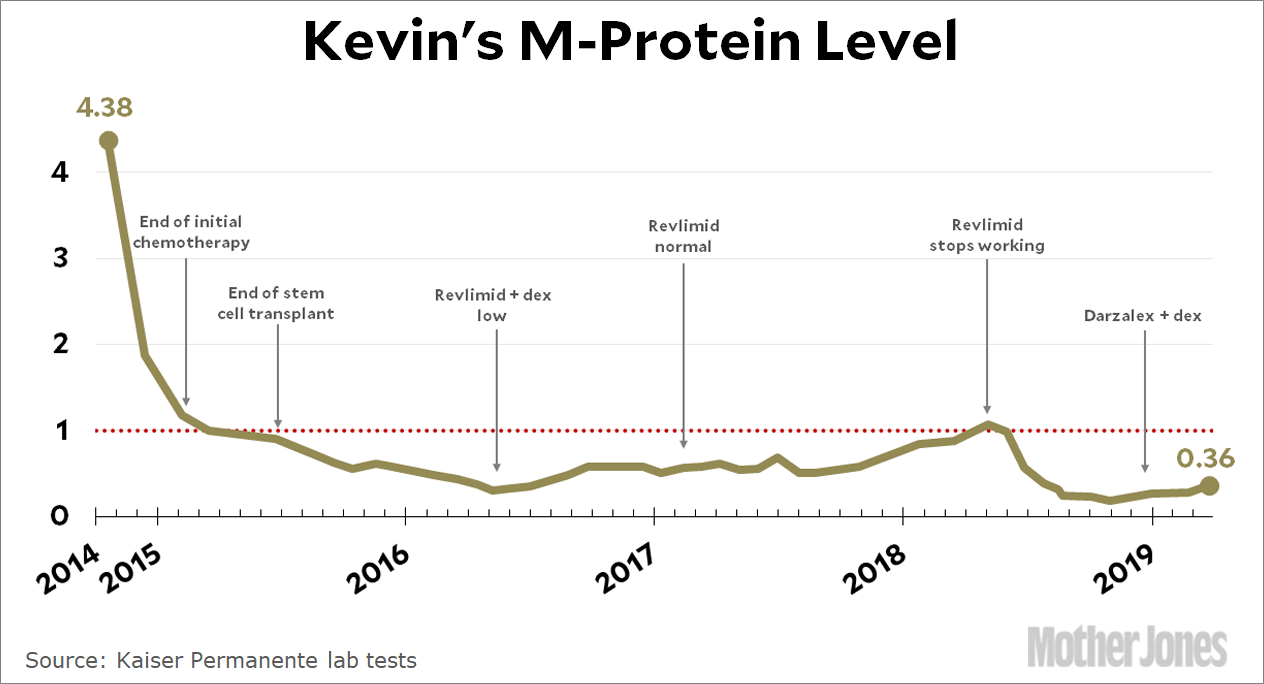
As for the multiple myeloma itself, the latest test shows that my cancer load is slightly up from last month:
This is nothing to worry about. We expected the number to go up a bit after I stopped the dex, and 0.36 is still lower than the readings I had for two years on the old medication. As long as the M-protein number flattens out below 0.5, I’m doing great.
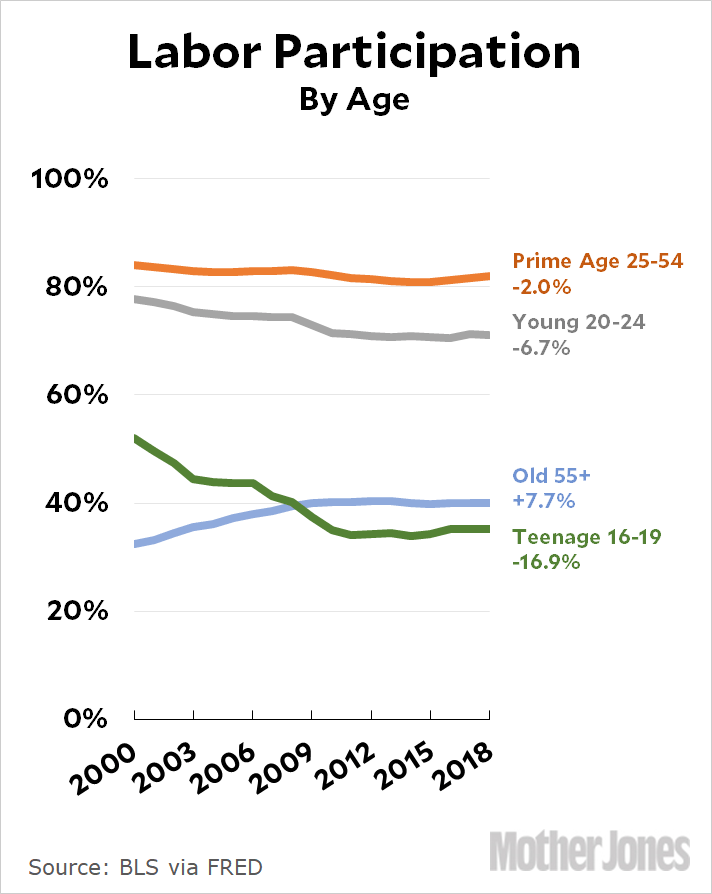
This morning’s post about automation got me curious about the labor participation rate by age group. Here it is for the past couple of decades:
Labor participation for prime-age workers has changed only slightly, declining from 84 percent to 82 percent. The big change has been among young and old. Older workers have increased their labor participation rate by nearly 8 percentage points while young workers have reduced their labor participation by about 7 points. Labor participation among teenagers has plummeted by 17 points.
Most of this change happened between 2000 and 2010. Participation rates have been nearly dead flat for all age groups since then.
I’m not quite sure what to make of this, though the 2000-10 period coincides with the greatest impact of Chinese imports on American labor. I’m skeptical that these two things are related, however, since Chinese imports should mainly have affected American manufacturing, which employs mostly prime-age workers. And yet prime-age workers saw virtually no change in labor participation during that period. The drop was all among young workers.
For what it’s worth, there’s a similar pattern in wages. For both young and prime-age workers, wages have been about flat since 2000. Among workers age 55-64, wages are up 8 percent.
Anyway, the answer to the question in the headline is: young workers between the age of 16-24 have been screwed the worst. Conversely, prime-age workers have been doing OK, while older workers have been doing great.
California has had an excellent rainy season, and for the first time in years no part of the state is suffering a drought at the moment. This moment probably won’t last long, but while it’s here I’ve been celebrating by taking pictures of water and its relatives: wildflowers, green hills, surging creeks, and so forth. This week’s photos are dedicated entirely to California’s water bounty, starting yesterday with my pictures of our local poppy bloom. It continues today with this picture of Ortega Falls, rendered in the long-exposure silkiness that everyone loves:
March 18, 2019 — Cleveland National Forest, California
And now for the sad story that accompanies this. In last week’s superbloom post I mentioned that I had only seen the bloom accidentally: I was on Ortega Highway for a different reason and accidentally overshot my destination. Well, this was my destination.
I had driven out to Ortega Falls hoping that it would be nice looking what with all the water we now have. But I also chose it because the falls are only a short quarter-mile hike from the road. That sounded perfect.
And it turned out to be true: the hike was only a quarter of a mile. Unfortunately, it was a quarter mile almost literally straight up and down in places, something I didn’t quite realize until I had already gone too far. Normally, even for an old fogey like me, this would be an annoyance but not much more. Unfortunately, several years ago I lost a big chunk of my breathing capacity for reasons that remain a mystery to everyone. Then a few weeks ago I got a cold that settled into my chest, and I discovered that with my breathing already compromised chest congestion was a real killer. By last week, however, the chest congestion was nearly gone, I thought, and a quarter mile would be no big deal.
I was so, so wrong. On my way back up from the falls, I was pulling myself up about ten feet at a time before stopping for five minutes to catch my breath. Rinse and repeat. I finally made it back to the top, but I almost collapsed doing it. It took me five hours to fully recover, which is about 4½ hours longer than I’ve ever needed to recover from anything in my life. The combination of breathing problems, chemotherapy, and chest congestion was something I should have taken far more seriously.
And to make it worse, I only got one picture out of the deal. It’s an OK picture, but certainly not worth the effort it took.
Many Democrats appeared eager to pivot back to health care, an issue that cut their way during last year’s midterm elections, after a summary of special counsel Robert S. Mueller III’s report suggested it was far less damaging to Trump than many had expected.
U.S. Sen. Lindsey Graham, R-S.C., on Monday laid out his next steps for dealing with the aftermath of Robert Mueller’s investigation into President Donald Trump’s 2016 campaign. First up: Launch an investigation into whether Hillary Clinton, Trump’s former democratic challenger, got help from President Barack Obama’s Department of Justice.
As much as we despise this stuff, you have to hand it to Republicans. They never gave up on Benghazi. That led directly to Hillary’s emails, and they never gave up on that. It seemed hopeless, but they never gave up. And in the end, they won. They managed to get even a buffoon like Donald Trump elected president.
I’ve never really been someone who believed that one party was fundamentally rougher and tougher than the other. Progressives complain that Democrats let Republicans walk all over them, but it’s the same on the other side: conservatives complain endlessly that Republicans let Democrats walk all over them. Both sides believe the other party is more disciplined, more ruthless, and more strategic than theirs.
But it’s hard to really believe there’s any symmetry here when you read stuff like this. Sure, there are cutthroat operatives in both parties. But look at the big picture. We know almost nothing about the Mueller report except for the carefully curated excerpts provided by a partisan attorney general, but many Democrats are eager to give up anyway. Even though we almost literally know nothing. In the meantime, Republicans, based on nothing at all, are revving up yet another investigation of Hillary Clinton—who is now a private citizen and will never run for any public office again.
This seems to reflect the natural impulses on both sides. Anyone who doubts this really, really needs to read “Swimming with Sharks,” Franklin Foer’s classic account of young Republicans and young Democrats. Be sure to read it to the end.
Tyler Cowen recommends a recent bit of research by Daron Acemoglu and Pascual Restrepo as “a new paper on automation that actually has some new and interesting results.” Basically, A&R look at two offsetting effects of automation: reduced demand for labor in existing fields vs. higher demand for labor in newly created fields. In the context of the Industrial Revolution, for example, this meant that weavers lost their jobs but automobile companies hired lots of new workers. In the end, everybody stayed employed but the overall level of productivity was much higher.
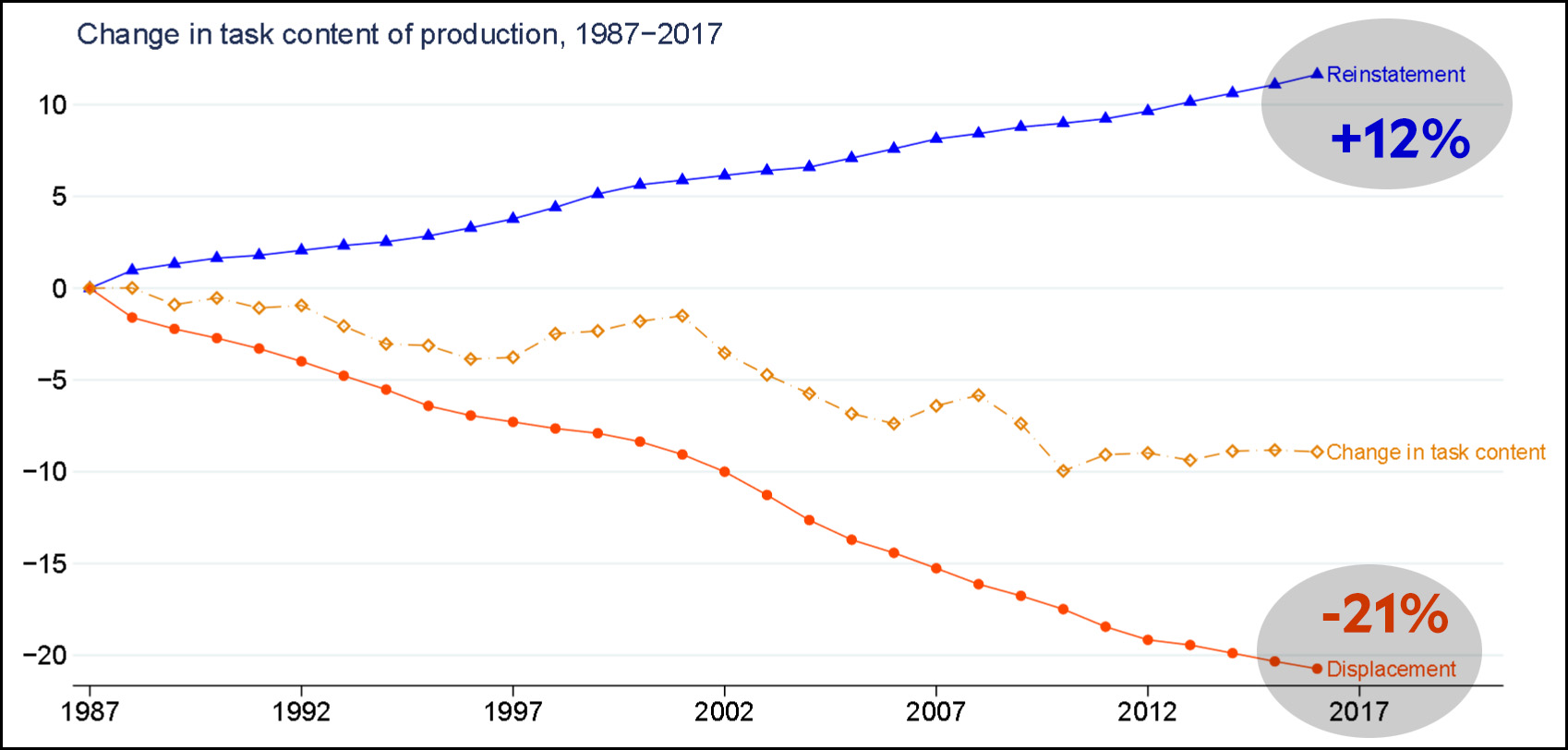
But how about automation in more recent times? Long story short, A&R find that the displacement and reinstatement effects were about equal during the postwar period from 1947-1987. However, from 1987 to the present day, displacement far exceeded reinstatement:
This chart shows that automation has displaced a lot of workers and nowhere near all of them have gotten jobs in new industries. Here’s their conclusion:
Our evidence and conceptual approach support neither the claims that the end of human work is imminent nor the presumption that technological change will always and everywhere be favorable to labor. Rather, it suggests that if the origin of productivity growth in the future continues to be automation, the relative standing of labor, together with the task content of production, will decline….We have also pointed out a number of reasons why the balance between automation and new tasks may have become inefficiently tilted in favor of the former, with potentially adverse implications for jobs and productivity and some directions for policy interventions to redress this imbalance.
If automation continues—and it will—“the relative standing of labor…will decline.” In other words, the end of human work isn’t imminent, but we’re getting closer every year. This partly explains why the labor participation rate has flattened and then declined since 1987, and why it never recovered after plunging during the Great Recession. It’s not the whole story, but automation has played a significant role and will almost certainly continue to do so in the future.
No matter how disappointed the Schiffs and Swalwells are now, they must issue mea culpas for dividing the country — to begin to heal this nation today and prepare a clean slate for the next Democrat to occupy the Oval Office….Former President Obama also has a role to play in healing this nation and saving his party’s next White House occupant. Mueller’s report proved two things: Trump did not collude with Russia, but a great many Russians interfered in our democracy on Obama’s watch, after they invaded Crimea and shoved Obama aside in Syria. A word from the former president acknowledging his administration’s failure to stop a hostile foreign power from attacking our democracy would help Washington move to the next task: securing our democracy so the Russians or any other foreign actor can’t hurt us again.
In early September [of 2016], Johnson, Comey, and Monaco arrived on Capitol Hill in a caravan of black SUVs for a meeting with 12 key members of Congress, including the leadership of both parties. The meeting devolved into a partisan squabble. “The Dems were, ‘Hey, we have to tell the public,’ ” recalled one participant. But Republicans resisted, arguing that to warn the public that the election was under attack would further Russia’s aim of sapping confidence in the system.
Mitch McConnell—who I get on with well and who’s a smart guy—Mitch McConnell wanted no part of having a bipartisan commitment that we would say, essentially, Russia’s doing this. Stop. Bipartisan, so it couldn’t be used as a weapon against the democratic nominee of a president trying to use the intelligence community…. Brennan and company came up and said: Here’s what we know. Why don’t we put out a bipartisan warning to Russia—hands off, man, or there’s going to be a problem? Democrat, Republican. Well, they would have no part of it.
But yes, it’s Obama who should apologize for the Russian hacking. Unbelievable.
Over at Vox, Sigal Samuel interviews David Brotherton, who has a theory about Ecuador’s murder rate:
In 2007, the crime-riddled nation of Ecuador did something surprising: It legalized the gangs that had been the source of much of the violence. Then something even more surprising happened over the next decade: Murder rates plummeted…from 15.35 per 100,000 people in 2011 to 5 per 100,000 people in 2017.
Brotherton theorizes that the decline in the murder rate was due to Ecuador’s 2007 decision to legalize gangs. Maybe so! But it’s also interesting to note that Ecuador phased out leaded gasoline between 1997 and 2001. This would lead you to expect a big drop in violent crime between 2014 and 2018. And that’s what happened.
This is just another quick reminder that nobody has yet seen the Mueller report. We know virtually nothing about what’s in it, aside from the fact that Mueller decided not to recommend any indictments for collusion.
Everything we do know—or think we know—is from the Barr memo. This means that reporting and headline writing should all refer to the Barr memo, not the Mueller report. This will change only if and when we see the Mueller report itself.
Three months ago a Texas judge struck down Obamacare. (He later issued a stay of his ruling pending appeal, which is why Obamacare is still up and running.) The theory behind the ruling was both simple and absurd: since Congress has reduced the fine for not having insurance to $0, the individual mandate has been effectively eliminated. And since the rest of Obamacare depends on the mandate, it should be eliminated too.
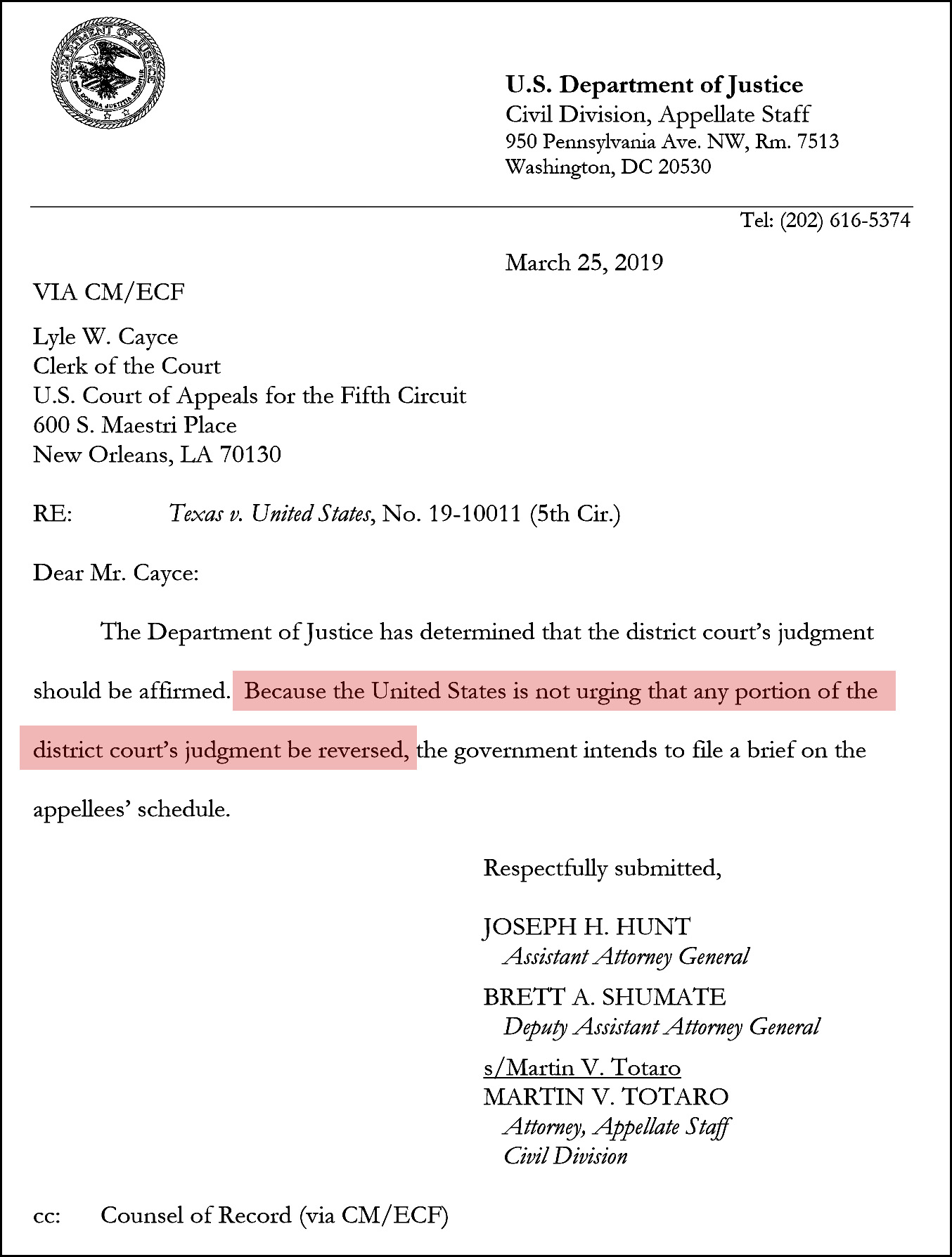
Donald Trump’s Justice Department declined to defend Obamacare in this case, but it didn’t suggest that the entire law should be struck down. It agreed only that the pre-existing conditions clause should be jettisoned. Today, however, produced a change of heart:
So there you have it: the Trump administration is urging the court to overturn all of Obamacare. This is—what? The third conservative effort to use the courts to repeal an act of Congress? I’ve lost count. They sure don’t give up when it comes to ripping health care away from the poor, do they?
In a recent redistricting case in Mississippi, a federal judge ruled that black voting strength had been illegally diluted in a particular district and ordered that several majority-black precincts be added to it. The case was appealed, and a three-judge appellate panel upheld the ruling, 2-1. The dissenting judge, Edith Brown Clement, unsurprisingly disagreed with the majority on a number of points of law.
But that’s not all. She also explicitly accused the majority of ruling in favor of the black defendants because they were Democrats:
This case presents several extraordinary issues. Unfortunately, this court’s usual procedures do not appear to permit en banc review of this denial of a stay even if a majority of the active judges would otherwise grant it. I am afraid defendants have simply had the poor luck of drawing a majority-minority panel. I trust that in light of this, the State will pursue a stay in the Supreme Court because of the injustice that results from the joint efforts of the district judge and the motions panel majority.
The Supreme Court has five Republican justices and four Democrats. I guess that’s more to Judge Clement’s liking.
UPDATE: Wait. Both of the judges in the majority appear to be white men. So what was Clement referring to? The consensus seems to be that she was referring to party affiliation, not race. I’ve revised the headline and the text to reflect that.
And we respect that! But maybe you’re of a mind to support our work directly instead? We have until December 31 to raise the last $400,000 we need to keep our nonprofit newsroom running at full strength into 2026. Will you make a gift today?
We noticed you have an ad blocker on. Can you pitch in a few bucks to help fund Mother Jones' investigative journalism?
Billionaires own the media,
but they don’t own us.
At Mother Jones we know these aren’t conventional times, and they require unconventional coverage. That’s what deliver every day: fierce, independent journalism you can’t find elsewhere. Perhaps never in the history of our country has that been more necessary than now. But we can’t do it without reader support—your support. Please chip in today.
Billionaires own the media,
but they don’t own us.
At Mother Jones we know these aren’t conventional times, and they require unconventional coverage. That’s what deliver every day: fierce, independent journalism you can’t find elsewhere. Perhaps never in the history of our country has that been more necessary than now. But we can’t do it without reader support—your support. Please chip in today.