• Trump Signals Possible Compromise on Immigration

    Erik Mcgregor/Pacific Press via ZUMA

    The Washington Post reports that the White House has an actual, concrete immigration proposal:

    President Trump’s immigration proposal to Congress will include a path to citizenship for an estimated 1.8 million young undocumented immigrants….The figure represents a significant concession to Democrats but is likely to produce sharp blowback among conservative Republicans.

    ….Trump’s plan, which will be formally sent to the Senate on Monday, also includes a $25 billion “trust fund” for a border wall and additional security upgrades on both the southwest and northern U.S. borders. And the president will propose significant curbs to legal immigration channels, restricting the ability of U.S. citizens to petition for visas only for spouses and minor children and ending categories for parents and siblings. Both of those provisions are likely to engender fierce objections among liberal Democrats.

    There’s nothing here about eliminating the visa lottery, but I’m sure that will be in Monday’s proposal as well. The bigger question is whether Trump’s plan really will follow this outline, or if a bunch of other deal-killing details will be tossed in by the time it finally gets committed to paper.

    I don’t think enough Democrats would support this to allow it to pass. But if it’s for real, it’s not a terrible starting point. Current negotiations in the Senate have broken down over a path to citizenship for Dreamers, but Trump has now weighed in very strongly on not only providing that path, but doing it for more than twice as many Dreamers as the 700,000 that have been under discussion before this. This will be a pretty good test of whether Trump truly has any policy influence over Republican members of Congress. If he does, the path to citizenship won’t be a stumbling block anymore.

    I guess I should probably add my usual caveat here: Trump’s proposal seems like a decent starting point to me because I’m not part of the far left on immigration. I’m no fan of major immigration restrictions, but neither do I think they’re the end of the world. To me, the bigger issue isn’t so much that this proposal is draconian, but that it might eliminate too many bargaining chips for a future comprehensive reform. If conservatives already have most of what they want, what incentive do they have to negotiate a plan that provides some kind of legal status for the 8-9 million undocumented immigrants who aren’t Dreamers?

  • Lunchtime Photo

    These are red deer at Knockreer House in Killarney National Park. I made a trip out there specifically to see the deer, and I ended up seeing a lot of them—but only by flagrantly flouting the rules. There was no fencing along the path when I spotted them, so I just stepped off and mushed my way through the bramble to get closer. This particular herd included four or five males, about a dozen females, and a few adolescent types. The females were pretty interested in me, but the males maintained a dignified attitude of not caring about some hairless little mammal with only two legs and no antlers.

    Anyway, it turns out I wasn’t supposed to step off the path, but I didn’t know it at the time. I probably would have done it anyway, though. If I was going to be denied a visit with puffins,¹ I was sure as hell at least going to see the red deer. Naturally I really wanted to see them rutting, but no such luck. Maybe that’s a morning activity.

    ¹We were there at the wrong time. The puffins had all gone home to Iceland by the time we arrived. Boo.

  • Are Wages Finally Going Up? Sure, For Some People.

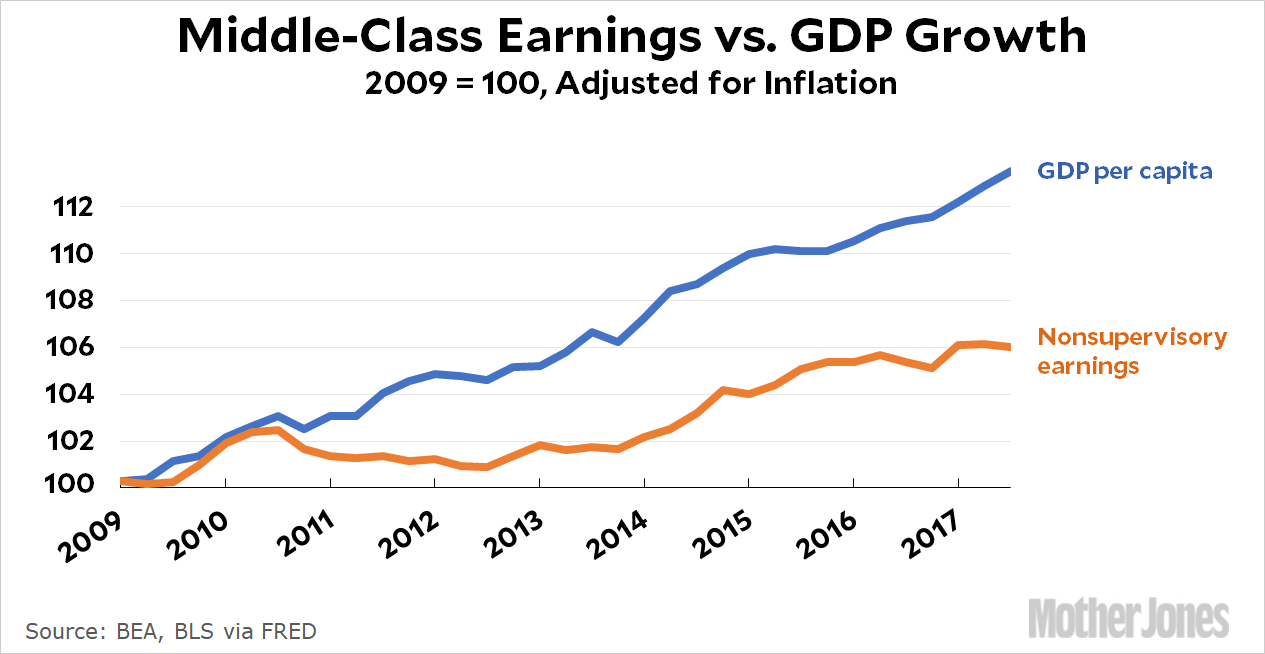
    Are wages finally going up? Let’s skip the anecdotal nonsense, shall we? Here are the numbers since the end of the Great Recession:

    GDP per capita has gone up 1.5 percent per year since 2009, accelerating to 2 percent over the past year. That’s not bad. America is getting richer, and over the past year has gotten richer at a faster pace.

    But it’s a different story for nonsupervisory workers, who make up 70 percent of the labor force. Their earnings have gone up 0.7 percent per year since 2009, accelerating decelerating to 0.6 percent in the past year. This includes the broad working and middle classes, but doesn’t include the college-educated upper middle classes and the rich.

    From a macro point of view, wages are finally picking up some steam. That suggests some labor tightness and it’s something for the Fed to consider when they set interest rates. But for all the ordinary working stiffs, 2017 has been a pretty meh kind of year. All those extra riches are going someplace else.

  • Today’s Mystery: What Is an Egg?

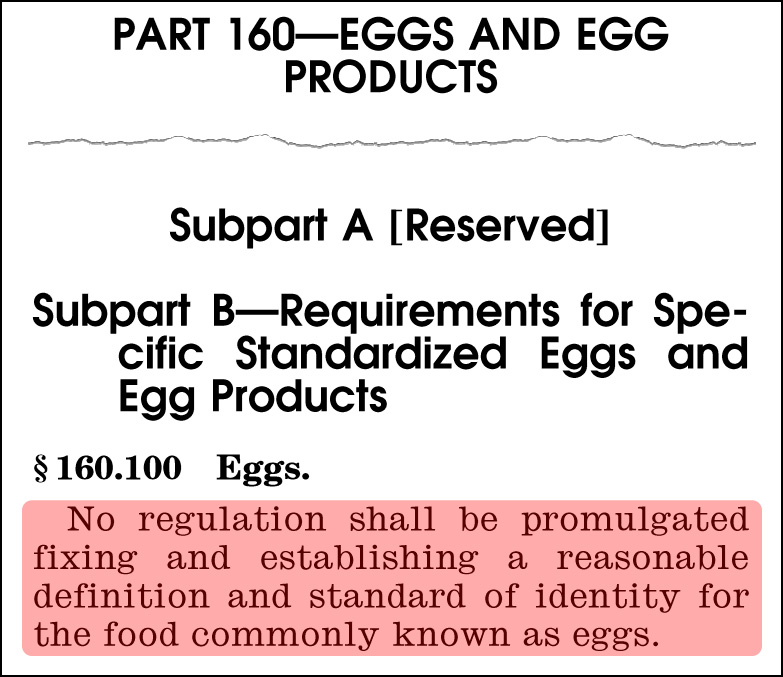
    Panera cracks open fresh eggs to make its breakfast sandwiches. Some chains use packaged gloop formed into hockey pucks. Naturally Panera wants to tout the fact that they use real eggs and the other guys don’t, but it turns out they can’t thanks to §100 of Part 160 of Title 21 of the Code of Federal Regulations:

    Caitlin Dewey reports that this restriction has been on the books since at least 1977, but has no idea why. So this is today’s question: Why is the FDA prohibited from regulating the food commonly known as eggs? Are any of my readers old geezers who used to work at the FDA? Or maybe you know someone who fits the bill? Or perhaps you’re a historian of egg regulations? If so, please chime in!

    UPDATE: We apparently have an answer from reader JB:

    The non-definition of egg dates back to 1939, when the FDA, in its infinite wisdom and following what must have been a truly egg-citing public hearing, decided that “it was deemed more suitable to include within each definition and standard for liquid, frozen, and dried manufactured egg products a definition of the term ‘eggs’ as that word is employed in its relationship to the manufactured product, rather than to establish an individual definition and standard of identity for eggs as a separate food.”  See 4 Fed. Reg. 3377 (attached/highlighted), adding what was then 21 CFR 42.000.

    Was this the result of lobbying from the manufacturers of “liquid, frozen, and dried manufactured egg products”? Maybe! There’s clearly more digging to be done here. However, it’s also possible that there was no real controversy back then over the meaning of “egg,” so they just decided to skip it.

  • The Dollar Today Is Worth Exactly What It Was Worth 30 Years Ago

    Yesterday at Davos, Treasury Secretary Steven Mnuchin casually suggested that the United States preferred a weak dollar because it makes our exports cheaper. A few hours later, Commerce Secretary Wilbur Ross said no, our strong dollar policy is the same as always. In other words, it was just another day at the office for the Trump administration, which was flying blind because the president hadn’t tweeted anything lately about his views on the role of currency flows in international trade equilibria. Larry Summers is unhappy about this:

    Beyond style, there are good economic reasons the last seven Treasury secretaries stayed with the strong dollar mantra. First, the level of the dollar determines America’s terms of trade. Yes, a weaker dollar means cheaper U.S. exports. But it also means higher priced imports and so less purchasing power for American incomes….Second, a weakening dollar likely means higher U.S. interest rates….Third, when policymakers appear like they might be endorsing a falling dollar after a period of sharp dollar decline like we have seen, there is some risk of avalanche effects.

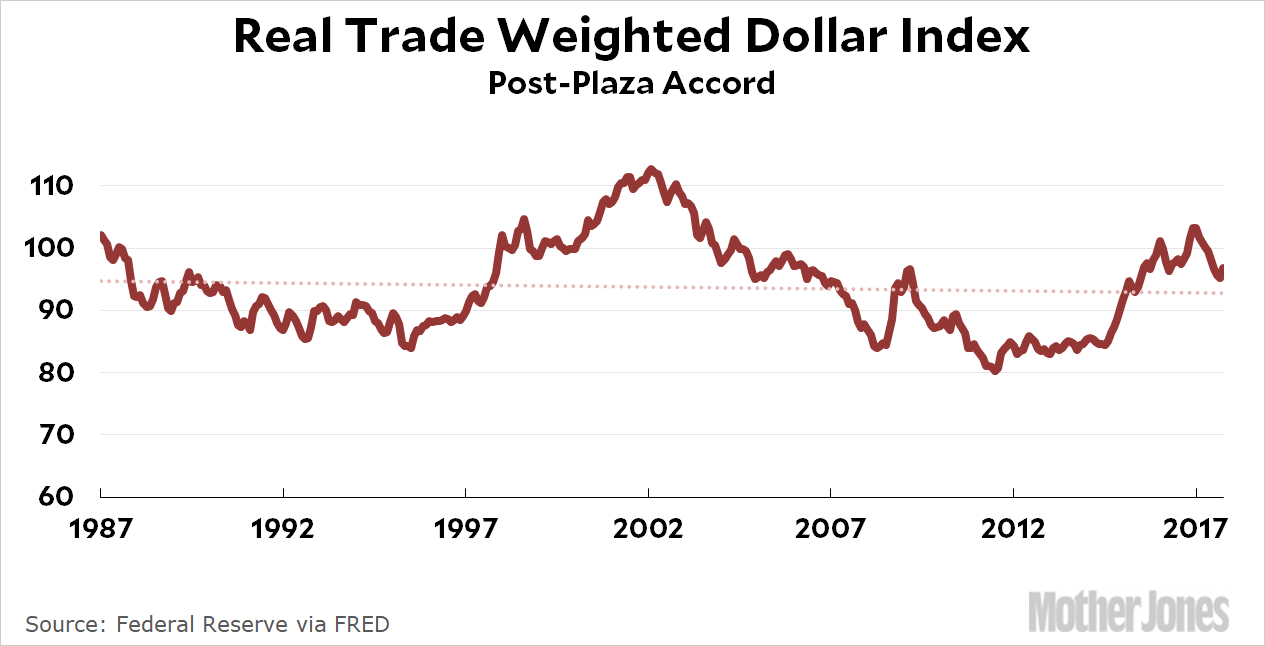
    I suppose Summers is right, but I can’t get too excited about this. Naturally I have a chart to explain why:

    In the early 80s the dollar got really, really strong, so in late 1985 a bunch of big countries signed the Plaza Accord to bring the value of the dollar back down to earth. Since then, the dollar has bobbed up and down and…pretty much always reverted to the mean within a few years. Right now it’s precisely where it was 30 years ago.

    Unlike Summers, I have never been especially convinced that pronouncements on the dollar have any effect at all. This is because the Treasury Secretary has next to no influence on the value of the dollar. It depends on fundamentals like inflation, interest rates, trade balances, market interventions, and so forth. Summers kinda sorta implies that the 1987 Black Monday stock market crash was due to James Baker’s threat to devalue the dollar, but I don’t know anyone who really believes that.

    Steve Mnuchin might think the dollar should be worth ten kwatloos, but nobody should care unless he announces some policy to back that up—and I’m not even sure what that could be. In the meantime, if bond traders want to get bent out of shape over every word that comes out of the Treasury Department, that’s their problem.

  • Corporate Bonuses Explained in 64 Words

    Just for the record, and yes, I know no one cares etc., but:

    Every year lots of corporations hand out bonuses to their workers. In good times more of them do it. In bad times fewer of them do it. The only difference this year is that a dozen or so of them have announced their bonuses in press releases and given credit to the Republican tax cut as a way of sucking up to Donald Trump.

    That’s it. I just wanted to whistle into the wind a bit this morning.

  • Locker : High School As Newspaper : ??

    Adorable stock photo of high school lockers because no actual photos of kids using lockers could be located.Image Source/ZUMAPRESS

    The Washington Post reports that high school kids no longer use their lockers. Instead, they stuff everything into a bag and “navigate the halls bent over by jam-packed backpacks like Himalayan Sherpas shuffling along without a base camp.” So far, so good. Excellent old-guy snark. But then reporter Joe Heim talks to a high school principal who tries to explain why:

    “The high school experience has evolved where learning is anytime, anyplace,” said Ann Bonitatibus, principal at Thomas Jefferson High School in Fairfax County, where most of the school’s individual lockers were removed during a renovation last year. “The more that our campuses are like that, the more inclined our students are to have their materials with them at all times and all places so that way they’re learning at lunch, at 20-minute break periods or between classes.

    Ha ha ha. Sure they are. My only question is whether Bonitatibus really believes this, or was just trying to put one over on Heim.

    The real answer, of course, is: who knows? Lockers became uncool for the usual mysterious teenage reasons—probably because it annoys their parents—and now you get laughed at for using one. So nobody uses them, and if you ask why, they invent some reason or other to fob off on the oldsters:

    “My school is really big,” [Isabel Echavarria] said. “It has four floors and a basement, and stopping in one specific location between each class would be ridiculous. And it’s harder to keep track of your stuff if it’s in another location.”

    Uh huh. At least everyone is even here. The kids have no idea why they do it and the adults have no idea why they do it. They just do.

  • Trump Says Something or Other About DACA, Will Probably Retract It Shortly

    Donald Trump said today that he is open to the idea of allowing Dreamers to “morph” into citizens after a period of 10 to 12 years:

    “Over a period of 10 to 12 years,” Mr. Trump said, “somebody does a great job, they work hard — that gives incentive to do a great job. Whatever they’re doing, if they do a great job, I think it’s a nice thing to have the incentive of, after a period of years, being able to become a citizen.”

    Whatever. The only thing I’m interested in is how the folks who really run things in the White House will row this back on Thursday. Will they say Trump was “speaking hurriedly”? That doing a “great job” means winning a Nobel Prize? That he was talking about Jupiter years, not Earth years? I can hardly wait for the eventual press conference from Davos revising and extending Trump’s remarks.

  • Can Blue States Force Net Neutrality on Internet Providers?

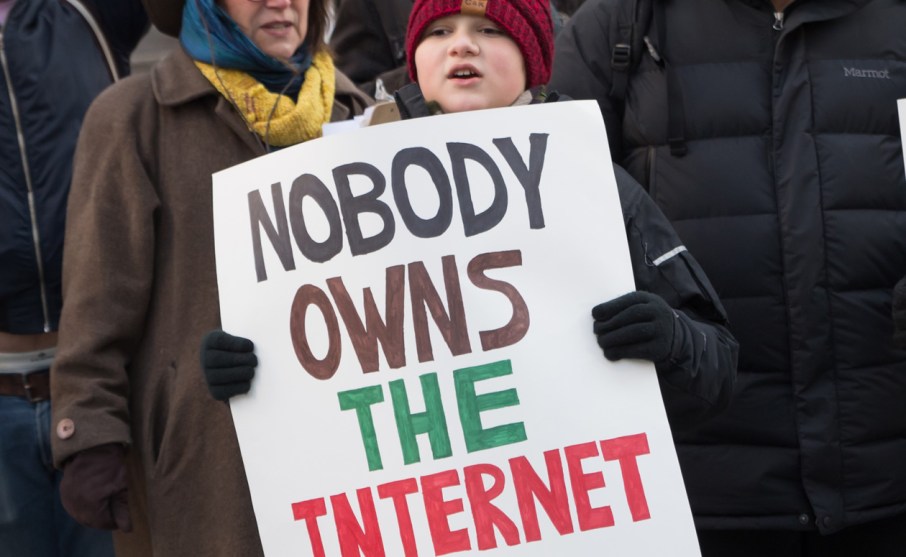
    As it happens, this kid is wrong. But it's a nice thought.Patrick Gorski/NurPhoto via ZUMA

    Kanyakrit Vongkiatkajorn reports that blue states are continuing the net neutrality battle:

    The battle to restore net neutrality received a huge boost on Wednesday when New York Gov. Andrew Cuomo signed an executive order directing state agencies to not enter into any contracts with internet service providers unless they follow net neutrality principles. The order comes just days after a similar order from Montana Gov. Steve Bullock, and makes New York the second state to enforce net neutrality protections since the Federal Communications Commission repealed it last month.

    If I understand this correctly, New York isn’t merely requiring that ISPs comply with net neutrality principles for internet service provided to state agencies. They’re requiring that ISPs comply with net neutrality principles for everyone. If they don’t, they get no state contracts.

    [UPDATE: I was wrong about this. They’re only requiring net neutrality for service to state agencies, not to anyone else. That makes this all but meaningless, and ISPs will be happy to do it. You can ignore the rest of this post.]

    Let’s assume this is legal.¹ How much leverage does this give them?

    I have no idea how to truly estimate this. But right now corporations employ about 140 million people. State governments employ 5 million people, or about 3.5 percent as many. ISPs take in annual revenues from provision of business internet services of around $30 billion. This suggests that total revenue from provision of internet services to state governments is about a billion dollars.

    This is just a wild guess. It might be more if, say, public universities use a lot more internet per employee than average. Then again, not every state will do this. So call it $1-2 billion or so. New York state accounts for maybe $50-100 million of that. I suppose that maybe $20 million of that comes up for renewal each year.

    These numbers seem low to me. Maybe I’m missing something. But even if they’re off by a factor of two or three, state governments just aren’t a big part of ISP revenue. So how will ISPs respond? One alternative is to simply decline to bid. Another would be to promise whatever the states want, and let them go to court if they ever decide a contract has been breached. Or maybe the whole thing collapses because there just aren’t very many ISPs to choose from who can bid for complex, statewide contracts.

    In any case, if ISPs decide that fudging on net neutrality is worth more to them than $1 billion or so—which it probably is—they won’t be willing to play this game. I’m curious about how this is going to work out.

    ¹I don’t know enough about the competing interests at work here. Internet provision is fundamentally under the jurisdiction of the federal government and overrides state regulation. If a court decided that New York’s action was, in essence, a thinly veiled effort to undercut legitimate federal authority, it might issue an injunction. Then again, it might not. Any lawyers with the appropriate background are invited to chime in.

  • Lunchtime Photo

    This is a dandelion on the campus of UC Irvine. It took a while to find one that was just right. I was looking for a location where the angle of the light and the nearby ground would put the dandelion in bright afternoon sunlight while the grass underneath remained in shade. This one was almost perfect, but there was a little bit of sunlight on the grass at the bottom. An artfully placed foot fixed that, though I almost fell over doing it. Anything for my art.

    By the way, have I mentioned lately that anyone who cares even a little bit about the sharpness of their screen should buy a 4K monitor? Well, you should. They cost about $200-300 these days for a low-end display, but even the low-end displays are great. Mine is, by a long way, the best $300 I spent last year. The picture below is an excellent test image if you want to compare a 4K monitor to a normal “high resolution” monitor.