• Obama Has a Refreshingly Clear-Eyed View of “Allies” Like Saudi Arabia


    I mentioned earlier that I’d probably write a few more posts about Jeffrey Goldberg’s essay on President Obama’s approach to foreign affairs. Here’s the first. It’s all about how Obama views Saudi Arabia:

    Though he has a reputation for prudence, he has also been eager to question some of the long-standing assumptions undergirding traditional U.S. foreign-policy thinking….He has [] questioned, often harshly, the role that America’s Sunni Arab allies play in fomenting anti-American terrorism. He is clearly irritated that foreign-policy orthodoxy compels him to treat Saudi Arabia as an ally….For Obama…the Middle East is a region to be avoided—one that, thanks to America’s energy revolution, will soon be of negligible relevance to the U.S. economy.

    ….Though he has argued, controversially, that the Middle East’s conflicts “date back millennia,” he also believes that the intensified Muslim fury of recent years was encouraged by countries considered friends of the U.S. In a meeting during APEC with Malcolm Turnbull, the new prime minister of Australia, Obama described how he has watched Indonesia gradually move from a relaxed, syncretistic Islam to a more fundamentalist, unforgiving interpretation; large numbers of Indonesian women, he observed, have now adopted the hijab, the Muslim head covering.

    Why, Turnbull asked, was this happening? Because, Obama answered, the Saudis and other Gulf Arabs have funneled money, and large numbers of imams and teachers, into the country. In the 1990s, the Saudis heavily funded Wahhabist madrassas, seminaries that teach the fundamentalist version of Islam favored by the Saudi ruling family, Obama told Turnbull. Today, Islam in Indonesia is much more Arab in orientation than it was when he lived there, he said.

    “Aren’t the Saudis your friends?,” Turnbull asked.

    Obama smiled. “It’s complicated,” he said.

    Obama’s patience with Saudi Arabia has always been limited….In the White House these days, one occasionally hears Obama’s National Security Council officials pointedly reminding visitors that the large majority of 9/11 hijackers were not Iranian, but Saudi—and Obama himself rails against Saudi Arabia’s state-sanctioned misogyny, arguing in private that “a country cannot function in the modern world when it is repressing half of its population.”

    ….Obama has come to a number of dovetailing conclusions about the world, and about America’s role in it. The first is that the Middle East is no longer terribly important to American interests. The second is that even if the Middle East were surpassingly important, there would still be little an American president could do to make it a better place.

    Oh man, do I love this guy. I understand why he can’t say stuff like this in public, but I sure wish he’d get drunk one night and blast it out as a tweetstorm. Goldberg acknowledges that the Saudis don’t trust Obama, and the reason is that they shouldn’t. Obama understands very clearly that their only real interest is in getting America to fight the kingdom’s tribal wars for it, all the while funding a brand of fundamentalist Islam that’s inherently unfriendly to the US and the West. America gets virtually nothing out of this relationship except a few military bases—which are only there to help us protect the Saudis.

    Obama is no isolationist—far from it, as Goldberg makes clear. And yes, his “Spockian” personality can sometimes make his assessments seem cold and distant. But he’s basically right. The Middle East is, in his words, a “shit show,” and that’s not going to change any time soon. It’s going to be the source of a lot of wars and a lot of innocent deaths over the next few decades. If there was anything we could do about this, intervention might be worthwhile on a pure humanitarian basis even if it did little for America’s interests.

    But we can’t. We failed in Lebanon. We failed in Iraq. We’re failing in Afghanistan. We failed in Libya. No matter how cold and distant it seems, there’s simply no reason for America to expend vast resources on an impossible task urged on us by a bunch of putative allies who are only interested in using us as a mercenary army. We should protect ourselves against the export of terrorism from the region—which might sometimes require a military solution—but that’s about it. It’s far past time to ratchet down our engagement in the region and let other countries take the lead if they really want to.
  • Trump Cancels Cincinnati Rally


    Donald Trump has canceled his rally in Cincinnati scheduled for Sunday afternoon:

    The Secret Service security supporting the GOP presidential front runner’s campaign could not complete its preparation work in time to hold the event at the Duke Energy Convention Center, said Eric Deters, a local spokesman for Trump’s campaign. “Trump wants to come here, and the campaign is still looking to find a location for either Sunday or Monday,” Deters said.

    Maybe this excuse is real, maybe it’s not. Who knows? I just thought you’d want to know.

  • Hillary Clinton’s Remark About Nancy Reagan and AIDS Was Completely Inexplicable


    On Friday afternoon, in an interview with Andrea Mitchell coinciding with Nancy Reagan’s funeral, Mitchell mentioned that Nancy Reagan had led efforts to fight gun violence and fund Alzheimer’s research. Here is the full context of Hillary Clinton’s reply:

    When something happens to you, like a good, dear friend James Brady being shot and suffering, your husband having Alzheimer’s, it can’t help but change your perspective, and I wish more people would pay attention to those who have gone through these issues.

    The other point that I wanted to make too is, it may be hard for your viewers to remember how difficult it was for people to talk about HIV/AIDS back in the 1980s. And because of both President and Mrs. Reagan — in particular Mrs. Reagan — we started a national conversation when before nobody would talk about it, nobody wanted to do anything about it. And that too is something that I really appreciate with her very effective, low-key advocacy. But it penetrated the public conscience and people began to say, “Hey, we have to do something about this too.”

    I wanted to present the full context of her remark so you could see what might have spurred it. Needless to say, it generated a tsunami of criticism, since Ronald Reagan was famously indifferent to AIDS and declined to mention it in a serious way until 1987. Within hours, Clinton offered an apology:

    This whole affair is completely inexplicable. Did Clinton forget about Reagan’s terrible legacy on AIDS? That’s hardly likely. She has a mind like a sponge, and the visceral gay hatred for Reagan’s legacy is very, very well known in the liberal community.

    Was she pandering? If so, it’s hard to figure out who she’s pandering to. Certainly not to liberals. And not even to centrists. Nor was she maneuvered into a position where she felt like she had to say something nice specifically about the Reagans and AIDS. She explicitly brought it up on her own.

    So what the hell happened? What’s the most sympathetic reading you can construct about this? It would go something like this:

    • In its early years, AIDS really didn’t get much attention outside of the medical and gay communities. That started to shift a bit in 1983, mostly leading to hysteria about catching it from toilet seats or handshakes from gay men.
    • Ronald Reagan at that time was a conservative in his 70s. It’s not surprising that he felt it was inappropriate for the president of the United States to talk about sexually-transmitted diseases in public. And he did go along with increases in research funding for AIDS during this period.
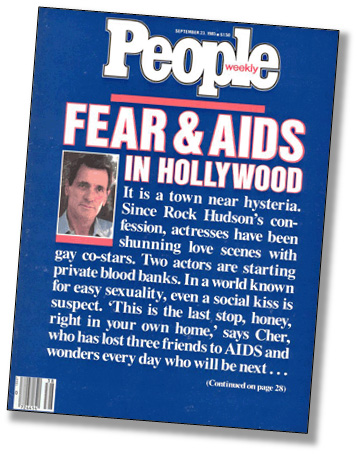
    • It’s really true that most people—and nearly all national politicians—had a hard time talking about AIDS during this period. America was nowhere near as gay-friendly in the early 80s as it is now. But there was a sea change in public perceptions in 1985. Ryan White, a charismatic teenager who acquired AIDS via a blood transfusion, was banned from school. Rock Hudson announced that he had AIDS. People magazine published its first cover story about AIDS and Time published only its second (the first was mainly about researchers trying to track down a cure). AIDS became a far more potent issue after these two events.
    • Clinton had earlier mentioned that when something happens to a person close to you it often has a galvanizing effect, and that prompted her to think of Rock Hudson, a friend of the Reagans from their Hollywood days. His announcement very clearly affected both of them deeply, and there’s evidence that around this time, Nancy started working behind the scenes to push her husband to take the AIDS epidemic more seriously.
    • And all this somehow spurred Clinton to momentarily lose both her historical sense and her political sense and produce the tone-deaf remark she did.

    I dunno. That’s the best I can do, and it’s not very persuasive. Clinton had just mentioned Alzheimer’s and very deliberately brought up AIDS as a distinct example of Nancy Reagan’s kindness. Her comment about AIDS was clear and coherent: it plainly referred to AIDS. It was no mistake. And even if Nancy Reagan was a bit more aroused about AIDS than her husband, it’s very common knowledge that her advocacy was still decidedly modest.

    Matt Yglesias suggests that Clinton’s gaffe is “revealing of her insider perspective on social change.” That is, Clinton thinks about these things from the top down, rather than the bottom up, and that prompts her to give more credit than she should to actors like the Reagans instead of to the activists who deserve it. I suppose that might be the answer—though Clinton, both by background and experience, sure seems pretty plugged into the power of grass-roots activism.

    So it’s a mystery. I can’t imagine why Clinton said something so dumb and inflammatory, and I can’t imagine she was pandering to anyone. What the hell caused her to momentarily lose her senses over this?

  • Who Will the Public Blame For Violence at Trump Rallies?

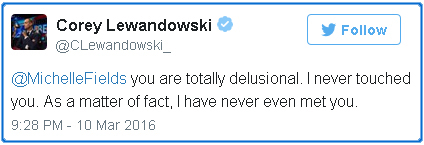
    Unless you just woke from a coma, you know what’s been going on at Donald Trump’s rallies over the past few days. After months of protesters interrupting his events and being treated with increasing ferocity, things have started boiling over. In Florida on Tuesday, a Breitbart reporter named Michelle Fields tried to ask a question about affirmative action, but Trump’s campaign manager grabbed her arm and nearly threw her to the ground—and then started up a Twitterstorm of smears claiming the incident never happened even though there was an eyewitness report, audio tape, and videotape of the incident.

    In North Carolina on Wednesday, a Trump supporter sucker punched a protester who was being led out by security guards. On Friday morning in St. Louis, a Trump rally erupted into clashes both inside and outside the arena, leading to dozens of arrests.

    Finally, on Friday evening in Chicago, thousands of Trump supporters and protesters engaged in verbal clashes and massive disruption hours before the rally was scheduled to start. A campaign spokesman said that after “meeting with law enforcement,” Trump decided to cancel the rally. The altercation then moved outside, where five people were arrested and a CBS reporter was detained covering the melee.

    So what was Trump’s response? “I don’t take responsibility,” he said. “Our freedom of speech has been violated totally.” Other Republicans agreed. Ted Cruz criticized the tone of Trump’s rallies, but said the real responsibility “lies with protesters who took violence into their own hands.” Marco Rubio said Trump needed to “own up” to his rhetoric, but “there are people that are protesting tonight that are part of organized efforts to disrupt this event.” Sean Hannity also defended Trump: “There’s no words that inspire people to hate.”

    And Trump himself delivered the bottom line: “This increases the vote for Trump.”

    Is Trump right? There’s no question that there’s an organized effort by protesters to disrupt Trump’s rallies. So far, though, they’ve been loud but peaceful. Does this mean the public will blame Trump, or will they conclude that the protesters are deliberately trying to stir up violence and they’re just getting what they asked for?

    Outside the right-wing press, the coverage of Trump’s rallies has been almost uniformly anti-Trump. But it’s obvious that Trump is reveling in this, and he has an animal cunning for finding the right angle to turn public opinion to his side. This is a delicate moment. Both sides have a point: Trump should be allowed to hold rallies, but he shouldn’t be allowed to pretend that he’s not consciously encouraging both the protests and the increasing violence. He obviously thinks it will help his cause in the end. Stay tuned.

  • Friday Cat Blogging – 11 March 2016


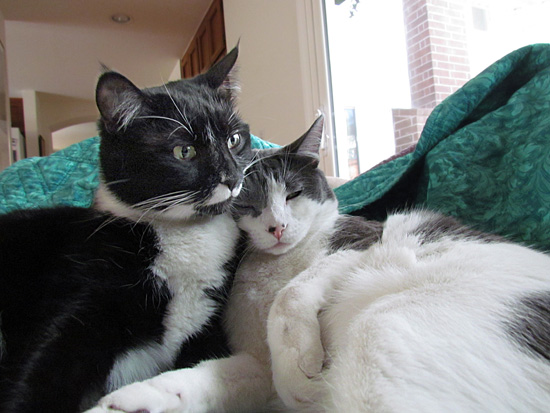
    Last week’s photo session with the cats was really great. I settled on the photo of Hilbert and his fabulous tongue because the timing was too good to pass up the joke, but that meant neglecting all the really good pictures they posed for that day. Here’s one of them. Aren’t they cute? Maybe I’ll use another one next week, though I suppose that depends on what the furballs do over the next few days. I bought a robot vacuum the other day, and there’s always the possibility that it will produce some amusing reactions. (So far, the only reaction has been deep suspicion.) In the meantime, enjoy this picture of domestic bliss, taken about a minute before the bliss dissolved.

    In other feline news, here’s a nice story about an autistic 6-year-old and her therapy cat.

  • Quote of the Day: Waste, Fraud, and Abuse Are Just a Con


    From David French, complaining about Donald Trump’s rather gleeful lack of policy knowledge:

    When a politician claims he’ll fix the budget by eliminating “waste, fraud, and abuse,” he’s appealing to don’t know/don’t cares.

    Sure, and Trump is more brazen and more stupid about this than most. But come on. Conservative politicians have been railing about the immense cost of waste, fraud, and abuse for decades. They do it because (a) it’s a good applause line, (b) its size is nice and vague, and (c) they’re afraid to propose major cuts to the big programs people actually care about (Social Security, Medicare, defense, etc.).

    During this time, the conservative intelligentsia has happily gone along with this charade. Now Trump is using it to great effect, and apparently the blame for this lies with lazy voters:
    The problem comes, however, when — during an election cycle — voters don’t even try. They ignore their responsibilities as citizens and become content with ignorance, happy to shortcut real evaluations with a number tried-and-true tricks. The identity of the speaker matters more than the content of the speech (We tune out the “establishment” or the “media” or “pundits.”) The tone matters more than substance (I’m not sure about Trump’s math, but he sure sounds presidential.) And narrative hovers over everything.

    It’s hard for a democracy to thrive without good leaders, but it can’t survive without good voters. And if you watch a debate without the slightest clue (or perhaps even concern) as to who’s telling the truth, you’re simply not doing your job.

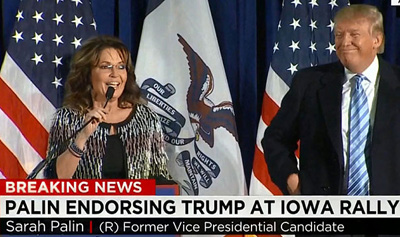
    Donald Trump is so brain-dead ignorant that it beggars the imagination. But for decades conservatives have been training their followers to wallow in ignorance, tune out the media, and pay more attention to narrative than to basic arithmetic. And they’ve happily embraced the public faces of that ignorance, people like Rush Limbaugh, Sarah Palin, Glenn Beck, and Matt Drudge.

    The old WFA con has been part of this all along. But now the conservative movement’s leaders are complaining that the rubes didn’t realize all along that it was just a bit of cynical rabble-rousing never meant to be taken seriously? Give me a break.

    POSTSCRIPT: On the bright side, props to French for endorsing the Oxford comma.

  • Obama: “I’m Very Proud” Of Backing Off on Bombing Syria


    I’ve long believed that the attack on Libya was something of a watershed for President Obama. Before that, he may have been more skeptical of using American military power than most people, but he was still basically on board the consensus train. After that, he finally felt in his gut what he had long believed in his mind: American intervention, especially in the Middle East, just doesn’t work very well.

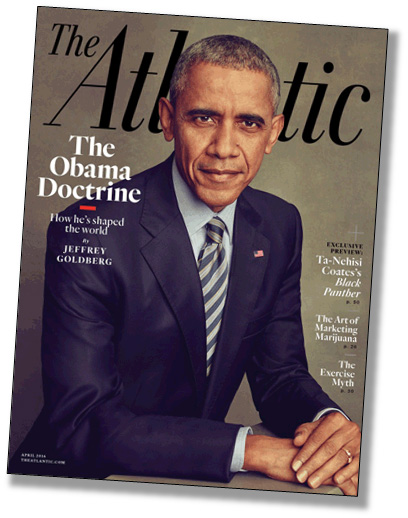
    But I might have the wrong war. In a fascinating cover story for the Atlantic, Jeffrey Goldberg suggests that the real turning point was Syria’s chemical weapons. Obama had famously drawn a “red line” on Syria in 2012: if the regime used chemical weapons, it could expect a ruthless American response. But a year later, when Bashar al-Assad’s army went ahead and used them anyway, Obama got cold feet.
    The fascinating part is this: if there’s a single foreign policy decision that’s earned him the most abuse, this is the one. But it turns out that Obama himself thinks it’s one of his finest moments:

    Given Obama’s reticence about intervention, the bright-red line he drew for Assad in the summer of 2012 was striking….It appeared as though Obama had drawn the conclusion that damage to American credibility in one region of the world would bleed into others, and that U.S. deterrent credibility was indeed at stake in Syria.

    ….Obama had already ordered the Pentagon to develop target lists. Five Arleigh Burke–class destroyers were in the Mediterranean, ready to fire cruise missiles at regime targets….But the president had grown queasy….The American people seemed unenthusiastic about a Syria intervention; so too did one of the few foreign leaders Obama respects, Angela Merkel, the German chancellor. She told him that her country would not participate in a Syria campaign. And in a stunning development, on Thursday, August 29, the British Parliament denied David Cameron its blessing for an attack. John Kerry later told me that when he heard that, “internally, I went, Oops.”

    ….Late on Friday afternoon, Obama determined that he was simply not prepared to authorize a strike….He was tired of watching Washington unthinkingly drift toward war in Muslim countries….The next few days were chaotic. The president asked Congress to authorize the use of force—the irrepressible Kerry served as chief lobbyist—and it quickly became apparent in the White House that Congress had little interest in a strike.

    ….“I’m very proud of this moment,” he told me. “The overwhelming weight of conventional wisdom and the machinery of our national-security apparatus had gone fairly far. The perception was that my credibility was at stake, that America’s credibility was at stake. And so for me to press the pause button at that moment, I knew, would cost me politically. And the fact that I was able to pull back from the immediate pressures and think through in my own mind what was in America’s interest, not only with respect to Syria but also with respect to our democracy, was as tough a decision as I’ve made—and I believe ultimately it was the right decision to make.”

    This was the moment the president believes he finally broke with what he calls, derisively, the “Washington playbook.”

    No wonder I like this guy so much. I’m going to miss him no matter who wins the election in November.

    Goldberg’s entire piece is long, but well worth a read—and I might have more to say about it later. But I found the Syria episode especially interesting. A couple of years ago I wrote that maintaining “credibility” was “perhaps the cause of more dumb wars than anything else in history,” and that fighting back against this notion was a “rare sign of wisdom in a president.” Basically, Obama made a mistake in setting out the red line in the first place, and eventually figured out that it was unwise to let our foreign policy be dictated by a brief, intemperate remark. That’s especially true when all the loudest hawks in Congress turn out to be a bunch of gutless armchair generals when you ask them to put their hawkishness to a roll-call vote.

    In any case: good for Obama. He’s correct that this decision cost him politically. He’s also correct that it was the right decision to make. Frankly, the mere fact that it pissed off so many of our Middle East allies—who plainly care about little except having America fight their tribal battles for them—is enough to convince me. American intervention in the Middle East has generally been pretty disastrous, and it’s long past time for everyone to figure that out. That very definitely includes all the folks who are actually in the Middle East.

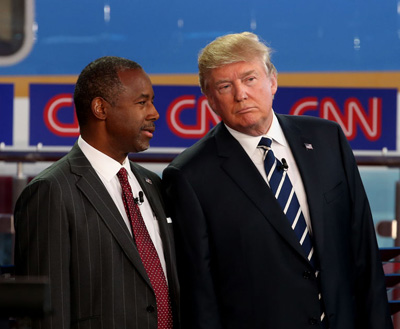
  • Ben Carson Had No Choice But To Endorse Donald Trump


    Quinn Hillyer is not pleased with Ben Carson’s endorsement of “moral monster” Donald Trump:

    Carson has spent an entire campaign pleading for honor and decency and decorum, only to endorse a man who is the crassest, most vulgar, most deceitful person in the race — a man who has repeatedly attacked in the most vicious ways, and lied about, every other candidate in the race. Trump is a man who has repeatedly incited violence at his rallies, saying that protesters should be punched out and carried away on a stretcher, and promising to pay the legal bills of those who throw the punches.
    ….Carson has talked about the need for a president to understand poverty, yet has endorsed a multi-million dollar inheritor who has spent his entire career leaving others impoverished by walking out on his debts, but refusing to pay full bills, and by trying to use to power of the state to seize their land. Worse, Carson is endorsing a man who has mocked his religion and who quite literally likened him to a child molester. In doing so, Dr. Carson has disgraced himself.

    Fair points! But Carson deserves a defense. Here it is:

    • Rubio is going to lose. Endorsing him wouldn’t benefit Carson in any way.
    • Carson hates Cruz’s guts.
    • Trump looks like he’s going to win.

    Oh, did you think I was going to defend Carson on moral grounds? So silly. Ben Carson has been grifting the conservative movement for years. He knows the main chance when he sees it, and right now Trump offers him the best prospect of staying in the spotlight and selling more books. I wonder if Trump will make him stand obediently behind him during his next rally, like he did with Chris Christie?

  • Is Anyone Still Defending Trade Deals These Days?


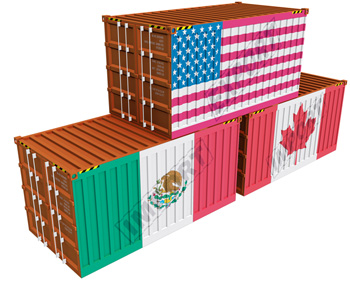
    I’m curious: is there anyone left who defends trade deals these days? Anyone who thinks NAFTA benefited the US; who thinks the WTO is a pretty good system; who thinks TPP is a good idea; and who supports all the smaller bilateral trade deals of the past couple of decades?

    Actually, let me rephrase that. I know there are lots of people who believe all this. But is there anyone left willing to say so in public? Literally every single presidential candidate has been flogging trade deals for the past few months, but no one seems to be fighting back. Is it just not worth it? Does everyone figure it’s nothing more than campaign posturing, and once the election is over we can go back to passing trade deals the same as we always have? Or what?