• An Unlikely Ray of Hope: Imagining a Future Where COVID-23 Changes Us for the Better

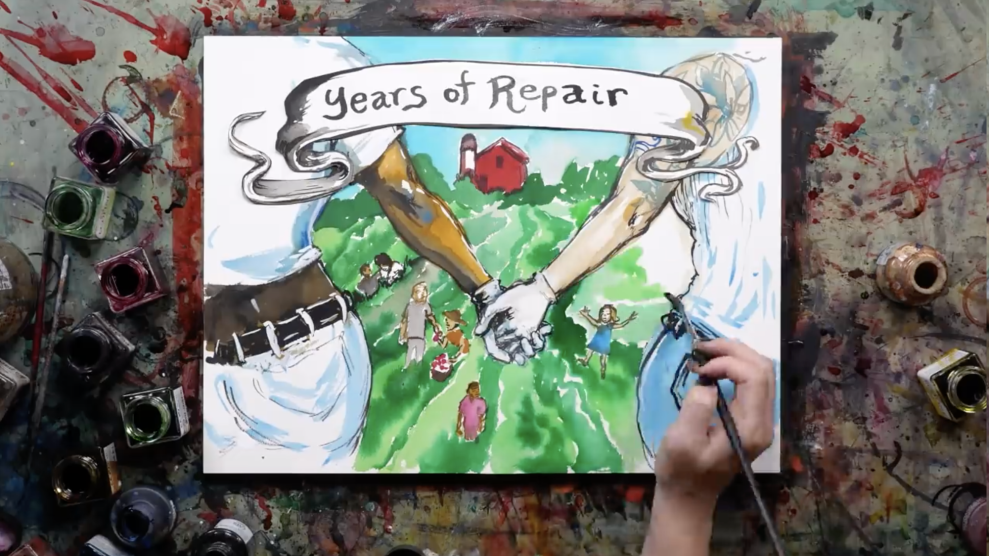
    Screenshot from "A Message From the Future II: The Years of Repair," animated by Molly Crabapple.The Intercept and the Leap

    “You can’t be what you can’t see”: This proverb often comes up in discussions of why representation matters. A young girl of color, for instance, might be less likely to believe she’s able to become a successful actor or politician if she doesn’t grow up seeing people who look like her in such roles. Yet in an Emmy-nominated video produced last year by Naomi Klein and the Intercept, Rep. Alexandria Ocasio-Cortez (D–N.Y.) offered this same idea as a clue for how to realize the dream of the Green New Deal.

    “We knew that we needed to save the planet and that we had all the technology to do it,” Ocasio-Cortez said in a “Message From the Future,” her voice laid over evolving visions painted by artist Molly Crabapple. “But people were scared. They said it was too big, too fast, not practical. I think that’s because they just couldn’t picture it yet.”

    A year and a half later, the challenges we face have only become more daunting, and the solutions even tougher to imagine. That might explain why “A Message From the Future II: the Years of Repair” (released this week) has a grittier, if still dreamy, tone. It imagines a future in which humans endure COVID-23 in widespread refugee camps amid mounting climate devastation—yet thanks to concerted collective action, these calamities change the world for the better, fostering a greener, decolonized, and more democratic society.

    The video offers hope because it assumes that even if we can’t yet see them, there are better days waiting for us on the far side of today’s madness. But the imagery also centers rent strikes, uprisings, and worker solidarity: seeds of a transformed future already taking root in the present.

    Featuring voices from around the world and a story co-written by Klein, Canadian filmmaker Avi Lewis, and Black Lives Matter co-founder Opal Tometi, “The Years of Repair” broadcasts a refreshing infusion of hope.

  • From Our (Recent) Archives, How to Prepare for the Next Pandemic

    Each week, we take a look at our archives for boosts to propel you into the weekend.

    What happens next?

    Today, as usual, I woke up in the predawn darkness to diligently blog and saw “the news”: President Donald Trump and first lady Melania Trump contracted the coronavirus. Many people had already spun out, spewing a slew of predictions, fears, jokes, sorrows, prayers, and vague twitches—both online and I am sure in random half-sentences in homes across these United States. All of that boggled my brain. So I read this Barefoot Contessa profile. It’s nice. 

    Then I started to wonder what I’d want the president to read right now from our archives, as he, potentially, finally—if he is the narcissist I believe him to be—is grappling with the implications of the coronavirus.

    It was pretty obvious. I think he should read our fantastic Pandemic-Proofing America series. It’s not what will happen next, but it lays out many things that should happen.

    This is good news: It’s clear that experts have ideas. And it is clear that, in another world (or another country, under another administration), there are—and were—ways to combat this virus. Would the solutions have been perfect? No. But we can prepare for the next. Sorry to sound like a hopeful hack, but that’s pretty fantastic news. I, and I’m sure others, have moments of pure nihilism. It’s important to remember that all this death is not required.

    Start with Andy Slavitt and the three things we need to do for next time, and keep reading all of them.

  • From the Sesame Street Writers’ Room to “The Jooniverse,” Comedian Joon Chung Has Good News

    With just 33 days until the election, and the pandemic’s end nowhere in sight, the stakes couldn’t be higher and the state of the universe is no laughing matter. An alternative: The Jooniverse, comedian Joon Chung’s new site, which promises personalized answers to all of life’s mysteries and miseries. “Welcome to The Jooniverse. You’re all just living in it,” his welcome note says. “If asking the universe feels too scary, ask me and I’ll respond with some advice.”

    The Jooniverse’s backstory is here, and your questions go here. See what good news, expertly bad puns, and healing humor before Election Day he has in store. Chung was recently a Sesame Street Writers’ Room fellow, and he’s developing a project with Sesame Workshop. He’s currently working on a preschool animated show. He was also named a Young Staten Island Talent to Look For, and he co-hosted the podcast Just the Gals. Previously he edited news and animated shorts for The Root, Jezebel, and other sites.

    “Asking the universe for anything is tough,” Chung says, “so ask me!” If you ask him and he delivers, share your results at recharge@motherjones.com and we’ll highlight a few. Let us know if you’d like your name included. A Recharge salute to Chung’s creative ventures.

  • Our Coverage of the Debate? Good. The Debate…Well, Read Our Coverage.

    Still spinning, unsure what to make of last night’s debate?

    Amid the bad (I mean really bad) crap that spun out of it, a sliver of a silver lining—according to our own David Corn—is that the debate “provided voters accurate impressions of these two men.” Trump was “full of lies and bluster.” Biden “stumbled through some answers” but came across as “competent.” You can read Corn’s full analysis here.

    Throughout the evening, Mother Jones reporters provided the analysis and commentary necessary to make sense of…whatever that was. Ali Breland peeked into the internet conversation by the Proud Boys, who celebrated Trump’s order to “stand by.” Breland wrote:

    In their publicly viewable Telegram channels, the Proud Boys immediately responded to Trump’s words with an eruption of praise. “Stand by!!! PROUD BOYS ARE HEROES!!!” one member of a large channel wrote. “They begged him to stab us in the back and he didn’t,” another wrote in a different channel.

    Nathalie Baptiste elucidated the exhausting experience of watching older white men discuss race while using “law and order” as a shorthand to call for the entrenchment and reinforcement of racial hierarchies. Kara Voght pointed out that, yes, Trump is going after your health care. Jeremy Schulman caught the false both-siderism of newspaper headlines this morning. And Rebecca Leber unpacked the surprisingly substantive climate change discussion.

    Big picture? It’s this point from our editor-in-chief, Clara Jeffery: Trump wants to delegitimize everything.

  • “Good News or Great News?” Here Are Key Questions for Tonight’s Presidential Debate.

    In case the moderator for tonight’s debate needs a hand with questions, and from the replay of Chris Wallace’s 2016 run, he might, we here at Recharge have drafted key conversation starters. Wallace is welcome to these lines of inquiry, all under one rubric fitting for our moment: “Good news or great news?” Everything’s here, COVID, the Constitution, the good fortune visited upon Americans over the past year:

    1. President Trump, since you’re the incumbent and a student of the Constitution, first one’s yours: Interfering with the Postal Service’s universal delivery mandate enshrined in Article I, Section 8, Clause 7 of the Constitution is a good or great thing?

    2. Also President Trump, since you’re a supremely good leader and we have a Supreme Court to which you nominated a replacement in record time, and since you tweetedThank you to @foxandfriends for covering, supremely, the greatest political scandal in the history of the United States, OBAMAGATE,” is it good or great news that I, Chris Wallace, of self-same Fox, am returning our thanks with lobbed softballs?

    3. Joe Biden, this one’s yours: Is it good or great news that…oop, we’re up against a break.

    4. President Trump, you said, and I’m quoting, “I am the least racist person there is anywhere in the world.” You’ve also said, and I’m quoting, “I have a great relationship with the Blacks. I’ve always had a great relationship with the Blacks.” Yet polls show that some number of voters don’t agree that you’re “the least racist person there is anywhere in the world.” And data shows that the coronavirus has a disparate impact on Black Americans. Is it good or great news that all polls and all data and all public health experts are inherently mistaken when they’re not in your favor or fit to your narrative?

    5. Joe Biden, this one’s yours: Is it good or…our apologies, another break. Everyone vote!

  • Sam Myers, the Late Blues God, Propels Us Into the Week With a Powerful New Album

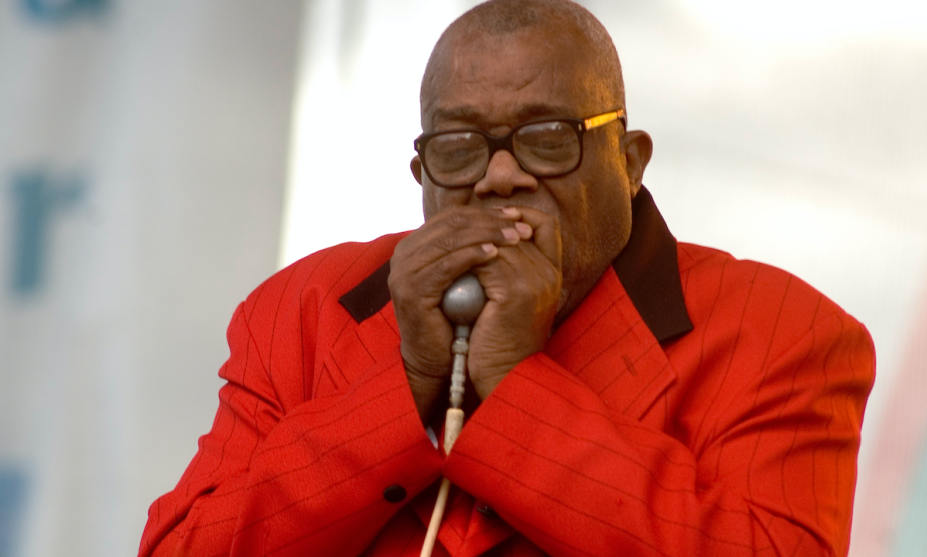
    The pioneering blues singer, harmonica player, and drummer Sam Myers

    When he was 7, Sam Myers’ eyesight was limited by cataracts that shaped his childhood and adulthood but never limited his music tours and ascension in the blues world—as a pioneering singer, harmonica player, and drummer. He became one of the most decorated and vibrant blues giants, jamming with Elmore James in the 1950s and Muddy Waters, Howlin’ Wolf, and Little Walter.

    In his 70 years, Myers spent two decades recording at bars, restaurants, and clubs in creative friendship with, among many supporters, the chef and producer Jack Chaplin, who’s familiar to Recharge readers as the versatile, acclaimed host of Daddy Jack’s Cooking With the Blues. The long-anticipated album, Sam Myers & the South Dallas Shoan-Nufferz: My Pal Sam, is a thrill of uptempo jams—a studio compilation of never-before-heard tracks available through Chaplin’s Patreon page

    Chaplin deserves a ton of credit for getting Myers into the studio again and into Chaplin’s spaces—in Dallas and now New London, Connecticut—along with the blues great Lucky Peterson. Chaplin has helped to keep the blues at bay by cooking for families and community members during the pandemic, with all the creative tips we’ve come to enjoy from his personalized channel Cooking With the Blues.

    There’s a lot of blues coming in the news ahead; here’s some strength to meet it with. Share your Myers and Chaplin shoutouts at recharge@motherjones.com, and get with Chaplin’s Patreon if you haven’t yet.

  • From Our Archives, the Signs of a Never-Ending Election

    Each week, we take a look at our archives for boosts to propel you into the weekend.

    In January 1992, Frances Fox Piven and Barbara Ehrenreich sat in on a forum hosted by the Nation to hear Jerry Brown—then running for the Democratic presidential nomination against third-way Democrat Bill Clinton. “Strikingly,” Ehrenreich noted in her essay for us on that campaign, “he was talking about class.” Piven and Ehrenreich nudged each other, raised eyebrows, and watched as “nearly five hundred hard-nosed New York leftists clapped till their hands were calloused.”

    It’s a tiny moment. But I spoke to Piven for an article earlier this year, and Ehrenreich is a hero—so it is one of those small, fascinating, and accidental scenes that gives one a jolt. Whoa! They’re friends! I’ve found that happening often in the archives, especially in the 1990s and 2000s. You recognize the names (Gingrich, Clinton, Trump), but they come up in different contexts. I was speaking recently to a friend about how these decades almost feel further away. The fall of the utopian ’60s to the overdrive ’80s consumerism is well-trod territory; I can chat about the 1930s and 1940s with any white man over the age of 60, as it is law they must be obsessed with either World War II or socialism. But chatter about the Iraq War and Clinton’s business-friendly Democratic Party is relegated to broader strokes. (That’s my narrow experience, at least.)

    Reading Ehrenreich’s larger analysis of the 1992 campaign, I was surprised by the details; I was surprised to see her framing of Clinton’s rise generally. The press loved his white male fighting spirit, she writes. They enjoyed the gladiatorial nature of his quest. It was, she felt though, almost meaningless. It was a PR stunt and a sideshow. She remembers George H. W. Bush canceling a trip to Brazil on government business because he was too busy running for reelection. And it dawned on her: “Today, being president is really no different from running for president.”

    That sounds almost trite. But whereas we may fix that to political jostling or reality TV or 24-hour news, Ehrenreich has, I think, a better explanation.

    She notes there is no “tangible product” for many when they look at the government. We are glimpsing, in the constant election cycle, “that emptiness at the center of things.” The business of government has been completely subsumed by the act of electioneering because the business of government is, well, gone: erased by Reagan and then adopted by Democrats.

    “It is government-as-spectacle,” she writes, “and much of it has been a sorry spectacle indeed.” Before, “words like ‘policy’ and ‘programs’ meant something even to ordinary people, of the kind who do not reside in think tanks.” Think of “Medicare, Medicaid, Title VII, Title IX, OEO, OSHA…”

    If you’re looking for the start of the never-ending campaign, she posits, why not locate it in when the government stopped having anything else to do. Ehrenreich, in those early days, did see hope in the Brown campaign: a smattering of burnout kids, workers, union nurses, and Allen Ginsberg.

    She decided to root for him when she saw Brown joust with Clinton in a debate, and upon being prodded on how his health care plan would have the audacity to harm the bottom line of rich doctors, Brown said, with a grin, “I can’t wait.”

    The longtime California politician is an odd figure. The son of a previous governor, prone to late-night working, and a figure associated with the 1960s left despite being in Yale Law School at the time; his penchant for a certain spirituality (he was called Gov. Moonbeam, famously), and also for strict Catholic rules, caught many off guard. Gary Wills in a 1976 essay for the New York Review of Books compared him to Thoreau (unfavorably!).

    In vying for Brown, Ehrenreich predicted the new leftist turn a bit too early. She thought Brown’s ideas were simmering into a Democratic party less interested in cutting and gutting and more invested in a class-based approach. It didn’t happen in the 1990s. But it might be happening now. (Might, I stress.) For all the vapidity of the constant electioneering, policies and programs do matter to people again: Medicaid, the Affordable Care Act, Social Security.

    I could be falling into the same hopeful trap here too.

    Ehrenreich ends on the right beat. We just don’t know:

    But the other great lesson of the last calendar year is: You never know. What began in a frenzy of jingoism ended in bitterness and economic collapse. Today’s defeat may be tomorrow’s opportunity, and opportunities evaporate even as they come into view. There is a wild churning force at work in our media-driven culture, driving us from “crisis” to “crisis,” from one mad, collective mood swing on to the next. Those who would win must learn how to ride along with this force, disdaining defeat, grasping every favorable current and eddy, trying and trying, getting the joke. There will be a next time, and this we know for sure: Next time is bound to be different.

  • As Billionaires Get Richer During the Pandemic, Here’s One Who Anonymously Gave Everything Away—All $8 Billion

    After 38 years of secret donations, a billionaire many times over has, at 89, given away all $8 billion to schools, charities, and foundations. Chuck Feeney of San Francisco has walked the walk after amassing his fortune as a co-founder of Duty Free Shoppers, following through on a pledge to empty his pockets for a clearer conscience. (His name became public only after the duty-free stores were sold and a lawsuit over the sale would’ve revealed his anonymous donations.)

    As my colleague Mark Helenowski visualized in a must-watch video revealing the staggering wealth accumulated by a tiny few during the pandemic, this period of crisis has been a payout for billionaires. Almost 650 of them have grown their collective wealth by an estimated $685 billion since March. Watch his animated video and take stock in—uh, take into account (uh, take into consideration)—the fact that while many superwealthy get superwealthier, at least one has taken steps to change course.

    I can hear your begrudging applause. I too am inclined not to applaud too loudly because Recharge’s coffers have not been lined with Feeney’s billions. If any billionaires get in touch at recharge@motherjones.com, I’d be amenable to putting you in contact with my colleagues in our giving department.

    Goodness in the world:

    Double win. Actors Ron and Jasmine Cephas Jones have become the first father-daughter pair to win Emmys at the same time. Well done.

    Marching on. This Saturday is the fourth annual March for Black Women, held virtually to keep marchers socially distanced. Speakers include Rep. Ilhan Omar, Gina Belafonte (daughter of Harry Belafonte), and Opal Tometi, a co-founder of Black Lives Matter.

    Soaring. Teenage trumpeters Maglyn Bertrand and Tatjana Lightbourn are the new Louis Armstrong House Museum fellows and they’re planning virtual tours and blogs to highlight Armstrong’s home and legacy.

    Screening. The LA Asian Pacific Film Festival is showing Francis Wong: Chinatown Revolutionary, a look at the pioneering San Francisco–based saxophonist and activist who co-founded Asian Improv aRTS with Jon Jang—who, together, merge their depth of music with historical narratives and a commitment to justice. Catch my interview with Jang.

    If you have a Recharge story or just want a direct word of recognition, let us know at recharge@motherjones.com.

  • Are You Threatened by My Uterus? I’m Not.

    The outpouring of remembrances of Justice Ruth Bader Ginsburg reveals the depth of her impact; her legacy brings our country and all women living here closer to the aspiration for equality under the law. Ginsburg was a critical member of the collective of women fighting for equal rights, and the fight enters a new phase of urgency and intensity.

    In the days before Notorious RBG’s death, reporters investigated allegations that ICE detainees were subjected to unwanted hysterectomies. Even as the story unfolded, I was outraged by my lack of surprise at the claims. As history repeatedly demonstrates, women with uteruses are one of mankind’s greatest threats.

    I don’t find my uterus threatening at all; just the opposite. I like getting my period. Sure it’s messy, a bit painful, sometimes inconvenient, but my period reminds me that beneath my layers of chosen duty—as a mother, wife, daughter, daughter-in-law, and community builder—I’m connected to what Audre Lorde calls The Erotic in her 1984 Sister Outsider. In literature there is light, and Lorde shines so much of it:

    There are many kinds of power, used and unused, acknowledged or otherwise. The erotic is a resource within each of us that lies in a deeply female and spiritual plane, firmly rooted in the power of our unexpressed or unrecognized feeling.

    For me, the end state of my body shedding my uterine lining is my connection to a life force so joyous and rapturous that it overrides and threatens everything about our social order. It is our connection to this power that drives violence and fear. The brutal oppression inflicted upon women of color is one of the consistent throughlines in America’s story.

    Women with uteruses can decide for ourselves to have children or not. I can decide whether to populate the country with just one more brown American citizen. Or not. At least for now.

    And no matter how hard many try, scores of white men and complicit white women are unable to stop us from being born and deciding what to do with our uteruses. No matter how much entitlement and evil manifests in the effort to control our bodies, people cannot sever our access to feminine power. They may be able to make me forget I have power, but they cannot eliminate its source.

    Wherever we find it—in literature, news, poetry, coalition building, running organizations, or strengthening and supporting those who do—The Erotic is there and it’s ours. Isn’t that glorious? It’s the ultimate charge.

    —Venu Gupta is Mother Jones’ Midwest regional development director. Share your stories with her at recharge@motherjones.com.

  • Your Remembrances of RBG Are Powerfully Insightful. Here’s a Sample. Keep Them Coming.

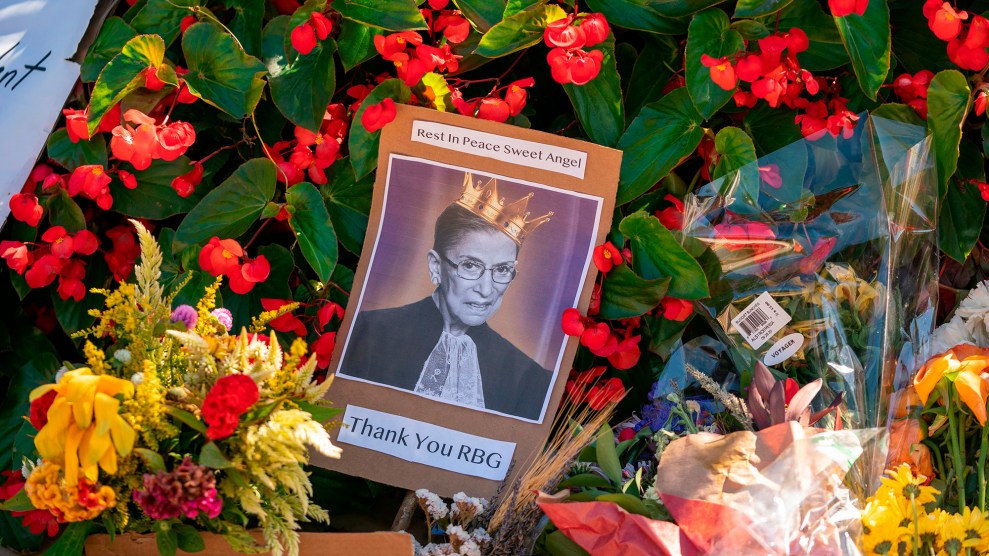
    A makeshift memorial for Justice Ruth Bader Ginsberg near the steps of the US Supreme CourtAlex Edelman/AFP/Getty

    As grieving continues and mobilizing begins in the wake of Ruth Bader Ginsburg’s death after a profound and pathbreaking life, so too does memorializing, and the sharing of her life’s lessons. Mother Jones readers are sending us glimpses of how you hear her legacy and where you find a recharge in her memory. Below is a selection. Keep your messages coming, in the form embedded in this week’s column by MoJo’s Monika Bauerlein, or by emailing us at recharge@motherjones.com.

    These especially ring true for many of us (and we also heard from those who wished she’d retired under President Obama, but that’s for another post):

    I was born in 1949 and RBG changed my life. Before she helped change the laws dealing with women’s rights, I couldn’t get a credit card in my name. In the want ads, jobs for men were listed separately from jobs for women & I wasn’t allowed to apply for any job listed for men. The laws were crazy & discriminated against women in many ways. Ruth changed that & I will be eternally grateful.
    —A reader who wishes to remain anonymous

    Ruth Bader Ginsburg is all that I ever hoped to be. A strong, intelligent woman who fought the good fight. Who protected the rights of the people who could not protect themselves. She shaped the lives of generations of women. She showed them that they could have control of their lives, their bodies, their family size, their futures. She gave generations of women (and men) hope. And self-determination. She did not allow old white men to control her or us. We cannot let her legacy die. We must fight on in her memory. I own my body. As does every Woman. And man. And I will not ever accept the chains that others wish to reapply. I, for one, will always love RBG and the justice she stood for. And the freedoms she fought for.
    —Roma Johnson-Egea
    Westerville, Ohio

    RBG was such a tower of strength, civility, and compassion in this seriously messed-up country. At least RBG was there to steady the judiciary. It comforts me to hold the memory of her courage and grace.
    —Margo Pearce
    Boston, Massachusetts

    Ruth Bader Ginsburg has inspired generations and made life fairer for all. Tzadik exemplifies her. I know that her reasoning has had an incredible impact the world over and that her dissents will pave the way for progress, as they already have in the Lilly Ledbetter Fair Pay Act. Ruth Bader Ginsburg lived with courage, dignity, humility, and love. There could be no better example of a life well-lived in the service of others.
    —Linda
    Hyattsville, Maryland

    Strength, fortitude, intelligence, calm, wisdom. Bonus: She’s from Brooklyn.
    —Gregory
    Brooklyn, New York

    Thinking of RBG reminds me of “When Great Trees Fall” by Maya Angelou.
    —Dee
    Concord, California

    At Dee’s suggestion, Maya Angelou’s “When Great Trees Fall”:

    When great trees fall,
    rocks on distant hills shudder,
    lions hunker down
    in tall grasses,
    and even elephants
    lumber after safety.

    When great trees fall
    in forests,
    small things recoil into silence,
    their senses
    eroded beyond fear.

    When great souls die,
    the air around us becomes
    light, rare, sterile.
    We breathe, briefly.
    Our eyes, briefly,
    see with
    a hurtful clarity.
    Our memory, suddenly sharpened,
    examines,
    gnaws on kind words
    unsaid,
    promised walks
    never taken.

    Great souls die and
    our reality, bound to
    them, takes leave of us.
    Our souls,
    dependent upon their
    nurture,
    now shrink, wizened.
    Our minds, formed
    and informed by their
    radiance, fall away.
    We are not so much maddened
    as reduced to the unutterable ignorance of
    dark, cold
    caves.

    And when great souls die,
    after a period peace blooms,
    slowly and always
    irregularly. Spaces fill
    with a kind of
    soothing electric vibration.
    Our senses, restored, never
    to be the same, whisper to us.
    They existed. They existed.
    We can be. Be and be
    better. For they existed.

    Send us your RBG recharges here or by emailing recharge@motherjones.com. And if you’re looking for a continuing boost, our Recharge blog awaits.

  • “The Root 100” Was Announced This Morning, the Annual List of the Most Influential Black Americans Ages 25–45

    A jumpstart to the week, and a big one to celebrate and contemplate: In its 11th year running, the Root 100 was just published, the annual list of “the most influential African Americans, ages 25 to 45,” selected by The Root’s editorial staff. It’s a powerful lineup.

    Go check. It’s here! Share it. Argue over it! Use exclamation marks! Tweet about it! Agree or disagree with the selections, and once you’re done sharing and debating it, learn from it. Discover or rediscover the 100 people honored by the site’s editors, writers, and producers. The team, led by Editor-in-Chief Danielle Belton and Managing Editor Genetta Adams, considered hundreds of publicly submitted nominees and, with the help of a custom-built algorithm, weighed influence by reach—the audiences touched across digital platforms and social media—and substance—the overall impact of work on communities, culture, and society. Winners were picked from the finalists pool by a committee of award-winning, National Association of Black Journalists–honored contributors.

    “This year is more important than ever to highlight those making strides to stand up against social injustices, no matter how large or small,” Belton says.

    While you’re browsing the list and learning about people on it—and sweating why you yourself, or influencers you cherish, didn’t make it—be sure to follow The Root’s editorial crew for continuing analysis and insight in the runup to the election. Follow Belton, Adams, Michael Harriot, Anne Branigin, Felice León, Terrell Jermaine Starr, and many other staffers, past and present, including, of recent Root glory, Danielle Young and Ashley Velez, two of the premier voices in video journalism and narrative storytelling.

    Here’s the full The Root 100. Congrats to the honorees, and the staff behind it.

  • From Our Archives, an Excerpt From Maxine Hong Kingston

    Each week, we take a look at our archives for boosts to propel you into the weekend.

    In Maxine Hong Kingston’s “The Brother in Vietnam,” which we excerpted in 1980, the main character is simply “the brother.”

    It is the Vietnam era. The draft looms. He, “the brother,” does not have a religion, a wife, a physical disability, or a desire to go to war—he has only a job teaching high school in California. So “the brother” does that, at first; he teaches. The brother waits to be called up to the war. He hopes not to be. He spouts a bit of anti-capitalism to his students in the meantime. Kingston writes:

    During Current Events, [the brother] told his class some atrocities to convince them about the wrongness of war. They looked at the pictures of napalmed children and said, “Sure, war is hell.” Where had they learned that acceptance? He told them the worst torture he knew: the Vikings used to cleave a prisoner of war’s back on either side of the spine, and pull the lungs out, which fluttered like wings when the man breathed. This torture was called the Burning Eagle. The brother felt that it was self-evident that we ought to do anything to stop war. But he was learning that, upon hearing terrible things, there are people who are, instead, filled with a crazy patriotism…

    He explained how water, electricity, gas and oil originally belonged to nobody and everybody. Like the air. “But the corporations that control electricity sell it to the rest of us.” “Well, of course they do,” said the student; “I’d sell the air if I had discovered it.” “What if some people can’t afford to buy it?” “Whoever discovered it deserves to be paid for it,” said the stubborn boy. “It’s Communist not to let him make all the money he can.” Although the students could not read or follow logic, they blocked him with their anti-Communism, which seemed to come naturally to them, without effort or study.

    Some have written that “the brother” is likely Kingston’s own brother. Her work often swirls into an autofiction, as Hua Hsu wrote in a profile this year in the New Yorker. This roots Kingston’s story in a tangible haze of guilt. Perhaps one we all recognize today.

    Hsu’s article begins where most do with Kingston: her iconic The Woman Warrior, which “changed American culture.” He describes the process of her writing the book—she burned out on Berkeley counterculture, moved to Hawaii, and, on vacation in Lāna’i, Kingston in 1973 began writing by moving a desk to face the wall.

    But it is his description of her process of writing her second book—China Men, a series of stories about immigrant men published in 1980, which includes “The Brother in Vietnam”—that caught me, and made our excerpt make more sense. He writes: 

    When she completed “China Men,” she and [her partner] flew to New York. After reading the manuscript, [her editor] told her that she had failed. “You don’t understand men,” she remembers him saying. “They’re lonelier than this.”

    Devastated, Kingston got on a bus uptown to her friend Lilah Kan’s apartment, where she and Earll were staying. “I just felt terrible,” she said. She was met by [friends] who greeted her with champagne and pot to celebrate her big meeting. They went ahead with the party, as she retreated into the corner with her Selectric typewriter and wrote a scene based on her father’s time in New York. So much of the immigrant story is joyless hard work. America is so free that you are even free to work through the holidays, Kingston wrote. She wanted to give the immigrant workers a day off. Her father enjoys a night out on the town, ending up at a tearoom, where Chinese men could buy dances with white women. Her father fox-trots with as many blondes as he desires, then returns home alone, wondering if his wife will ever make it to America.

    This work follows a similarly sly trajectory. Unsure what to do, Kingston’s “brother” actually enlists in the Navy. “He arrived at his decision by reasoning like this,” she writes. “In a country that operates on a war economy, there isn’t much difference between being in the Navy and being a civilian.” If every microwave purchase fuels the bombs what point is there?

    Yet the brother cannot fully give up his hatred of the Vietnam War. As much as he tries to give in, Kingston finds that the brother keeps fighting: in small, subtle ways. It is the “sadness” of men that her editor wanted. But the strength too.

    The brother cannot fully go limp, cynical, and evil. He is complicit, yes, in war, but never wages it fully. In Vietnam, as part of the Navy, he refuses to kill. And he refuses to die.

    There’s a shrewd lesson there. Sometimes we must just survive.

    Check out Hsu’s profile, and pick up a copy of any of Kingston’s books.

  • Between the Wildfires and the Pandemic, Live Music Is Resiliently Pulling Through

    As wildfires ravage the West Coast and continue to engulf lives, livelihoods, and homes, spreading the worst air quality in the world, it’s hard to imagine live music going strong. It does, remotely and safely, and just in time. One of the most thrilling this month comes from California, a powerhouse performance on September 26 by Zakir Hussain, Charles Lloyd, and Julian Lage, any one of whom is must-watch. This is the first time they’re performing as a trio.

    Healdsburg Jazz is impressively unfazed by the heavy extra work of safely producing shows during the pandemic and fires, and they’re pulling in deep ones. Watch Hussain on tabla, Lloyd on saxophone, and Lage on guitar, and let us know at recharge@motherjones.com how you hear each and how you imagine their collective pulse to sound.

    If you need a pulse check around the clock, our Recharge blog awaits. And mark the date.

  • CNN’s Brian Stelter Unpacks Fox’s Playbook on the Latest Mother Jones Podcast

    As my colleague Molly Schwartz neatly sums up, the lies, obfuscations, and dizzying talking points of Fox News are bad. Exposing them is good. We’ve known this forever, but it is freshly necessary to corroborate, investigate, and understand the big picture and the small, to see how we got here. In case you missed the steady skewering that Fox and Trump took last week by CNN’s chief media correspondent, Brian Stelter, in conversation with Mother Jones Editor-in-Chief Clara Jeffery, catch it here. With Jeffery’s pinpoint questions, he assesses whether Fox explains Trump or Trump explains Fox, or each explains the other in a dance of propaganda and power trading. He dishes on what Fox insiders told him for his book Hoax: Donald Trump, Fox News and the Dangerous Distortion of Truth. It’s all laid out, the horror and the humor, the madness and the bleakly fascinating details.

    “You say that Hoax is essentially about the Foxification of Trump and the Trumpification of Fox,” the conversation begins. “Who leads this dance, the president or the network?” The answer is good. (Back to good-good news tomorrow. Today we welcome, for a midweek lift, good-bad news.) Reach us with personal stories and good-good recharges at recharge@motherjones.com.

  • A 100-Year-Old Postcard Just Arrived in the Michigan Mail. A Family Search Begins.

    Here’s a post office puzzle that isn’t about the scapegoating of workers or the sabotaging of the universal delivery mandate by a corrupt president and an inept postmaster general. This one’s good; read the whole tale, an epic about a 1920 postcard that took its time reaching its mailbox this month, with a come-from-behind win thanks to the dedication of postal workers. Kudos to the Washington Post’s Sydney Page for piecing it together. Highlights:

    —“Dear cousins,” the postcard starts. “We are quite well but mother has awful lame knees. It is awful cold here.”

    —“Don’t forget to write us,” the note ends, followed by a question about whether ol’ Roy got his pants fixed yet.

    —There’s a Halloween illustration on the front, with the words “Witch would you rather be, a goose or a pumpkin-head?”

    —The one-cent George Washington stamp is legibly marked October 29, 1920.

    —The 30-year-old who received it has pledged to help find members of the original family. “I was shocked,” she said. “At first I didn’t think much of it, other than that it’s old and interesting, but then I took a closer look.”

    —A local librarian is pitching in to complete the puzzle; he has turned, in part, to the 1920 census. (If you’re a census neglecter, get on it.)

    —The Facebook group Positively Belding is on the case.

    —The letter is signed by one Flossie Burgess.

    If you’re related to a Flossie Burgess, let Page know, or drop a line to recharge@motherjones.com. We hope Roy got his pants fixed.

  • A Graphic Designer Is Relabeling Canned Food With Calls for Justice

    If you live in Texas or know someone who does, look twice—or have them look twice—before reaching for that jar of peanut butter or can of soup, cranberries, or ground coffee. And definitely that tin of Spam, container of salt, and jar of mayo. A San Antonio artist has been sneaking around to supermarkets and relabeling food in an act of creative consumer disobedience. Jars and containers are popping up on shelves with parody labels bearing call-to-action political messages, and the labels are virtually indistinguishable from the originals. You’d be forgiven for mistaking them until you get home, when your astute, label-reading housemate makes the fool of you.

    “One of my San Antonio friends has been using his graphic design skillz to re-label grocery store cans with facts about local/national police issues,” tweeted the artist’s friend, who hasn’t named the artist, but the friend, with permission, has made the labels available as PDFs: “Want to bring this revolution to your grocery aisle? He’s made the label files public.”

    See the photos here and here. Enjoy your Ocean Spray Whole Berry Cranberry Sauce, or, if you’re looking, Priorities San Antonio Just Added $8.1 Million to the Police Budget Cranberry Sauce.

  • From Our Archives, a Radicalizing Moment for a Pioneering Organizer

    In August 1976, before Ron Chernow wrote his famous biographies—of Grant, Hamilton, and Washington—he was a freelance magazine writer in New York with a story in Mother Jones. It was our cover that month: a gripping profile of the fight by domestic workers, primarily Black women, to form a union. Chernow writes that they’re “the last frontier of labor organizing.” (It goes without saying these were earlier times, before the Reagan era, when one could think of labor as having a “last” frontier.)

    Most of the piece focuses on Carolyn Reed, a worker in New York who on her midday break goes to other apartments, getting to know each door worker to organize them. You can read more about her here, from Yes magazine, which excerpted a portion of Premilla Nadasen’s book Household Workers Unite: The Untold Story of African American Women Who Built a Movement. And much of our own piece can be found here, with Google Books. It includes vivid scenes in which Reed stands up to Republican legislators in the New York state Assembly. When probed by them on the role of helping the elderly who want to be treated like family by their workers, she is forthright:

    “Can I just make a comment on the companion thing,” she says gently. “I don’t like to take the companionship thing and make it an excuse for someone being underpaid. Basically this is what happens. For too long, we have been addressed as ‘one of the family.’ The basic thing is to be paid and have the right kind of coverage.”

    It works. The legislators are convinced to vote in Reed’s favor (though she worries it’s only appeasement for bigger battles down the road). Reading about wins like this is not only gratifying; it also helps make sense of how workers have continued to organize. The National Domestic Workers Alliance is relatively new, forming in 2007, but has gained and grown from the hard work by Reed and others—and it has amassed increasing power. You can read about the long history of this work in a timeline we created, too.

    But, for a moment back to Reed. There is a gem of a moment in this article in how she came to organizing work.

    It is 1963, she is working in a home and wants to join marchers in Washington, DC. Her employer says no. They want her to work a dinner party at their home that evening instead:

    In protest, [Reed] kept the television set blaring throughout the day, pouring out speeches from the Lincoln Memorial. At the dinner table, one pompous doctor wondered aloud, “What do these people want?” He answered his own question: “What they need is an education.”

    “That galled me so,” says Reed, “that I said in the kitchen, ‘What the hell do you think they’re marching for?’ So I went into the dining room and I passed the beans. When I got him, I just—choomph!—right in his lap. ‘Excuse me so much,’ I said, ‘I really should be educated as to how to serve beans.'”

    She then retired to her room and nobody dare bother her that night. Her employers still retained her.

    Incredible! If you have any stories of activism spurred by or involving beans, please let us know at recharge@motherjones.com. I imagine it will be hard to beat this one though.

  • Can We Knit Our Way Forward? Probably Not, But I’m Trying Anyway.

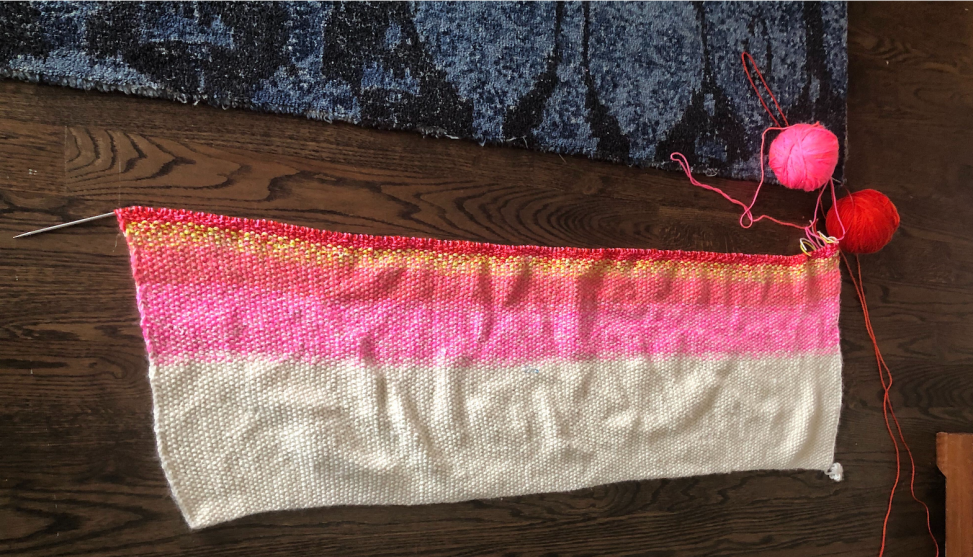
    A perfectly good work in progressVenu Gupta

    I have never looked so hard for ways to recharge myself and come up short. Forget feeling recharged—I would take a day without anguish and despair.

    The fabric of our country is giving way; threads pulled and seams undone. Whether we actually had a more perfect union before the 2016 election or I just saw it that way by selectively focusing on the potential around us, I’m not sure. Either way there’s no chance that I can unsee, and many of us can unsee, America’s sins and separateness.

    I have found a bit of solace and relief in knitting. For days on end during the protests, I shuffled around my house, jittery and nervous not for my safety but for our country’s, and for its future. With each story of militarized assault on free speech and assembly, and with each act of solidarity and strength by protesters, my urge to knit grew stronger. The healing power of knitting—to steadily build—is akin to the power of storytelling, if only in the privacy of my hands and my home. Each day I resisted my urge to knit because I don’t usually knit in the summer—too hot in Chicago, all that wool in my lap. Then one day I relented. As the protests grew, I was moved to take out my needles and yarn.

    Knitting has surged in popularity during the pandemic, with knitting sites and chatrooms growing. I want our country remade and repaired; I want people who’ve suffered for generations to be made whole; I want that line “life, liberty, and the pursuit of happiness for all” to mean those last two words. Yet I can’t stand the process that change demands, the upheaval required of uprising, when it feels and hurts like nails on a chalkboard. Uncertainty to me feels like nails on 10 chalkboards. But I know the sound is of something better to come, that we have to take apart what’s loose and weak to make it tighter and stronger. And start again.

    I began the Muhuroosa Blanket pattern a year and a half ago—a year and a half ago!—giddy to create something beautiful and useful. I restarted 10 times—180 stitches, 90 knits, and 90 purls, multiplied by 10. I guess I didn’t have to start fresh, but the blanket would’ve been f’ed if I hadn’t. Even with a good foundation of knits and purls, it’s bound to be a mess. I’m one-third of the way through.

    One stitch after another, back and forth, fixing some mistakes but not all, reminds me that change and creation are slow but possible—and then fast. Seams can be reinforced and threads placed in the right way. But we’ll have to pay vigilant attention as it goes, or we’ll have to start again.

    Venu Gupta is Mother Jones’ Midwest regional development director. Share your stories with her at recharge@motherjones.com.

  • A New Coalition of Poets, Novelists, and Playwrights Is Mobilizing Against Trump

    To the long list of groups formally opposed to Donald Trump’s reelection, we can now add Writers Against Trump. The coalition formed a few weeks ago to mobilize the literary community in opposition to “the racist, destructive, incompetent, corrupt, and fascist regime of Donald Trump, and to give our language, thought, and time to his defeat in November.” The group joins the growing ranks of Against Trumpers, from Republican Voters Against Trump to the Democratic Coalition Against Trump, Christians Against Trump, Jews Against Trump, American Muslims Against Trump, Atheists Against Trump, Hairdressers Against Trump, and Cute Animals Against Trump, which tweets @damncutebunnies. The literary group is collecting video and written testimonies from authors “at all stages in their careers” to assess the stakes in the election and add their voices on Instagram, Facebook, and its website.

    The coalition’s organizers include Paul Auster and Siri Hustvedt, as well as Carolyn Forché and Natasha Trethewey. And one John Turturro has come out swinging in the group’s support with a video of his own.

    Unsurprising for a group of literary giants, they get to the core of the candidate and the essence of the moment: “The brutal and criminal regime called an ‘administration’ may remain in power a while longer, spewing disinformation, exacerbating ill health, earth-hatred, obscene inequality, race- and woman-hatred, and encouraging violence, but as an unintended consequence, we are coming together to resist. We hope you’ll join us, and bring us your good ideas and your energy.”

    Writers everywhere are welcome. More than 1,300 have joined so far. Auster’s, Hustvadt’s, Forché’s, and Turturro’s videos are here.

  • After 6 Murder Trials and 23 Years Behind Bars, Curtis Flowers Is Set Free

    The scope of good news that makes Recharge is expansive, from stories of justice achieved to the brightening, heartening, surprising boosts from the archives, like Dorothea Lange’s photos getting digitized, Satchel Paige’s life advice revisited (from our second-ever magazine), and Pharoahe Monch’s truth-telling returned to. Then there’s the genre of good that is essentially bad interrupted, or atrocity halted; when injustice is intervened on late, like wrongly prosecuted people no longer prosecuted, decades after irreversible harm accumulates.

    My colleague Venu Gupta messaged me with a story of exactly this kind. An innocent man, Curtis Flowers, tried six times on murder changes and incarcerated for 23 years before the case was dropped. “How have we come to a point where we caused so much pain to someone and feel like the end of that pain is a celebration?” Venu asked. What does it say about the world “that a man who was not guilty and spent decades in jail after six trials was then found not guilty”?

    Read the full story by Mother Jones and by the Mississippi Center for Justice’s tireless, heroic leaders (here and here), and share more goodness like it, and all forms of recharges, at recharge@motherjones.com. Also share the Recharge blog at motherjones.com/recharge with one person who might want or need it today.