




In 1965, James Ridgeway helped launch the modern muckraking era by revealing that General Motors had hired private eyes to spy on an obscure consumer advocate named Ralph Nader. He worked for many years at the Village Voice, has written 16 books, and has codirected Blood in the Face, a film about the far right. In 2012, he was named a Soros Justice Media Fellow.
Serving time in prison is not supposed to be pleasant. Nor, however, is it supposed to include being raped by fellow prisoners or staff, beaten by guards for the slightest provocation, driven mad by long-term solitary confinement, or killed off by medical neglect. These are the fates of thousands of prisoners every year—men, women, and children housed in lockups that give Gitmo and Abu Ghraib a run for their money.
While there's plenty of blame to go around, and while not all of the facilities described in this series have all of the problems we explore, some stand out as particularly bad actors. We've compiled this subjective list of America's 10 worst lockups (plus a handful of dishonorable mentions) based on three years of research, correspondence with prisoners, and interviews with criminal-justice reform advocates concerning the penal facilities with the grimmest claims to infamy.
We will be rolling out the remaining profiles in the coming days, complete with photos and video. Our sixth contender is a California fortress of isolation where it's easy to find yourself in the hole, and extremely hard to get out of it.
Pelican Bay State Prison (Crescent City, California)
Number of prisoners: 3,500 (1,500 in solitary)
Who's in charge: Greg Lewis, warden; Jeffrey Beard, secretary, California Department of Corrections and Rehabilitation
More than 500 Pelican Bay prisoners have been in solitary in excess of a decade. Nearly 80 have been there more than two.
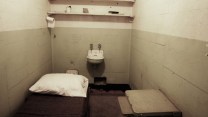
The basics: California leads the nation both in its overall prison population and in the number of prisoners in solitary confinement—about 11,000 men and women on any given day. At Pelican Bay, the state's first and most notorious supermax, the 1,500 occupants of the Security Housing Unit (SHU) and Administrative Housing Unit spend 22.5 hours a day alone in windowless cells measuring about 7 x 11 feet. The remaining 90 minutes are spent, also alone, in bare concrete exercise pens. With no phone calls allowed, and only the rare noncontact visit, these prisoners, like those at ADX and Texas' Allan Polunsky Unit, can only access the world outside their cells via their "feeding slots." And their only interactions with fellow prisoners consists of shouting through steel mesh—until the guards order them to shut up.
Desk area of Pelican Bay SHU cell. Todd Ashker
More than 500 Pelican Bay prisoners have lived in the SHU in excess of a decade, nearly 80 have been there for more than two decades, and one prisoner recently marked his 40th year in solitary. Two-thirds of these prisoners are serving indeterminate stints in the hole—not because of any misbehavior, but because corrections staff have labeled them gang members or "associates."
A 2012 Mother Jonesinvestigation by Shane Bauer found that many of the racially charged gang "validations" were based on the prisoners' reading materials (Karl Marx and George Jackson), writings (advocating prisoners' rights or "Afro-centric ideology"), and drawings (such as Aztec symbols). "One inmate's validation includes a Christmas card with stars drawn on it—alleged gang symbols—among Hershey's Kisses and a candy cane," Bauer wrote. Others are validated on the say-so of prisoners who snitch—which until very recently was one of the only ways to get out of the SHU. The other was to die.
Serving time in prison is not supposed to be pleasant. Nor, however, is it supposed to include being raped by fellow prisoners or staff, beaten by guards for the slightest provocation, driven mad by long-term solitary confinement, or killed off by medical neglect. These are the fates of thousands of prisoners every year—men, women, and children housed in lockups that give Gitmo and Abu Ghraib a run for their money.
While there's plenty of blame to go around, and while not all of the facilities described in this series have all of the problems we explore, some stand out as particularly bad actors. We've compiled this subjective list of America's 10 worst lockups (plus a handful of dishonorable mentions) based on three years of research, correspondence with prisoners, and interviews with criminal-justice reform advocates concerning the penal facilities with the grimmest claims to infamy.
We will be rolling out the remaining contenders in the coming days, complete with photos and video. Fifth on the list is a notorious Southern California institution whose residents live in fear of attacks by a "savage gang of deputies."
Men's Central Jail and Twin Towers Correctional Facility (Los Angeles)
Number of prisoners: 9,500 combined
Who's in charge: Ralph G. Ornelas and Randal J. Stover, jail captains; Lee Baca, LA County sheriff
The basics: "To be an inmate in the Los Angeles County jails is to fear attacks" by a "savage gang of deputies," explains an extensive 2011 report (PDF) from the American Civil Liberties Union, which processes about 4,500 complaints each year from inmates of the nation's largest jail system. Packed at the best of times, Twin Towers and Men's Central are overflowing with prisoners transferred there from overcrowded California prisons under the state's court-ordered reorganization scheme. Eyewitnesses, including several prison chaplains, have reported that attacks by deputies at the twin facilities are often unprovoked or brought on by the slightest infractions. Additional deputies often pile on, sometimes after being alerted to the action on their walkie-talkies.
Serving time in prison is not supposed to be pleasant. Nor, however, is it supposed to include being raped by fellow prisoners or staff, beaten by guards for the slightest provocation, driven mad by long-term solitary confinement, or killed off by medical neglect. These are the fates of thousands of prisoners every year—men, women, and children housed in lockups that give Gitmo and Abu Ghraib a run for their money.
While there's plenty of blame to go around, and while not all of the facilities described in this series have all of the problems we explore, some stand out as particularly bad actors. We've compiled this subjective list of America's 10 worst lockups (plus a handful of dishonorable mentions) based on three years of research, correspondence with prisoners, and interviews with criminal-justice reform advocates concerning the penal facilities with the grimmest claims to infamy.
We will be rolling out more prison profiles in the coming days, complete with photos and video. Today let's head over to the Big Easy to visit what the Justice Department has deemed a "violent and dangerous institution."
Orleans Parish Prison (New Orleans)
Number of prisoners: 3,400
Who's in charge: Major Kevin Winfield, warden; Marlin N. Gusman, Orleans Parish sheriff
The basics: New Orleans' barbaric city jail first hit the national radar after Hurricane Katrina, when thousands of inmates were abandoned for days in flooded cells without food, water, ventilation, or electricity—some of them were "standing in sewage-tainted water up to their chests," according to the ACLU. But OPP's problems neither began with Katrina nor ended in the storm's wake, when prisoners were taken back to the surviving buildings.
Almost half of all prisoners at OPP are pretrial, accused but not convicted of crimes. Yet a stint here can be a de facto death sentence. According to investigations by the Justice Department, in the past two years, at least two inmates have managed to kill themselves while on suicide watch—one of them by stuffing toilet paper into his mouth until he suffocated. A third died while being held in five-point restraints. A fourth was found dead after allegedly being beaten and pepper sprayed (PDF). Prisoners also say that the guards supply them with drugs, and will often stand by during a melee and let inmates fight themselves bloody, according to a criminal defense attorney who served time at OPP himself.
DOJ: Orleans Parish "is deliberately indifferent to prisoners with serious medical and mental health needs."
In an interview with Mother Jones, Sheriff Gusman and jail doctor Samuel Gore disputed some of these details. In the pepper-spray incident, they contend, the man died three or four days afterward, and not as a result of his altercation: "The autopsy was clear," Gore says. "It was not a violent death. There was just minor bruises and minor abrasions." The restrained woman, the doctor says, was acting beligerent, spitting at deputies and "voicing suicidal ideations." She had slipped her restraints and then, as staffers tried to put her back into them, stopped breathing and went "flaccid." She was resuscitated and taken to the hospital where she died—the cause was not determined. As for guards supplying drugs, Gusman said: "We have a zero-tolerance drug policy here. We looked at our records. Last time we arrested an employee was in 2011. Does it happen? Can it happen? Sure, it can happen. We take it very seriously."
Serving time in prison is not supposed to be pleasant. Nor, however, is it supposed to include being raped by fellow prisoners or staff, beaten by guards for the slightest provocation, driven mad by long-term solitary confinement, or killed off by medical neglect. These are the fates of thousands of prisoners every year—men, women, and children housed in lockups that give Gitmo and Abu Ghraib a run for their money.
While there's plenty of blame to go around, and while not all of the facilities described in this series have all of the problems we explore, some stand out as particularly bad actors. We've compiled this subjective list of America's 10 worst lockups (plus a handful of dishonorable mentions) based on three years of research, correspondence with prisoners, and interviews with criminal-justice reform advocates concerning the penal facilities with the grimmest claims to infamy.
We will be rolling out profiles of all of the contenders in the coming days, complete with photos and video. Our third contender you're probably already familiar with, thanks to a proudly defiant boss who takes pride in humiliating his heavily Latino jail population, and pinching pennies at the expense of their humane treatment.
Tent City Jail (Phoenix)
Number of prisoners: ~2,000
Who's in charge: Joe Arpaio, warden and sheriff of Maricopa County
The basics: No jail is more closely associated with its jailer than Tent City, the 20-year-old brainchild of Maricopa County's infamous tough-guy sheriff Joe Arpaio. In 1993, to save the county the cost of building a new jail, Arpaio set up hundreds of Army surplus tents from the Korean War era and used them to house prisoners. Tent City residents now number more than 2,000, most of them awaiting trial. (See this county press release (PDF) for an event celebrating its 20th year.) The tents are unheated in winter and uncooled in summer—temperatures inside them have been clocked as high as 145 degrees. A few permanent buildings suffice for showers and meals, and a guard tower displays a permanent "vacancy" sign, warning passersby to stay in line. Arpaio himself has called the place a "concentration camp," while Tent City's prisoners have gone so far as to cobble together a survival guide.
Serving time in prison is not supposed to be pleasant. Nor, however, is it supposed to include being raped by fellow prisoners or staff, beaten by guards for the slightest provocation, driven mad by long-term solitary confinement, or killed off by medical neglect. These are the fates of thousands of prisoners every year—men, women, and children housed in lockups that give Gitmo and Abu Ghraib a run for their money.
While there's plenty of blame to go around, and while not all of the facilities described in this series have all of the problems we explore, some stand out as particularly bad actors. We've compiled this subjective list of America's 10 worst lockups (plus a handful of dishonorable mentions) based on three years of research, correspondence with prisoners, and interviews with criminal-justice reform advocates concerning the penal facilities with the grimmest claims to infamy.
We will be rolling out profiles of all of the contenders in the coming days, complete with photos and video. Now let's head on down to Texas to visit our second contender, where condemned men (even severely mentally ill ones) spend their final years under what are arguably the nation's harshest death-row conditions.
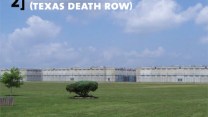
Allan B. Polunsky Unit, a.k.a. death row (Livingston, Texas)
Number of prisoners: ~300
Who's in charge: Richard Alford, former warden at Polunksy, he now oversees all the region's prisons; Oliver Bell, chairman, Texas Board of Criminal Justice
The basics: "The most lethal [death row] anywhere in the democratic world" is also probably "the hardest place to do time in Texas," writes Robert Perkinson, author of the book TexasTough. Indeed, the all-solitary Allan B. Polunsky Unit houses condemned Texans under some of the nation's harshest death row conditions. The prisoners are housed in single cells on 22-hour-a-day lockdown, and even during their daily "recreation" hour, they are confined in separate cages. With no access to phones, televisions, contact visits, they remain in essentially a concrete tomb (PDF) until execution day—a stretch of at least three years for the mandatory appeals, and far longer if they opt to keep fighting. Some have been known to commit suicide or waive their appeals rather than continue living under such conditions.
The backlash: At Polunsky, the "emotional torture" of awaiting death in total isolation is "driving men out of their minds," former prisoner Anthony Graves told senators last year at the first-ever Judiciary Committee hearing on solitary confinement. "I would watch guys come to prison totally sane and in three years they don't live in the real world anymore," recalled Graves, who was exonerated in 2010, after spending more than 18 years on death row.
Graves detailed for the senators some of the profoundly erratic behavior of his fellow prisoners. "I know a guy who would sit in the middle of the floor, rip his sheet up, wrap it around himself, and light it on fire. Another guy…would take his feces and smear it all over his face as though he was in military combat."
This man, Graves added, was ruled competent for execution. While on the gurney, "he was babbling incoherently to the officers, 'I demand that you release me soldier, this is your captain speaking.' These were the words coming out of a man's mouth, who was driven insane by the prison conditions, as the poison was being pumped into his arms."
Another prisoner, a paranoid schizophrenic named Andre Thomas, scooped out his eye and ate it during his stay at Polunsky. He, too, remains on track for execution. It is perhaps no wonder that Dallas insurance executive Charles Terrell asked to have his name removed from the facility after it became death row.
Research for this project was supported by a grant from the Investigative Fund and The Nation Institute, as well as a Soros Justice Media Fellowship from the Open Society Foundations.Additional reporting by Beth Broyles, Valeria Monfrini, Katie Rose Quandt, and Sal Rodriguez.