This is Orange County’s ubiquitous marine layer, but seen from above instead of below. The only thing missing is a foggy shark fin cruising around the clouds.


This is Orange County’s ubiquitous marine layer, but seen from above instead of below. The only thing missing is a foggy shark fin cruising around the clouds.
Metzel Mikhail/TASS via ZUMA
It’s Monday morning, so I might as well start off with where we are on the collusion witch hunt news, so that at least I can keep track of which new lies get told this week. Aaron Blake gets me up to speed:
The most notable portion of the interviews was when Giuliani rekindled the idea that collusion isn’t even a crime….“Hacking is the crime. The president didn’t hack. He didn’t pay for the hacking.”
He added on Fox: “I have been sitting here looking in the federal code trying to find collusion as a crime. Collusion is not a crime.” In case you forgot, Trump himself has been arguing for more than a year not that collusion wasn’t a crime, but that there simply was “no collusion.”
….Giuliani also, at one point, seemed to offer a very narrow denial of what happened with the Trump Tower meeting. While discussing Michael Cohen’s allegation that Trump knew about the meeting, Giuliani focused his defense on arguing not necessarily that Trump didn’t know about it — but that he wasn’t physically at the meeting. And he did it on both shows. “I’m happy to tell Mueller that Trump wasn’t at the Trump Tower meeting,” Giuliani said.
So: Trump didn’t pay the Russians to hack the DNC server and he wasn’t physically present at the Trump Tower meeting.
As far as I know, no one has ever accused him of either of these things, but now that he’s denied them I suppose my working assumption is that he did pay for the hacks and he was at the Trump Tower meeting. This is partly based on the fact that Rudy must have brought this up for some reason—presumably to get ahead of an accusation coming shortly?—but mainly it’s based on Trump’s Razor: everything Trump says is a lie until proven otherwise. I’ve rarely gone wrong applying Trump’s Razor to the various burblings that come out of the mouths of both Trump and his spokespeople, and I doubt it will steer me wrong this time.
One way or another, then, documents and/or testimony from Trump Org. folks will demonstrate that Trump paid to hack something; and also that he sat in on one or more of the “adoption” meetings with the Russians at Trump Tower. That’s my guess, anyway.
Sergi Reboredo/ZUMA
I have a bad memory, but many of my readers have great memories and periodically remind me of things I’ve said in the past. A couple of days ago, JH emailed to remind me that a year ago I offered up three tests of Donald Trump’s approach to foreign policy:
Immigration. Trump hasn’t done much on the policy side to reduce illegal immigration, but he has stepped up the pace of high-profile raids. He’s also blustered a lot and pissed off just about the entire nation of Mexico. Will this be effective in scaring Latin Americans away from crossing the border into El Norte?
Qatar. The US has been unhappy with Qatar’s support for terrorist groups for several years. Now Trump has decided to turn this into a highly public battle. Will Qatar respond positively to this?
NATO. Every American president has pressed our NATO allies to spend more on defense, with only sporadic success. Trump has decided to up the ante by implicitly threatening to leave NATO if they don’t. Will this finally get them to commit to higher defense budgets?
My prediction, of course, was that Trump would fail on all three of these. So far, I’d say I was right about both illegal immigration (border crossing rates haven’t changed much) and NATO defense budgets (they haven’t committed to anything more than they already committed to Obama). That leaves Qatar, which I haven’t really kept up with. But Trump’s initial response to the Gulf boycott of Qatar was to take Jared Kushner’s advice and support the Saudi position, which got him nowhere. More recently, he’s changed his tune, inviting the emir of Qatar to the White House and extolling him as “a friend of mine — knew him long before I entered the world of politics. He’s a great gentleman.” Also: “A lot of countries were funding terrorism and we’re stopping it. It’s getting stopped and fast. Very important. And you’ve now become a very big advocate, and we appreciate that.”
So did Trump’s initial support of Saudi Arabia produce any change in Qatari behavior? As near as I can tell, it hasn’t, and American influence in general has produced zero movement from either side. So I guess that makes Trump 0 for 3.
But not to worry. There’s still NAFTA and China and Syria and Russia and North Korea and Yemen and Iran. Trump has had no successes there either, but it’s early days. Stay tuned.
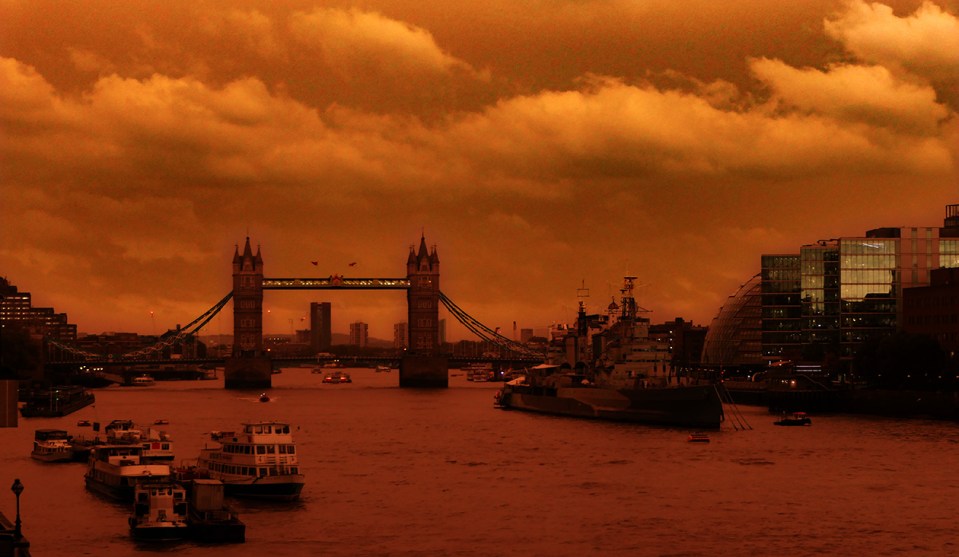
A Brexit storm is coming. Is there any way to stop it?
After writing on Friday about the possibility of Britain canceling Brexit when 11th-hour panic sets in, several readers suggested this wasn’t possible. Article 50 has been triggered, and once triggered it can’t be untriggered. On March 30 of next year, one way or another, Britain will no longer be part of the EU.
I was curious about that, so I surfed around looking for legal opinions. Long story short, here’s an excerpt of Wikipedia’s summary:
British government lawyers had argued that the Article 50 process could not be stopped….US law professor Jens Dammann argues: “there are strong policy reasons for allowing a Member State to rescind its declaration of withdrawal until the moment that the State’s membership in the European Union actually ends” and “there are persuasive doctrinal arguments justifying the recognition of such a right as a matter of black letter law”….EU politicians have said that if the UK changes its mind, they are sure a political formula will be found to reverse article 50….In October 2017, barrister Jessica Simor QC of the leading London law firm Matrix Chambers lodged a freedom of information request to the UK Prime Minister for disclosure of legal advice which, she claims, states that the UK government can withdraw the Article 50 application at any time before 29 March 2019; she notes that Article 50 provides only for notification of an intention to withdraw and contends that such intention can be changed at any time before actual withdrawal.
In other words, the “answer” is that no one knows for sure. Article 50 is short and says only that a member state can leave the EU with two-years notice. It says nothing about whether that notice can be revoked. Beyond that, my rough sense from reading a dozen or so pieces about this is that most people think the EU would figure out a way to cancel Brexit if Britain asked them to. No one really wants Britain to leave, and the legal issues are hazy enough that the EU’s clanking bureaucratic machinery can probably muddle its way into any decision that Angela Merkel wants it to.
Joel Marklund/Bildbyran via ZUMA
A conversation:
Q: How do you pay for all these programs?
A: Well, that’s going to be a big negotiation with a lot of people in Congress. We have more than a trillion dollars worth of what are called “tax expenditures” that both liberals and conservatives think have gotten out of hand.1 More than two-thirds of these expenditures are effectively handouts to the affluent.2 We also pay enormous subsidies to multinational corporations every year,3 including the appalling $20 billion we pay year after year to the oil and coal industries.4
There’s spending on defense that could be rationalized: even lots of Republicans agree that there’s billions in wasted earmark spending in the latest Pentagon budget.5 Kirsten Gillibrand represents Wall Street, and she thinks a tiny financial transaction fee—tenths of a cent per trade—could be a win-win by raising money and reducing the chance of another financial meltdown.6 Bernie Sanders suggests we should crack down on offshore tax havens7 and reduce the capital gains breaks that millionaires enjoy.8 Top marginal rates on the super rich have been cut in half since the Reagan era9 and Elizabeth Warren has pointed out that America was a pretty prosperous place under the higher rates of the 50s and 60s.10 There are lots of creative ideas for carbon charges that would reduce wasteful energy use and raise money for research into solar and wind and other renewable resources.11
But that’s what negotiations are all about. The press fixates on adding up a bunch of numbers in Column A and then “fact checking” whether they match another bunch in Column B. That’s pointless. Every committee in Congress is going to have its own ideas about revenue and spending, and so does the president. But elections aren’t about spreadsheets. They’re about telling people what we believe in. The hundred-page white papers and blue-pencil markups come later, after you’ve won an election. Right now, people just want to know what we’re going to fight for once we get there.
That’s it. That’s really all you need. Just repeat some version of “it’s a negotiation” until everyone finally gets tired and decides to move on.
1Congressional Budget Office: “Tax Expenditures”
2Tax Policy Center: “Who Benefits From Tax Expenditures?”
3New York Times: “Why Are Your State Tax Dollars Subsidizing Corporations?”
4Vox: “Friendly policies keep US oil and coal afloat far more than we thought”
5Citizens Against Government Waste: “2018 Congressional Pig Book Summary”
6Rolling Stone: “We Need a Financial Transactions Tax Before It’s Too Late”
7The Guardian: “Bernie Sanders warns of ‘international oligarchy’ after Paradise Papers leak”
8berniesanders.com: “Making the Wealthy, Wall Street, and Large Corporations Pay their Fair Share”
9Tax Policy Center: “Top Individual Income Tax Rate: 1946-2017”
10CNBC: “Sen. Elizabeth Warren wants to roll back the GOP tax cuts”
11Motherboard: “Majority of US Supports a Carbon Tax and Wants to Spend the Money on Renewable Energy”
Here’s a lovely long-lens picture of Hilbert hanging out on the roof. I love the sharpness even when the lens is zoomed to its maximum extension. In a picture like this it produces nice bokeh, and it turns out that it’s also a great way of taking closeups of flowers and such. The Sony’s lens is odd in that its maximum zoom is also its closest focusing point, which has both pros and cons. The downside is that you have to back up three feet to get good focus, and sometimes this is difficult. But usually it’s not, and the upside is that it produces very nice images with bokeh that you usually can’t get when you’re using, say, a 50mm lens from a few inches away. Hilbert approves.

Brais G. Rouco/SOPA Images via ZUMA
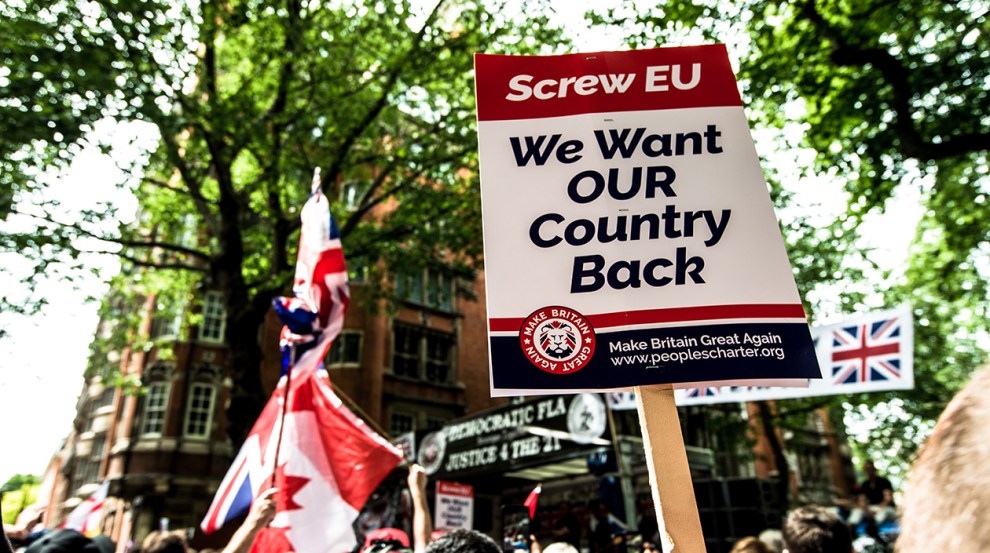
We are now eight months away from Brexit. In theory, the terms of Brexit will be dictated by whatever agreements are hammered out between the UK and the EU, but damn little progress has been made so far and there’s not much time left. So what happens if Der Tag arrives and no agreements have been agreed to?
Well, that’s “no-deal Brexit.” On the scale of Brexits, there is “soft Brexit,” “hard Brexit,” and “no-deal Brexit.” It is the hardest of hard Brexits: the UK and the EU just split apart and no one really has any idea what the new rules are.
What’s the likelihood of that happening? On the one hand, this kind of negotiation is massively complex, and we’re getting to the point where there’s just flatly not time to do it. On the other hand, we’ve seen before that deadlines can be wonderful motivators. When we get down to the final few weeks and panic starts to set in, it might turn out that both sides have a little more flexibility than they’ve admitted so far. And on the third hand, it’s even possible that if the EU sticks to its guns and panic turns into hysteria, Britain might call off Brexit entirely. Parliament certainly has the power to do this if it’s so inclined.
So just what kind of panic and hysteria am I talking about? I now turn the microphone over to Charlie Stross, who puts both his narrative talents and his political cynicism to work explaining just what he thinks no-deal Brexit might look like:
The EU is the UK’s largest trading partner, with roughly 44% of all our foreign trade going through our EU siblings. This includes food—the cramped, densely populated UK hasn’t been self-sufficient in food since the 19th century, and we import more than 50% of what we eat.
A customs union with the EU has been ruled out unless the UK agrees to cooperate with certain EU “red line” requirements—essentially the basis for continuing free trade: for reasons too preposterous and stupid to go into this is unacceptable to the Conservative party even when national food security is in jeopardy. In event of a no-deal Brexit, Operation Stack will become permanent, causing gridlock on motorway routes approaching Channel ports. Perishable goods and foodstuffs will be caught up in unpredictable protracted delays, resulting in dairy produce (including infant formula) becoming ‘very scarce’. Large manufacturing concerns with cross-border supply chains such as BMW, Airbus, and Toyota are threatening to shut down production in the UK in event of a hard Brexit; Amazon’s UK manager warns of civil unrest in event of a no-deal Brexit, and in event of a no-deal that doesn’t include services (as well as goods) it’s hard to see how the Amazon supply chain can continue to function in the UK.
….Current warnings are that a no-deal Brexit would see trade at the port of Dover collapse on day one, cutting the UK off from the continent; supermarkets in Scotland will run out of food within a couple of days, and hospitals will run out of medicines within a couple of weeks. After two weeks we’d be running out of fuel as well. Note that this warning comes from the civil service, not anti-Brexit campaigners, and is a medium-bad scenario—the existence of an “Armageddon scenario” has been mooted but its contents not disclosed.
In the past month, the Health Secretary has admitted that the government is making plans to stockpile vital blood products and medicines in case of a no-deal Brexit, and the Brexit secretary is allegedly making plans to ensure there are “adequate food supplies” to cover a no-deal exit.
….A Hard Brexit, on its own, would be a very dubious but probably long-term survivable scenario, with the UK economy taking a hit not much worse than the 10% downsizing Margaret Thatcher inflicted on it in 1979-80. But a hard Brexit, coinciding with the worst harvest failures in decades, ongoing climate destabilization, a fisheries collapse, and a global trade war being started by the Tangerine Shitgibbon in the White House is … well, I’m not optimistic.
Right now, the British cabinet seems to be locked in a suicide pact with itself. Theresa May is too weak to beat back the cabal of unscrupulous opportunists within her own party who want the worst to happen—the disaster capitalists, crooked market short-sellers, and swivel-eyed imperialist revenants of the European Research Group. Any replacement Conservative PM would face exactly the same impedance mismatch between reality and his or her back bench MPs. On the other side of the house, Jeremy Corbyn’s dislike for the EU as a capitalist entity has combined with his fear of alienating the minority of “legitimate concerns” racist voters in Labour’s base so that he’s unwilling or unable to adopt an anti-Brexit stance.
….What happens next? On a micro scale: I’m stockpiling enough essential medicines to keep me alive for six months, and will in due course try and stockpile enough food for a couple of weeks. I’m also going to try and move as much of my savings into other currencies as possible, preferably in financial institutions accessible from but outside the UK. (I expect a Sterling crisis to follow promptly in event of NDB. We saw Sterling drop 10% the day after the referendum—and certain people made a fuck-ton of money by shorting the stock market; I expect it to go into free fall if our trade with the EU is suddenly guillotined.)
Maybe Charlie is just a worrier? But at least he’s an entertaining one—as long as you live in some other country, of course. And I have to admit that if you put a gun to my head and forced me to make a prediction, I’d say that some kind of panic-induced shambles of an agreement will be cobbled together at the last minute, preventing the worst from happening. Details will then be worked out over the next decade or so, since Britain and the EU don’t have anything better to do with their time, do they?
In the meantime, I’d guess that China and Russia can barely conceal their incredible good fortune in watching both the US and the EU create completely unnecessary domestic chaos just at a time when both countries have problems of their own and could use a little economic breathing space. We live in interesting times.
Mark Reinstein via ZUMA
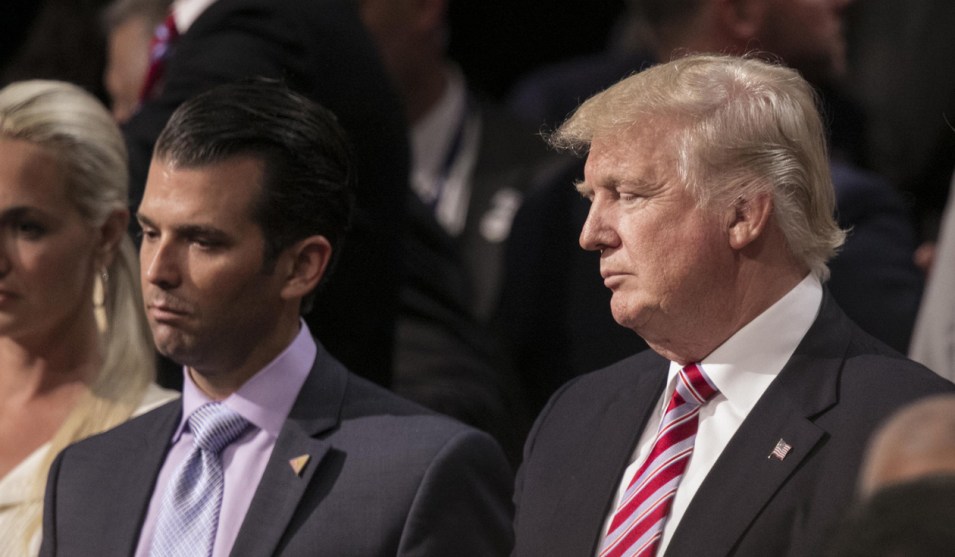
There’s something about the whole Trump Tower meeting that might be obvious to everyone by now, but I’m not sure it is. It might not even be especially important. For what it’s worth, though, here’s what I think happened:
Long story short, the Russian dirt was a nothingburger, which is why we never heard about it. Trump sure wanted it, but there was just nothing there.
Reviver Auto
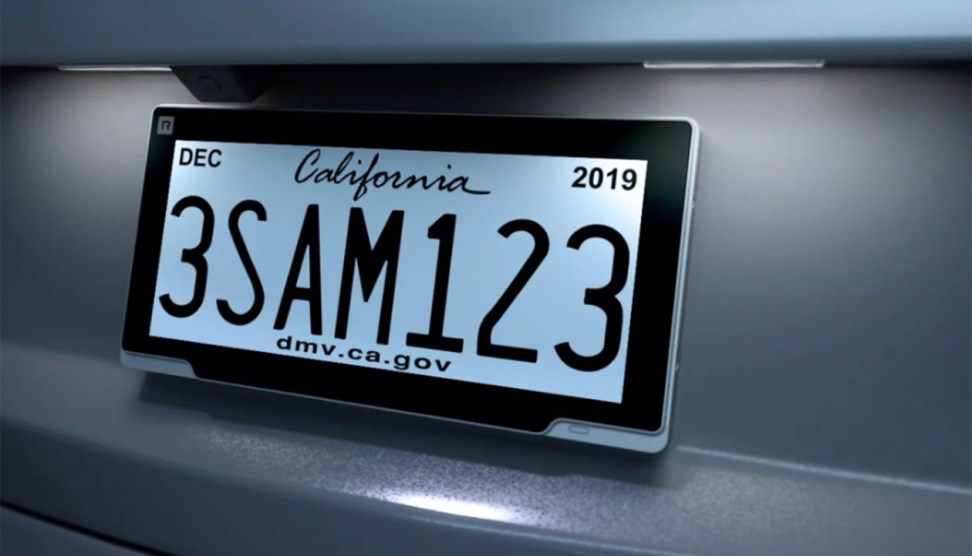
The highest IQs our nation produces are now hard at work replacing the boring, old-fashioned license plate:
Reviver Auto’s RPlate can be validated via cellular signal when registration fees are paid, saving a state the cost of postage and materials for paper renewals. The screen can display anything, making it easy to switch designs if an owner wants to buy a vanity plate. Amber Alerts can be flashed on the plate; if the vehicle is stolen, the plate can be changed to display that fact. When the vehicle is parked, businesses can display advertisements on the plate, even targeting a vehicle’s particular location because the plate is connected to GPS. The GPS would also allow commercial fleet owners to track their vehicles.
Imagine my excitement. Not only will Amber Alerts infest my phone, they’ll infest my license plate too. And advertising! Who wouldn’t love the idea of turning every license plate in the state into a miniature, GPS-based billboard? If you’re parked in Palm Springs, you’ll get lots of ads for adult diapers. If you’re parked across the street from USC, you’ll get ads for Trojans. So sweet.
And the best news of all? It only costs $699! Plus $75 per year to connect to the cell network. This compares to $0 for the crummy, lifeless, 20th-century license plates we are all forced to suffer with now.
The US economy grew 4.1 percent in the second quarter:
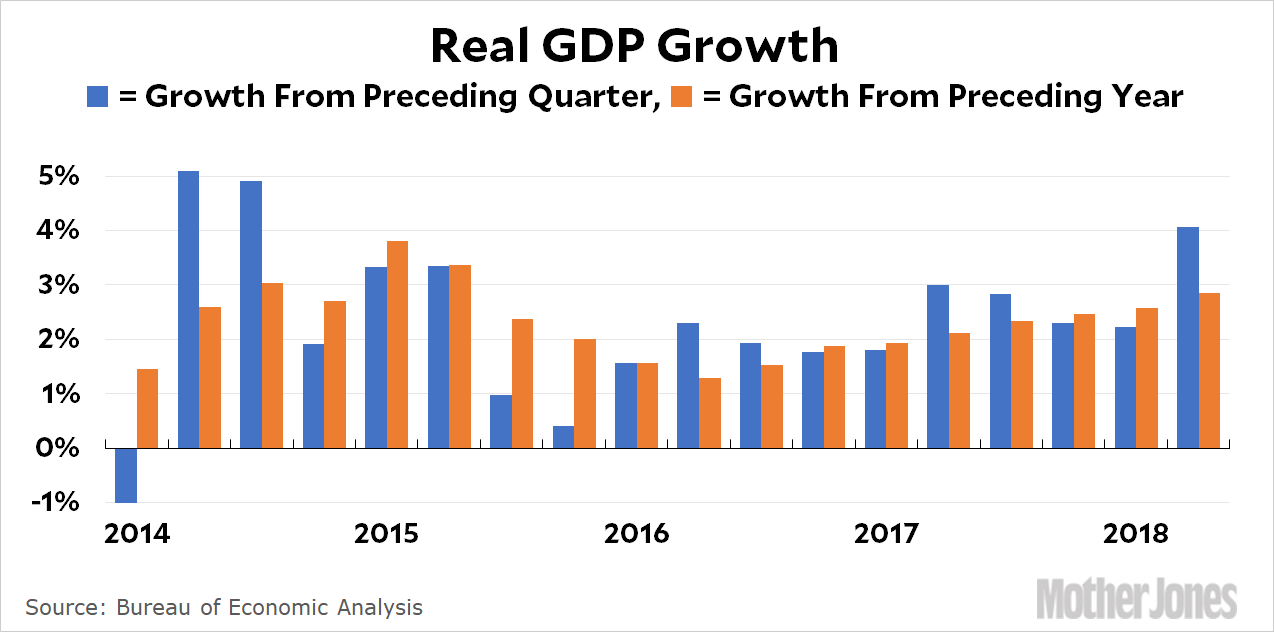
That’s a big number, but it might be an outlier. GDP is a little unusual in being routinely reported as growth from the previous quarter, rather than the more normal growth over the previous year. Year-over-year growth is less noisy and is therefore a better guide to what’s really going on, so I’ve included both in my chart this time around. As you can see, YOY growth was 2.8 percent in Q2, and this number has been growing steadily since early 2016. This is a positive sign, and who knows? Maybe we’ll hit 3 percent by the end of the year.
Either way, though, I think 2.8 percent—which is a perfectly strong number—is most likely the best indicator of actual economic growth right now. Time will tell how long we can keep this up.

Award-winning photojournalism.
Stunning video. Fearless conversations.


