• Quote of the Day: With Friends Like Trump, Who Needs Enemies?

    Even “new” Europe is finally figuring out that Donald Trump doesn’t think much of them:

    Before long, the entire world is going to realize that the United States has not just retreated from its usual role as global leader, but has basically declared war on everyone. It’s a cold war, to be sure, but no less damaging for all of that.

  • Facebook Sure Has a Lot of Fake Accounts

    Wait. What?

    Facebook revealed Tuesday that it removed more than half a billion fake accounts and millions of pieces of violent or obscene content during the first three months of 2018.

    Half a billion? Yes. 583 million, to be exact. And they removed about the same number last quarter. They take ’em down, and the spammers just put ’em back up. At any given time, this means that nearly a third of all Facebook accounts are fake.

  • Urban Density and Productivity: A Slightly Wonky Gripe About the Whole Enterprise

    This post is going to be sort of boring, but I might as well get it off my chest. It’s an illustration of the kind of quicksand that some of the urban densification arguments are built on.

    James Pethokoukis writes today about housing shortages in Seattle and notes in passing that land-use regulations have “smothered wage and gross domestic product growth in American cities by a stunning 50 percent over the past 50 years.” So I click the link and get this:

    How Local Housing Regulations Smother the U.S. Economy

    By Chang-Tai Hsieh and Enrico Moretti

    Land-use restrictions are a significant drag on economic growth in the United States. The creeping web of these regulations has smothered wage and gross domestic product growth in American cities by a stunning 50 percent over the past 50 years. Without these regulations, our research shows, the United States economy today would be 9 percent bigger — which would mean, for the average American worker, an additional $6,775 in annual income.

    There’s something wrong there, but instead of spending time on it I just go straight to the research paper, which says this:

    We find that the increased spatial misallocation of labor due to housing supply constraints in cities with high productivity growth rates lowered aggregate growth between 1964 and 2009 by a significant amount. In particular, we calculate that increasing housing supply in New York, San Jose, and San Francisco by relaxing land use restrictions to the level of the median US City would increase the growth rate of aggregate output by 36.3%. In this scenario, US GDP in 2009 would be 3.7% higher, which translates into an additional $3,685 in average annual earnings.

    We’re already down from 50 percent to 36.3 percent! But even that seems hard to reconcile with their statement that GDP would be 3.7 percent higher. Here’s the arithmetic:

    • Real GDP in 1964: $3,734 trillion
    • Real GDP in 2009: $14,418 trillion
    • Growth rate: 3.05 percent per year
    • Real GDP in 2009 if it’s 3.7 percent higher: $14,951 trillion
    • Growth rate using higher GDP: 3.13 percent

    So how do they figure that looser land-use regs would “increase the growth rate of aggregate output” by 36.3 percent? Simple: by defining this as the “growth of residual real per capita earnings.” Beyond that, the paper makes use of a wildly complex model that requires a ton of estimated inputs—employment, wages, union density, local amenities, total factor productivity, housing prices, labor demand, specialization by city, elasticity of housing supply, welfare effects, labor mobility, gender, race, education level, and more—any of which could probably change their results significantly.

    I’m not trying to dismiss this study because it uses a complex model. A recent Fed study that strikes me as the best research we have on city density and productivity is also filled with difficult math. But the Hsieh-Moretti study relies on a truly huge number of estimates, some of them difficult to calculate, that probably make the error bars on the whole enterprise bigger than the effect they found. What’s more, their results are conditioned on relaxing land-use regs in New York, San Francisco, and Silicon Valley¹ to the US median, which is an enormous change that would be a massive political lift. I think most urbanists would be pretty happy if they could do a tenth of that, and so far they haven’t been able to. So in the end, they find that (a) an enormous change would (b) increase the growth rate of output, conventionally defined, by about 2.6 percent and (c) only if you trust that their model and all the inputs they used are collectively accurate to begin with.

    This is the kind of thing that’s made me wary of these productivity studies.

    ¹Why only these three cities? Unless I misread something, the reason is that land-use regs didn’t have a negative impact on any other cities in America. Those three were it. (As of 2009, anyway.)

  • Lunchtime Photo

    Today’s photo is my mother’s selection. It’s a closeup of a nesting Canada Goose taken from above. This goose originally had four eggs in her nest, but then lost two of them. She ate one of the ruined eggs, which sounds kind of ghoulish, but I suppose when you have to spend a month on a nest it makes sense to get nourishment anywhere you can. In the end, she lost another egg too for unknown reasons. It was intact, but it just never hatched. I didn’t see the hatching of the final egg, but I presume it did indeed hatch and there’s a goose running around with just one baby. In fact, I suspect it’s this one.

    April 3, 2018 — Irvine, California
  • Calculus or Statistics? This is the Great Decision for Tomorrow’s Third Graders.

    The CTO of SnapLogic has something to say:

    Thousands of American high-school students on Tuesday will take the Advanced Placement calculus exam. Many are probably dreading it, perhaps seeing the test as an attempt to show off skills they will never use. What if they’re right?

    I started thinking about this recently when my 14-year-old daughter was doing her pre-calculus homework. I couldn’t help wondering: Is this the best direction for children her age? Students need skills to thrive in the 21st-century workplace, and I’m not convinced calculus is high on that list. Sure, calculus is essential for some careers, particularly in physics and engineering. But few eighth-graders are set on those fields.

    Nobody takes calculus in ninth grade unless they’re a super-genius. So was this entire op-ed just an excuse to brag on his daughter? Why else would he make completely unnecessary references to her age three separate times?

    Anyway, his larger point is that he’d rather see high-school students take computer programming or statistics. I suppose I agree, though I’ll confess to second thoughts lately on statistics, which I think benefits from a certain level of numerical maturity that might be missing in high school. But I’m not sure about that.

  • Quote of the Day: Political Correctness Is About Decent Manners

    Jonah Goldberg writes today about the growing generation gap within the conservative movement:

    In the current issue of the Weekly Standard, Ben Shapiro has a fascinating essay on the profound divide between young and old on the right….Shapiro argues persuasively that young conservatives care about character and values, while older ones have largely abandoned such concerns, preferring solid policy victories and perceived wins in the war on political correctness.

    What explains the opposing visions? Part of it, Shapiro writes, is the usual tendency of young people to gravitate toward libertarianism and idealism. But there’s another reason: Young people understand that some of the things old people see as “political correctness” aren’t necessarily the product of a Marxist virus that somehow escaped a laboratory at Berkeley. Some of it reflects an attempt to craft decent manners in the increasingly diverse and egalitarian society that young people actually live in.

    As it happens, this is not quite what Shapiro says. Here’s his original formulation:

    Saying innately offensive things and then justifying those offensive statements under the rubric of political incorrectness actually undermines the battle against political correctness. The left wants to make the case that when conservatives say they’re being politically incorrect, they’re actually covering for their own bigotry; lending that case a helping hand by promoting bigotry under the guise of fighting political correctness does the left’s work for it.

    Shapiro is arguing that having an obvious bigot in the White House undermines the righteous battle against political correctness. Goldberg, by contrast, suggests that political correctness itself isn’t necessarily all bad. Those are two different things.

    Needless to say, I prefer Goldberg’s version. I happen to think that political correctness is more fraught than liberals give it credit for: not all of it is for the good, and the part that is for the good can be genuinely confusing and onerous to those who aren’t steeped in the vocabulary demanded by its practitioners. Even if your intentions are good, it can be nerve-wracking to know that you might get walloped at any time for a mistake you didn’t even know you had made. This is especially true for the vast majority of people who aren’t all that skilled at using language in the first place, and liberals could afford to be a little more sympathetic about this.

    That said, I wish more conservatives would go at least as far as Goldberg does. Young people actually live in the diverse society that many older people just read about. That means they have to act decently toward people of other cultures, skin colors, and religions not out of the dictates of PC, but simply in order to live their lives without coming to blows all the time. Figuring out how to do that is a matter of trial and error, and sometimes that means things will go too far or become too pettifogging. That’s just the nature of human interaction, which has long relied on semi-ceremonious codes of politeness to negotiate new and difficult situations. But it usually self corrects eventually and we end up with reasonable compromises. This would happen faster if there were more good faith on both sides.

  • The ZTE Affair May Have Been the First Strike in a Global Thermonuclear Trade War

    Matthias Oesterle via ZUMA

    There’s been a ton of commentary about the ZTE affair, but I think something is missing. To recap, ZTE is a huge Chinese telecoms company that sold stuff to Iran back when they were under sanctions. They were fined, but then they kept on doing it. So we basically sentenced them to death: we prohibited them from using US parts in their smartphones. Since they rely on those parts, this meant they couldn’t make smartphones anymore. And if they can’t do that, they’re out of business.¹

    Then, out of the blue, President Trump announced that he planned to work with China to lift the ban. Everyone was taken aback. Trump is supposedly tough on trade, tough on China, and tough on Iran sanctions. This is the last thing in the world anyone expected him to go soft on. Why did he do it? Speculation has focused on a few possibilities:

    • China’s president Xi called him and basically asked for a personal favor. Trump is a sucker for this kind of thing.
    • He’s using this as a bargaining chip in the ongoing trade negotiations with China.
    • He’s dangling it as a carrot to get China’s cooperation in the upcoming talks with North Korea.

    But there’s another possibility: China may have threatened massive retaliation. The death penalty against ZTE was popular among both left and right as an appropriate action against a serial bad actor, but I found that a little odd. Have we ever literally put a big company out of business entirely for violating trade sanctions? When I first heard about it, I was stunned. Even though ZTE had obviously broken US laws over and over, I was surprised we were willing to put a stake through its heart.

    This highlights the risks of global supply chains: they have the potential to make trade wars far worse. When we think of trade wars, we usually think of tariffs, and that’s bad enough. But what if countries start banning the use of local products? This puts the entire modern trade system at risk of meltdown. The United States has the ability to destroy a huge Chinese company by simply cutting off its access to parts that are vital to its phones. But there are plenty of US companies that rely on unique parts or production facilities from China and Japan and Germany and elsewhere. What happens if they start retaliating in the same way? This is, roughly, nuclear trade war.

    The damage from something like this could be huge. It’s not just that a bunch of companies could be wiped out, but that it would make multinational corporations leery of using global supply chains at all. China could put Apple out of business with a stroke, and Apple knows it. They have to trust that China won’t interfere with their assembly operations no matter how bad their political relations are with the US. The same is true in the other direction.

    So that’s the fourth possibility: Xi threatened to retaliate on a scale as big as ZTE. This would be catastrophic for the world trade system, and you might reasonably wonder if he really would have followed through. The question is whether you’d be willing to risk finding out. Maybe Trump wasn’t.

    ¹Or, more accurately, one of their divisions is out of business. But it’s a pretty big division.


  • Did Manufacturing Collapse In the Aughts?

    What happened to manufacturing in the aughts? The usual story is that employment plummeted but output increased. Apparently manufacturing got a lot more efficient during this period, which is why so many people lost their jobs.

    Susan Houseman begs to differ. Using sophisticated decompositions, she finds that it’s all a mirage: computer manufacturing got more efficient, but that’s about it. And even that’s a bit of a mirage due to the way inflation is calculated: it’s not that American workers are making a lot more computers than they used to, it’s that they’re making more MIPS, so to speak. It’s the same number of boxes, but a whole lot more computing power.

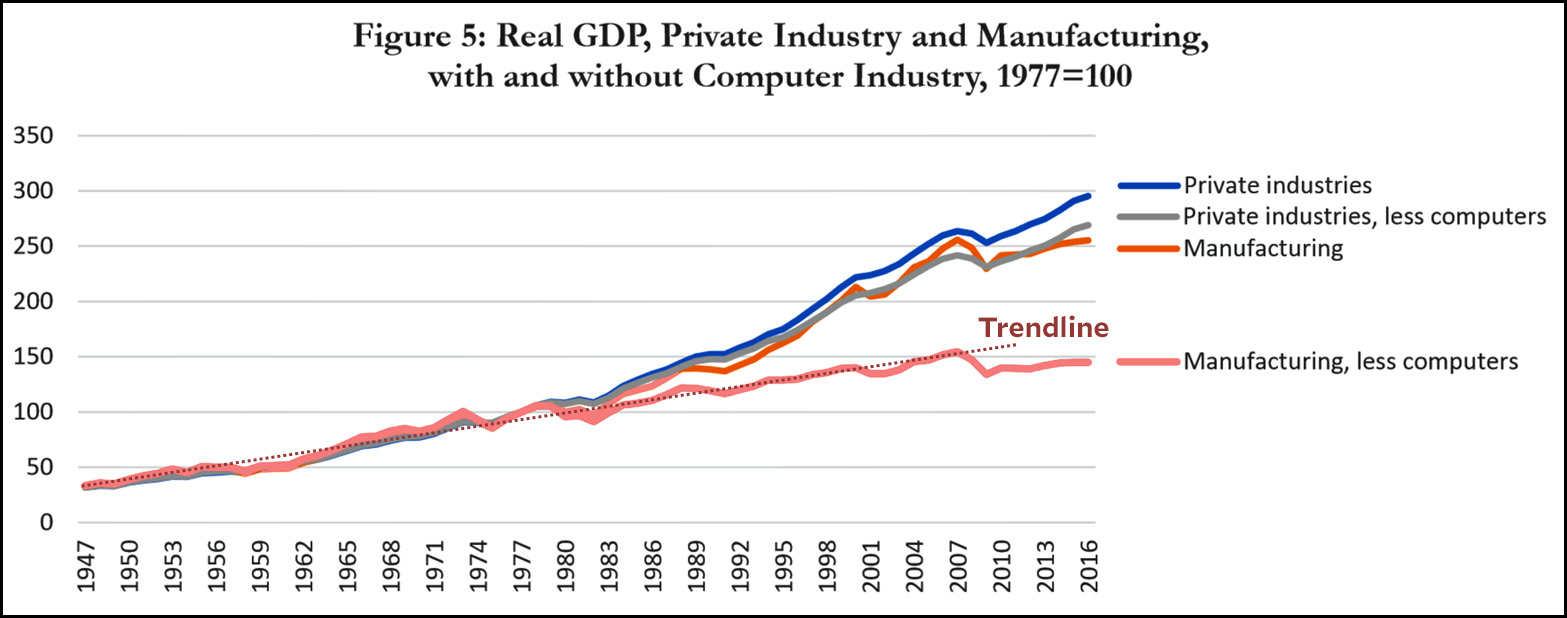
    The conclusion she draws from all this is that the loss of manufacturing jobs after 2000 was more likely related to China than to automation. But I’m a little confused. Let’s start with Houseman’s own chart:

    When you pull out computers, manufacturing output grows at a pretty sluggish rate compared to the rest of the economy. The thing is, it looks like this growth rate has been pretty constant ever since 1947 right up to the Great Recession. It doesn’t tell us much.

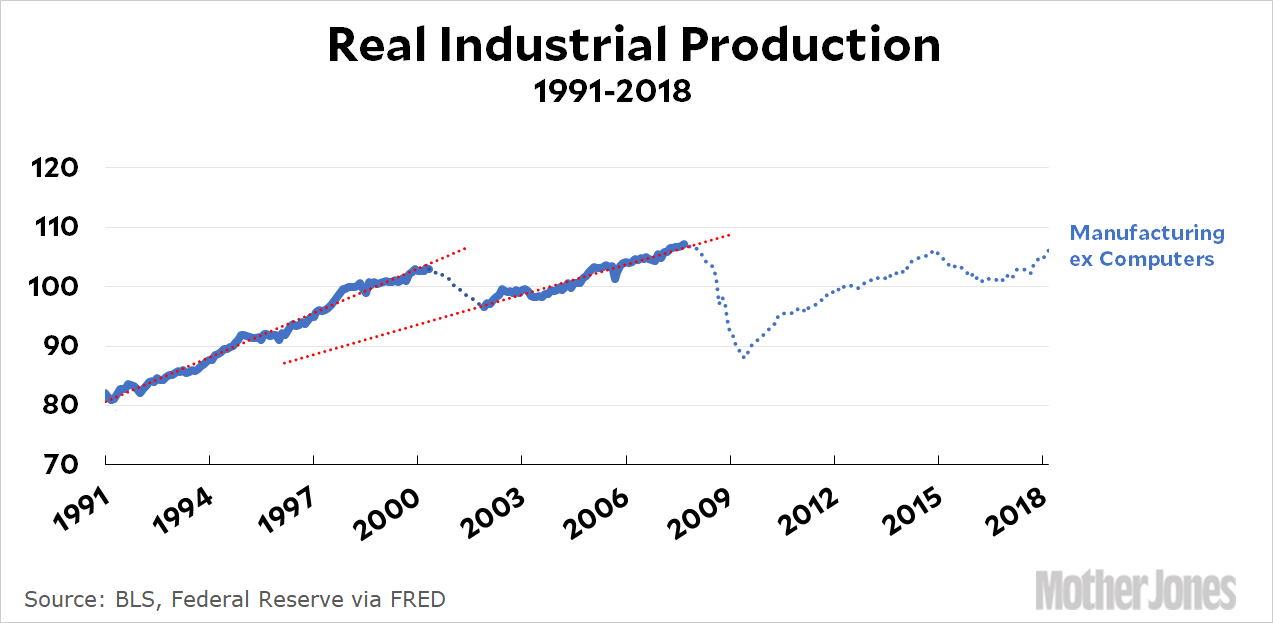
    But it’s easy to zoom in. The mega-growth of the computer sector is no secret, and you hardly need access to sophisticated data to see it. In fact, it’s so well-known and so obviously important that the Fed helpfully produces a standard series for all manufacturing production excluding computers. Let’s look at that:

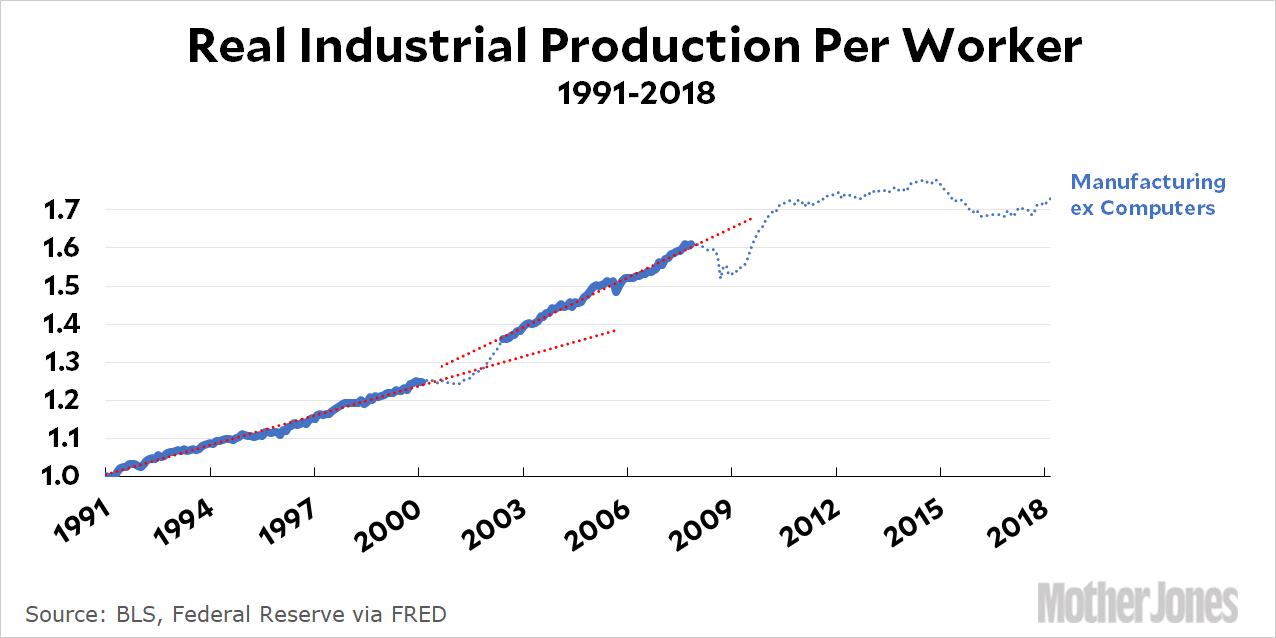
    After the 2000 recession, manufacturing growth picks up, but it’s slower than before. The growth rate in the aughts is about a third lower than in the 90s. Now here’s manufacturing productivity growth:

    After the 2000 recession, manufacturing productivity grew faster than before. The productivity growth rate in the aughts is about 75 percent higher than in the 90s. So we have two data points related to the manufacturing sector excluding computers:

    • The growth rate of manufacturing output slowed down after 2000.
    • The growth rate of manufacturing productivity speeded up.

    The first bullet suggests job losses due to China: we’re making less stuff than we should because we’ve offshored a lot of it. The second bullet suggests job losses due to automation gains: we’re losing jobs because output per worker is going up faster than before. I don’t really have a dog in this fight, but it sure looks to me like both played a role. Based on the slope of the trendlines I’d guess that it’s about 60 percent automation and 40 percent China. But I’m wide open to better estimates—of which there are many, I’m afraid.

  • Medicaid Work Requirements and the Politics of Whiteness

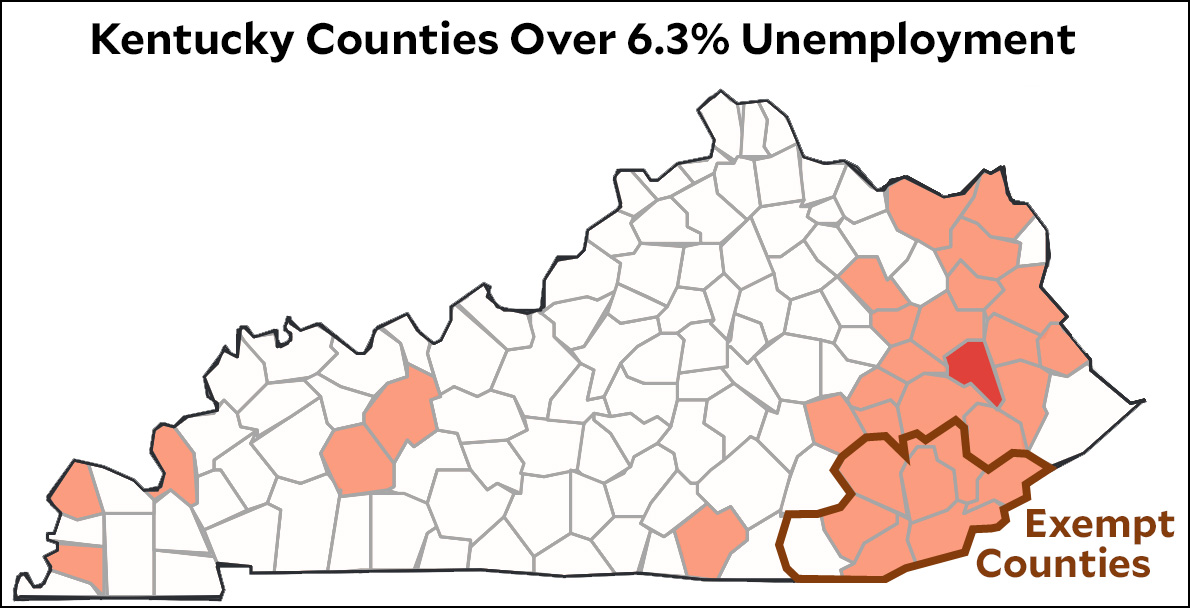
    Kentucky has received permission from the Trump administration to roll out work requirements for Medicaid later this year. Eight counties have been exempted from the new requirements for a while:

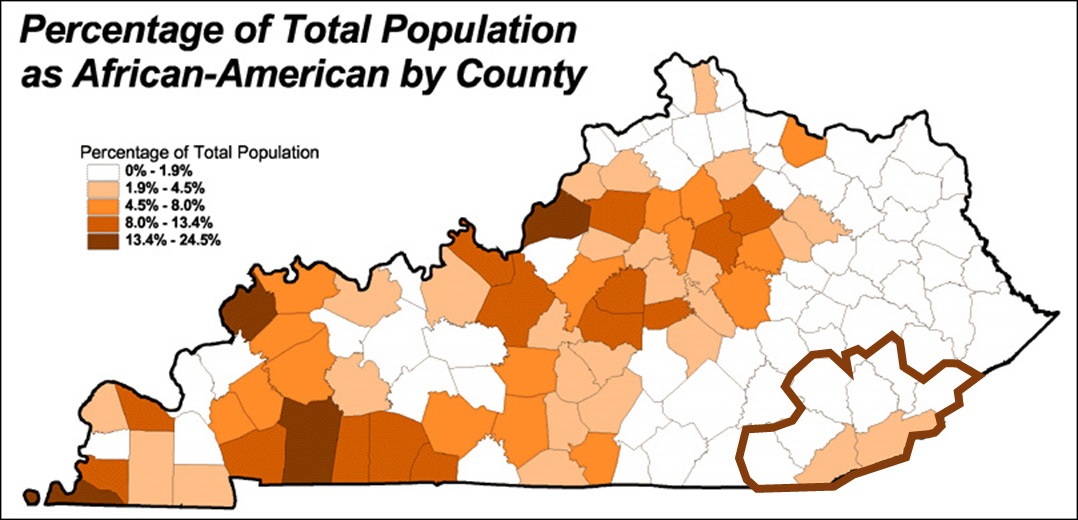
    That’s coal country down there, and unemployment is pretty high. As you might guess, the population is also pretty white:

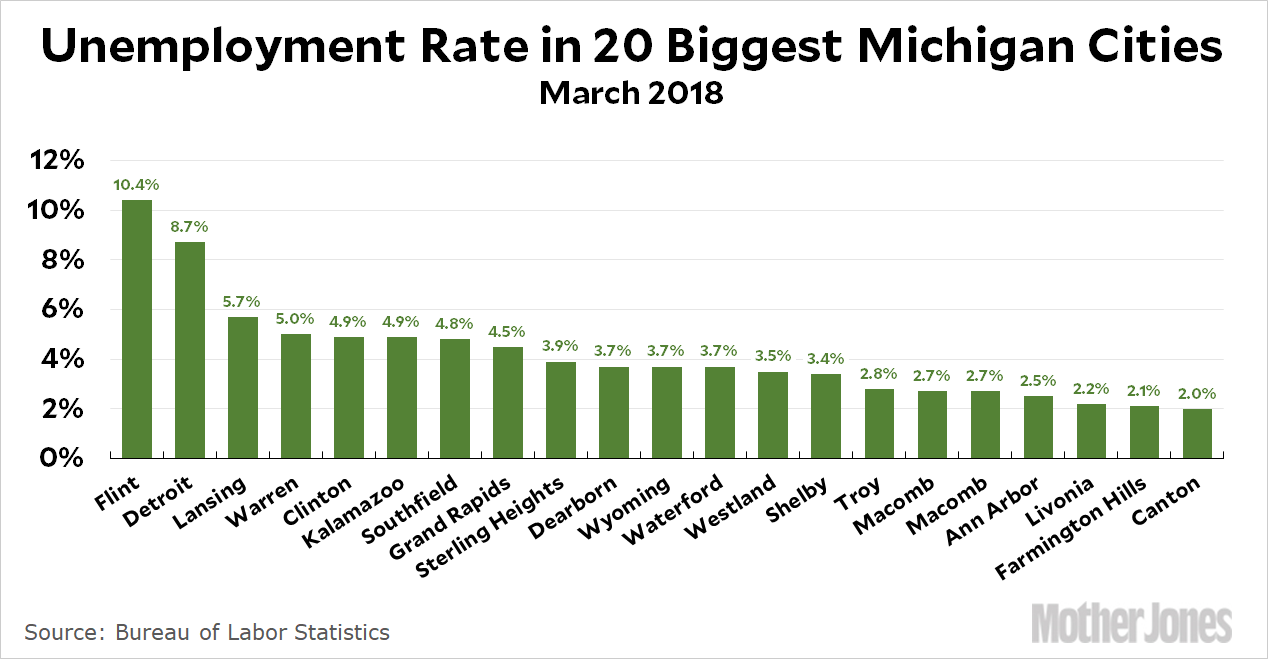
    It’s hard to tell if there was any racial motivation here. The exempt counties are historically among the poorest in the state, and coal country often gets special consideration in Kentucky. But then Ohio and Michigan took a look and decided to follow suit by implementing Medicaid work requirements but exempting counties with high unemployment. In Michigan, the cutoff was 8.5 percent unemployment, which happens to describe only about a dozen rural, white counties. If they had done it by city instead, it would look like this:

    Detroit and Flint—both with large black populations—have high unemployment rates and should qualify for exemptions. But they don’t because they’re part of larger counties with low unemployment rates. That’s a tough break, isn’t it?

    But here’s the odd thing. The official excuse for this is that unemployment rates are consistently available at the county level but not at the city level. That’s what the feds give them, so that’s what they have to work with. Except it’s not true. In Kentucky, they may have exempted a bunch of folks from coal country who happen to be white, but that’s sort of a misdemeanor as these things go. For the rest of the state, they exempted people from the work requirement if they already qualify for exemption from the SNAP work requirement. That’s pretty easy, after all. States already have the SNAP exemptions figured out, so there’s zero work involved in using that.

    But here’s the thing: SNAP exemptions are based on both cities and counties as the regions of interest. In Michigan, for example, both Detroit and Flint are designated as “Labor Surplus Areas” and therefore qualify for exemptions. So Michigan latched onto Kentucky’s idea of exemption by county but decided not to follow their lead in using SNAP criteria for most of the state.

    Why? It’s a mystery. But the bottom line is this: Michigan passed up on the easiest exemption criteria, instead making up a brand new one that just happens to exclude the biggest black populations in the state. Ohio is going down the same road, and a bunch of other red states are queued up behind them. Is this just a big coincidence? It hardly seems likely, does it?

    POSTSCRIPT: It’s worth noting the political genius of this, which goes well beyond favoring whites over blacks. It’s also guaranteed to provoke a lot of blowback—like this post, for example. Republicans can then sigh and throw up their hands: You liberals have to make everything about race, don’t you? We just wanted to encourage able-bodied welfare recipients to find jobs. They don’t mention that they did this deliberately and were probably hoping for exactly this blowback since it does nothing but help them with their base, which thinks the exact same thing.

    The alternative is that they’re all so innocent that they didn’t even notice the racial impact of their handiwork. I leave it to you to decide how likely that is.