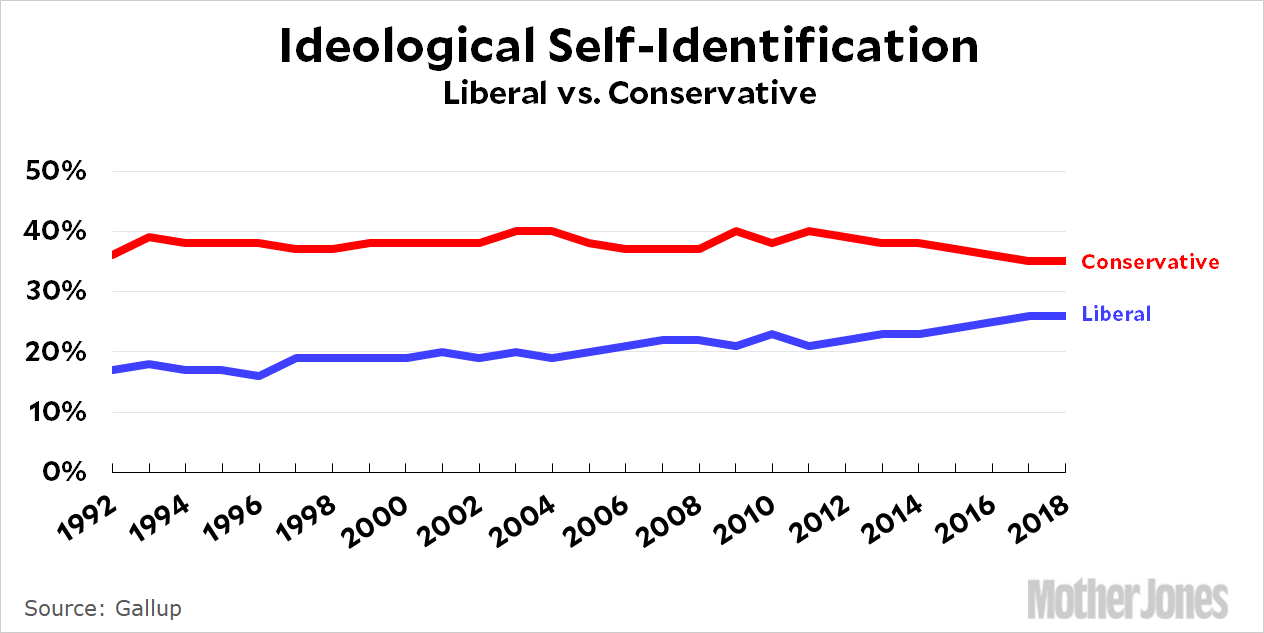
Apropos of nothing in particular, here’s a familiar chart:
Things are slowly getting better, but there are still a lot more voters who self-ID as conservative than liberal. There are endless ways of trying to spin this result away, but they’re mostly special pleading and you should ignore them. This is basically what progressives are up against.¹
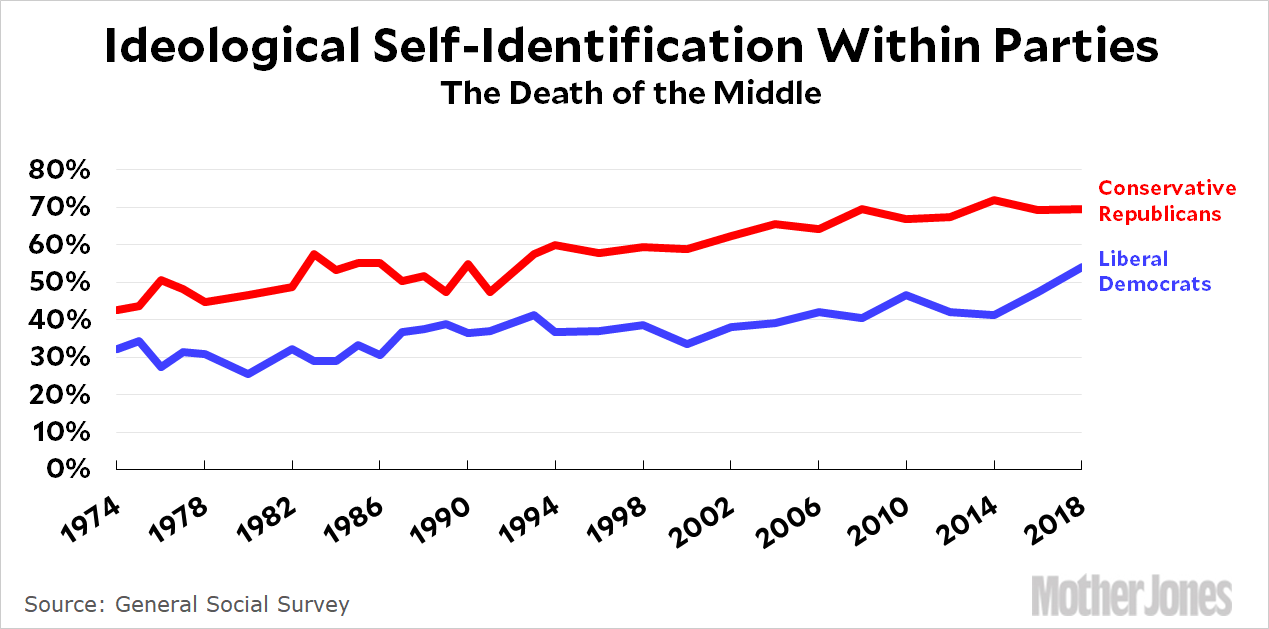
And while we’re at it, here’s how things look within our two major parties:
Republicans have gotten steadily more conservative and Democrats have gotten steadily more liberal. This polarization started when the South made its transition from mostly Democratic to mostly Republican, but then it just kept on going. Since 2000—well after the transition was complete—both parties have gotten substantially less friendly to moderates.
¹It would sure be interesting to see this on a state-by-state basis, wouldn’t it?
Traditionally it’s always been Republicans suppressing votes in places. Let’s start protecting our voters. We know where they are….Let’s start playing offense a little bit. That’s what you’re going to see in 2020. It’s going to be a much bigger program, a much more aggressive program, a much better-funded program.
Naturally Clark tried to pretend he hadn’t said what he said, but a recording of the entire conversation makes it clear that, in fact, he said what he said. And who knows what this much bigger, more aggressive program for 2020 might be? Whatever it is, I’m sure it will be entirely on the up and up.
I have been musing about a project using long exposure times, so last night I practiced on Hilbert. He was sitting in his favorite chair and barely even twitching, so I brought out a stick with a toy at the end and waved it around. Then I took a bunch of pictures as he whapped away at it.
This one used an exposure of 0.6 seconds. What do you think? Does it need a little less? A little more? Or do I just need to take more pictures until I get one better than this?
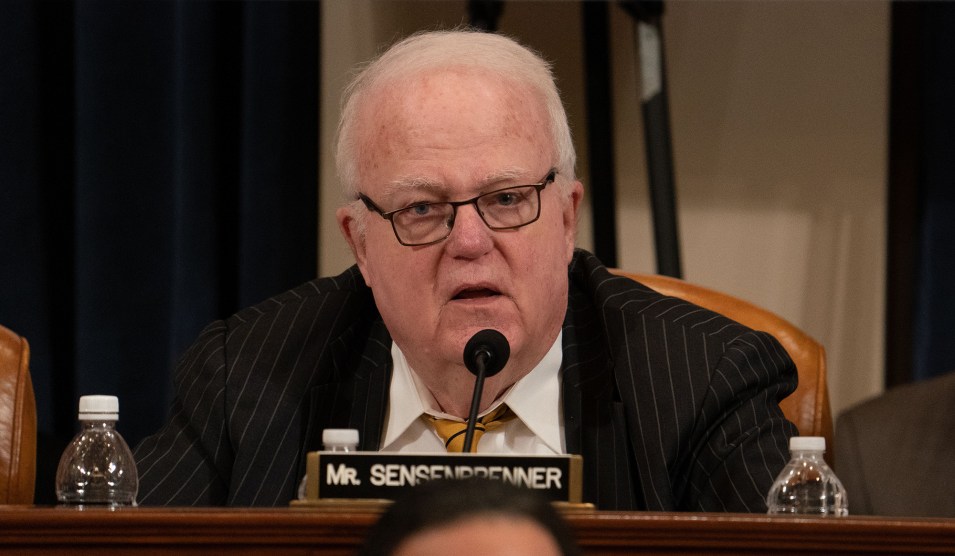
Earlier this Congress, Nancy Pelosi, the speaker of the House, and Jerrold Nadler, the chairman of the House Judiciary Committee, set forth criteria for undertaking an impeachment. They said that the evidence would have to be overwhelming and compelling, and, importantly, it would have to be bipartisan.
Looking back at the Clinton impeachment, I’m convinced we satisfied each of these. Kenneth Starr, the independent counsel, conducted a very lengthy and nonpartisan investigation, delivering 36 boxes of evidence to Congress. He concluded that the president had committed grand jury perjury and obstructed justice to cover his lies. Mr. Starr testified before our committee that the president might have committed impeachable offenses.
Ken Starr conducted a “lengthy and nonpartisan investigation.” God almighty. As we all know, it was indeed lengthy. But nonpartisan? After knowingly continuing to probe the Whitewater “scandal” long after he knew it was bogus, Starr eventually pushed his Ahab-like investigation into every crevice he could dream up, finally harpooning his white whale not by finding any presidential misconduct, but by laying out a carefully calculated and planned perjury trap for Clinton over the inconsequential question of whether he had ever gotten a blow job from Monica Lewinsky.
But sure, this was just an ordinary citizen doing his job, not a Republican diehard refusing to stop until he had something—anything—he could use against Clinton.
Donald Trump, by contrast, is being impeached not because Democrats even tried to investigate him over Ukraine. It just fell into their laps and then Trump himself released the transcript that showed he had tried to extort a foreign country to benefit him personally. There was no need for a long investigation because witnesses basically fell out of trees to confirm that, in fact, this was exactly what Trump had done. Nor was this a personal peccadillo. It was, plainly, a clear and serious abuse of presidential power.
I don’t know why I’m bothering with all this. It’s not like I expect anything different from Republican leaders these days. I guess my brain just melted a little bit when Sensenbrenner had the gall to take to the New York Times to pretend that the Clinton impeachment was nonpartisan. For chrissake.
Nickolay Lamm/Courtesy of Climate Central/sealevel.climatecentral.org
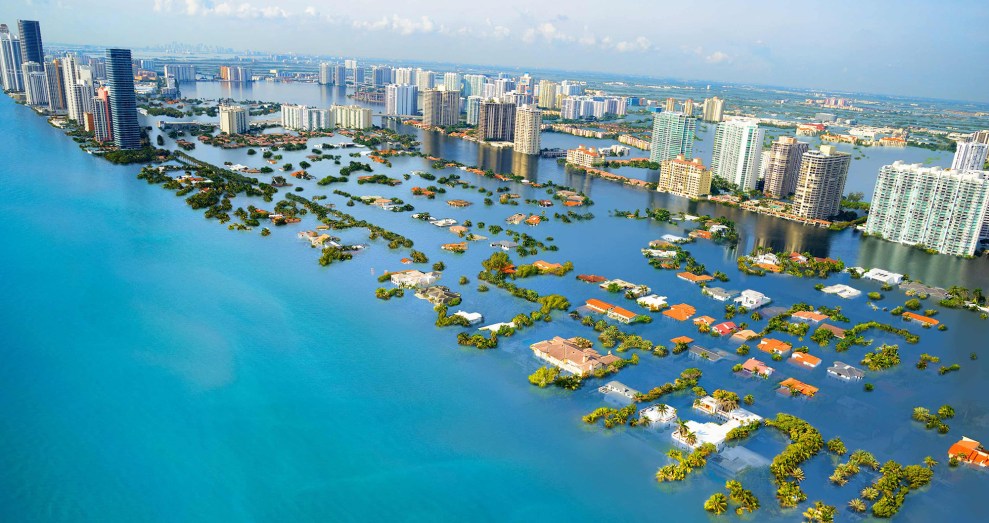
One of my beliefs about climate change is that it will be very difficult—in fact, all but impossible—to persuade people to sacrifice their standard of living even modestly in order to fight rising temperatures. Polling bears out this reluctance even in the face of imminent catastrophe, but more to the point, so does the entire history of mankind. Here’s how I put it in my climate piece:
None of this should surprise us. Fifteen years ago, UCLA geography professor Jared Diamond wrote a book called Collapse. In it, he recounted a dozen examples of societies that faced imminent environmental catastrophes and failed to stop them. It’s not because they were ignorant about the problems they faced….They just couldn’t find the collective will to stop.
Over and over, human civilizations have destroyed their environments because no one—no ruler, corporation, or government—was willing to give up their piece of it. We have overfished, overgrazed, overhunted, overmined, overpolluted, and overconsumed. We have destroyed our lifeblood rather than make even modest changes to our lifestyles.
So here’s my question, and it’s an honest one. I’m hardly an expert on world history, after all. My question is whether I’m right about human societies being routinely too shortsighted and self-interested to address catastrophes that are pretty obviously barreling toward them in a matter of decades. Aside from wartime, in other words, are there examples in the past couple of millennia of societies making collective sacrifices in order to address some kind of imminent environmental catastrophe? I am, of course, thinking of societies of substantial size, not small tribes in the Amazon or remote islands in the Indian Ocean. (After all, climate change requires action from the biggest society of them all, the entire earth.) I’m also thinking of significant, widespread, deliberate sacrifice, not just life getting a little harder for the peons.
I haven’t been able to think of one, but that doesn’t mean they don’t exist. Can anyone think of anything?
You know how apps are constantly asking you if they can track your location? This may seem perfectly ordinary for, say Google Maps, which has a genuine interest in improving their mapping software by finding out how people use it. But why do magazines need to know your location? Or Spotify? Or Facebook?
They don’t, really. But gigantic databases of people’s movements are valuable commodities in the era of information supremacy, and all that location data eventually ends up in the hands of companies who can sell it to the highest bidder. The New York Times recently got hold of one such database, which holds 50 billion pings of 12 million people, and they were pretty shocked by just how easily they could use it to follow anyone they put their minds to.
But wait. Isn’t all this data anonymized? It’s not like each ping includes your name and Social Security number. Think again:
In most cases, ascertaining a home location and an office location was enough to identify a person. Consider your daily commute: Would any other smartphone travel directly between your house and your office every day?…Yet companies continue to claim that the data are anonymous. In marketing materials and at trade conferences, anonymity is a major selling point — key to allaying concerns over such invasive monitoring.
To evaluate the companies’ claims, we turned most of our attention to identifying people in positions of power. With the help of publicly available information, like home addresses, we easily identified and then tracked scores of notables. We followed military officials with security clearances as they drove home at night. We tracked law enforcement officers as they took their kids to school. We watched high-powered lawyers (and their guests) as they traveled from private jets to vacation properties. We did not name any of the people we identified without their permission.
This is the location data of a single New York City resident over the course of a few days.
New York Times
Large gatherings can produce treasure troves:
The inauguration weekend yielded a trove of personal stories and experiences: elite attendees at presidential ceremonies, religious observers at church services, supporters assembling across the National Mall — all surveilled and recorded permanently in rigorous detail….Protesters were tracked just as rigorously….We spotted a senior official at the Department of Defense walking through the Women’s March, beginning on the National Mall and moving past the Smithsonian National Museum of American History that afternoon. His wife was also on the mall that day, something we discovered after tracking him to his home in Virginia. Her phone was also beaming out location data, along with the phones of several neighbors.
The official’s data trail also led to a high school, homes of friends, a visit to Joint Base Andrews, workdays spent in the Pentagon and a ceremony at Joint Base Myer-Henderson Hall with President Barack Obama in 2017 (nearly a dozen more phones were tracked there, too). Inauguration Day weekend was marked by other protests — and riots. Hundreds of protesters, some in black hoods and masks, gathered north of the National Mall that Friday, eventually setting fire to a limousine near Franklin Square. The data documented those rioters, too. Filtering the data to that precise time and location led us to the doorsteps of some who were there. Police were present as well, many with faces obscured by riot gear. The data led us to the homes of at least two police officers who had been at the scene.
And of course, this is just child’s play. The reporters aren’t experts in this stuff, and they had access to just one smallish database. In real life, information can be compared across databases to effectively de-anonymize the data. They know who you are, where you’ve been, what you buy, and what countries you visit on overseas trips. If the government did something like this, we’d all be outraged. But for some reason, when private companies do it we just shrug. But it can be used for more than just getting us to buy more stuff:
In one case, we observed a change in the regular movements of a Microsoft engineer. He made a visit one Tuesday afternoon to the main Seattle campus of a Microsoft competitor, Amazon. The following month, he started a new job at Amazon. It took minutes to identify him as Ben Broili, a manager now for Amazon Prime Air, a drone delivery service. “I can’t say I’m surprised,” Mr. Broili told us in early December. “But knowing that you all can get ahold of it and comb through and place me to see where I work and live — that’s weird.” That we could so easily discern that Mr. Broili was out on a job interview raises some obvious questions, like: Could the internal location surveillance of executives and employees become standard corporate practice?
Read the whole thing for more. And then consider just how many ways this data could be sold to people with goals a lot shadier than figuring out which tables you browsed at the Apple store. In the meantime, when an app asks if it can track your location, just say no. I always do.
The must-pass defense authorization bill includes a set of provisions to improve 401(k) retirement accounts that Democrats were unable to pass as a standalone bill earlier this year. The Wall Street Journal summarizes them:
One prominent provision of the legislation passed Thursday, which President Trump is expected to sign, encourages 401(k) plans to replicate a feature of old-fashioned pensions by offering [annuities] with guaranteed income payments. The legislation also seeks to expand retirement plan coverage by making it easier for small companies to join together to offer 401(k) plans and share administrative costs. An estimated 30% of private-sector employees work for employers that don’t currently offer a way to save for the future.
….To encourage workers to save more, the legislation allows employers that automatically enroll workers in certain 401(k) plans to automatically raise employees’ savings rates to 15% of annual earnings over time, up from a 10% cap now. Other features of the legislation include a provision requiring employers to allow certain part-time workers to participate in 401(k) plans.
The downside of annuities, of course, is that they tend to be fairly expensive. “Given the prevalence of high cost, low-quality annuities, we don’t start with the thought that this is a great idea,” said Barbara Roper, director of investor protection at the nonprofit Consumer Federation of America. However, greater competition may lead to lower costs if annuities prove popular with 401(k) buyers.
Generally speaking, Congress seems open to the idea of improving 401(k) plans and making them more widely available, especially to low-income workers. The 2006 reforms have worked well so far, and these new changes should improve 401(k) accounts even further. This is nice to see, since old school pensions are gone and 401(k) pensions are here to stay, whether we like it or not.
The Boeing Starliner crew capsule, on a final unmanned test run sitting on top of a ULA Atlas 5 rocket, launched successfully this morning from Cape Canaveral. If the test flight finishes successfully, a manned mission is scheduled for early 2020. It will carry up to seven passengers to the International Space Station, the first American craft to fly humans to the ISS since the retirement of the space shuttle fleet in 2011.
UPDATE: Well, the launch wasn’t entirely successful after all. According to NASA, “Boeing’s CST-100 Starliner is not in its planned orbit. The spacecraft currently is in a stable configuration while flight controllers are troubleshooting.” More later.
UPDATE 2: Apparently a faulty timer caused the spacecraft to burn too much fuel trying to get into the wrong orbit. By the time it was discovered and fixed, there wasn’t enough fuel left to attempt to dock with the ISS. So the mission has ended in failure.
It made a big difference having only seven candidates on the debate stage tonight. Almost everyone got time to weigh in on almost every subject, and there was less downtime while the debate suddenly seemed to stop dead so we could hear from the folks who had no business being there. That said, here are my first impressions of how everyone did:
Amy Klobuchar seemed like the big winner, relatively speaking. She got plenty of speaking time, she was clearer than usual in her answers, and she did the best job by far of selling a moderate vision without directly attacking Warren or Sanders.
Pete Buttigieg was the big loser. I thought he sounded more politician-y and rehearsed tonight than usual, and his newfound combativeness didn’t play well. During his squabble over fundraising with Warren and his squabble with Klobuchar over experience, I thought he came out on the losing end both times.
Joe Biden had a good night. For one thing, the tone of this debate was louder and more aggressive than past debates, and by contrast Biden sounded like a cool drink of water whenever he spoke. That’s a good look for him. He also did well when he got a little more animated, as he did when talking about immigration and Afghanistan.
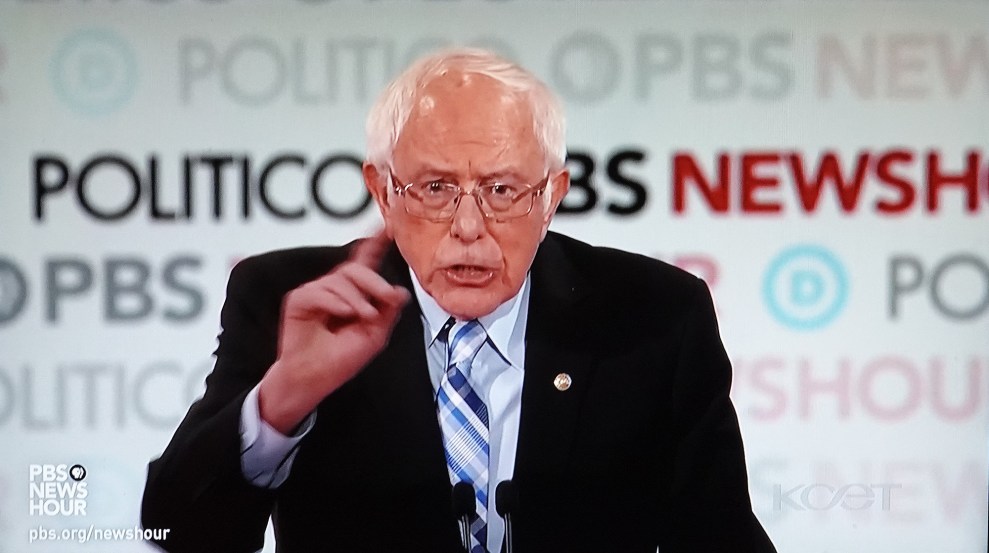
Bernie Sanders was . . . Bernie Sanders. Even after you account for the fact that I’ve never been a big fan of his, he just sounded like he had absolutely nothing new to say. In debate after debate, all we hear is that he’s somehow going to lead a revolution and then all our progressive dreams will come true. Meh.
Elizabeth Warren had some good answers and some bad ones. I’m undecided about whether it was smart to simply say “They’re wrong!” when she was asked about economists who said her two-percent wealth tax would be bad for the economy. On the one hand, yay! She’s probably right. On the other hand, don’t you have to at least pretend to take the experts seriously? This is a Democratic debate, after all, not a Republican one.
On the positive side, “billionaires in wine caves” is likely to be the meme of the night.
Andrew Yang showed some nice flashes of humor, and I admire the guts of anyone who’s willing to say “thorium nuclear reactor” on a public stage. But he’s still never going to be president of the United States.
Tom Steyer didn’t matter before the debate, and he still doesn’t matter.
Bernie Sanders says Medicare for All will pass after his silver tongued oratory spurs a revolution. Really?PBS
I’ve written at greater length about this before, but it’s worth mentioning that the only way a Democratic president will get anything done is to get bills through the Senate with Republican support. Even if Democrats win a thin Senate majority in 2020, we already know they don’t have the votes to eliminate the filibuster. So they’ll need 60 votes for anything. It’s true that there are a few things they can pass via reconciliation, but that has limits too.
So . . . when the candidates talk about how they’re going to get things done, take it with a great big shaker of salt.
Can you pitch in a few bucks to help fund Mother Jones' investigative journalism? We're a nonprofit (so it's tax-deductible), and reader support makes up about two-thirds of our budget.
We noticed you have an ad blocker on. Can you pitch in a few bucks to help fund Mother Jones' investigative journalism?
Help us finish strong.
We’re not shy about asking you to help pay for the journalism you rely on—especially now. We have until December 31 to raise $400,000 to keep our nonprofit newsroom running at full strength into 2026. We’re off to a good start, but to make our goal we need contributions from readers who have never given before—and from steadfast donors who can give again. Every gift matters. Will you help us close the gap?
Help us finish strong.
We’re not shy about asking you to help pay for the journalism you rely on—especially now. We have until December 31 to raise $400,000 to keep our nonprofit newsroom running at full strength into 2026. We’re off to a good start, but to make our goal we need contributions from readers who have never given before—and from steadfast donors who can give again. Every gift matters. Will you help us close the gap?