This handsome little bird is a yellow warbler, or so I’m told, and it will stay that way unless someone reliable tells me different. It is feasting on one of our yummy, yummy seed pods.
UPDATE: It’s a lesser goldfinch. You can tell by the beak.
Back in 1984, when I got my first job in the tech industry, human beings created circuit boards. Engineers designed them, and then other people figured out how to fit all the chips onto a board and connect them to each other in the proper way (this is called “routing”). It’s a tricky task, and it got trickier as circuit boards got denser and more complex.
Eventually, autorouting software got good enough to be a significant help, and then—well, you know what happened next, don’t you? Autorouting software got so good that it could do the whole task on its own in a few seconds. People who did routing for a living were all put out of jobs.
Autorouting software is not artificial intelligence. It’s just ordinary software that got better and better. But what about chess software? What about go software? What about software that does what PhD biochemists do?
Wait. What was the last one again? Here is biochemist Derek Lowe on a new piece of software for performing retrosynthesis, the process by which chemists create blueprints for constructing organic molecules:
Organic synthesis is a lot harder to reduce to game-type evaluation than chess is, as the authors rightly point out. To get around this, the program combines neural-network processing with a Monte Carlo tree search technique….What the authors did…was have the program generate retrosyntheses for already-synthesized molecules, and then have these routes and the known ones evaluated blind by experienced chemists. The results were a toss-up: the machine routes were considered just as plausible or desirable as the human ones, and that (as above) is a victory for the machine. AI wins ties.
….Where does that put us? And by “us”, I mean “us synthetic chemists”. My conclusions from the earlier paper stand: we are going to have to get used to this, because if the software is not coming to take retrosynthetic planning away from us now, it will do so shortly….It’s not that this new software is coming up with routes that no human would be able to. But if we’re approaching “good as a human”, the next step is always “even better than a human”. Eventually — and not that long from now — such programs are going to go on to generate “Hey, why didn’t I think of that” routes, but you know what? Those of us in the field now are going to be the only ones saying that. The next generation of chemists won’t bother.
I want to emphasize, as usual, that this is still not AI. However, it uses techniques that are to AI what Robert Goddard’s model rockets were to the Apollo program. Goddard didn’t know for sure that what he was doing could be scaled up to man-on-the-moon size, just as we don’t know for sure that current deep-learning algorithms can eventually form the basis for AI. But the odds seem pretty good. In time, our current algorithms will seem like little more than toylike proofs of concept, but they’ll still be the starting point. Lowe says the next generation of chemists won’t bother with synthetic transformation routes, but of course that’s only the beginning. Eventually, they won’t bother with creating new molecules at all. A computer will do it.
So who will be put out of work first? Truck drivers or pharmaceutical biochemists? Is anyone taking bets?
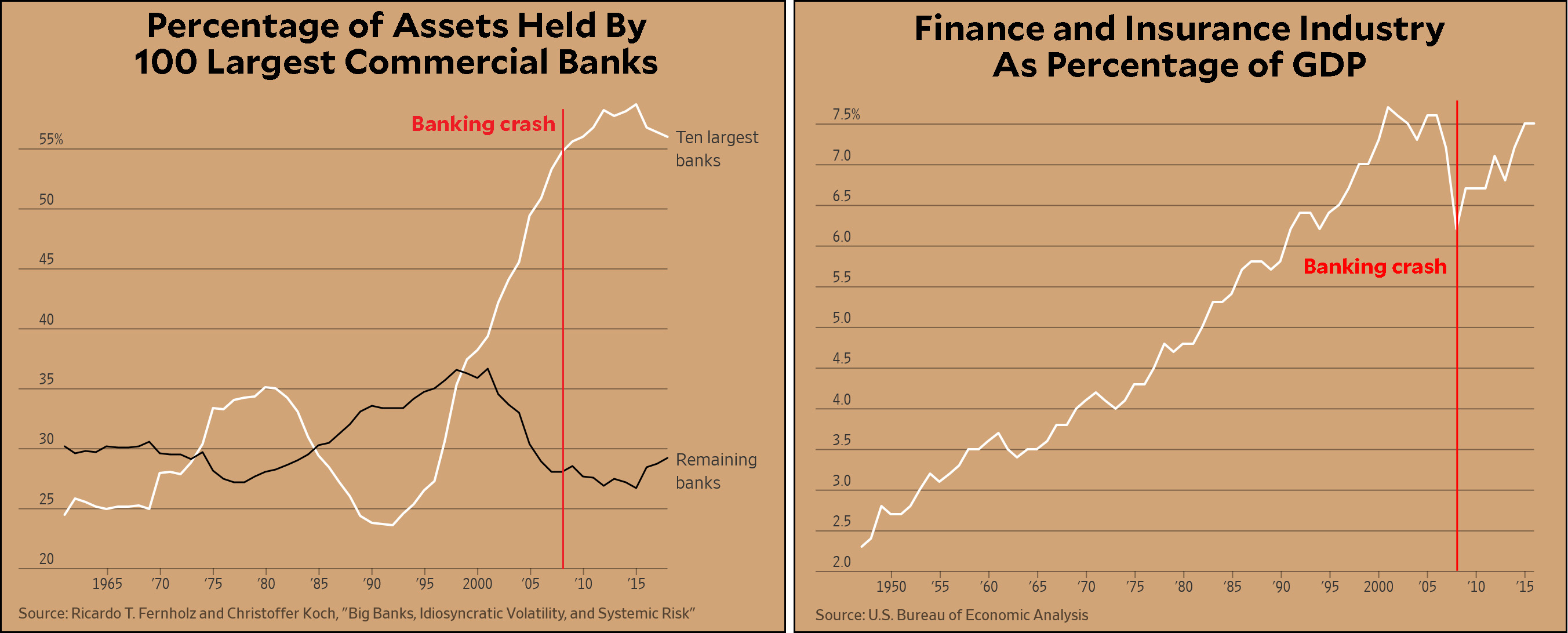
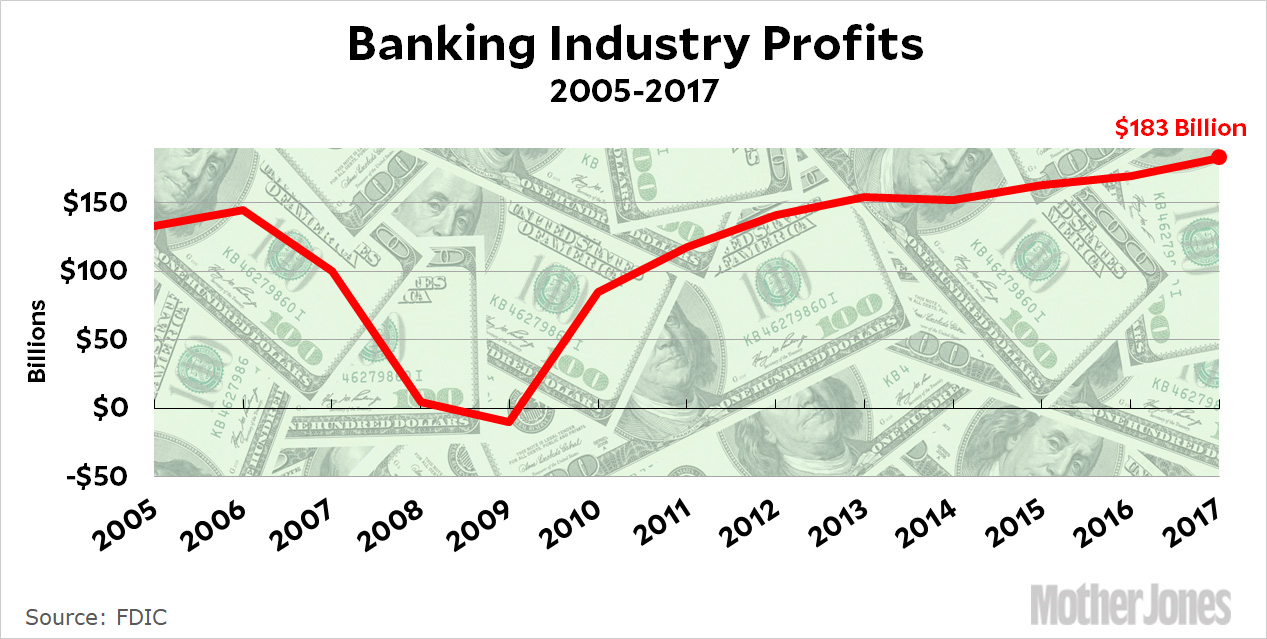
The Wall Street Journal has a graphical retrospective today about the banking industry ten years after the great crash. Here are a couple of their charts:
Remember this the next time you hear tales of woe from the financial industry about the devastating effects of Dodd-Frank. It’s really crippled their ability to make money, hasn’t it?
The White House is poised to give its budget office greater control over some of the Treasury Department’s regulations, handing budget director Mick Mulvaney a victory in a months-long power struggle with Treasury Secretary Steven Mnuchin, according to three sources familiar with the discussions.
….The highly sensitive debate has consumed the attention of top officials at both agencies. At stake is the final say over IRS regulations — and the implementation of the Republicans’ tax law….Downtown lobbyists have been keenly tracking the debate as they seek to influence the outcome of the new tax law. The move raises the possibility that key regulations surrounding the law — especially on the nuances of the international rules and the taxation of certain types of businesses — could be delayed if they must pass through both Treasury and OMB’s Office of Information and Regulatory Affairs.
Nearly all federal agency regulations are reviewed by OMB, which typically does a cost-benefit analysis before recommending whether they should be approved. Conservatives like this because cost-benefit analyses are fairly easy to tweak, thus making it easier to kill off regulatory proposals. And since OMB is part of the White House, its decisions tend to be more overtly political than those of bureaucrats in the agencies. For conservatives, OMB review is a good way of keeping a close eye on all those radical lefties in the Deep State who are constantly trying to expand the scope of government meddling in the ability of God-fearing corporate executives to make money.
IRS regulations, however, are different. They’ve never been part of the OMB review process because they aren’t supposed to be influenced by cost-benefit calculations. They’re supposed to represent the IRS’s best technical expertise regarding how tax law is meant to work. So what’s the point of having a second review by OMB?
“The OMB is good at doing cost benefit, but they are not good at doing tax. They have no experience whatsoever in tax law,” said Mark Mazur, former assistant secretary for tax policy at Treasury and director of the nonpartisan Urban-Brookings Tax Policy Center. “In order to do a good job, they would have to hire 20 tax attorneys, which is what Treasury already does. You are duplicating the assets that you already have.”
Obviously OMB Director Mick Mulvaney wants more authority over tax law interpretation. But why? As always, cui bono is our guide to answering this question.
A few days ago, in my mini-jeremiad against Uber, I said, “They’re exactly the kind of company that would cut corners: cheap optics, lousy safety drivers, pushing to drive at night before the software is ready, etc.” But I was just ranting. I had no idea just how right I was:
In 2016, Uber decided to shift from using Ford Fusion cars to Volvo XC90s for its self-driving car program. When it did so, it make big changes to its sensor design: the number of LIDAR sensors were reduced from five to just one — mounted on the roof — and in their place, the number of radar sensors was increased from seven to 10. Uber also reduced the number of cameras on the car from 20 to seven.
Removing LIDAR sensors from the front, back and sides and replacing them with a 360-degree sensor on the roof is more cost-effective but results in a blind spot low to the ground all around the car. In a remarkable statement, given that Uber’s car ran down and killed a pedestrian at night, the president of the company that builds Uber’s LIDAR sensors, Marta Hall of Velodyne, told Reuters: “If you’re going to avoid pedestrians, you’re going to need to have a side LIDAR to see those pedestrians and avoid them, especially at night.”
The use of a single LIDAR sensor is all the more remarkable given that other companies running self-driving programs use significantly more: Google-owned Waymo has six on its cars; General Motors uses five.
This is the kind of thing you do very late in a testing cycle, once everything is working and you’re focused on cost and efficiency improvements. It’s insane that you’d do it early in the testing program, which is where Uber was.
That said, even with fewer cameras it’s still an open question how the video, lidar, and radar sensors all managed to miss seeing a pedestrian in front of the car. I’ll bet Uber already has a pretty good idea of what happened, but so far they aren’t telling.
Sherry Turkle is an MIT professor who thinks social media is decimating face-to-face contact. Claude Fischer is a Berkeley professor who thinks social media has done nothing of the sort. Here he is in a 2012 Boston Review article:
The first systematic studies of the Internet’s social side suggested that early adopters were hiding away from people. But as Internet use became widespread, the findings changed. Robert Kraut, a leading researcher who had raised early warnings explicitly recanted; the resulting Times headline was, “Cyberspace Isn’t So Lonely After All.” People using the Internet, most studies show, increase the volume of their meaningful social contacts. E-communications do not generally replace in-person contact. True, serious introverts go online to avoid seeing people, but extroverts go online to see people more often. People use new media largely to enhance their existing relationships—say, by sending pictures to grandma—although a forthcoming study shows that many more Americans are meeting life partners online. Internet dating is especially fruitful for Americans who may face problems finding mates, such as gays and older women. Finally, people tell researchers that electronic media have enriched their personal relationships.
And again in 2015, responding to an essay by Turkle in the New York Times which suggested that conversation is dying as people escape into their smartphones:
There may well be something to this assertion. But we want some systematic, reliable evidence that Americans converse less in person than before, attend to one another less, and suffer more as a consequence. It is hard to find such evidence. Much of the “data” in Turkle’s essay (and I presume the new book) is anecdotal: As in Alone Together, the documentation is mainly people here and there, especially unhappy people, with whom she talks. These reports may all be totally truthful and still the thesis be wrong. Fifty years ago, Turkle might have well have heard similar grousing about people eating together silently, or burying their noses in the newspaper, or, heaven knows, turning away to watch the always-on TV set. In addition, Turkle cherry picks studies….
I don’t think there’s any doubt that social networks and ubiquitous smartphones are changing the way we relate with each other. It’s still early days, however, and we don’t know for sure how that’s going to play out. So far, though, I think Fischer has the better of the argument when it comes to in-person contact: we have as much of it as we’ve ever had, and people don’t report being isolated or lonely any more than they have in the past. Old people should probably stop stressing out about this so much.
Facebook on Wednesday sought to make it simpler for people to control how their data is used….In the coming months, privacy controls that are now in 20 places on Facebook’s app will be merged into a single page, and will include what the company says will be easier-to-comprehend features that explain how the company is using a person’s data, the company announced. Facebook also will create a page that makes it easier for people to download their data so that they can more clearly view what information the company collects about them.
Twenty places! Can anyone tell me with a straight face that this was all just a big blooper and Facebook is only now realizing that its privacy controls are a wee bit confusing? Seriously?
This whole Kevin Williamson thing is weird. You may recall that liberals are spitting mad that the Atlantic hired him recently for a forthcoming section dedicated to ideas, opinion, and commentary on their website, but as near as I can tell this contretemps has had exactly zero penetration into the outside world. I’ve written about it, Slate has written about it, the Prospect has written about it, and so forth. But no one who isn’t an obsessive political junkie has heard anything about this.
The other weird thing is that—again, as near as I can tell—the entire objection to his hiring continues to be based on precisely two things out of his ten-year writing career at National Review. The first is a tweet saying that abortion should be treated like any other homicide, and the second is a magazine piece he wrote in 2014 that started off with a racially clueless anecdote. I talked about both of them here.
I’ve been waiting around for another shoe to drop, but there’s been nothing so far. So is this really all there is? Lots of conservatives believe that abortion is murder. Williamson was willing to take this publicly to its logical endpoint—that women who get abortions should be prosecuted for murder one—but that act of folly is the only difference between him and every other right-wing pundit. As for the racial anecdote, it was pretty offensive. But it was mostly offensive in a clueless way, not a deep-seated racist way. And he hasn’t repeated either of these things in the past few years, so they really are isolated incidents. Hell, even I’ve written more than two things over the past decade that have pissed off both my editors and assorted lefties.
In any case, these are still the main charges on the bill of particulars against Williamson, but there’s only so long you can keep pounding away on just two things. So eventually, as these things do, the thrashing of Williamson morphed into a broader critique: namely that he’s just another white dude failing upward. If the Atlantic really wants diversity, why not hire a socialist woman? Or a Hispanic who supports Trump?
This is kind of tedious. Fair or not, one of the steppingstones to getting a plum writing gig is to be a provocative, engaging, stylish writer. Williamson is. If the Atlantic just wanted a conservative from National Review, they could have hired Ramesh Ponnuru or Reihan Salam. They’re more reliably conservative than Williamson and they aren’t white. Problem solved. Hell, Salam is already a contributing editor there, so obviously they like his writing. But the Atlantic nonetheless pursued Williamson for several months thanks to his sometimes unpredictable opinions and energetic prose style. There’s a pretty limited supply of people like that.
I wouldn’t care all that much about this except that it’s becoming a habit. Liberals went ape when the New York Times hired a Pulitzer-winning conservative columnist. It happened again when the Washington Post hired a libertarian. Also when the Times hired a queer, anarchist, female activist for its editorial page. And when MSNBC hired Hugh Hewitt for a weekend morning show. I suppose this all makes sense in a working-the-refs kind of way, but not in any other way. Are we really all going to keep getting outraged every time a conservative writer gets hired? That’s not a very good look, nor is it a very good use of our energy. I don’t think liberals are poorly represented in the pages of our biggest magazines and newspapers, after all.¹
What’s more, it’s obviously not doing any good. Lefties are making a fuss over Williamson, which is probably making life tough for both Williamson himself and the editor of the Atlantic, but that’s about it. No one outside the political magazine ghetto cares. And it’s probably a good thing, too. If it ever did make it into the mainstream, I’m pretty sure I know whose side the public would end up on.
¹Or in the Atlantic’s new ideas section, which appears to be starting off with four liberals and one conservative.
While there has been extensive research and a host of published reports on climate change, clear gaps remain including our understanding of the role of human activity and what we can do about it.
What a fuckwit. The role of humans is: we’re the ones causing it. What we can do about it is: reduce our carbon emissions. Any other questions, folks?
So who’s replacing him? A Heritage Foundation-approved ideologue who wants to privatize everything? Nope. The job is going to rear admiral Ronny Jackson, the president’s personal physician. He certainly looks the part, doesn’t he? And I guess he must have a terrific bedside manner. And lots of ribbons.
For Trump, I suppose this is the next best thing to hiring someone from the Fox News Medical A-Team.
And we respect that! But maybe you’re of a mind to support our work directly instead? We have until December 31 to raise the last $400,000 we need to keep our nonprofit newsroom running at full strength into 2026. Will you make a gift today?
We noticed you have an ad blocker on. Can you pitch in a few bucks to help fund Mother Jones' investigative journalism?
Billionaires own the media,
but they don’t own us.
At Mother Jones we know these aren’t conventional times, and they require unconventional coverage. That’s what deliver every day: fierce, independent journalism you can’t find elsewhere. Perhaps never in the history of our country has that been more necessary than now. But we can’t do it without reader support—your support. Please chip in today.
Billionaires own the media,
but they don’t own us.
At Mother Jones we know these aren’t conventional times, and they require unconventional coverage. That’s what deliver every day: fierce, independent journalism you can’t find elsewhere. Perhaps never in the history of our country has that been more necessary than now. But we can’t do it without reader support—your support. Please chip in today.