• Never Forget That Nancy Pelosi Is Very Smart

    Michael Brochstein/ZUMA

    It’s summer and the news is slow. This means that Nancy Pelosi’s dismissive attitude toward “The Squad” of progressives led by Alexandria Ocasio-Cortez continues to fill the news pages. Just to refresh your memory, here’s the full excerpt from Maureen Dowd’s recent profile of Pelosi that started the whole thing:

    I asked Pelosi whether, after being the subject of so many you-go-girl memes for literally clapping back at Trump, it was jarring to get a bad headline like the one in HuffPost that day — “What The Hell Is Nancy Pelosi Doing?” The article described the outrage of the Squad, as Alexandria Ocasio-Cortez of New York, Ilhan Omar of Minnesota, Rashida Tlaib of Michigan and Ayanna Pressley of Massachusetts are known.

    Pelosi feels that the four made themselves irrelevant to the process by voting against “our bill,” as she put it, which she felt was the strongest one she could get. “All these people have their public whatever and their Twitter world,” she said. “But they didn’t have any following. They’re four people and that’s how many votes they got.”

    This is all about the $4.5 billion bill funding additional aid to address the emergency at the border. And to refresh your memory yet again, the bill Pelosi is talking about is not the one that eventually passed after the Senate revolted and forced her hand. It was the original House bill, which included quite a few restrictions on how the money could be spent. That bill received unanimous opposition from Republicans and from the four members of The Squad. Every other Democrat voted for it.

    So what’s going on? In one sense, Pelosi is just playing her traditional role as a working politician: you’re successful if you can round up the votes to get things done. The squad members may get a lot of press, but they couldn’t even persuade their fellow progressives to hold out for a better bill, let alone any of the centrists. That really is kind of a pitiful performance, and Pelosi is rightfully pointing out that she’s the one who put in the shoe leather work to get support for a stronger bill than the ones Republicans were proposing.

    Of course, AOC and her colleagues don’t care about that. They’re playing an entirely different game, and they know perfectly well they don’t have the votes to actually pass anything. Their goal is to move public opinion, and the way you do that is by holding out from the majority in the most conspicuous possible way. If it works, AOC will someday be Speaker of the House and her Democratic Socialist politics will have broad support throughout the country. If it doesn’t work, she’ll serve a few terms, write a book, and then disappear.

    In other words, there’s nothing much going on here that we haven’t seen a dozen times before. Young Turks vs. The Old Guard is a guaranteed crowd pleaser. Sometimes it works (Democrats in 1972, Republicans in 1994), sometimes it doesn’t (Democrats in 1980, Republicans in 2010).

    In this sense, then, I don’t really take Pelosi’s comments very seriously. Why is she dissing AOC? Because that’s her role as leader of the party, that’s why. Among other things, she needs to protect all the people who did vote for her bill even if they had qualms about it. She’s taking the heat so they don’t have to.

    But in another sense, it’s also because she knows what she’s doing. It’s interesting to watch the dynamics swirling around Pelosi. There can hardly be any question that she’s pretty progressive. She is, for example, considerably farther to the left than Paul Ryan was to the right. (According to VoteView, she ranked #32 out of 200 Democrats in the previous session of Congress.) And most progressives respect the hell out of her. She has a well-deserved reputation as the smartest, most effective Democratic politician of her era.

    But I’ve always thought that if you respect someone, it means you respect them even when you disagree with them. So you can still disagree with Pelosi, but you should acknowledge that she most likely has pretty good reasons for not pursuing impeachment; going slow on investigations; not pushing for an even more liberal border bill,¹ and being publicly dismissive of AOC. I don’t know that I agree with all of these decisions, but I don’t suddenly think Pelosi is a dimwitted sellout because of that. I think we just disagree. And given her massively greater knowledge of Congress, I suspect she’s more right about this stuff than I am.

    ¹She was pretty obviously right about the border bill, for example. Even the version she supported turned out to be too liberal for Senate Democrats to stomach. As a result, we ended up with the Republican bill.

  • California’s Two Recent Earthquakes Erupted on Unknown Fault Lines

    My geophysicist friend tells me that the two big Ridgecrest earthquakes last week happened along fault lines we didn’t even know existed. Here’s a map of all the aftershocks from the two quakes:

    The shorter set of aftershocks outlines the area of the 6.4 earthquake. The longer set outlines the 7.1 earthquake. The purple lines show all the previously mapped fault segments in the area. One of those is a potential problem:

    My worry is that both of these fault segments were not mapped before, and both lie close to a long fault that ruptured historically. The Garlock Fault lies at the lower right of the figure, trending WSW-ENE, and it produced a 7.5 quake in 1952. For the last few days the folks at the USGS have probably been estimating how many bars of stress have been gained or lost on the Garlock as a result of the quakes that SoCal experienced last week. Although rock stresses are typically measured in kilobars, history tells us that 1-2 bars of additional stress can trigger the next quake. A 7.5 quake would be 0.4 Richter units larger than the Friday quake, roughly 4x larger in energy release. But also along a longer fault that crosses some major highways. I would be concerned for at least the next 12 months.

    And that is your earthquake news for the day.

  • White House Unable to Think of Any Trump Environmental Accomplishments

    Michael Brochstein/ZUMA

    Let’s review Donald Trump’s environmental record:

    • Pulled out of the Paris Accord.
    • Has worked hard to repeal the Clean Power Plan.
    • Tried to massively expand offshore oil drilling.
    • Repealed higher mileage standards for cars and trucks.
    • Proposed massive budget cuts for the EPA.
    • Revoked California’s waiver to adopt stricter air quality standards.
    • Slashed the size of the Bears Ears and Grand Staircase national monuments put in place by President Obama.
    • Nominated a former coal lobbyist to head the EPA.
    • Has proposed a huge reduction in the number of waterways protected by the Clean Water Act.
    • Signed a bill to open up ANWR to oil drilling.
    • Has done everything humanly possible to promote coal use.
    • Proposed eliminating the Great Lakes Restoration Initiative, designed to help clean up the Great Lakes.
    • Proposed rolling back plans to reduce methane leaks.

    I’m sure there’s more, but I think those are the highlights. Apparently someone told Trump that this isn’t playing well among suburban moms or something, so today he gave a long, rambling speech about the world historical greatness of his environmental stewardship. You can read about it here.

    I don’t have the patience to listen to what’s apparently just more of Trump’s usual inventions and lies—Rebecca Leber has us covered on that front—thanks Rebecca!—but I was amused to carefully read through the White House fact sheet on Trump’s environmental leadership. I say “carefully” because it is, literally, less than 500 words long—and that includes a boast that the US has increased its oil and natural gas production. I am not lying to you here. This is an actual statement in a fact sheet about how Trump has been good for the environment.

    But that’s not surprising once you read through the whole thing and realize that even the spinmeisters at the White House couldn’t figure out anything to say. They note that air and water quality has improved since 1970—which has nothing to do with Trump. They say that CO2 emissions might decline next year—which, if it happens, would be solely due to favorable weather. They enthuse over the fact that Trump has maintained the operation of three or four specific EPA programs—all of which were started by other people years ago and have been running for decades. They brag that Trump signed a bill to create 1.3 million new acres of wilderness—a bill that he was forced to sign because it was passed by veto-proof majorities. They claim that Trump “took action” to improve forest management—apparently referring to a recent proposal to reduce oversight for industry projects on federal land. And, finally, they say that Trump has proposed opening up new areas for hunting and fishing.

    That last sentence is actually true, and it’s actually something Trump has done. It doesn’t really do anything to improve the environment, and it affects way less than the million acres they claim, but hey—at least it’s sort of based in reality. In Trumpland that counts as pretty nearly the truth.

  • CBO Says $15 Minimum Wage Would Be Mostly Positive

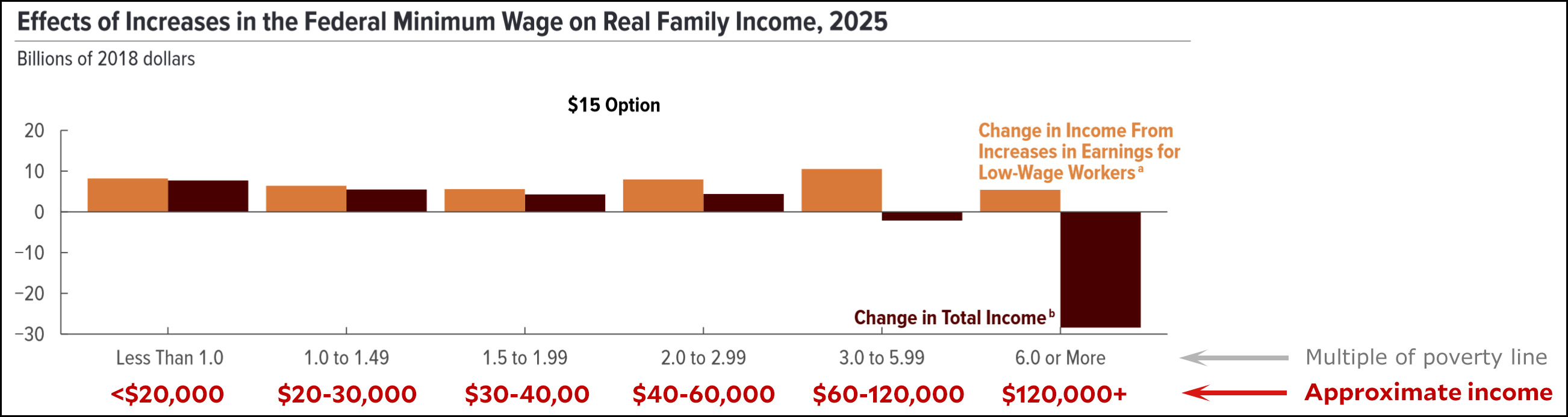
    The Congressional Budget Office has published a new report on the $15 minimum wage.¹ Unusually for the CBO, it was a little hard to dig out all the relevant numbers, which means I had to read the whole thing fairly carefully. That’s very annoying, isn’t it?

    Anyway, here are the main takeaways:

    • Families below the poverty line would see a 5.3 percent increase in earnings. Families above the poverty line would see a 0.1 percent reduction in total income.
    • Wages would rise for more than 20 million workers. However, among adults, 700,000 would lose their jobs. Many of these would be part-time workers, but CBO doesn’t put a number on it.
    • Total wages for workers would rise by $44 billion (accounting for both higher wages and increased joblessness). Income for business owners would fall $14 billion.
    • Consumers would pay higher prices amounting to a total of $39 billion. That’s an increase of about 0.3 percent.

    Very few policy proposals are literally 100 percent positive, and the $15 minimum wage is no exception: a small number of low-income workers would lose their jobs and the affluent would pay slightly more for the stuff they buy. However, this is about as positive as you can expect in the real world. It’s a pretty small tradeoff for a 5 percent income boost for 20 million people.

    ¹The report also analyzes proposals for a $10 and $12 minimum wage, which I’m ignoring here.

  • Lunchtime Photo

    A flock of snowy egrets has made its home in a tree at a nearby intersection. “You’ve gotta go see it!” Marian told me. “Have you gone to see it yet?” she asked me a couple of days later. So I finally went to see it.

    Like most other animals, the egrets were lazy and uncooperative, mostly just sitting around and doing nothing interesting. But I did get lucky and catch one as it flew directly overhead with the noontime sun backlighting its wings. Very pretty.

    July 6, 2019 — Irvine, California
  • Trump: Brexit Would Have Gone Better If They’d Listened to Trump

    After the Mail on Sunday published leaked cables from the UK ambassador calling Donald Trump clumsy and inept, it was inevitable that Trump would reply:

    I don’t remember: did Trump ever tell us how he thought Brexit should be handled? We’d all love to hear it. I’m sure his buddy Boris will follow his advice, though.

    As for the ambassador, he’s now persona non grata—which, in fairness, is hardly a surprise. No ambassador can stick around after he’s been caught telling the bare truth. They all do it, but we have to pretend they don’t or else the whole diplomatic edifice of the world would collapse. No worries, though: I’m sure he’ll land on his feet.

  • Raw Data: One-Third of Students Graduate From Community College

    After I wrote about my take on free college for all, I got an email from a policy expert who had a lot to say about our current educational system. This might turn into a post someday, but one thing he mentioned struck me as surprising:

    I have talked with many community college presidents and provosts, and they will readily admit that most students at their college expect to get by by the skin of their teeth — and for good reason, since the 6-year graduation rate at community colleges is about 20% nationally. If you’re hoping to marginally succeed, that likely means that you think there’s a reasonable chance that you’ll fail out, increasing the risk of going to college.

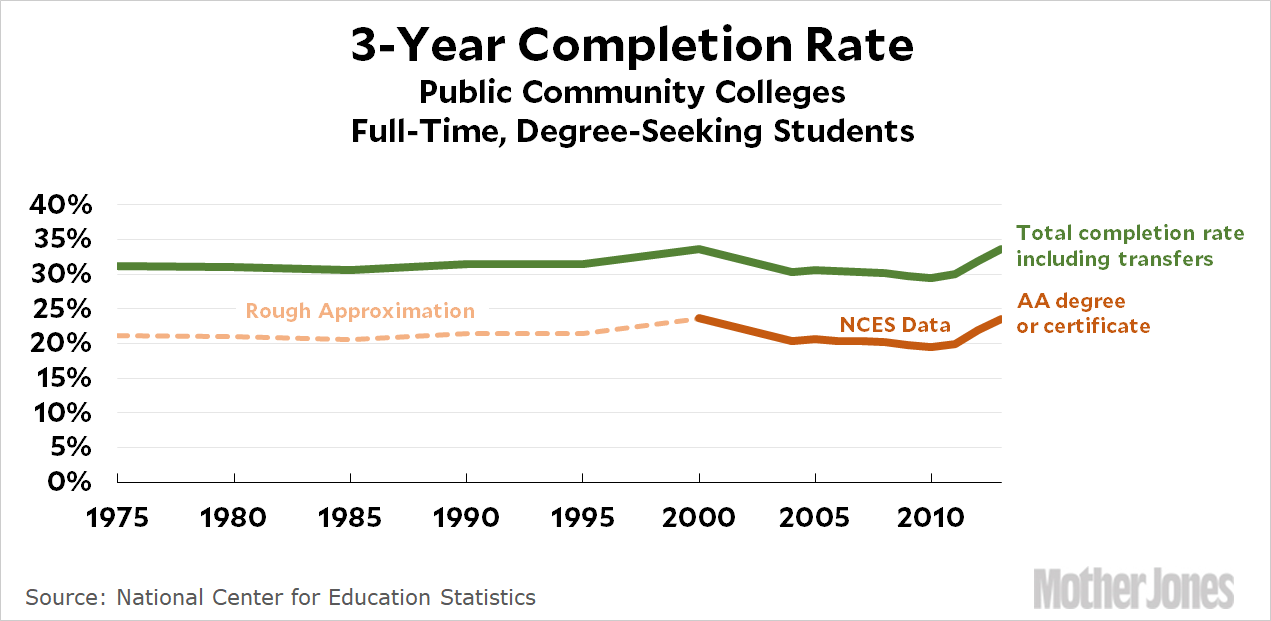
    I don’t know about the 6-year completion rate, but the feds have data on completion “within 150 percent of normal time,” which I assume would be three years for a 2-year community college. Here’s the completion rate since 2000, along with a very rough approximation for the decades before that. Note that this is for full-time, degree-seeking students, so it doesn’t include adult education or folks who are just taking a class or two for personal fulfillment:

    UPDATE: The original version of this chart didn’t include students who skip their AA but transfer to a 4-year university. This adds about 10 percentage points to the total. I’ve corrected the chart and the text. Thanks to the Twitter followers who pointed this out and made me do a little more digging.

    Sure enough, only about 20 percent of degree-seeking students get their AA, though the completion rate is more like a third when you count transfers to 4-year universities. It might be a little higher if you look at 4-year completion rates, but I doubt it goes up much after that. You could probably say, very roughly, that only one-third of students who start at community colleges with the aim of getting a degree ever finish.

    I don’t have anything special to say about this. It just seemed like a surprising statistic that I thought might be of interest. My emailer’s general point was that money wasn’t at the root of this dismal completion rate, so making community colleges free wouldn’t fix it. Maybe so. Maybe we have other, bigger problems at this level.

    UPDATE 2: My Twitter followers also questioned whether money was really so inconsequential as all that. I can’t say for sure, but the completion rate is almost identical for the top three income quartiles, which suggests money is not the gating item. The completion rate is lower for the poorest income quartile, but even there the difference isn’t huge (roughly 30 percent vs. 37 percent).

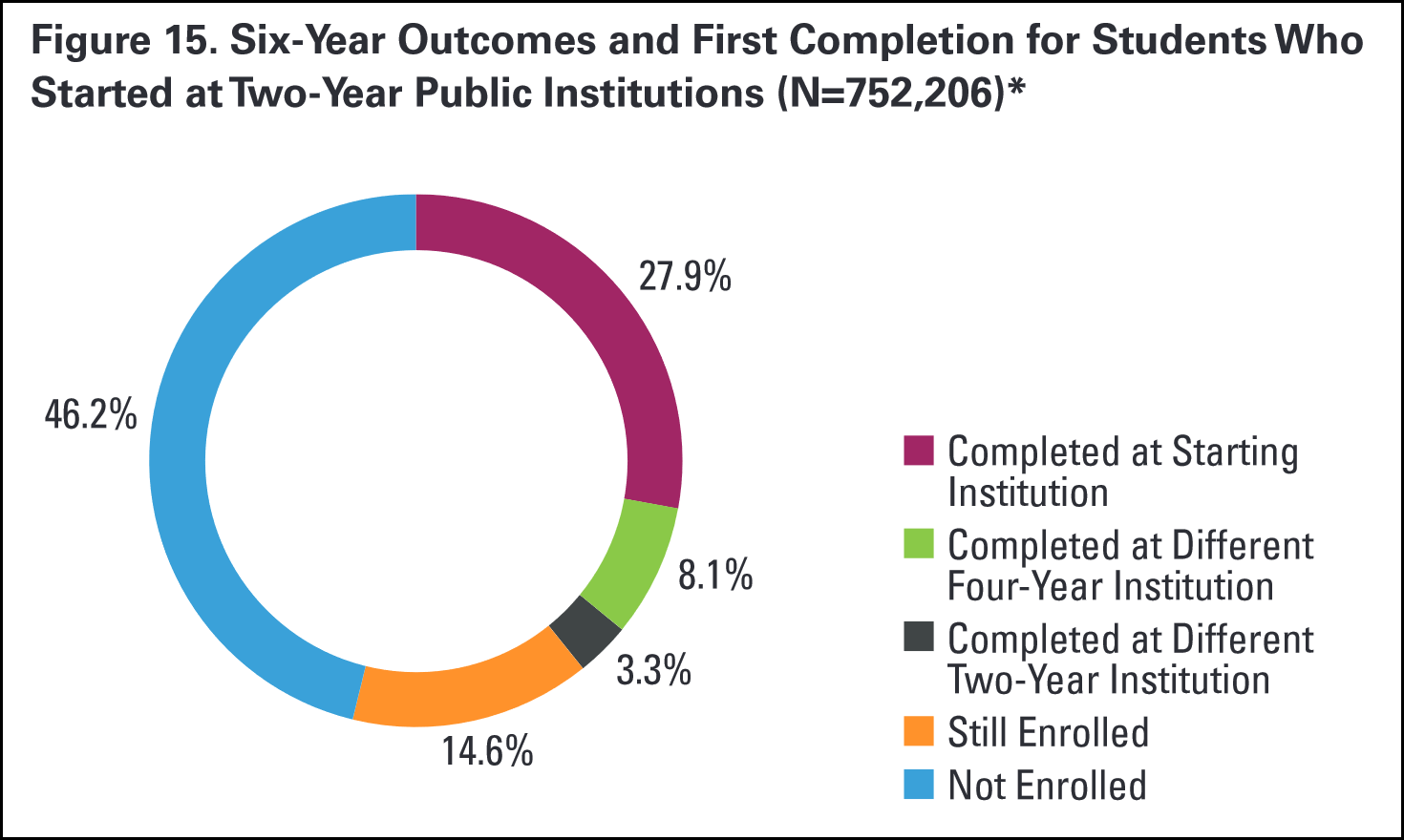
    YET ANOTHER UPDATE: For what it’s worth, the National Student Clearinghouse Reseach Center estimates that the total 6-year completion rate for community college students is 39.2 percent:

  • The Citizenship Question Could Tell Us Just How Hackish the Supreme Court Has Become

    Fred Schilling, Supreme Court Curator's Office

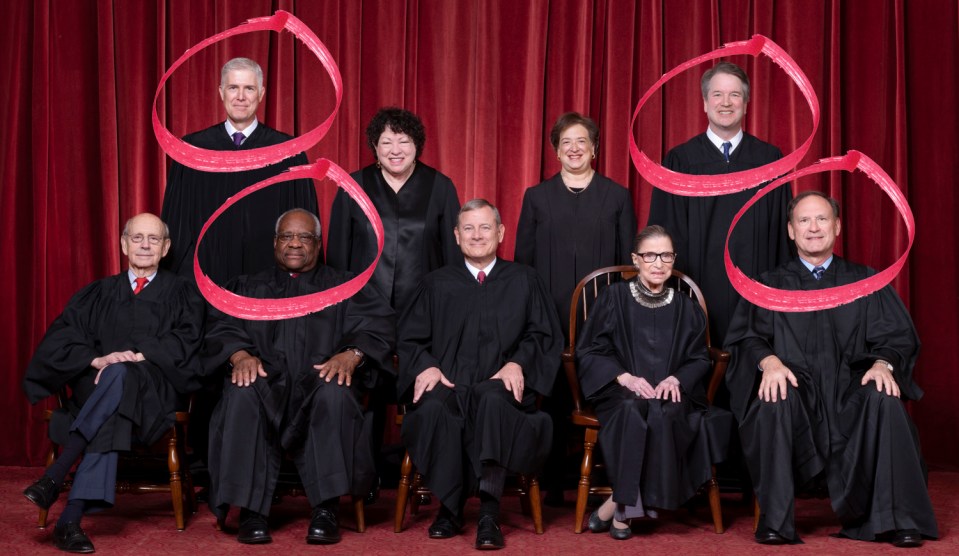
    Last Friday, President Trump suggested that he might sign an executive order putting a citizenship question on the 2020 census. I hope he does it.

    Here’s why. First of all, it would almost certainly fail. It would be in court instantly along with a request for emergency appeal directly to the Supreme Court, which would be granted. The five justices who voted against the citizenship question originally would also vote to overturn the executive order and that would be the end of things.

    But it would also give us a chance to learn something about the other four justices. Even though they originally voted to allow the citizenship question, they should agree that the Court ruled against it and the president is bound by its ruling. Even in what the justices might consider a righteous cause, presidents aren’t allowed to flout a Supreme Court ruling. That should produce a quick, unanimous opinion.

    If it doesn’t, it will tell us something important about just how hackish the four conservatives are. And that in turn will tell us something important about whether and what we should do about it.